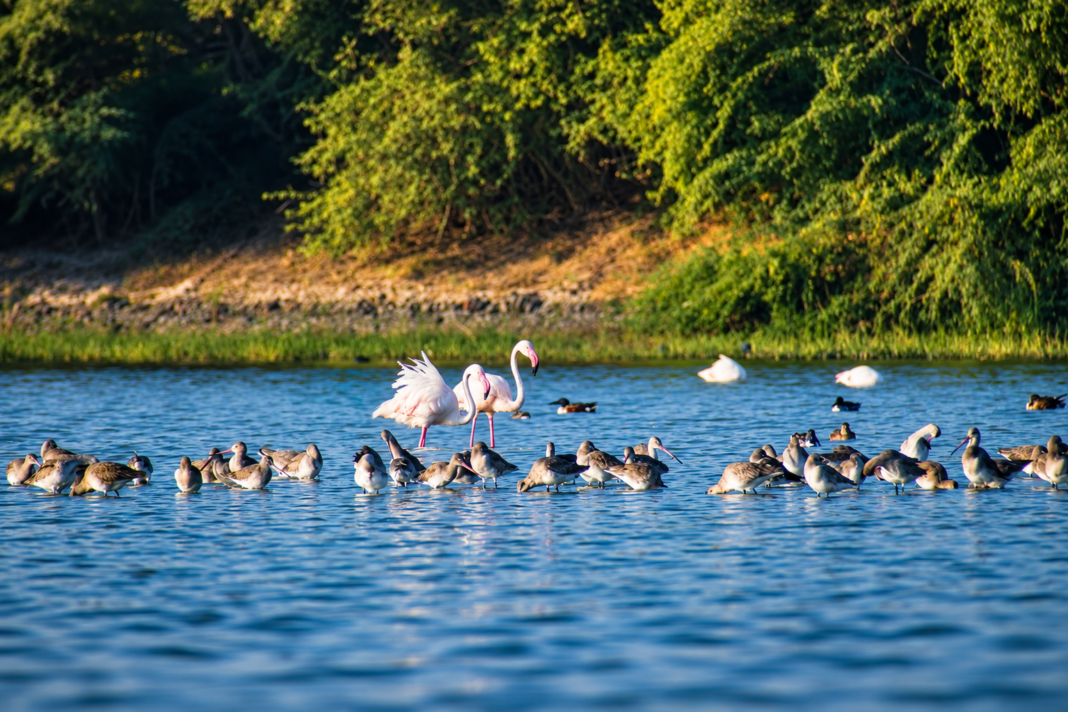
Forty minutes northwest of the city, past the last of the ring-road construction, the tarmac gives way to farmland and then to a sheet of shallow water the size of a small town. This is Thol — an irrigation tank dug in 1912 that has quietly become one of India’s most important wetlands, and the single best morning out an Amdavadi can have without leaving the district. In winter, tens of thousands of birds arrive here from Central Asia. Most of the city has still never been.
Quick answer
Thol Lake is a 699-hectare wetland bird sanctuary about 25 km northwest of Ahmedabad in Kadi taluka, Mehsana district, and a designated Ramsar site of international importance. It is open daily, roughly 6:00 AM to 6:00 PM, with a small entry fee plus separate charges for cameras and vehicles. Visit between November and February, arrive at sunrise, and expect flamingos, pelicans, sarus cranes and more than 320 recorded bird species.
At a glance
| Detail | Information |
|---|---|
| Location | Thol village, Kadi taluka, Mehsana district, Gujarat |
| Distance from Ahmedabad | About 25 km northwest; a 40–60 minute drive |
| Status | Wildlife sanctuary since 1988; Ramsar site since April 2021 |
| Area | 699 hectares (about 1,730 acres) |
| Built | 1912, as an irrigation reservoir under the Gaekwad regime |
| Bird species recorded | Over 320, including 110-plus waterbird species |
| Timings | Approximately 6:00 AM – 6:00 PM daily |
| Entry fee | Around ₹50 per person, plus camera and vehicle charges |
| Best season | November to February |
| Best time of day | Sunrise to about 9:00 AM, and the last hour before sunset |
| Ideal duration | 2–4 hours |
Why Thol Lake is worth the trip
Thol was never meant to be a sanctuary. It was dug in 1912 as a shallow reservoir to irrigate the farmland around Thol village, part of the Gaekwad administration’s waterworks. Over a century, the shallow water, the reed beds at its edges and the surrounding grassland turned it into something far more valuable than an irrigation tank: a staging post on the Central Asian Flyway, the migratory corridor that carries birds from Siberia and Central Asia down into the Indian subcontinent each winter.
Gujarat declared it a bird sanctuary in 1988. In April 2021 it was designated a Ramsar site, which places it on the list of wetlands recognised as internationally important. The official Ramsar documentation records more than 320 bird species at Thol, roughly 57 per cent of all the bird species found in Gujarat, and over 110 waterbird species, which is close to 43 per cent of all of India’s waterbirds. More than 30 of those are threatened species.
What that means on the ground is simple. Between November and February, standing on the embankment at sunrise, you can see flamingos, pelicans and thousands of ducks on one sheet of water, with sarus cranes — the world’s tallest flying bird — stalking the shallows behind them. Very few cities anywhere have that forty minutes from the office.
Best time to visit Thol Lake
The season is November to February, and this is not a soft preference. Migratory birds arrive with the cold and leave by early March, and the difference between a January morning and an April morning at Thol is the difference between a spectacle and a quiet walk beside a shrinking pond. Water levels drop through the summer, and by May much of the lakebed can be exposed.
Within the season, the time of day matters as much as the month. Come at sunrise: the birds are most active in the first two hours of light, the water is still, and the light is what photographers drive out here for. The hour before sunset is the second-best window. Midday is the worst — the birds settle, the heat builds and there is very little shade on the embankment.
Weekdays are markedly quieter than weekends. On a Sunday in peak season the approach road and the main viewing points fill up with families and picnic groups, which is pleasant but not what you came for if you want to hear anything.
- Peak season: November to February
- Best hours: Sunrise to 9:00 AM; 5:00 PM to sunset
- Avoid: Midday, and weekends in peak season if you want quiet
- Off-season: March to June is hot with few migratory birds; the monsoon refills the lake
Thol Lake timings and entry fee
The sanctuary is generally open daily from about 6:00 AM to 6:00 PM. Entry is around ₹50 per person, with separate charges for a still camera (about ₹200) and for bringing a car in (about ₹500). Charges for professional camera equipment and video are higher, and rates for foreign nationals differ.
Treat all of these as indicative rather than fixed. Forest department rates are revised periodically, differ between Indian and foreign visitors, and are not always reflected on third-party websites, so carry cash and confirm at the gate. If you are planning a shoot or bringing a drone, contact the sanctuary office in advance — drones are not permitted without written permission, and turning up with one will end your visit early.
- Timings: Approximately 6:00 AM – 6:00 PM, daily
- Entry: Around ₹50 per person (confirm current rates at the gate)
- Still camera: Around ₹200
- Car entry: Around ₹500
- Drones: Not permitted without prior written permission from the forest department
How to reach Thol Lake from Ahmedabad
Thol village sits in Kadi taluka of Mehsana district, about 25 km northwest of Ahmedabad and roughly 23 km from Gandhinagar. Driving is by far the easiest option, and from the western side of the city — SG Highway, Thaltej, Gota — it is a 40 to 60 minute run depending on traffic on the Ahmedabad–Mehsana stretch.
By car, head out towards Kalol via SG Highway and follow signs for Thol village; most navigation apps route it correctly. There is no direct public transport to the sanctuary gate. State buses run to Kadi and Kalol, from which you would need a local auto or taxi for the last stretch, which makes a pre-booked cab or your own vehicle the sensible choice for a sunrise visit. Ahmedabad Junction (Kalupur) is about 32 km away and the airport roughly 34 km.
One practical note: if you are coming for sunrise, leave the city in the dark. The whole point of the trip is being on the embankment as the light comes up, and arriving at 8:30 means missing the best hour.
- By car: 40–60 minutes from western Ahmedabad via SG Highway and Kalol
- From Gandhinagar: About 23 km
- Nearest railway station: Ahmedabad Junction (Kalupur), about 32 km
- Nearest airport: Sardar Vallabhbhai Patel International, about 34 km
- Public transport: No direct service to the gate; buses reach Kadi or Kalol, then a local auto or taxi
📍 Google Maps: Thol Lake Bird Sanctuary
Birds you can spot at Thol Lake
The headline birds are the flamingos, which gather in large numbers through the winter and have historically been recorded in the thousands. Greater white pelicans are the other crowd-pleaser, fishing in coordinated groups across open water. But the bird that makes Thol genuinely significant is the sarus crane, a globally vulnerable species that stands taller than a person and nests here in numbers.
For birders, the Ramsar listing is the thing to read. Thol regularly hosts more than one per cent of the world population of glossy ibis. Its threatened species include the critically endangered white-rumped vulture and sociable lapwing, and the vulnerable common pochard and lesser white-fronted goose. Indian skimmers, several eagle species, herons, egrets, spoonbills, storks and large rafts of wintering ducks round out a morning’s list.
It is not only birds. Blackbuck and other mammals use the grassland around the lake, particularly in the dry months, and jackals and foxes are seen on the quieter approaches.
- Signature species: Greater flamingo, greater white pelican, sarus crane
- Notable waterbirds: Glossy ibis, Indian skimmer, spoonbill, painted stork, herons and egrets
- Threatened species: White-rumped vulture, sociable lapwing, common pochard, lesser white-fronted goose
- Mammals: Blackbuck, jackal, fox
Things to do at Thol Lake
Birdwatching is the reason to come, and the best way to do it is slowly: walk a stretch of the embankment, stop, and let the water settle around you. Binoculars change the experience completely — without them, most of what is on the far water is a distant smudge. Local guides are available and are worth hiring for a first visit, both for finding birds and for reading the lake.
Photography is the other draw, and Thol has a serious following among Ahmedabad’s wildlife photographers. Sunrise from the embankment, with mist on the water and birds lifting off, is the shot everyone comes for. Bring the longest lens you own; even the big congregations sit further out than you expect.
The sanctuary authorities also run camping and trekking programmes through the year, and the surrounding grassland makes for an easy, flat walk. It is a good, undemanding outing with children, provided you set expectations that this is a place for quiet watching rather than running around.
What to carry
Thol is a wetland with very little shade and no significant facilities inside, so what you bring makes the difference between a good morning and a short one.
- Binoculars: The single most useful thing you can carry. 8×42 or 10×42 is ideal
- Camera: A telephoto lens of 300 mm or longer; the birds keep their distance
- Water: Carry your own; there is little available inside
- Clothing: Muted colours, a hat, and layers — winter mornings here are genuinely cold
- Footwear: Closed walking shoes; the embankment and margins can be muddy
- Cash: For entry and camera charges, since card facilities are unreliable
Rules and etiquette at the sanctuary
This is a protected wetland and a Ramsar site, not a picnic spot, and the difference matters. The birds are the reason the place exists, and a disturbed flock is a flock that stops using the lake.
Keep your voice down and keep your distance. Never chase, flush or bait birds for a photograph — walking towards a resting flock to make it take off is the single most common bad behaviour here and it is worth calling out. Do not play music. Carry your litter back out with you, especially plastic. Stay on the marked paths and embankment rather than walking into the reed beds, and do not feed anything. Drones need prior written permission, and flying one over a roosting flock is both illegal and genuinely damaging.
Where to eat near Thol Lake
There is no restaurant worth planning around at the sanctuary itself, so handle food one of two ways. Either carry a flask and breakfast with you and eat in the car, which is what most early visitors do, or do the birding at first light and drive back into the city for a proper breakfast.
The return route through Kalol and SG Highway puts you within reach of Ahmedabad’s best early kitchens by about 9:30 AM, which is good timing for a South Indian breakfast in Bodakdev or a long coffee on the way home. If you are eating locally instead, the dhabas along the Ahmedabad–Mehsana highway do dependable Gujarati and Punjabi food, and are at their best for a late lunch on the way back.
Places to combine with a Thol trip
Thol works well as the first half of a day out to the northwest of the city, since you will be finished at the lake by mid-morning anyway.
Nearby places to pair with Thol
- Adalaj Stepwell — A five-storey, intricately carved stepwell from 1499, about 30 km from Thol on the way back towards Gandhinagar. The obvious second stop of the morning and one of Gujarat’s finest monuments. Google Maps
- Nalsarovar Bird Sanctuary — The other great wetland of the region, southwest of Ahmedabad and larger than Thol, with boat rides across the shallows. Too far to combine in one day, but the natural follow-up trip for anyone who enjoys Thol. Google Maps
- Akshardham, Gandhinagar — About 23 km from the lake, and an easy pairing if you want a full day out of the city rather than a morning. Google Maps
- Vadaj and Kalol farm stops — The drive back runs through farmland, and roadside stalls in season sell fresh produce and sugarcane juice. Worth a stop if you are not in a hurry. Google Maps
- Ahmedabad’s breakfast cafes — Time the return for 9:30 AM and you are within reach of the city’s best morning kitchens — see our guides to Ahmedabad’s cafes and South Indian restaurants. Google Maps
Frequently asked questions
Where is Thol Lake located?
Thol Lake is near Thol village in Kadi taluka, Mehsana district, Gujarat, about 25 km northwest of Ahmedabad and roughly 23 km from Gandhinagar. It is a 40 to 60 minute drive from the western side of Ahmedabad.
What is the entry fee for Thol Lake Bird Sanctuary?
Entry is around ₹50 per person, with roughly ₹200 for a still camera and ₹500 for car entry. Forest department rates are revised periodically and differ for foreign nationals, so carry cash and confirm the current rates at the gate.
What are Thol Lake timings?
The sanctuary is generally open daily from about 6:00 AM to 6:00 PM. The best hours for birds are sunrise to around 9:00 AM and the last hour before sunset.
What is the best time to visit Thol Lake?
November to February, when migratory birds arrive on the Central Asian Flyway. Migratory species leave by early March, and from March to June the weather is hot and water levels drop, so the sanctuary is much quieter.
Which birds are found at Thol Lake?
Over 320 bird species have been recorded, including greater flamingos, greater white pelicans, sarus cranes, glossy ibis, Indian skimmers, spoonbills, painted storks and large numbers of wintering ducks. More than 30 threatened species use the wetland, among them the critically endangered white-rumped vulture and sociable lapwing.
Is Thol Lake a Ramsar site?
Yes. Thol Lake Wildlife Sanctuary was designated a Ramsar site of international importance on 5 April 2021. It was first declared a wildlife sanctuary in 1988, and the lake itself was built in 1912 as an irrigation reservoir.
How do I reach Thol Lake by public transport?
There is no direct public transport to the sanctuary gate. State buses run to Kadi and Kalol, from where you would need a local auto or taxi. For a sunrise visit, a private vehicle or a pre-booked cab is the practical option.
Are drones allowed at Thol Lake?
No. Drones require prior written permission from the forest department. Flying one over roosting birds disturbs the flocks and can end your visit.
Timings, entry fees and sanctuary rules are as of September 2026 and are revised from time to time — confirm at the gate before you plan a shoot. Been recently, or have a species list to share? Tell us on Instagram at @amdavadgully.