Let’s start with the thing every other article on this topic refuses to say.
Ahmedabad has essentially one waterfall within day-trip distance. One. Zanzari, on the Vatrak river near Dehgam, roughly 75–85 km out. Everything else that gets listed under “waterfalls near Ahmedabad” is between 170 and 400 kilometres away, which is not a day trip — it’s a weekend, and pretending otherwise is how people end up driving seven hours and arriving after dark.
That’s not a reason to skip this list. Gujarat has genuinely spectacular waterfalls. The Dangs in particular, in August and September, look like a different state entirely. It’s just that you need to plan them as trips, not outings.
So this guide is organised by how far you actually have to drive, tells you which falls are running when, and includes a safety section that matters more here than in any other guide we’ve written — because people die at Gujarat waterfalls every monsoon, and most of those deaths are preventable.
Timing note: you’re reading this at the right moment. August to October is peak season. By December most of these are down to a trickle, and by March many are dry rock.
Quick reference
| Waterfall | Distance from Ahmedabad | Trip type | Peak season |
|---|---|---|---|
| Zanzari | ~75–85 km | Day trip | Sept–Oct, Feb–May |
| Khuniya Mahadev | ~170 km | Long day trip | July–Sept |
| Hathni Mata | ~200 km | Long day / overnight | July–Sept |
| Zarwani | ~200 km | Overnight (with SOU) | July–Oct |
| Ninai | ~250 km | Overnight | July–Sept |
| Chimer | ~330 km | Weekend | July–Sept |
| Gira | ~350 km | Weekend | July–Oct |
| Girmal | ~380 km | Weekend | July–Oct |
| Bilpudi / Shankar (Dharampur) | ~400 km | Weekend | July–Sept |
| Jamjir | ~400 km | Weekend (with Gir) | Aug–Oct |
Tier 1: The only real day trip
1. Zanzari Waterfall — the one you can actually do on a Sunday
Where: on the Vatrak river near Zanzari village, between Dehgam and Bayad Distance: roughly 75–85 km from Ahmedabad, about 62 km from Gandhinagar. Nearest railway station is Nandol Dehgam, around 38 km away. What it is:a series of rapids running over dark rock, with the main drop at around 25 feet. Getting to it: roughly 1.5 km on foot from the parking area. Camel rides are usually available to cover that stretch, which children find far more exciting than the waterfall.
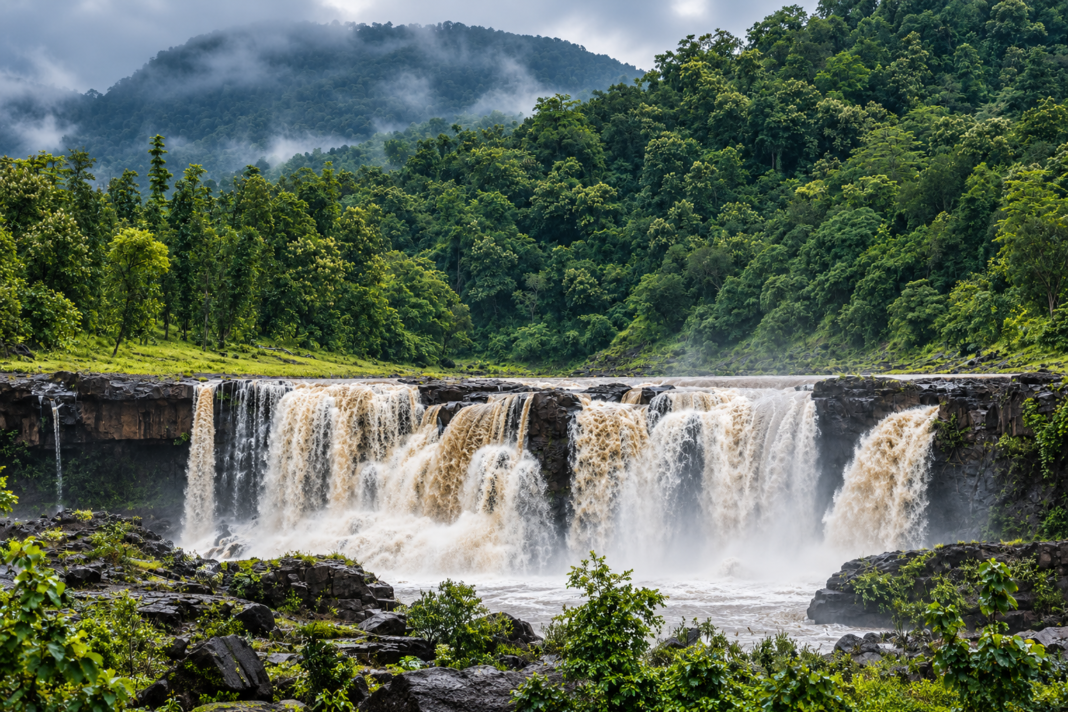
This is the default monsoon outing for Ahmedabad and Gandhinagar, and its appeal is real: dramatic rocky cliffs, a wide rock shelf, natural pools between the rapids, and a landscape that looks nothing like anything within an hour of the city.
The thing nobody tells you: Zanzari is not a perennial waterfall, and its flow depends heavily on water released upstream. In summer the river drops to a stream. Some of the best conditions are actually September–October — after the heaviest rain, when the flow is strong but the water isn’t violent — and February to May, when releases from upstream keep it running and the rocks are safe to walk on.
And the serious warning. Peak monsoon at Zanzari is genuinely dangerous. Multiple visitors have drowned here over the years by getting into the water when it was running hard. The current is stronger than it looks, the rock is slick, and there is no rescue infrastructure. Local guidance is straightforward: in heavy monsoon flow, look, photograph, and stay out of the water.
Practical: no facilities on site. Carry your own food and water. Go in the morning or late afternoon. Weekdays are dramatically better than Sundays.
Verdict: the only true day trip on this list, and worth doing — with your feet dry when the river is high.
Tier 2: Long day trips and overnights (170–250 km)
2. Khuniya Mahadev Waterfall — waterfall behind a temple
Where: in the Pavagadh hills, behind a Shiva temple Distance: about 55 km from Vadodara, roughly 170 km from Ahmedabad — call it three hours each way. Season: monsoon only. It’s fully seasonal.
A short hike takes you from the temple to the fall, through some of the better forest scenery in central Gujarat. The combination is the appeal: a working religious site, a genuine walk, and a waterfall that most tourists have never heard of.
Best paired with: Pavagadh and Champaner, the UNESCO-listed archaeological park, which is right there and deserves a full day of its own.
Verdict: the smartest waterfall trip in this tier, because the waterfall is the bonus rather than the whole justification for the drive.
3. Hathni Mata Waterfall — the tall one
Where: near Jambughoda, in the Pavagadh–Chhota Udepur belt Distance: roughly 200 km from Ahmedabad Timings:typically 6 am to 6 pm
The most photographed waterfall in central Gujarat — a tall single drop into a rocky basin, commonly quoted at around 100 metres, though you’ll see wildly different figures depending on who’s writing.
The name comes from a rock at the base that the local tribal community reads as a baby elephant, and there’s a small cave temple to Hathni Mata beside the falls. The rock is often decorated with flowers. Tribal fairs are held in the area, mostly in the winter months.
Practical warnings that matter:
- The approach road is good but very narrow. Meeting a bus on it is not fun. Small car, daylight only.
- It gets genuinely packed on monsoon weekends. Go on a weekday or don’t bother.
- It’s remote. Carry all your own food and water; assume no reliable facilities.
Verdict: the most scenically impressive fall within 200 km. Treat it as a full-day expedition with an early start, or stay over near Jambughoda.
4. Zarwani Waterfall — the one attached to the Statue of Unity
Where: Zarwani village, deep inside the Shoolpaneshwar Wildlife Sanctuary Distance: roughly 200 km from Ahmedabad — but only about 12 km from the Statue of Unity and 15 km from Kevadia railway station Timings:typically 6 am to 6 pm
The sanctuary setting is what makes this one. It’s a forest-department-managed area with an eco-campsite, and the department can arrange trekking and picnic access — which you should organise in advance rather than assume on arrival.
The real argument for Zarwani is that it turns a Statue of Unity trip from a monument visit into a proper weekend. Kevadia now has the statue, a jungle safari, a cactus garden, river rafting and this waterfall inside a 15 km radius. Nobody plans it as a nature trip. They should.
Verdict: best overnight combination on this list. Book the Kevadia side first, add Zarwani to the itinerary second.
5. Ninai Falls — the wide one
Where: Sagai village, Dediapada taluka, Narmada district, off State Highway 163 Distance: roughly 250 km from Ahmedabad; about 35 km from Dediapada and 143 km from Surat Height: around 30 feet — this is a wide, stepped fall rather than a tall drop
Ninai sits in tribal Narmada district in the same broad belt as Zarwani and Shoolpaneshwar, and it’s the classic Gujarat monsoon photograph: water spilling across a wide rock ledge into a shallow pool, dense forest on all sides.
Access is the constraint. The last stretch is rough, and in heavy rain the approach can become genuinely difficult. Check conditions locally before committing.
Verdict: beautiful, and best done as part of a Narmada–Dediapada loop with Zarwani and the Statue of Unity rather than as a standalone.
Tier 3: Weekend trips (300 km+)
Everything below here is a two-day minimum. Included because they’re the best waterfalls in Gujarat, and because “near Ahmedabad” is how people search even when they mean “reachable from Ahmedabad.”
6. Chimer Falls — the one that isn’t in the guidebooks
Where: near Songadh, Tapi district Distance: roughly 330 km from Ahmedabad
A multi-step cascade dropping across successive rock levels, barely covered in mainstream travel writing, and correspondingly undisturbed.
Do not treat this casually. Reaching it involves local trails, it’s poorly signposted, and it’s not a place to attempt alone on a heavy rain day. Go with someone who knows the route, carry more water than you think you need, and turn back if conditions look wrong.
Verdict: for experienced, well-prepared travellers only. Skip if you’re bringing children or you’ve never done an unmarked trail.
7. Gira Falls — the accessible Dangs classic
Where: near Waghai, Dang district, on the Ambika river Distance: roughly 350 km from Ahmedabad Height: a natural drop of around 30 metres
The most visitor-friendly of the Dangs waterfalls. Broad, powerful in monsoon, and reached by a short walk over rocks from the road. Locals sell bamboo craft near the falls, and the whole area shifts into a different register in the rains.
Combine with: Waghai Botanical Garden and Vansda National Park, both close by, plus Saputara as your base.
Season: July to October, and it’s genuinely worth going immediately after the monsoon rather than during it — better flow-to-safety ratio, better light.
Verdict: the best Dangs waterfall for a normal traveller who wants to see something spectacular without a trek.
8. Girmal Falls — the tallest in Gujarat
Where: near Girmal village on the Ahwa–Songadh road, inside Purna Wildlife Sanctuary, Dang district Distance:roughly 380 km from Ahmedabad. About 35 km from Mahal, 50 km from Ahwa, 78 km from Waghai and 89 km from Saputara. Height: more than 100 feet — the highest waterfall in the state River: the Gira
In full monsoon flow it throws up enough spray to create its own fog bank, and rainbows in it are common rather than lucky.
Two things make this the standout:
First, the infrastructure. The forest department has built proper viewpoints and pathways with safety railing, and cut steps to bring you close. That’s rare in Gujarat and it makes a big difference.
Second, the U-turn. On the approach, the Gira river makes a complete hairpin, and the forest department has built a viewpoint directly above it — with an Eco-Development Committee-run restaurant beside it, sensibly called the U-turn restaurant. The food is good. Stop.
Important: you cannot bathe at Girmal. The view is from above; there’s no route down to the base. If you came to get in the water, this is not that trip.
Verdict: the single most impressive waterfall in Gujarat, and the best-managed. Budget a full day for the destination alone, base yourself at Saputara or Ahwa.
9. Bilpudi and Shankar Falls, Dharampur — the Wilson Hills pair
Where: Dharampur, Valsad district. Shankar Falls sits about 40 km from Dharampur and 6 km from Wilson Hills.Distance: roughly 400 km from Ahmedabad
South Gujarat hill-country waterfalls, quiet, green, and almost entirely unvisited by anyone from Ahmedabad. Facilities are minimal to non-existent — plan to eat at Wilson Hills.
Verdict: for a Saputara–Dharampur–Valsad monsoon loop, not a standalone target.
10. Jamjir Falls — the Saurashtra outlier
Where: Jamvala-Gir village, Gir Somnath district Distance: roughly 400 km from Ahmedabad
Two separate torrents dropping at different levels before merging — a genuinely unusual formation, and the only serious waterfall on the Saurashtra side.
The reason to go is that it’s near Gir. Combine it with a lion safari and Somnath and you have one of the better weekends in Gujarat, with a waterfall as the surprise.
Verdict: never worth the drive alone. Excellent as an add-on to Gir.
The realistic alternative: river spots within 100 km
If what you actually want is “somewhere near Ahmedabad to get into moving water on a Sunday,” waterfalls are the wrong category. These are closer, safer and more practical:
- Hiranya check dam, Polo Forest — about 150 km, and the whole Polo Forest area is at its best from July to November, with 15th-century ruins in the forest and a strong weekend camping culture.
- Sapteshwar — river bathing on the Sabarmati, a classic Gujarati picnic spot.
- Galteshwar — an old temple site on the river in Kheda district.
- Sant Sarovar — near Gandhinagar, easily the closest option.
- Sindhrot check dam — on the Vadodara side.
None of these are dramatic. All of them are doable and back home by evening.
Safety: read this before you go anywhere
More than any other guide on this site, this one needs a proper safety section. Gujarat loses people at waterfalls every monsoon, and the pattern is depressingly consistent.
The five things that actually kill people:
- Getting into fast-flowing water. Monsoon current is far stronger than it appears from the bank, and a shallow-looking rapid will take an adult off their feet. At Zanzari specifically, this has caused repeated deaths. If the water is running hard, do not enter it.
- Flash floods and upstream releases. Water levels can rise with no warning from rain kilometres upstream, or from a dam release you have no way of knowing about. Never camp or sit in a riverbed. If the water starts rising or turning muddy, leave immediately — that’s your only warning.
- Slippery rock. Wet basalt with algae has effectively no grip. Most serious injuries at these sites are falls, not drownings. Proper shoes with grip, never flip-flops, and never run on wet rock.
- Climbing for photographs. Every year, somebody goes over the top of a fall trying to get a shot from the lip. There is no photo worth this.
- Alcohol. Gujarat is a dry state, which does not stop people, and it is a factor in a meaningful share of these incidents. Don’t.
Practical precautions:
- Go with people, never alone, especially at the remote falls.
- Tell someone your route and expected return time. Mobile signal is patchy to absent at most of these sites.
- Check the weather upstream, not just where you are. Rain 30 km away is your problem.
- Leave by 4 pm. These are forest roads without lighting, and animals cross them at dusk.
- There are no lifeguards. Anywhere. Assume self-rescue is your only option, and plan not to need it.
- Carry: water, food, a basic first-aid kit, a torch, a fully charged phone, and dry clothes in a sealed bag.
Forest permissions: several of these sit inside wildlife sanctuaries — Shoolpaneshwar, Purna — where access, camping and trekking may need forest department clearance. Arrange it beforehand rather than negotiating at a checkpost.
When to go
July–August: maximum water, maximum drama, maximum risk, worst road conditions. Great for photographers who intend to stay on the bank.
September–October: the sweet spot. Strong flow, safer water, greener landscape, better light, and the roads have stopped being a lottery. This is the window to plan for.
November–February: the bigger falls in the Dangs still run, but reduced. Pleasant driving weather, comfortable trekking, less spectacle.
March–June: most of these are dry or nearly so. Zanzari can run in this window depending on upstream releases, but confirm before driving out.
Always check current flow before leaving. These are seasonal falls, and a five-hour drive to a dry rock face is a genuinely miserable day.
Frequently asked questions
Which waterfall is closest to Ahmedabad? Zanzari, on the Vatrak river near Dehgam, roughly 75–85 km away. It’s the only waterfall that works as a real day trip from the city.
Is Zanzari waterfall safe? It’s safe to visit and unsafe to swim in during heavy monsoon flow. There have been multiple drownings over the years. Visit outside peak flow, and stay out of the water when the river is running hard.
Which is the highest waterfall in Gujarat? Girmal Falls in Dang district, on the Gira river inside Purna Wildlife Sanctuary, at over 100 feet.
What is the best time to visit waterfalls near Ahmedabad? July to October, with September and October offering the best balance of strong flow, safety and road conditions.
Can I do a waterfall day trip from Ahmedabad? Only Zanzari realistically. Khuniya Mahadev at around 170 km is possible as a very long day with a pre-dawn start. Everything else needs an overnight.
Are there waterfalls near the Statue of Unity? Yes — Zarwani Waterfall is about 12 km from the Statue of Unity and 15 km from Kevadia railway station, inside the Shoolpaneshwar Wildlife Sanctuary.
Do I need permission to visit these waterfalls? Some sit inside wildlife sanctuaries where trekking, camping or picnic access may require forest department clearance. Contact the department in advance for Zarwani and the Purna sanctuary area.
Can you swim at Girmal Falls? No. Girmal is viewed from above via forest department viewpoints and pathways; there’s no access to the base.
Are there facilities at these waterfalls? Mostly not. Zanzari, Hathni Mata and Ninai have effectively nothing — carry your own food and water. Girmal is the exception, with a forest department-run restaurant at the U-turn viewpoint on the approach.
What should I wear? Shoes with real grip — not flip-flops, not new trainers. Quick-drying clothes, and a full change sealed in a plastic bag.
One last thing
The honest summary of this entire article: Ahmedabad is not a waterfall city. It sits in the dry half of Gujarat, and the water is 300 kilometres south, in the Dangs, where the hills start.
Which is worth knowing rather than resenting. Because it means the right plan isn’t a Sunday drive — it’s two days in September, a room in Saputara or Ahwa, and the Dangs at the exact moment the rain stops and everything is still running.
That trip is genuinely one of the best things you can do from this city. It just isn’t a day trip, and everyone who tells you it is has never made the drive.
Amdavad Gully covers this city and everything within a tank of fuel of it. Been to any of these recently? Send us current conditions — with seasonal falls, this month’s report beats last year’s guide every time.