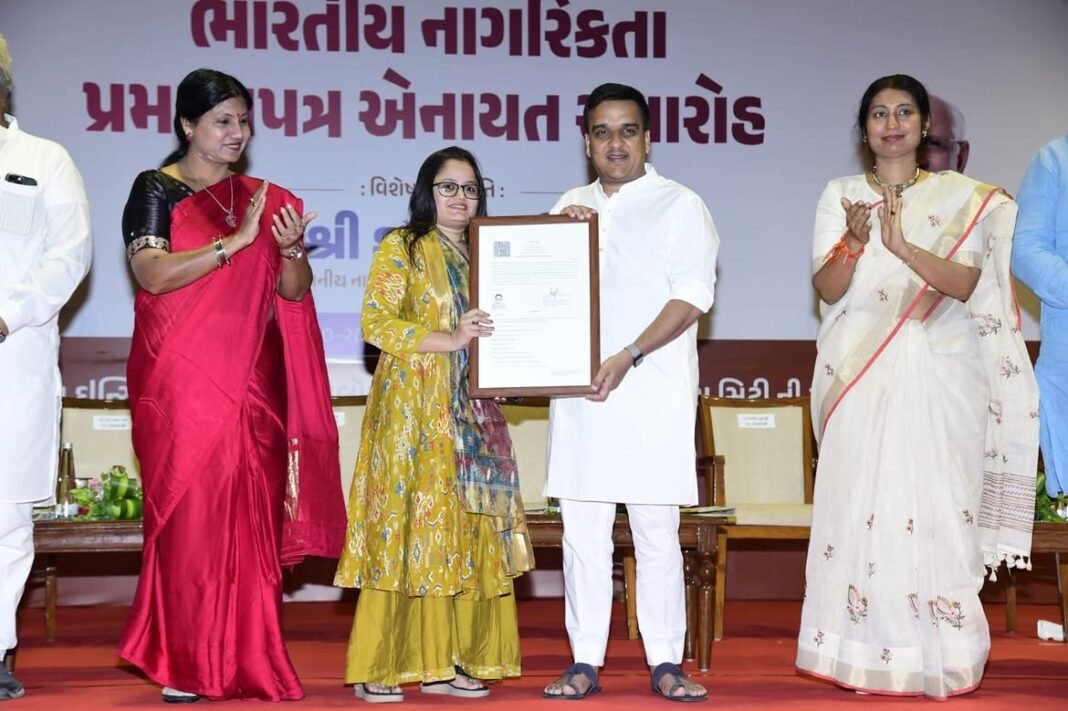
Ahmedabad: 158 refugees received Indian citizenship in Ahmedabad at a special ceremony. Gujarat Deputy Chief Minister Harsh Sanghavi handed over the certificates, DD News reported. As a result, these families are now full Indian citizens.
For refugee families, this moment matters a great deal. A certificate usually ends years of visa renewals and paperwork. Also, it lets them apply for a passport, vote and use welfare schemes.
The event is not a one-off, however. Ahmedabad’s collector is among a small group in India who can grant citizenship directly. So the city has hosted several large batches since 2023.
Key takeaways: Indian citizenship in Ahmedabad
- Who: 158 people who came to India as refugees.
- What: They received Indian citizenship certificates.
- Where: Ahmedabad, Gujarat.
- Handed over by: Gujarat Deputy Chief Minister Harsh Sanghavi.
- Event name: Bharatiya Nagrikta Pramanpatra Enayat Samaroh (Indian Citizenship Certificate Award Ceremony).
- When: [DATE OF CEREMONY].
- Why Ahmedabad: Since 2016, its collector can grant citizenship to eligible migrants.
What happened at the Ahmedabad citizenship ceremony?
Simply put, 158 refugees received Indian citizenship in Ahmedabad on one stage. In addition, the Gujarati stage banner named it the Bharatiya Nagrikta Pramanpatra Enayat Samaroh. In English, that means the Indian Citizenship Certificate Award Ceremony.
Deputy CM Harsh Sanghavi presented the certificates in frames. Photos from the event show recipients holding them next to him and other dignitaries.
[ADD: venue name, date, and names of the district collector, MLAs and other officials present.]
[ADD: one direct quote from Harsh Sanghavi, from the official release.]
[ADD: one quote from a recipient on what citizenship means to their family.]
Notably, Sanghavi has led such ceremonies before. For example, he handed certificates to 108 people at the Ahmedabad Collectorate in September 2023, All India Radio reported. At that time, he was Gujarat’s Minister of State for Home.
Who are the 158 new Indian citizens?
The new citizens are refugees who had settled in and around Ahmedabad. [ADD: countries of origin and communities, as stated in the DD News report.]
Earlier batches in the city were mostly Hindu, Sikh, Jain and Buddhist migrants from Pakistan. Many of these families crossed the border years, or even decades, ago. Until now, most of them lived on Long Term Visas that needed regular renewal.
Generally, people in this situation can follow one of two legal routes:
- The collector route. The Centre gave this power to selected collectors in 2016 and 2018. It uses the regular registration and naturalisation rules of the Citizenship Act, 1955.
- The CAA route. The Citizenship (Amendment) Act, 2019 offers a faster path. Its rules came into force in March 2024.
For instance, PTI reported that 195 people got certificates in Ahmedabad in December 2025. Of these, 122 qualified under the CAA, while 73 applied through the collector’s office. [ADD: the same split for this batch of 158, if the report gives it.]
How can Ahmedabad grant Indian citizenship locally?
Ahmedabad can grant Indian citizenship locally because the Centre delegated the power. It did this through gazette notifications in 2016 and 2018. In Gujarat, these cover the collectors of Ahmedabad, Gandhinagar and Kutch.
Normally, citizenship is a central subject. That means the Union Ministry of Home Affairs usually takes the final call. However, these notifications let the chosen collectors decide cases themselves. They cover minority communities from Pakistan, Afghanistan and Bangladesh.
Even so, applicants still complete the full procedure under the Citizenship Act. All India Radio noted this when it covered an earlier batch.
The biggest benefit is speed. Because the district handles verification, checks and certificates, files no longer travel between state and central offices.
Where does the CAA fit in?
The CAA created a separate, faster route to citizenship. It covers Hindus, Sikhs, Buddhists, Jains, Parsis and Christians from Afghanistan, Bangladesh and Pakistan. Also, applicants must have entered India on or before December 31, 2014.
For these applicants, the residence requirement falls from 11 years to 5. The Centre notified the CAA rules in March 2024. Since then, people apply online on the official Indian Citizenship Online portal.
Under the CAA rules, a district-level committee checks each application first. Then a state-level empowered committee takes the final decision. That is why one ceremony can include people from both routes.
You can read the full Citizenship Act on the India Code portal. Meanwhile, the Ministry of Home Affairs publishes official updates.
Registration vs naturalisation: what is the difference?
Registration and naturalisation are the two main ways a foreign national becomes an Indian citizen. Both appear in the Citizenship Act, 1955. However, they suit different people.
Citizenship by registration falls under Section 5 of the Act. It mainly serves people with an Indian link. For example, a person of Indian origin can usually apply after living in India for seven years. Similarly, a foreign spouse of an Indian citizen can apply through this route.
Citizenship by naturalisation falls under Section 6 of the Act. It serves people without a family link to India. Typically, applicants must have lived in India for 11 of the last 14 years. In addition, they must have stayed here for the full year just before applying.
This is where the CAA makes a big difference. For eligible applicants, it cuts the 11-year requirement to just five years. As a result, families who arrived closer to the 2014 cut-off can qualify years sooner.
In both cases, the applicant takes an oath of allegiance before receiving the certificate. So whichever route a family takes, the final step looks the same on stage.
What is a Long Term Visa?
A Long Term Visa, or LTV, is a visa the Ministry of Home Affairs grants to some foreign nationals who plan to stay in India for a long time. Many refugees in Ahmedabad hold one while they wait for citizenship.
For minority migrants from Pakistan, Afghanistan and Bangladesh, an LTV works as a bridge. It lets them live in India legally while their citizenship application moves forward. Also, it allows some everyday rights, such as opening a bank account and taking private jobs.
Still, an LTV has clear limits. Holders must renew it from time to time. Besides, they cannot vote or hold an Indian passport. That is why a citizenship certificate means so much to these families: it replaces a temporary permit with a permanent status.
How many refugees have received Indian citizenship in Ahmedabad?
More than 1,100 refugees received Indian citizenship in Ahmedabad by September 2023. According to the state government, the collectorate had granted citizenship to 1,149 Pakistani Hindu migrants by then. All India Radio, on the other hand, put the figure at over 1,200.
Since 2023, the city has also hosted these large ceremonies:
| When | People | Route and who handed over |
|---|---|---|
| [MONTH] 2026 | 158 | Deputy CM Harsh Sanghavi |
| December 2025 | 195 | 122 under the CAA, 73 via the collector; Harsh Sanghavi present |
| August 2024 | 188 | Under the CAA; Union Home Minister Amit Shah (All India Radio) |
| March 2024 | 18 | Certificate camp in Ahmedabad |
| September 2023 | 108 | Collector’s office; then MoS Home Harsh Sanghavi |
In total, these five ceremonies alone added 667 new citizens in about three years. Clearly, the collector route and the CAA route now work side by side in the same district.
What changes after getting Indian citizenship?
After getting Indian citizenship, a long-term resident gains the same rights as any other citizen. For refugee families, the changes are practical and immediate.
- Passports and travel. New citizens can apply for an Indian passport. For example, PTI reported on an Ahmedabad gynaecologist who migrated in 1956. He only learnt he lacked citizenship when he applied for a passport. Finally, in 2025, he got both under the CAA and could visit his daughter abroad.
- The right to vote. Citizens aged 18 and above can enrol as voters. As a result, they can vote in local, state and national elections.
- No more visa renewals. Long Term Visas need regular renewal and limit movement and work. Citizenship ends that cycle for good.
- Property, jobs and welfare. Citizens can buy property, apply for government jobs and join welfare schemes.
- Easier paperwork for children. School admissions, scholarships and ID documents get simpler once parents hold citizenship.
Above all, citizenship ends the uncertainty. A visa can lapse or face refusal. In contrast, the government can cancel citizenship only under narrow conditions in the Citizenship Act.
How to apply for Indian citizenship in Ahmedabad
To apply for Indian citizenship in Ahmedabad, you apply online and then verify documents in person. The steps are broadly the same for both routes, although the forms differ.
- Check your route. First, see if the CAA covers you. If not, use the regular registration or naturalisation forms.
- Apply online. Next, submit your form on the Indian Citizenship Online portal. Avoid agents who promise faster approval for a fee.
- Upload documents. Usually, you need proof of your country of origin, your date of entry into India and your residence.
- Attend verification. Then, officials check your original documents at the district office or committee.
- Take the oath. After that, you swear allegiance to the Constitution of India before an authorised officer.
- Get your certificate. Finally, you receive the certificate at the office or at a public ceremony.
For local help, contact the Ahmedabad District Collectorate. [ADD: collectorate helpline or address from the official release, if listed.]
Why is the CAA debated?
The CAA is still one of India’s most debated laws. Even so, ceremonies like this one now happen regularly. Here is what each side says.
What supporters say. The Union and Gujarat governments call the law a shield for persecuted minorities from neighbouring Muslim-majority countries. In their view, it gives long-settled refugees dignity and a clear path to citizenship. For example, Union Home Minister Amit Shah spoke at an Ahmedabad ceremony in August 2024. There, he said the Act does not take away any religion’s citizenship rights, All India Radio reported.
What critics say. On the other hand, opponents say a religion-based fast track clashes with the Constitution’s promise of equality. They note that the law leaves out Muslims, including persecuted Muslim sects from the same countries. Besides, it does not cover refugees from other neighbours. The law also sparked large protests across India in 2019 and 2020.
Where it stands. Several petitions challenging the law are before the Supreme Court. [VERIFY: current status of the Supreme Court case before publishing.]
Importantly, Ahmedabad’s collector route dates back to 2016, before the CAA existed. Today, both routes run together.
What does this mean for Ahmedabad?
For Ahmedabad, these ceremonies mark a quiet but steady change. Hundreds of families who lived on temporary visas are now permanent members of the city.
In practical terms, they can now take part fully in civic life. For example, they can vote in municipal elections, apply for government housing schemes and run businesses without visa limits. Over time, that makes them a fuller part of the city’s neighbourhoods, markets and workforce.
Also, the city’s collectorate has built real experience in handling these cases. So Ahmedabad is likely to stay a key centre for such ceremonies in Gujarat.
FAQs about Indian citizenship in Ahmedabad
How many refugees got Indian citizenship in Ahmedabad?
158 refugees got Indian citizenship in Ahmedabad at the latest ceremony. Gujarat Deputy CM Harsh Sanghavi handed over their certificates.
Who distributed the citizenship certificates in Ahmedabad?
Gujarat Deputy Chief Minister Harsh Sanghavi distributed the certificates. He also led earlier ceremonies in the city, including in September 2023 and December 2025.
Can the Ahmedabad collector grant Indian citizenship?
Yes. Gazette notifications from 2016 and 2018 allow the collectors of Ahmedabad, Gandhinagar and Kutch to grant it. This applies to minority communities from Pakistan, Afghanistan and Bangladesh.
Who is eligible for citizenship under the CAA?
Hindus, Sikhs, Buddhists, Jains, Parsis and Christians from Afghanistan, Bangladesh and Pakistan are eligible. However, they must have entered India on or before December 31, 2014.
Where do I apply for Indian citizenship?
You apply online on the official Indian Citizenship Online portal. After that, you attend verification and take the oath of allegiance.
How many people have received Indian citizenship in Ahmedabad so far?
More than 1,100 people received Indian citizenship in Ahmedabad by September 2023. Since then, ceremonies in 2024, 2025 and 2026 have added several hundred more.
Can new citizens get an Indian passport?
Yes. Once they hold a citizenship certificate, new citizens can apply for an Indian passport like any other citizen.
For more city news, explore the latest Ahmedabad stories on Amdavad Gully.