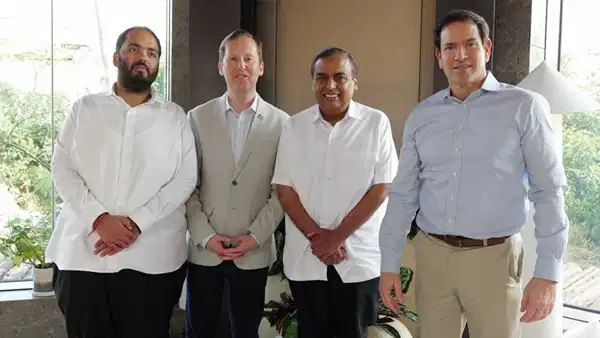
US Secretary of State Marco Rubio wrapped up a two-day India visit on 21 October 2026 with a stop at Reliance Industries’ Jamnagar refinery in Gujarat. There, he met Reliance chairman Mukesh Ambani at the world’s largest single-site refining complex. Before that, he held talks with External Affairs Minister S. Jaishankar in Mumbai.
Notably, Rubio skipped New Delhi entirely. Instead, his India visit centred on energy, trade and business. So, why did the top US diplomat fly to Jamnagar? And why does this trip matter right now, for India and for Gujarat? Here is the full picture.
Quick answer: Marco Rubio’s India visit, October 2026
- Dates: 20–21 October 2026
- Day 1, Mumbai: Talks with EAM S. Jaishankar; a trilateral meeting with the UAE foreign minister; tribute to 26/11 victims
- Day 2, Jamnagar (Gujarat): Visit to Reliance’s refinery complex and meeting with Mukesh Ambani
- Key themes: US energy exports, Venezuelan crude, Russian oil, the India-US trade deal, defence and technology
- Accompanied by: US Ambassador to India Sergio Gor
Marco Rubio’s India Visit: The Itinerary
Rubio arrived in India on 20 October, after attending a C5+1 summit in Uzbekistan. It was his second trip to India in about six months. He had last visited in May 2026.
This time, however, the route was unusual. US Secretaries of State normally hold talks in New Delhi. Rubio instead split his trip between Mumbai and Jamnagar.
| Day | City | Key engagements |
|---|---|---|
| 20 October | Mumbai, Maharashtra | Talks with S. Jaishankar; India–US–UAE trilateral; tribute to 26/11 victims |
| 21 October | Jamnagar, Gujarat | Tour of Reliance refinery complex; meeting with Mukesh Ambani |
The US Ambassador to India, Sergio Gor, said this trip was more business-focused than the earlier one. The State Department also said Rubio would meet business leaders to promote investment and economic ties.
Day 1: Talks With Jaishankar in Mumbai
In Mumbai, Rubio and Jaishankar discussed the full range of the India-US partnership. According to the US State Department readout, the talks covered four main areas.
- Energy: Rubio pushed for more US energy exports to India. He framed this as a way for India to diversify its supply.
- Defence and nuclear: He praised recent progress in defence and civil nuclear cooperation.
- Technology: He encouraged more Indian purchases of US technology and systems.
- Regional issues: Both sides discussed global developments, including the Middle East.
Jaishankar, for his part, said the talks covered trade, energy, technology and defence, along with regional developments.
Later, the two ministers met UAE Foreign Minister Sheikh Abdullah bin Zayed Al Nahyan. That trilateral meeting focused on regional energy security and shared economic goals.
Rubio also paid tribute to the victims of the November 2008 Mumbai terror attacks. Six American nationals were among those killed.
Day 2: Rubio in Gujarat — The Jamnagar Visit
On 21 October, Rubio flew to Jamnagar on Gujarat’s Gulf of Kutch coast. He arrived around noon, with Ambassador Gor by his side.
At Jamnagar, he toured Reliance Industries’ refining complex and met Mukesh Ambani. Local police, the district administration and Reliance put tight security in place for the visit.
The day before, Rubio had described India as a “refining superpower.” Ahead of the trip, he also said the US would discuss with Reliance the processing of more Venezuelan crude. In short, Jamnagar was not a courtesy stop. It was the heart of the visit’s energy agenda.
After the visit, Ambassador Gor shared a striking number on social media. He said the US share of India’s LPG imports has risen from under 10% to 67% in a year. That would make the US India’s largest LPG supplier. This is the ambassador’s figure and has not been independently verified.
Gor also highlighted Reliance’s planned role in a new oil refinery in Brownsville, Texas. He called it a major opportunity for US energy production and jobs.
Why Jamnagar? Inside the World’s Largest Refinery
To understand the visit, it helps to understand Jamnagar.
Reliance’s Jamnagar complex is the world’s largest single-site refinery. It can process about 1.4 million barrels of crude oil per day. According to the company, that is roughly 1.5% of global refining capacity.
The complex has two refineries:
- Domestic refinery: Commissioned in 1999, with about 660,000 barrels per day of capacity.
- Export refinery: Commissioned in 2008 inside a special economic zone, with about 580,000 barrels per day.
Crucially, Jamnagar can handle heavy, high-sulphur crude that many refineries struggle with. Reliance says it has processed more than 216 grades of crude. That flexibility makes it valuable when global oil supply shifts suddenly.
Jamnagar is also a major exporter. Diesel is its biggest export, followed by petrol and jet fuel. Europe is its largest market, and it also ships products to the US.
The Energy Agenda: Venezuela, Russia and US Supplies
Three energy threads ran through Rubio’s Gujarat visit.
1. Venezuelan crude
Jamnagar is at the centre of a revival in Venezuelan crude imports to India. Reports describe Reliance as the largest buyer of Venezuelan crude outside the US. Rubio said he wanted to see what was holding up larger volumes and what opportunities existed.
2. Russian oil
India has been one of the largest buyers of Russian oil since 2022. In August 2025, Washington raised tariffs on most Indian goods to as much as 50%, linking part of this to Russian oil purchases. Reliance then cut its Russian imports sharply. Even so, industry data cited in reports shows Russian crude still made up about a third of Jamnagar’s intake in July–September 2026.
Rubio acknowledged that India has diversified its energy sources. However, he noted it still buys substantial amounts from Russia. At the same time, he called India an important ally and partner of the United States.
3. More American energy for India
The flip side is US supply. Washington wants India to buy more American crude, LPG and gas. Gor’s LPG figure shows that this shift is already under way. For India, more suppliers means less risk from any single region.
Where the India-US Trade Deal Stands
Trade was the other big theme of the Marco Rubio India visit.
Relations took a hit in August 2025, when the US imposed tariffs of up to 50% on most Indian goods. A framework agreed in February 2026 brought the rate down to 18%. Since then, however, talks have moved slowly.
Earlier in October, Finance Minister Nirmala Sitharaman said the talks had plateaued. Commerce Minister Piyush Goyal later said the first tranche was in its final stages. India wants a final tariff rate that keeps its exporters competitive with rivals such as Vietnam.
In Mumbai, Rubio struck an upbeat note. He said the two sides were “very, very close” to a deal, with a few items still to settle.
Meanwhile, the Russian oil issue still hangs over trade. A recent US sanctions law allows tariffs of up to 100% on the biggest buyers of Russian energy. President Trump has since waived or suspended that step for now.
The Mumbai vs New Delhi Debate
The choice of venue sparked a political row in India.
The debate began when Ambassador Gor said Washington expected Jaishankar to travel to Mumbai for the meeting. Opposition Congress leaders criticised this. Rahul Gandhi, Jairam Ramesh and Pawan Khera argued the arrangement did not reflect India’s standing.
The Ministry of External Affairs did not give a reason for the venue. Spokesperson Randhir Jaiswal confirmed the agenda covered energy, trade and investment, defence, and critical and emerging technologies. Supporters of the visit pointed to its practical outcomes on energy and trade rather than its location.
In any case, the routing signalled the trip’s priorities. Mumbai is India’s financial capital. Jamnagar is its refining capital. Both fit a visit built around business and energy.
Why the Visit Matters at This Time
Timing is everything in diplomacy. Several pressures came together in October 2026.
A trade deal on the edge
After months of slow progress, both sides are trying to close the first tranche of a trade deal. A high-level visit can help push the final pieces into place.
Energy markets under strain
Conflict in the Middle East has disrupted oil flows. As a result, refiners that can take many types of crude, like Jamnagar, have become strategically important. They help keep fuel flowing when usual sources are hit.
High US fuel prices
Diesel prices in the US have been near record highs. With US midterm elections due on 3 November, energy supply is a pressing domestic issue in Washington. Jamnagar is one of the world’s biggest diesel exporters.
Ties that are strained but growing
India-US relations have faced friction over tariffs, Russian oil and US outreach to Pakistan. Even so, trade, defence and technology ties have kept growing. Bilateral trade rose about 12% in 2025 to nearly $240 billion, according to figures cited by analysts. The visit signalled that both sides want to protect that momentum.
India’s wider balancing act
The US sees India as a key partner in the Indo-Pacific. India, meanwhile, wants strong ties with Washington without giving up its own energy and strategic choices. This visit showed both sides working within that balance.
What It Means for Gujarat
For Gujarat, the visit was a reminder of the state’s outsized role in India’s energy economy.
Gujarat as India’s energy gateway: The state’s coastline is home to major crude, LPG and LNG import points. Jamnagar alone handles a large share of India’s refining. Any shift in where India buys its energy runs straight through Gujarat’s ports and refineries.
Jobs and industry: More crude and product trade can mean more activity for Jamnagar’s refining ecosystem. That includes logistics firms, port services, engineering contractors and small suppliers across Saurashtra.
A familiar diplomatic stop: Gujarat has hosted many world leaders. China’s Xi Jinping visited Ahmedabad in 2014. Japan’s Shinzo Abe came in 2017 for the bullet train launch. Donald Trump attended the Namaste Trump event in Ahmedabad in 2020. The UK’s Boris Johnson began his India visit in Gujarat in 2022. Rubio’s Jamnagar stop adds to that list.
Investment flows both ways: Notably, the visit highlighted Gujarat-based industry investing abroad. Reliance’s planned role in a Texas refinery shows Indian capital now flowing into the US energy sector too.
What to Watch Next
The visit has ended, but several threads remain open.
- Trade deal announcement: Watch for a formal first-tranche agreement and the final tariff rate for Indian goods.
- Venezuelan crude volumes: Any rise in Reliance’s Venezuelan intake would show the Jamnagar talks bearing fruit.
- Russian oil policy: US sanctions decisions after the 3 November midterms could affect Indian refiners.
- US energy imports: Further growth in US crude, LPG and LNG purchases by India is likely to continue.
- Defence and technology deals: Rubio’s praise for defence and nuclear progress hints at more announcements ahead.
Official updates are published by the Ministry of External Affairs and the US State Department. The US Embassy in India also shares visit updates.
Frequently Asked Questions
When did Marco Rubio visit India?
Marco Rubio visited India on 20–21 October 2026. He was in Mumbai on 20 October and Jamnagar, Gujarat, on 21 October.
Why did Marco Rubio visit Gujarat?
Rubio visited Jamnagar to tour Reliance Industries’ refinery complex and meet Mukesh Ambani. The visit focused on energy cooperation, including refining Venezuelan crude and expanding US energy exports to India.
Whom did Rubio meet in India?
He met External Affairs Minister S. Jaishankar in Mumbai and held a trilateral meeting with the UAE foreign minister. In Jamnagar, he met Reliance chairman Mukesh Ambani.
Why did Rubio skip New Delhi?
No official reason was given. The trip was described as business-focused, and the Mumbai and Jamnagar stops matched its energy and trade agenda. The venue drew criticism from opposition leaders in India.
What is special about the Jamnagar refinery?
Jamnagar is the world’s largest single-site refinery, with about 1.4 million barrels per day of capacity. It can process heavy, high-sulphur crude and has handled more than 216 crude grades.
Is the India-US trade deal finalised?
Not yet. Rubio said both sides were very close to a deal, with a few issues still to resolve. A February 2026 framework had already cut US tariffs on most Indian goods to 18%.
What did the US say about India’s LPG imports?
Ambassador Sergio Gor said the US share of India’s LPG imports rose from under 10% to 67% in a year. That would make the US India’s largest LPG supplier.
The Bottom Line
Marco Rubio’s India visit was short, but its message was clear. Energy and trade now sit at the centre of India-US ties. By choosing Jamnagar, Washington put Gujarat at the heart of that conversation.
For Gujarat, the visit underlines the state’s role as India’s energy gateway. The coming weeks, with a possible trade deal and the US midterms, will show what the trip delivers. Amdavad Gully will keep tracking the story.
Sources: US State Department readout, 20 October 2026; Ministry of External Affairs; US Embassy in India.