There is one day a year when Ahmedabad stops.
Not slows down. Stops. Offices shut. Shops shutter. Traffic thins to nothing. And roughly seven million people climb onto their roofs at sunrise, stay there for twelve hours, and try to cut each other’s kites out of the sky.
That’s Uttarayan — Makar Sankranti, the sun’s northward turn, and by some distance the biggest, loudest, most joyful thing this city does. The next one falls on 14 January 2027, with Vasi Uttarayan the following day.
If you’ve only seen it in photographs, you’ve seen the kites. What the photographs miss is the sound: a citywide roar that rolls across neighbourhoods every few seconds as somebody, somewhere, cuts somebody else’s string and an entire rooftop screams “Kai po che!”
This guide covers how the day actually runs, where to watch it if you don’t know anyone with a terrace, what to buy and where, the food, the safety issues nobody warns visitors about, and the difference between Uttarayan and the International Kite Festival — which is not the same thing, and confuses almost everybody.
Uttarayan at a glance
| Next Uttarayan | 14 January 2027 (Vasi Uttarayan, 15 January) |
| What happens | Citywide rooftop kite flying, dawn to night |
| International Kite Festival | Usually early-to-mid January at Sabarmati Riverfront; a separate spectator event |
| IKF entry | Free; nominal parking charge |
| Where to be | A rooftop — ideally in the old city |
| Food | Undhiyu, jalebi, til laddu, chikki |
| Book accommodation | Two to three months ahead, minimum |
| Weather | Cool mornings, strong midday sun, cold nights |
| The one rule | Cotton string only. Never nylon or glass-coated manja. |
What Uttarayan actually is
Makar Sankranti marks the sun’s transition into Capricorn and the beginning of uttarayan — its northward journey. It’s one of the few Indian festivals fixed to the solar calendar, which is why it lands on 14 January nearly every year while everything else moves around.
Across India it’s a harvest festival marked with sesame, jaggery and ritual bathing. In Gujarat, somewhere along the way, it became about kites — and then it became about cutting other people’s kites, which is a meaningfully different festival.
The kite tradition itself is old and imported: kites likely reached India through Persian traders or Buddhist pilgrims from China, and were adopted enthusiastically by Gujarat’s merchant class. What’s genuinely unusual is the scale and the density. The old city’s rooftops are packed tight enough that ten terraces can fight each other simultaneously. It’s less a festival than a citywide aerial combat sport with snacks.
The rhythm of the day, hour by hour
This is what nobody tells you, and it’s the difference between watching Uttarayan and doing it.
5:00–6:00 am — Alarms go off. Children who cannot be woken for school are up voluntarily and already on the roof. Chai appears. Rolls of string get wound onto firkis.
6:30–8:00 am — First light, gentle breeze, thin crowds. This is the calm phase. It’s also, importantly, when birds are out feeding — the window authorities specifically ask people to avoid.
9:00 am–12:00 pm — Peak wind, peak density, peak noise. The sky genuinely disappears. This is the two hours you came for. Kites at every altitude, cut kites drifting down, kids on the street chasing them, loudspeakers on every third terrace playing whatever’s popular that year.
12:00–3:00 pm — The sun gets serious. Wind can drop. Rooftops thin out for lunch — undhiyu, jalebi, and a nap that nobody admits to.
3:00–5:30 pm — Second wind, literally. Afternoon breeze returns, everyone comes back up, and this session runs harder than the morning because everybody’s competitive by now.
Sunset — The best light of the day, and the best photographs. Kites silhouetted against orange. Also the second bird-active window.
After dark — Tukkals. Paper lanterns strung along kite lines, lit and sent up so the sky fills with slow-drifting points of light. Fireworks in places. This is the part visitors don’t expect and always remember.
Night — Everyone eats too much and goes to bed sunburnt with raw fingers.
15 January — Vasi Uttarayan — Day two. Slightly smaller, considerably more relaxed, leftover feasts, and more kite flying by people who refuse to accept it’s over.
Where to experience it (ranked honestly)
1. A rooftop in the old city — the real thing
Khadia, Raipur, Dariapur, Shahpur, Kalupur. The pols of the walled city, where terraces are close together, buildings are tall, and the competition is fiercest. Some of the old havelis have terraces overlooking half the city.
How to get on one: this is the hard part. The best route is an invitation — Amdavadis are famously hospitable and Uttarayan is the day they’re most likely to adopt a stranger. Failing that, several old-city homes and haveli owners rent out terraces to groups during Uttarayan. Rates vary considerably; expect group pricing rather than per-head, and book by November or December for anything decent.
Heritage hotels in the old city, notably around the Bhadra and Lal Darwaja area, run rooftop packages with kites, food and a guide included. More expensive, far less friction, and genuinely good if you’re short on local contacts.
2. A residential society terrace in the newer city
Satellite, Bodakdev, Prahlad Nagar, Vastrapur, Maninagar. Less atmospheric than the old city, more space, better facilities, easier logistics. If you’re staying with friends or in a serviced apartment, this is your default and it’s perfectly good.
3. The International Kite Festival at Sabarmati Riverfront
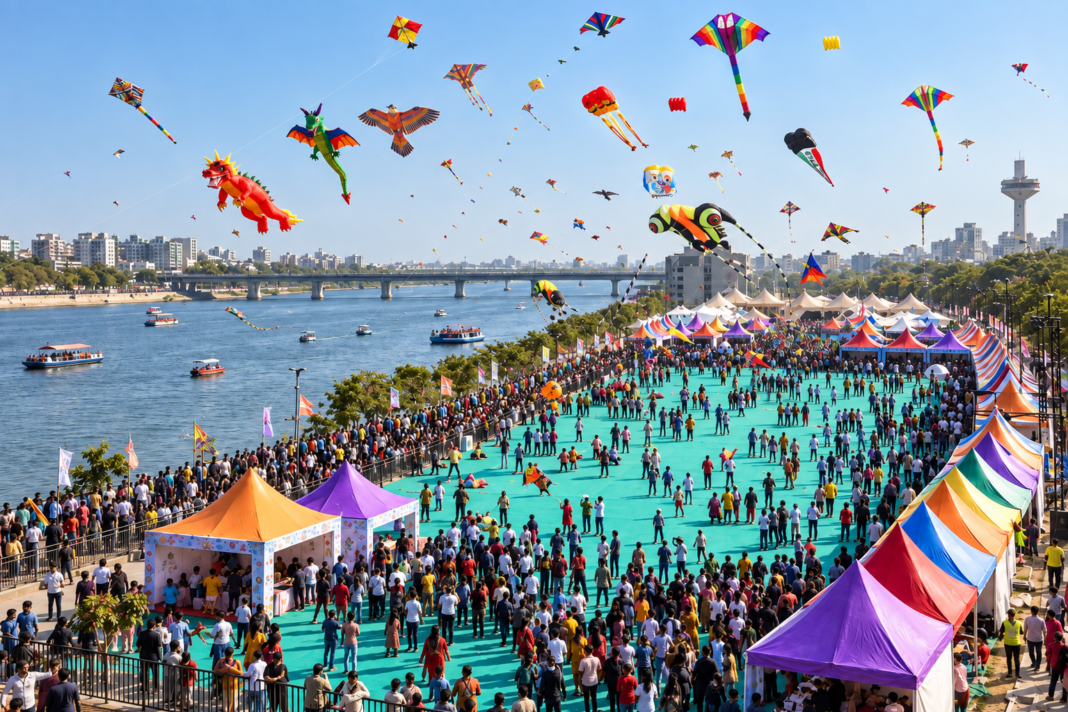
Understand what this is before you go. The International Kite Festival (IKF) is a Gujarat Tourism event, running since 1989, and it is a spectator exhibition, not a participatory kite fight. International flyers from dozens of countries display huge, elaborate, often three-dimensional kites. There are themed pavilions, handicraft stalls, food, and cultural performances.
What it isn’t: a place where you fly your own kite. The public generally has no access to the flying area.
The 2026 edition ran across multiple Gujarat cities from around 10 January, with Ahmedabad hosting the main leg from 12 January at the Sabarmati Riverfront near Vallabh Sadan, entry free, with a small parking charge. Recent editions have added a heritage-pol setup and kite museum on the riverfront walkway, a night kite-flying session with illuminated tukkals, and a food bazaar built around undhiyu, jalebi, til laddu and chikki.
Nearest metro: Old High Court, the interchange station — genuinely the smartest way to get there on festival days.
Our verdict: worth an afternoon, especially with kids, and especially for the giant kites and the night tukkal session. But don’t mistake it for Uttarayan. It’s the polished exhibition alongside the real thing.
2027 dates hadn’t been announced at the time of writing. They usually land in the days immediately before 14 January and are published on the Gujarat Tourism kite festival site around November or December.
4. Kankaria and public grounds
Open, accessible, family-friendly. Lower intensity than the old city, but easy and free.
Patang Bazaar: buying your kit
For roughly a week before Uttarayan, the kite markets in Raipur, Tankshal, Kalupur and Naroda stay open through the night. Lanes packed shoulder to shoulder at 2 am, stalls stacked floor to ceiling with paper kites, everyone haggling.
Going to Patang Bazaar at midnight two nights before Uttarayan is, on its own, one of the best things you can do in Ahmedabad.
What you actually need
Patang (kites) — Paper kites over a bamboo spine and bow. Sold in bundles. Sizes range from small ghasia to large cheel. Buy far more than you think you need — you will lose most of them, and that’s the entire point. For a group of four flying all day, 50–100 kites is not excessive.
Dor / string — This is the critical decision, and there’s a right answer. See the safety section below. Buy plain cotton thread or saddi. Not nylon. Not glass-coated.
Firki — The spool the string is wound on. Get a decent one; cheap ones jam and cost you kites.
Tukkal — Paper lanterns for the night session.
Accessories — Finger tape or medical tape (non-negotiable, see below), a spare firki, and glue and paper for repairs.
Rough budget: a solid day’s supplies for a group of four runs a few thousand rupees, most of it kites and string.
How to actually fly (and cut)
The basics take about twenty minutes to learn and a lifetime to be good at.
Launching: you want a second person holding the kite about ten metres away, string taut. On a gust, they release and you pull in sharp, short tugs. The kite climbs on tension, not on wind alone.
Steering: pull to climb and turn, release to drift. Gujarat’s fighter kites have no tail — they’re deliberately unstable, which is what makes them manoeuvrable and infuriating.
The cut (pech): you cross your string against a rival’s and saw. Two schools: pulling (aggressive, fast, string-against-string friction) and releasing (letting your line run so their line burns against yours). Locals argue about which is nobler. Both work.
When you win: the entire rooftop shouts “Kai po che!” — roughly, “it’s cut!” You’ll also hear “Lapet!” (reel it in!) and “E lapet!” thrown around constantly.
When you lose: your kite drifts off and somebody’s child on the street below sprints after it. This is a completely normal part of the day and there is no dignity in mourning.
The food
Uttarayan food is winter food, and it’s excellent.
Undhiyu — The centrepiece. A slow-cooked mixed winter vegetable dish — surti papdi, purple yam, brinjal, potato, muthiya dumplings — traditionally cooked upside down in an earthen pot. Rich, complex, and only properly good in this season. Eaten with puri.
Jalebi — Served with undhiyu, not after. The combination sounds wrong and is in fact perfect.
Til laddu and til chikki — Sesame and jaggery, the actual Makar Sankranti ritual food across India. Warming, and pointedly seasonal.
Chikki — Peanut and jaggery brittle. Rooftop fuel.
Ponk — Tender green sorghum, a Surat specialty that shows up in Ahmedabad in winter, eaten with sev and chutneys.
Shakkariya and boiled tubers — Sweet potato, sesame, winter tubers. Simple and constant.
Ordering undhiyu: most families order it in from a sweet shop or caterer rather than making it. Place your order days ahead — good shops sell out, and on 14 January itself you will find nothing.
Safety: the part most guides skip
This is a genuinely dangerous festival if handled carelessly. Take this section seriously.
Manja is the problem
Glass-coated and nylon kite string — manja — is sharp enough to cut through skin. The National Green Tribunal banned nylon, Chinese and glass-coated manja in July 2017, and Ahmedabad police run seizure drives every year, but illegal string still circulates.
The consequences are not theoretical. People die every year from throat lacerations caused by loose strings strung across roads. In one Gujarat Uttarayan season, three people including a child were killed this way, with dozens more injured across Ahmedabad, Rajkot, Surat and Vadodara.
What to do:
- Buy plain cotton thread or saddi. It flies fine. You’ll cut fewer kites and you won’t hurt anyone.
- If you ride a two-wheeler on 14 or 15 January, wear a neck guard or a thick scarf. Locals do this as routine. Loose strings hang invisible across roads.
- Better: don’t ride a two-wheeler on Uttarayan at all. Take a car or stay put.
Rooftop safety
- Check the parapet before anyone goes near the edge. Old buildings, old walls, twelve hours of enthusiastic people.
- Children need constant supervision. Kids chasing cut kites across adjoining terraces is how accidents happen.
- Tape your fingers. Cotton string will still shred your index and middle fingers over a full day of pulling. Medical tape, before you start, not after it hurts.
Sun and exposure
Twelve hours on an exposed roof in January sun burns people badly, and the cool air hides it.
- Sunscreen, reapplied.
- A cap and sunglasses.
- Layers — mornings and nights are genuinely cold, midday is not.
- Water. More than you think.
Birds — please read this
Uttarayan is brutal for birds. Kite strings slice wings and feet; injured birds hide and often bleed to death before rescuers reach them. Pigeons, crows, black kites, owls and even vultures are affected.
Gujarat runs Karuna Abhiyan, a state rescue drive that operates roughly 10–20 January every year, with thousands of volunteers, hundreds of veterinary doctors and treatment centres across the state. Over its lifetime it has handled tens of thousands of rescues, with Ahmedabad district accounting for the largest share.
What you can do:
- Use cotton string. This is by far the biggest single thing.
- Avoid flying in the early morning and around sunset, when birds are most active — this is an explicit government request, not a suggestion from us.
- If you find an injured bird: don’t pull the string off it, don’t give it water, cover it gently with a cloth and get it to a treatment centre. Karuna Abhiyan has published a WhatsApp helpline — send “Karuna” to 8320002000 — plus an online map of nearby centres, and local animal welfare NGOs run rescue lines through the festival.
This doesn’t make the festival less fun. It makes it less cruel, which is a fair trade.
Planning a trip around Uttarayan
Book accommodation by October or November. Hotels in Ahmedabad fill up and prices climb sharply for 12–15 January. This is the single busiest tourism window of the Gujarat year.
Flights and trains into Ahmedabad get expensive and full for the same window. Book early.
Arrive by 12 or 13 January. You want the Patang Bazaar night, the IKF, and time to sort out a rooftop.
Expect the city to shut on 14 January. Most shops, offices and many restaurants close. Museums and monuments may have restricted hours. Plan sightseeing for the days on either side, not the day itself.
Getting around on the day: roads are eerily empty of regular traffic but dense with pedestrians and stray string. Metro and cars, not two-wheelers.
Stay for 15 January. Vasi Uttarayan is calmer, warmer in feel, and often the day visitors enjoy most because they’ve stopped being overwhelmed.
Combine it well: heritage walk on the 12th, Patang Bazaar that night, IKF on the 13th, rooftop on the 14th, Manek Chowk when you can eat again.
Photography notes
- Golden hour on 14 January is the shot. Kites silhouetted, tukkals starting, warm light across terraces.
- Get high. The photograph is not of one kite. It’s of a sky with a thousand and rooftops full of people.
- Shoot the people, not just the sky. Faces looking up, taped fingers, a child holding a firki — these carry the day better than kite-against-blue.
- A zoom helps for compressing layers of rooftops.
- Protect your gear — dust, sun, and enthusiastic elbows.
- Ask before photographing families on private terraces. You’re a guest.
A small glossary
- Patang — kite
- Dor — kite string
- Firki — the spool
- Manja — coated/abrasive string (the banned kind)
- Saddi — plain cotton thread
- Pech — a kite duel
- Kai po che! — “I’ve cut it!”
- Lapet! — “Reel it in!”
- Tukkal — night lantern flown on the line
- Vasi Uttarayan — the second day, 15 January
Frequently asked questions
When is Uttarayan 2027? 14 January 2027, with Vasi Uttarayan on 15 January. The date is fixed by the solar calendar and rarely shifts.
Is Uttarayan the same as the International Kite Festival? No. Uttarayan is the citywide rooftop festival everyone participates in. The International Kite Festival is a Gujarat Tourism exhibition at the Sabarmati Riverfront, usually in the days just before, where professional flyers display large kites and the public watches.
Is the International Kite Festival free? Yes, entry has been free in recent years, with a nominal parking charge. Public access to the flying area is not provided.
Can tourists fly kites in Ahmedabad? Absolutely — that’s the whole point. You need roof access, which means an invitation, a rented terrace, or a hotel rooftop package.
Where can I find a rooftop if I don’t know anyone? Old-city homes and havelis rent terraces to groups during Uttarayan, and several heritage hotels run rooftop packages including kites and food. Book by early December.
Where do I buy kites in Ahmedabad? Patang Bazaar in Raipur, Tankshal, Kalupur and Naroda, open through the night for about a week before the festival.
Is kite flying dangerous? It can be. Glass-coated and nylon manja causes serious injuries and deaths every year. Use plain cotton string, wear a neck guard if riding a two-wheeler, tape your fingers, and supervise children near roof edges.
Is Chinese manja legal in India? No. Nylon, Chinese and glass-coated manja have been banned by the National Green Tribunal since 2017, and police run seizure drives before every Uttarayan.
What should I eat during Uttarayan? Undhiyu with puri and jalebi, plus til laddu, chikki and ponk. Order undhiyu days in advance.
Will shops and attractions be open on 14 January? Largely not. Plan sightseeing for the days before and after.
The last word
Most festivals are performed. Somebody organises them, somebody attends them, and there’s a stage somewhere with a boundary around it.
Uttarayan has no stage. There’s no venue, no ticket, no organiser. Just an entire city that decided, collectively and without discussion, to spend one day a year on its roofs, looking up, shouting at strangers three buildings away.
You can watch it from the riverfront and it will be lovely. But if you can get onto a terrace in Khadia at nine in the morning on 14 January, with a chai going cold beside you and tape on your fingers and the sky completely gone behind paper — that’s the version worth planning a year around.
Cotton string. Watch the birds. Kai po che.
Amdavad Gully covers this city street by street. Renting out a terrace, running a rooftop, or know a Patang Bazaar stall that deserves the credit? Tell us — we’ll put it in next year’s guide.