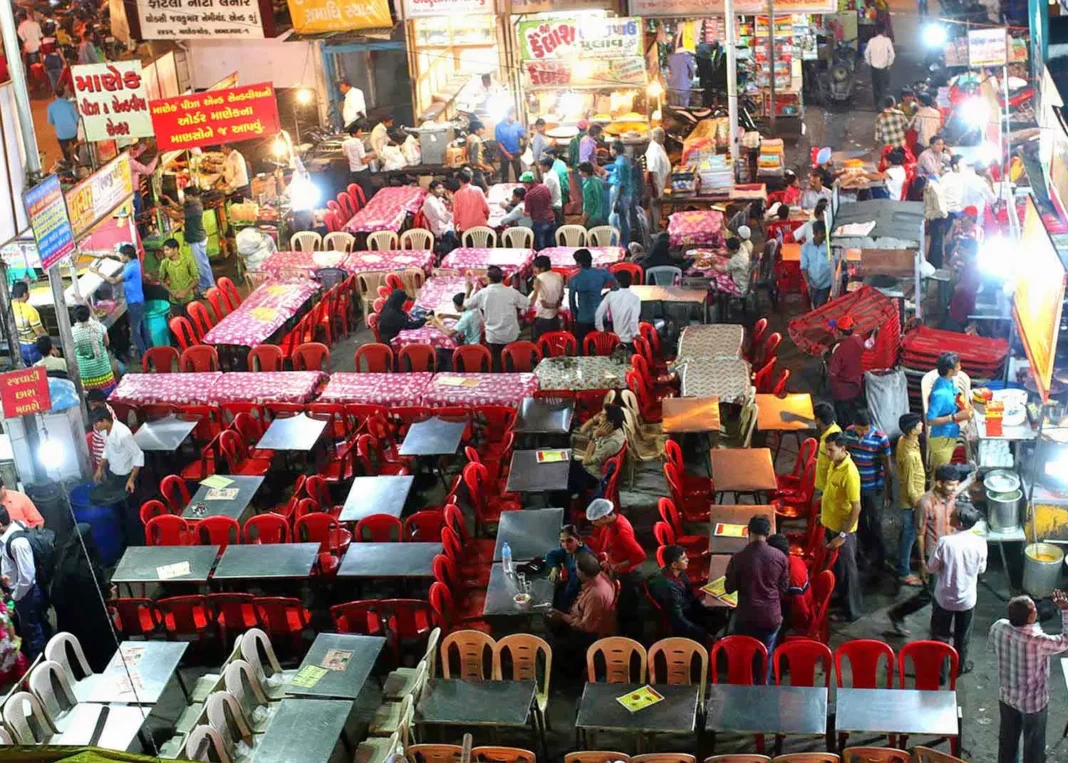
There is a square in old Ahmedabad that is three completely different places depending on when you show up.
At 6 am it’s a vegetable market — carts of methi and flowers, people buying grass to feed cows before work. By 11 am it’s one of India’s biggest gold and bullion markets, all weighing scales and quiet, serious money. And then around 8 pm the shutters come down, the tables come out, the burners fire up, and Manek Chowk becomes the loudest, butteriest, most gloriously unnecessary food market in western India.
Same stone. Same 600-year-old square. Three economies, one day.
Most food guides give you a list of six dishes and a photo of pav bhaji. This one gives you the order to eat things in, the stalls actually worth queuing at, a realistic budget, the hygiene rules that matter, and the honest verdict on which famous item is overrated.
Come hungry. Genuinely. Skip dinner.
Manek Chowk at a glance
| Where | Manek Chowk, old city, near Jama Masjid and Rani no Hajiro |
| Night market (Ratri Bazaar) hours | Stalls build up from around 8 pm, peak 9:30 pm–midnight, many run till 1 am |
| Best time to arrive | 8:30–9:00 pm, before peak |
| Cost | Roughly ₹400–700 for two people, eating properly |
| Payment | Carry cash; many stalls take UPI, some don’t |
| Food type | Almost entirely vegetarian |
| Nearest metro | Kalupur / old city stations, then a short auto ride |
| Best for | Groups, sharing, late nights, first-timers to Gujarat |
The three shifts: understanding the square
You’ll enjoy the food more if you know what you’re standing in.
Morning (roughly 6–11 am): a working vegetable and flower market. Quiet, functional, no tourists. Locals also buy bundles of green fodder here for gau-seva, feeding cows — a tradition that predates everything else in this guide.
Afternoon (roughly 11 am–8 pm): the bullion market takes over. Gold, silver, precious stones, and some of the oldest jewellery businesses in India operating out of shops the size of a bathroom. Adjacent Rani no Hajiro turns into a textile lane selling bandhani, chaniya cholis and dress material.
Night (8 pm–1 am): the Ratri Bazaar. The jewellers lock up, and within about twenty minutes the same square is filled with carts, plastic stools, folding tables and the smell of Amul butter hitting a hot tawa.
The square is named after Baba Maneknath, the saint who, by local legend, kept unravelling Ahmed Shah’s city walls by night in the 15th century until an arrangement was reached. His descendants still hoist a flag at Manek Burj on Vijayadashami — a tradition running roughly 600 years and now in its 12th generation.
The food market is the newest layer. It grew from around the 1970s, reportedly starting with a kulfi cart that got popular enough that everyone else followed.
When to go: timing is the whole game
Arrive between 8:30 and 9:00 pm. This is the sweet spot. Stalls are fully fired up, you can still get a table, and you can walk the perimeter and scout before committing.
Peak is 9:30 pm to midnight. Maximum energy, maximum wait, maximum chaos. Great atmosphere, harder logistics.
After midnight things thin out but many stalls run till around 1 am. If you like your street food with elbow room, this is your window.
Best nights: weekdays if you want to actually sit down. Weekends if you want the full carnival. Friday and Saturday nights are genuinely packed.
Seasonal: November to February is perfect. Navratri nights are extraordinary — the square fills after garba and stays open very late. Summer is survivable at night but sticky.
Avoid: arriving at 7 pm expecting food. You’ll find jewellers packing up and nothing to eat.
What to eat at Manek Chowk: the full list
Here’s the honest breakdown, roughly in the order a local would eat it.
1. Pav bhaji — start here, always
The anchor dish. A mashed vegetable curry cooked down on a huge tawa, finished with a quantity of butter that would concern a cardiologist, served with soft pav toasted in more butter.
Variants to know:
- Butter pav bhaji — the standard, already excessive
- Cheese pav bhaji — grated cheese blanketing the top
- Khada pav bhaji — chunkier, vegetables left whole rather than mashed
- Jain pav bhaji — no onion, no garlic, no potato; widely available and taken seriously here
Where: Bahuchar Pav Bhaji and Mahalaxmi Pav Bhaji are the names people repeat. Honestly, several stalls do this well — go by which tawa has the biggest crowd.
Order it first. It’s savoury, it’s hot, and it sets the baseline. Everything after this is escalation.
2. Ghotala dosa — the dish that explains this place
If you eat one thing at Manek Chowk that you can’t get anywhere else, make it this.
Ghotalo means a mess, a mix-up, a scandal. The dish lives up to the name: a dosa broken up and scrambled on the tawa with spiced potato, vegetables, masala and an absurd amount of butter, served as a hot, chaotic, deeply satisfying heap. Some versions come with cheese, some with an egg-scramble style treatment.
Where: Balan Dosa Centre, inside the Ratri Bazaar, is the name most associated with it — a Manek Chowk institution running since the late 1970s.
It is not elegant. It is not remotely healthy. It is the single most Manek Chowk thing on the menu.
3. Gwalia dosa (Gwalior dosa)
A butter-drenched masala dosa, crisp, folded, served with coconut chutney and sambhar. Ahmedabad’s love for South Indian food is real and slightly unhinged, and this is its flagship.
Where: Balan Dosa and the dedicated dosa stalls along the row. Look for the ones where the tawa is a metre wide and never empty.
4. Jini dosa
Chopped vegetables, cheese, schezwan-adjacent masala, rolled tight and cut into rounds like a savoury swiss roll. Somewhere between a dosa, a frankie and a pizza. It shouldn’t work. It does.
Order this if you’re in a group and want something that shares easily.
5. The sandwiches — Ahmedabad’s most notorious invention
Three thick slices of soft white bread. Butter. Grated cheese. And then, depending on the stall, fillings ranging from reasonable to deranged.
The reasonable end: vegetable, cheese-chilli, ghughra sandwich (spiced potato filling, samosa-like, onions and capsicum, green chutney).
The deranged end: pineapple cheese sandwich, chocolate sandwich (yes, chocolate sauce and cheese, together), rabri sandwich, ice-cream sandwiches, jam-and-cheese combinations that will start arguments in your group chat.
Where: Manek Sandwich and the sandwich counters attached to the pav bhaji stalls. Bahuchar is a common recommendation.
Our honest take: the ghughra sandwich and the cheese-chilli are genuinely good food. The chocolate sandwich is a dare, not a dish. Order it once, for the story, and split it four ways.
6. Dabeli
Spiced potato in a pav, with sweet-tangy dabeli masala, pomegranate, roasted peanuts and sev. Small, cheap, brilliant, and the best palate-shifter in the square when everything else is starting to taste like butter.
7. Chaat — pani puri, sev puri, bhel
Every night market has chaat. Manek Chowk’s is solid rather than exceptional, but the pani puri stalls turn over fast, which is exactly what you want.
Skip if: you’re short on stomach space. This is the most replaceable category here.
8. Fruit shots and juices
Jamun, mango, guava, mixed — served in small glasses, seasonal, everywhere.
Honest verdict: overhyped. It’s a good palate cleanser between the butter courses and a nice photograph. It’s not the reason to come. If your stomach is uncertain about street ice and cut fruit, skip these specifically and drink something sealed.
9. Bhajiya and fried things
Methi bhajiya, mirchi bhajiya, batata vada, and in monsoon, gota. Hot, crisp, and best eaten standing.
10. Kulfi — the mandatory finish
The kulfiwalas were here first, and they’re still the last stop of the night.
Asharfi Kulfi — one of the oldest names in the square, operating since the 1940s, known for sancha (old-style, hand-churned) ice cream alongside kulfi. Kesar, badam, chocolate, seasonal fruit flavours, sugar-free options.
Bastiram Kulfi — the other legacy name, also dating to the 1940s, famous for dense, stickless kulfi and the rabdi kulfi: slices of slow-churned kesar or pista kulfi drowned in thick, cold rabdi.
Order the rabdi kulfi. After forty minutes of butter and cheese, dense cold cream is exactly the correct ending. Don’t argue.
11. Kulfi falooda
Kulfi, falooda sev, rose syrup, nuts, sometimes ice cream. Bigger, sweeter, more theatrical. Good for sharing.
12. Walk 100 metres for fafda-jalebi
Here’s the local move nobody puts in guides. Step away from the main food square and into the surrounding lanes and you’ll find hot jalebi, fafda and ghatiya with raw papaya chutney at old-school shops that have nothing to do with the tourist crush.
Better jalebi, half the price, and you’ll feel like you’ve cracked something.
The eating order (a real plan, not a list)
The mistake everyone makes is ordering everything at once from one stall and then discovering they’re full after the pav bhaji.
For two people, 90 minutes:
- One plate cheese pav bhaji — share
- One ghotala dosa — share
- One ghughra or cheese-chilli sandwich — share
- One dabeli each (palate reset)
- One rabdi kulfi each
For four people, two hours: Add a jini dosa, a Gwalia dosa, one chocolate sandwich (for the dare), a plate of chaat, and finish with kulfi falooda plus rabdi kulfi so you can compare.
Solo: Pav bhaji, half a ghotala dosa if you can persuade them, one dabeli, one kulfi. Sit at a shared table. Someone will talk to you.
Rules that make it work:
- Share everything. Portions are large and rich. Ordering one plate each is a rookie error.
- Move between stalls. Don’t anchor at one table for the entire night. The point is the crawl.
- Alternate savoury and sharp. Butter, then dabeli or chaat, then butter again. Otherwise everything tastes the same by item four.
- Save 20% of your appetite for kulfi. People routinely fail at this.
What it costs
Approximate, and it moves with inflation and stall:
| Item | Rough cost |
|---|---|
| Pav bhaji (butter/cheese) | ₹100–180 |
| Ghotala dosa | ₹120–200 |
| Gwalia / Jini dosa | ₹100–180 |
| Sandwich | ₹70–150 |
| Dabeli | ₹40–70 |
| Chaat plate | ₹50–100 |
| Fruit shot | ₹40–80 |
| Kulfi | ₹60–150 |
| Rabdi kulfi | ₹100–200 |
Realistic totals: ₹400–700 for two eating well. ₹1,000–1,400 for four going hard. It is one of the best value nights out in urban India.
Carry cash. UPI works at most established stalls now, but network at peak crowd is unreliable and smaller carts still run on notes.
How to pick a stall (when everything looks the same)
- Follow the queue, not the signage. The biggest, ugliest crowd is usually correct.
- Watch the turnover. You want a tawa that never rests. Fast turnover means fresh food and less standing time for anything.
- Watch the butter block. If it’s disappearing fast, business is good.
- Legacy names are legacy for a reason — Asharfi, Bastiram, Balan. They’ve survived fifty-plus years in the most competitive food square in the state.
- Don’t dismiss the small cart with the dedicated line. Some of the best single items here come from unnamed stalls that regulars go to on autopilot.
- Ignore any stall aggressively soliciting tourists. The good ones don’t need to.
Stomach survival: the honest hygiene section
Street food carries risk. Here’s how locals reduce it without missing out.
- Eat hot food, freshly cooked in front of you. Anything coming straight off a tawa at 250°C is your safest option — which happily includes pav bhaji, all the dosas and the sandwiches.
- Be more careful with cold and raw items: cut fruit, fruit shots, chutneys sitting out, ice in drinks, and pani puri water. These are where problems usually start.
- Kulfi from the legacy vendors is generally fine — high turnover, proper freezing, generations of reputation on the line.
- Carry your own water. Sealed bottles only.
- Carry tissues and hand sanitiser. There’s no sink and there is a great deal of butter.
- If you’ve just landed in India, ease in. Do the cooked items on night one; save the chaat and fruit shots for later in the trip.
None of this is a reason to skip Manek Chowk. It’s a reason to eat it intelligently.
Practical stuff
Getting there: Auto or cab is easiest; drop pin at Manek Chowk itself, not “old city”. From the western suburbs, allow 30–40 minutes at night. The metro gets you to the old city, then take a short auto.
Parking: difficult and getting worse after 9 pm. Two-wheelers manage. Cars struggle. Seriously consider not driving.
Seating: plastic stools and folding tables in the open square. First come, first served. Expect to share. At peak you may eat standing, which is fine and traditional.
Toilets: limited. Plan accordingly before you arrive.
Kids: fine and common until around 11 pm; families are everywhere. It’s loud and crowded, so keep hands held.
Solo women travellers: the square is busy, well-lit and family-heavy well past midnight, and is generally considered safe. Usual city precautions apply.
Alcohol: none. Gujarat is a dry state. This entire market runs on butter, sugar and enthusiasm, which turns out to be enough.
Vegetarian, Jain and vegan:
- Vegetarian: almost the entire market. This is one of India’s great vegetarian food streets.
- Jain: widely catered for — say “Jain” when ordering and most stalls will make it without onion, garlic and root vegetables.
- Vegan: genuinely hard. Butter and cheese are the point. Dabeli without butter, some chaat, and fruit are your realistic options. Be explicit and expect confusion.
What else to do while you’re there
Manek Chowk sits inside a UNESCO World Heritage city, and almost nobody eating there looks up.
- Jama Masjid — a two-minute walk. The 1424 courtyard is lit at night and worth standing in for five quiet minutes.
- Badshah no Hajiro and Rani no Hajiro — the tombs of Ahmed Shah I and the Sultanate queens, flanking the square.
- Manek Burj — the point from which, by tradition, the construction of Ahmedabad began.
- The night heritage walk — an evening guided route through the old city that conveniently ends at Manek Chowk. Do the walk, then eat. Best possible sequence.
- Bhatiyar Gully — a ten-minute ride away near Teen Darwaza, where the city’s late-night Mughlai street food lives: kebabs, nihari, bheja fry. If you eat meat, this is the essential counterpart to Manek Chowk’s vegetarian excess.
Combine it properly: heritage walk in the morning, Manek Chowk at night, same square, same day. You’ll understand Ahmedabad better in 24 hours than most visitors do in a week.
Six mistakes to avoid
- Eating dinner first. You will get through two items and regret your life.
- Ordering one plate per person. Everything is huge. Share or fail.
- Arriving at 7 pm. Nothing’s open yet.
- Driving a car. Parking will ruin your mood before you’ve eaten anything.
- Committing to the first stall you see. Walk the whole perimeter first. It takes four minutes.
- Skipping the kulfi because you’re full. The kulfi is the point. Pace for it.
Frequently asked questions
What time does Manek Chowk night market open? Stalls begin setting up around 8 pm, peak between 9:30 pm and midnight, and many run until about 1 am.
What is Manek Chowk famous for? Being three markets in one square — vegetables in the morning, gold and bullion by day, and one of India’s best-known night street food markets after dark.
What should I eat at Manek Chowk? Cheese pav bhaji, ghotala dosa, a ghughra or cheese sandwich, a dabeli, and rabdi kulfi to finish.
How much does eating at Manek Chowk cost? Roughly ₹400–700 for two people eating a full spread of five or six shared items.
Is Manek Chowk vegetarian? Almost entirely, yes. Jain options are widely available. For non-vegetarian late-night food, head to Bhatiyar Gully instead.
Is Manek Chowk open on all days? The night market runs daily, though individual stalls take their own days off and hours shift during festivals and heavy rain.
Is the street food at Manek Chowk safe? Stick to freshly cooked hot items, be selective about cut fruit, ice and chaat water, drink sealed bottled water, and you’ll almost certainly be fine.
Is Manek Chowk worth visiting? Yes — it’s one of the most distinctive urban food experiences in India, and unusually, it’s a place locals genuinely use rather than a market performed for tourists.
Can I visit Manek Chowk during the day? Yes, and you should. The morning vegetable market and the afternoon bullion trade are a completely different, quieter, and quite fascinating experience.
One last thing
The reason Manek Chowk works isn’t the food, exactly. Plenty of Indian cities have a night food street.
It’s that the tables are set down in the same square where a sultan is buried, next to a mosque built in 1424, in a neighbourhood people have lived in continuously for six centuries — and nobody there treats any of that as remarkable. The jeweller who locked up at eight is somebody’s uncle. The kulfiwala’s grandfather started the cart. The flag on Manek Burj gets hoisted by the twelfth generation of the same family.
You’re not visiting a heritage site. You’re eating dinner in one.
Get the rabdi kulfi.
Amdavad Gully covers this city street by street — food, heritage, business and the people behind the counters. Got a Manek Chowk stall we’ve unfairly ignored? Tell us. We’ll go eat it.