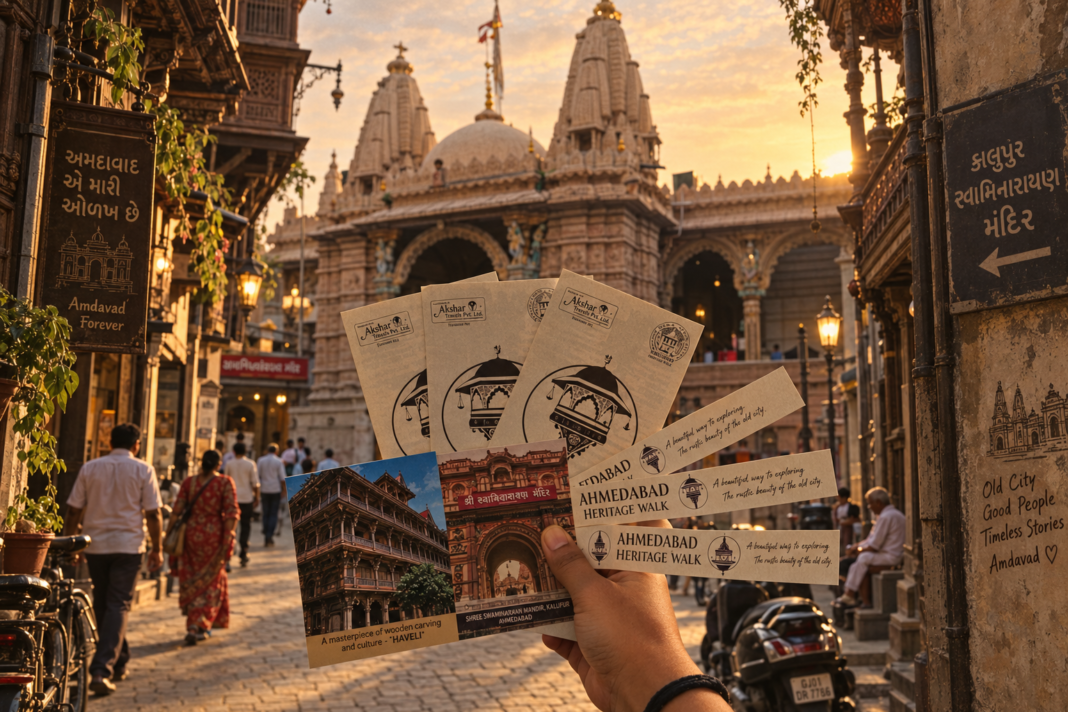
At 7:45 on a winter morning, the lane outside the Kalupur Swaminarayan Temple smells like fried gram flour and diesel. A milkman is arguing with a scooter. Somebody’s grandmother is sweeping an otla. And about thirty people are standing around looking mildly lost, waiting for a guide who is about to walk them two kilometres into the middle of the 15th century.
That’s the Ahmedabad heritage walk. It’s been running in some form since 1997, it costs less than a decent pizza, and it is — without exaggeration — the single best thing you can do in this city.
Most write-ups tell you three facts: it starts at a temple, it ends at a mosque, it takes two and a half hours. That’s not a guide. That’s a caption.
This is the full thing: the route stop by stop, what to actually look at when you get there, how to book, what to wear, what to eat, when to skip it, and the alternative walks locals do instead. Written by people who live here and have done it more times than we’d admit.
Quick facts: the Ahmedabad heritage walk at a glance
| Route | Kalupur Swaminarayan Temple → Jama Masjid (“Mandir to Masjid”) |
| Start time | Around 7:45–8:00 am, daily |
| Ends | Roughly 10:30 am |
| Duration | About 2.5 hours |
| Distance | Around 2 km, entirely on foot |
| Stops | Roughly 20 |
| Cost | Around ₹200 for Indian citizens, ₹300 for foreign nationals; premium/breakfast-inclusive options are sometimes offered |
| Run by | Ahmedabad Municipal Corporation, with a travel partner managing operations |
| Booking | heritagewalkahmedabad.com — book ahead, especially in winter |
| Closed | Confirm before you go; the schedule shifts around festivals and public holidays |
Prices and timings do change. Treat this table as a planning tool, not a contract — always confirm on the official site the week you’re travelling.
Why this walk exists, and why it matters
In July 2017, Ahmedabad became India’s first UNESCO World Heritage City. Not Delhi. Not Jaipur. Not Varanasi.
The listing wasn’t for a single monument. It was for the walled city as a whole — roughly six centuries of continuously inhabited urban fabric, built as a dense weave of neighbourhoods called pols, threaded with Hindu temples, Jain derasars, Sultanate mosques and tombs, all sitting on top of each other in a way almost nowhere else in the world manages.
You cannot see this from a car. You cannot see it from a rooftop. The whole point of the old city is that its best material is behind an unmarked door, up a lane too narrow for a rickshaw, in a courtyard you’d never know was there.
Hence: the walk.
What a pol actually is
Understand this and the entire walk clicks into place.
A pol is a self-contained residential cluster, usually organised around caste, community or trade, entered through a single gate that could be closed at night. Inside, it functions like a village compressed into a few hundred metres:
- A gate — lockable, defensible, the pol’s front door.
- A chabutro — an ornate raised bird feeder, usually in the central square. Jain influence: feeding birds is an act of merit. Some are plain wood, some are carved masterpieces with stained glass.
- A community well — shared water, and the social centre of the pol.
- Otlas — the raised platforms outside every house where people sit, gossip, keep an eye on the lane, and effectively police the neighbourhood without ever calling it that.
- Secret passages and cul-de-sacs — genuinely. Escape routes between pols, built for riots, raids and awkward political weather.
- Deep, narrow houses with internal courtyards for light and air, and carved wooden facades that were a straightforward flex of merchant wealth.
Add up a few hundred of these and you get old Ahmedabad: a city designed for security, community and shade, three things modern Indian urban planning still struggles with.
The route, stop by stop
This is the official route. Guides vary the order slightly and skip stops when a temple is mid-ritual or a lane is dug up, but this is what you can expect.
1. Swaminarayan Temple, Kalupur — the starting point
Built in 1822, this was the very first temple of the Swaminarayan sect. The land was granted by the British; Swaminarayan handed construction responsibility to Anandanand Swami.
What to look for: the Burmese teak. Every arch, bracket and column is carved and then painted in bright, almost cartoonish colour — the visual signature of Swaminarayan temples worldwide starts here. Look up at the bracket carvings: birds, elephants, peacocks, dancers. The adjoining haveli houses pilgrim quarters and a dedicated women’s section.
Practical: there’s a strict dress code. Shoulders, chest, navel and upper arms covered; anything below the waist at least knee-length. This applies to everyone, and it’s enforced. More on dress code below.
2. Kavi Dalpatram Chowk, Lambeshwar ni Pol
A small square dedicated to the 19th-century Gujarati poet Dalpatram, who lived here. A bronze statue of him sits on an otla, in front of an outline of the house that once stood there.
What to look for: the detailing. The Kathiawari embroidery on his kurta. The worn right foot — polished by decades of people touching it. This is the walk’s first sign that you’re not touring monuments, you’re touring a neighbourhood that happens to remember its own writers.
3. Calico Dome
A geodesic dome, inspired by Buckminster Fuller, designed by Gautam Sarabhai and his team, opened in 1962 as the Calico Mills showroom.
The story here is Ahmedabad in miniature. Frank Lloyd Wright designed an administrative building for Calico on this site that never got built. The dome that replaced it hosted the city’s first fashion show — Parveen Babi walked here as a student in the 1970s. Then the mills closed in the ’90s, the dome fell into disrepair, the 2001 earthquake took the centre out, rain finished the interiors, and eventually it collapsed entirely. The AMC bought the site as heritage property in 2006.
What to look for: the gap. A textile empire, a fashion moment, a modernist experiment and a ruin, all on one plot.
4. Kala Ramji Mandir, Haja Patel ni Pol
A very old temple tucked inside a residential pol, unusual because the idol of Rama is seated rather than standing — commonly read as depicting the vanvas, the forest exile.
What to look for: the idols are carved from kasoti, the black touchstone traditionally used to test the purity of gold. In a neighbourhood of goldsmiths, that is not a coincidence. The wood carving and the central courtyard are textbook Ahmedabad domestic architecture.
5. Shantinathji Derasar, Haja Patel ni Pol
Step into the pol first and just stand there for a moment. Cows. Men arguing about nothing. Women working on the otlas. A carved wooden chabutro in the middle of it.
Then go inside the derasar. The exterior is modest; the interior ceiling, brackets, jalis and panels are extraordinary. The temple was originally almost entirely wood — when Relief Road was cut through the old city, it was shifted inward and rebuilt in marble, with some of the original wooden elements retained.
What to look for: the joinery. Wooden Jain temples in India are rare survivors, and the pieces reused here are the good stuff.
6. Kuvavala Khancho
Kuvo = well. Khancho = passage. A junction named for the wells that once sat beside it — and one of the walk’s genuinely great five minutes.
What to look for: four houses facing each other, each with a facade in a different style — Persian, Mughal, Maratha and European — with the original owners’ emblems above the doors. Four empires, one intersection.
Then look at the walls for small parrot holes: deliberate nesting cavities built into house exteriors because the dense pols had no trees. A city that built apartments for birds.
7. Jagvallabh Parshvanath Derasar, Nisha Pol
A large, delicately built Jain temple. From the entrance you get a view of the Parshvanath sahastrafena idol in the standing kayotsarga posture. A second sanctum, built in 1603 by Nagarsheth Khushalchand, holds a small black Chintamani Parshvanath idol in padmasana. There’s also a six-foot Adinath.
What to look for: scale contrast. Six-foot idols and inch-scale carving in the same room.
8. Zaveri Vad
Goldsmith territory. Haveli-type houses with heavily decorated facades, most of them still occupied and still working.
What to look for: the ground floors are shops, the upper floors are homes. Live-work architecture, 400 years before anyone made a startup buzzword out of it.
9. Sambhavnath ni Khadki
Believed to be the oldest Jain temple in Ahmedabad, built in 1662 and originally in wood, restored in marble in 1904.
What to look for: it’s built largely underground — from the khadki you only see the dome and shikhara rising out of the ground. Ask your guide why. The answers are about safety, politics and humility, and they’re all interesting.
10. Chaumukhji ni Khadki
Formerly Satharni Khadki. Beside it is a Vaishnav haveli of Gunsaiji. Historians believe remains of a 10th-century derasar are preserved within the Ajitnathji Derasar here — meaning parts of this site predate the founding of Ahmedabad by 400 years.
What to look for: the Hindu-Jain architectural blend, which is the real theme of the entire old city.
11. Doshivada ni Pol
More goldsmiths, more jewellery shops, more decorated haveli facades. Near the end of the pol is a beautifully carved chabutro with stained glass — a colonial-era twist on a traditional Gujarati form. There’s also a building here that was once the tallest in the walled city.
What to look for: the stained-glass chabutro. It’s the single most photographed object on the walk for good reason.
12. Ashtapadji Derasar
At the end of Doshivada ni Pol, beside the Jain library. Marble, Hindu-Jain style, built around 1856 by Sheth Maganlal Karamchand.
What to look for: the figurative sculpture — dancers, musicians, animals, floral motifs — and the coloured marble, sourced from several different quarries for different figures. Next door is a shop selling the five articles a Svetambar Jain monk carries. Look, don’t shop.
13. Harkunvar Shethani ni Haveli
The showstopper. Roughly 180 years old, around 60 rooms, most opening onto continuous pillared balconies, supported by the longest carved wooden bracket in Ahmedabad.
What to look for: Indo-Chinese motifs in the woodwork — evidence of a merchant family whose trade reached well beyond Gujarat. Stand back far enough to take in the whole facade, then get close enough to see one bracket properly. Both views are necessary.
14. Fernandez Bridge
Not really a bridge in any useful sense any more — it’s the Chopda Bazaar, one of India’s oldest book markets, in existence since 1884. Thousands of people come through daily for used and new books.
What to look for: the stacking. Textbooks to the ceiling, competitive exam guides, ancient Gujarati titles. If you have twenty spare minutes after the walk, come back.
15. Chandla Ol
The city’s biggest and oldest market for brass puja items — thalis, lotas, sev-sancha, idols, lamps, flower vases.
What to look for: the sound. It’s a lane that clangs. Also one of the better places in the old city to buy something small and genuinely local.
16. Manek Burj / Maneknath’s Temple, Manek Chowk
Legend says the saint Baba Maneknath repeatedly interrupted Ahmed Shah’s construction of the new city in the 15th century — unweaving by night what was built by day — until an accommodation was reached. His descendants have hoisted a flag at Manek Burj on Vijayadashami for roughly 600 years, now in the 12th generation.
What to look for: this is, by family tradition, the point from which the construction of Ahmedabad began. You’re standing at the city’s zero milestone.
17. Rani no Hajiro
A 15th-century walled compound of tombs where the queens of the Sultanate were buried. Stone carving on the outer walls, an open-air courtyard rather than the usual domed enclosure — reportedly at the request of Ahmed Shah’s queen.
What to look for: the surrounding market. The compound is now ringed by textile stalls selling bandhani and chaniya cholis, which sounds like desecration until you realise this is exactly how the old city has always worked. Also: brocade, introduced in Ahmed Shah’s reign, was traditionally used to cover these graves.
18. Badshah no Hajiro (Ahmed Shah’s Tomb)
Built in 1446, just outside the eastern gate of Jama Masjid. The founder of Ahmedabad, Ahmed Shah I, is buried here, along with his son Muhammad Shah and grandson Qutbuddin Ahmed Shah III.
What to look for: the perforated stone windows and the square plan with porticos.
Important: women are not permitted inside the inner chamber, and men must cover their heads to enter. Carry a scarf or handkerchief.
19. Jama Masjid — the finish
Inaugurated on 4 January 1424 by Ahmed Shah I, and probably the largest mosque built in the subcontinent in its period. Yellow sandstone. 260 pillars. 15 domes. Hindu, Jain and Islamic architectural vocabularies fused into one building — including material salvaged from demolished temples, a fact your guide should mention and most write-ups avoid.
What to look for: don’t photograph and leave. Take your shoes off, walk to the far corner of the courtyard, sit on the stone and look back across the pillars. The morning light comes through at an angle that makes the whole hypostyle hall read like a forest. Ten minutes of sitting here is worth the entire ticket.
20. Mahurat ni Pol
Often included, sometimes not, depending on time. The first pol of the city, settled by Jains in the second half of the 15th century during Mehmud Begda’s reign.
What to look for: the transformation. Around 100 jewellery shops now operate here, and only a handful of families still live in it. The Ahmedabad Stock Exchange building went up in front of it. The city’s oldest residential neighbourhood became its bullion market, which is either tragic or extremely on-brand for Ahmedabad, depending on your mood.
Booking, cost and logistics
Where to book: the official site, heritagewalkahmedabad.com, run under the Ahmedabad Municipal Corporation with a travel partner handling operations.
Cost: around ₹200 for Indian citizens and ₹300 for foreign nationals, inclusive of taxes. Premium options that bundle breakfast at a heritage restaurant have been offered at roughly double that — check what’s currently listed.
Refunds: generally none once booked. Don’t book speculatively.
Do you need to pre-book? In peak season (November–February, and especially around Uttarayan), yes. In the off months you can often turn up and pay, but you’re gambling.
Where exactly to meet: the courtyard at Kalupur Swaminarayan Temple. If you’re using a cab, drop pin at the temple, not “Kalupur” generally — the station area is a different chaos entirely.
Getting there: Kalupur railway station is a few minutes away. The metro’s east–west line makes the old city far more reachable than it used to be. An auto from the western suburbs takes 25–40 minutes; leave by 7:00 am to be safe.
Arrive 15 minutes early. The walk starts on time and does not wait. This is the single most common complaint from people who missed it.
What to wear, and what to carry
Dress code is real. The Swaminarayan Temple requires covered shoulders, chest, navel and upper arms, and knee-length or longer below. You’ll also enter multiple Jain derasars and mosques.
- Shoes you can remove easily. You will take them off and put them on six to eight times. Slip-ons, not laces.
- Socks, if you dislike walking barefoot on marble and stone.
- A scarf or cap — needed for men at Badshah no Hajiro, useful everywhere.
- Water. It’s mostly shaded, but two and a half hours is two and a half hours.
- Cash. For chai, for a chabutro-side snack, for the book market afterwards.
- Leather: some Jain temples restrict leather items including belts and wallets. Guides usually flag this; travel light and you’ll avoid the issue.
- Photography: fine in most exterior spaces, restricted inside several temples. Ask before shooting, always, and don’t photograph residents’ interiors or women without asking.
Eat like you planned it
The walk ends at Jama Masjid around 10:30 am, ravenous, in the middle of one of India’s great food districts. Don’t waste that.
Before (if you can get there by 7:15): fafda-jalebi at an old Gandhi Road institution, or a quick chai. Keep it light — you’re about to walk.
Straight after, within a five-minute radius:
- Manek Chowk — by day it’s a jewellery market, but the morning food stalls do excellent bhajiya, poha and chai.
- Old-school Gandhi Road breakfast houses for fafda, jalebi, gathiya and methi na gota.
- Bhajiya and dal vada carts around Raipur and Khadia.
- Lucky Tea Stall, a short ride away, for bun maska and chai in a café built around graves the owners refused to move.
Come back at 9 pm. Manek Chowk transforms into a full street-food carnival — cheese pav bhaji, sandwiches, kulfi — until well past midnight. Doing the same square at 8 am and 10 pm on the same day is the best possible introduction to this city.
The other heritage walks (locals’ picks)
The AMC morning walk is the classic. It isn’t the only one.
Night Heritage Walk — Starts in the evening near Sidi Saiyyed Mosque and finishes at Manek Chowk, covering around 16 stops over roughly two kilometres. The old city lit up, cooler air, and you end exactly where the food is. If you can only do one, and you’re not a morning person, do this.
Jain Heritage Walk — Starts early from Shantinath Derasar, covers around ten derasars in about two and a half hours, and ends near Manek Chowk. Denser, quieter, and much better on architecture and craft detail than the general walk.
House of MG breakfast walk — A shorter route through city highlights ending with breakfast at the heritage hotel. Costs more, smaller groups, more comfortable. Good for older travellers or anyone who wants the food built in.
Private guided walks — Several independent operators run small-group and custom routes, including Mandvi ni Pol and Khadia-focused walks that the standard route skips. Worth it if you’ve already done the AMC walk once.
Timings and operators change; confirm before you plan a day around any of these.
Can you do it yourself?
Yes, and you’ll get about 40% of the value.
The monuments — Jama Masjid, Rani no Hajiro, Badshah no Hajiro, Manek Chowk — are findable and open. The problem is everything else. The derasars are behind unmarked doors. The havelis look like ordinary buildings until someone points out the bracket. The pols are a genuine maze, and Google Maps handles them badly.
If you’re going solo anyway, this is a workable self-guided loop:
Swaminarayan Temple → Dalpatram Chowk → walk south through the pols towards Relief Road → Fernandez Bridge book market → Chandla Ol → Manek Chowk → Rani no Hajiro → Badshah no Hajiro → Jama Masjid → Teen Darwaza → Bhadra Fort.
Allow three hours, ask people for directions freely (Amdavadis are friendly about this), and accept that you’ll walk past three brilliant things without noticing them.
Our honest recommendation: do the guided walk first, then come back alone the next morning to sit in the places you liked. That’s the combination that works.
Six mistakes people make
- Turning up at 8:00 for an 8:00 start. Be there at 7:45.
- Doing it in May. By 10 am in summer, the old city is an oven. November to February, or accept your fate.
- Wearing lace-up shoes. Six removals. You’ll regret it by stop four.
- Eating a heavy breakfast first. You’ll be miserable, and you’ll miss the far better breakfast at the end.
- Treating it as a photo run. The walk rewards standing still. The guide’s stories are the product; the buildings are the illustrations.
- Skipping it because “it’s just an old market.” It’s a UNESCO World Heritage listing that people still live inside. There is very little like it left anywhere.
Best time of year
November to February is ideal — cool mornings, clear light, comfortable walking.
Mid-January (Uttarayan) is spectacular and chaotic: the old city rooftops fill with kite flyers, the sky disappears, and the walk happens under a canopy of string. Book far ahead.
March to June is punishing. If you must, the early start genuinely helps — you’ll finish before the worst of it.
Monsoon (July–September) is atmospheric and slippery in equal measure. Carry an umbrella and expect the route to be trimmed.
Frequently asked questions
What time does the Ahmedabad heritage walk start? Around 7:45–8:00 am daily from the Kalupur Swaminarayan Temple, ending near Jama Masjid at about 10:30 am.
How much does the Ahmedabad heritage walk cost? Roughly ₹200 for Indian citizens and ₹300 for foreign nationals, with premium breakfast-inclusive options sometimes available. Confirm current rates when booking.
Do I need to book in advance? Strongly recommended in winter and around festivals. Book on the official heritage walk site; refunds generally aren’t offered.
How long is the walk? About 2 km over roughly 2.5 hours, with around 20 stops.
Is the heritage walk suitable for senior citizens and children? It’s flat, slow-paced and short in distance, but it’s continuous walking with limited seating and several shoe removals. Seniors manage it regularly; you’ll just need to keep pace with the group. Young children get bored around the halfway mark.
Is there a dress code? Yes. Shoulders and knees covered at minimum. Men need a head covering for Badshah no Hajiro. Slip-on shoes strongly advised.
Is the walk available in languages other than English? Guides commonly conduct it in English, Hindi and Gujarati. Confirm your preferred language when booking, particularly for groups.
Is there a night heritage walk in Ahmedabad? Yes — an evening route from near Sidi Saiyyed Mosque ending at Manek Chowk. Confirm current timings before planning around it.
Is the old city safe to walk? Yes. It’s busy, residential and well-used from early morning. Standard urban precautions apply, as anywhere.
The last word
There’s a moment on this walk — usually somewhere around Kuvavala Khancho, when you’re looking at four house facades built by four different empires facing each other across one small junction — where the whole thing stops being a tour.
You realise nobody planned this as heritage. It’s just what happens when a city keeps its old buildings, keeps living in them, and keeps trading, praying and arguing inside them for six hundred years without pausing to make it a museum.
Ahmedabad is not preserved. It’s still running. The walk is just the door.
Two hours. Two kilometres. Two hundred rupees. Go.
Amdavad Gully covers this city street by street — heritage, food, business and the people keeping the old lanes alive. Been on the walk? Tell us which stop stayed with you.