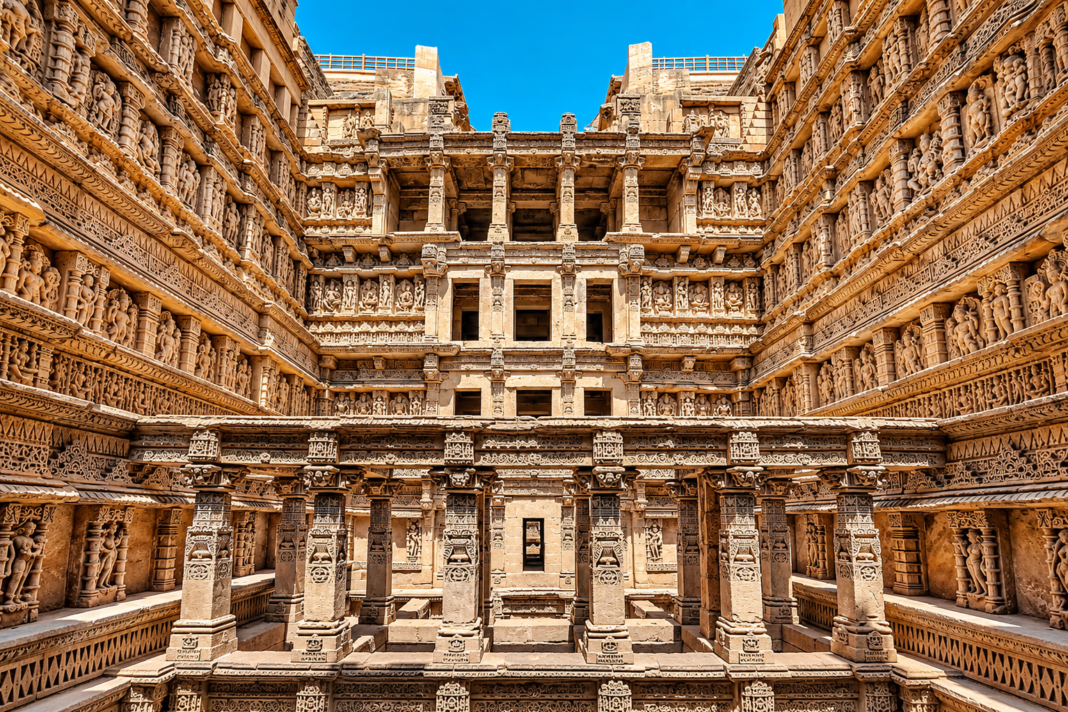
Quick answer: The Adalaj Stepwell (Adalaj ni Vav) is a five-storey carved stepwell in Adalaj village, about 18 km north of Ahmedabad. Queen Rudabai, widow of the Vaghela chief Rana Veer Singh, built it in 1498–99, during the reign of Sultan Mahmud Begada. It blends Hindu, Jain and Islamic design. Today, the Archaeological Survey of India (ASI) protects it. It’s open daily from about 6 AM to 6 PM, and tickets cost around ₹20–25 for Indians.
From the road, you’d never guess it’s there. You walk across a plain stone courtyard, and then the ground simply opens up. Steps lead down, floor after floor, past carved pillars, stone elephants and dancing figures. Meanwhile, the air gets cooler with every level. At the bottom, light falls through an eight-sided shaft onto still water.
That’s the Adalaj Stepwell. For more than 500 years, it has given water, shade and a place to meet. It’s also one of the most beautiful buildings in Gujarat, and one of the easiest to reach from Ahmedabad.
In this guide, you’ll learn the history and legend behind the Adalaj Stepwell. We also explain how its clever design works and what to look for in the carvings. Finally, you’ll get timings, tickets, directions and tips for your visit.
Adalaj Stepwell at a Glance
| Detail | Information |
|---|---|
| Local name | Adalaj ni Vav, also Rudabai Stepwell |
| Location | Adalaj village, Gandhinagar district, Gujarat |
| Distance | About 18 km from Ahmedabad; about 5 km from Gandhinagar |
| Built | 1498–99 CE |
| Built by | Queen Rudabai, widow of Rana Veer Singh of the Vaghela dynasty |
| Ruler at the time | Sultan Mahmud Begada of Gujarat |
| Depth | Five storeys |
| Style | Solanki (Maru-Gurjara) style with Islamic details |
| Material | Sandstone |
| Protected by | Archaeological Survey of India (ASI) |
| Timings | Open daily, about 6:00 AM to 6:00 PM |
| Entry fee | About ₹20–25 for Indians, ₹250–300 for foreign nationals |
| Time needed | 45 minutes to 1 hour |
What Is a Stepwell?
A stepwell is a well you can walk into. In Gujarati, it’s called a vav. In Hindi, people call it a baori or baoli.
A normal well is just a deep hole. To get water, you drop a bucket on a rope. A stepwell works differently. Long flights of steps lead down to the water, so people can reach it on foot, even when the water level drops.
Gujarat and Rajasthan get most of their rain in a few monsoon months. For the rest of the year, the land stays dry. So, people needed a way to reach groundwater far below the surface. Stepwells solved this problem. What’s more, they stayed cool in the summer heat, because most of the structure sits underground.
Over time, stepwells became more than water sources. They turned into places to rest, pray and meet. In particular, women gathered here every day to fetch water and share news. As a result, the richest patrons turned stepwells into works of art.
Gujarat has more than 120 stepwells. Among them, Adalaj is one of the most famous, along with Rani ki Vav in Patan.
History of the Adalaj Stepwell
Who Built the Adalaj Stepwell?
At the end of the 15th century, the Vaghela dynasty ruled a small area called Dandai Desh. Its chief, Rana Veer Singh, began building a stepwell at Adalaj to help his people through the dry months.
However, he never saw it finished. Sultan Mahmud Begada of Gujarat attacked his kingdom, and Rana Veer Singh died in battle. After that, his widow, Queen Rudabai, took up the project.
A Sanskrit inscription on a stone slab inside the well records the details. According to it, Queen Rudabai built the stepwell in Vikram Samvat 1555, which is 1499 CE. The inscription also gives the cost: about 5,00,111 tankas, the currency of the time. That was a huge sum, which shows how much the project mattered.
Why Does It Mix Hindu and Islamic Styles?
Work on the stepwell continued under Mahmud Begada. As a result, the building combines two traditions.
On one hand, the pillars, brackets and carvings follow the Solanki style of Gujarat, full of Hindu and Jain symbols. On the other hand, the floral patterns and some geometric details show Islamic design. Because of this mix, historians often call Adalaj a great example of Indo-Islamic architecture.
The Legend of Queen Rudabai
Local people tell a sad story about the stepwell. According to the legend, Mahmud Begada fell in love with the widowed queen after the battle. He asked her to marry him.
Rudabai agreed, but only on one condition. First, he had to finish the stepwell her husband had started. The Sultan agreed and completed the work.
When the well was ready, Rudabai walked around it in prayer. Then, instead of marrying the man who had killed her husband, she jumped into the well and gave up her life. For this reason, many people also call it the Rudabai Stepwell.
A second story adds to the drama. Near the well, you’ll see a few old graves. Local lore says they belong to the master masons. According to the tale, the Sultan had them killed, so they could never build anything as beautiful again. Historians have not proved either story. Still, both are part of the stepwell’s charm.
A Short Timeline
- Late 1400s: Rana Veer Singh of the Vaghela dynasty starts building the stepwell.
- Soon after: Mahmud Begada defeats him, and the work passes to the Sultan’s reign.
- 1499 CE (VS 1555): Queen Rudabai completes the well, as the Sanskrit inscription records.
- Centuries later: Villagers still use it for water, rest and festivals.
- Today: The ASI protects it, and visitors come from across the world.
Architecture of the Adalaj Stepwell
The Adalaj Stepwell is a clever piece of engineering as much as a work of art. Here’s how it’s built.
Five Storeys Deep
The stepwell runs along a north–south line. You enter at ground level and walk down through five storeys. At each level, you reach a wide landing with rows of carved pillars. Then, you continue down to the next level.
At the far end, the steps meet a deep circular well. Above it rises an eight-sided (octagonal) shaft that opens to the sky.
Three Entrances
Most stepwells have a single entrance. By contrast, Adalaj has three. Stairs come in from the south, east and west, and all three meet at the first large landing. This design let many people enter at once, which was useful on busy mornings.
Built Without Mortar-Heavy Arches
The builders used a trabeate system. In simple words, they placed flat stone beams across upright pillars, like a table on its legs. This method comes from Hindu temple building. It gives the stepwell its long, open halls of columns.
A Natural Air Cooler
The best part of the design is how cool it stays. Openings in the ceilings above the landings let in light and air. However, direct sunlight hardly ever reaches the steps. Gujarat Tourism notes that the sun touches them only briefly around noon.
As a result, the inside of the well stays about 5 to 6°C cooler than the ground above. In summer, when Ahmedabad crosses 40°C, you’ll feel the difference within a few steps. For travellers and villagers long ago, this made the stepwell a welcome resting place.
Rooms for Rest
At the corners of the landings, you’ll find small rooms with carved windows (jharokhas). Travellers, traders and pilgrims could rest here in the shade. In this way, the stepwell also worked like a roadside inn.
Carvings to Look For
Almost every surface at Adalaj is carved. So, slow down and look closely. Here are the details you shouldn’t miss.
- Elephants: Rows of tiny stone elephants line the walls. Look carefully, and you’ll see that no two are exactly alike.
- Ami Khumbor: This carving shows a sacred water pot. It stands for the water of life, which fits a stepwell perfectly.
- Kalpavriksha: The “wish-fulfilling tree” is carved from a single block of stone. It’s one of the most photographed panels in the well.
- Navagraha panel: A band of carvings shows the nine planets of Hindu astronomy. Villagers once prayed to them before starting important tasks.
- Daily life: Look for women churning buttermilk, dressing their hair and carrying pots. You’ll also see dancers and musicians.
- Flowers and patterns: Delicate floral designs and geometric shapes show the Islamic side of the building.
Tip: The light changes as you go down. Therefore, the carvings on the lower levels look best in the late morning, when soft light filters through the shaft.
Adalaj vs Rani ki Vav vs Dada Harir: How They Compare
Gujarat has three famous stepwells that many visitors compare. Here’s a quick look.
| Feature | Adalaj ni Vav | Rani ki Vav | Dada Harir ni Vav |
|---|---|---|---|
| Location | Adalaj, near Gandhinagar | Patan | Asarwa, Ahmedabad |
| Built | 1498–99 | 11th century | 1499–1500 |
| Built by | Queen Rudabai | Queen Udayamati | Bai Harir Sultani |
| Depth | Five storeys | Seven levels | Five storeys |
| Known for | Blend of styles, cool air | Hundreds of sculptures | Quiet, few visitors |
| Status | ASI protected | UNESCO World Heritage Site | Protected monument |
| From Ahmedabad | About 18 km | About 125 km | Within the city |
In short, Rani ki Vav is the grandest, and UNESCO listed it as a World Heritage Site in 2014. Adalaj, however, is the easiest to visit and the best preserved of the Ahmedabad-area wells. Meanwhile, Dada Harir ni Vav, built at almost the same time, is a quiet alternative inside the city.
Adalaj Stepwell Timings and Entry Fee
- Timings: Open every day, from about 6:00 AM to 6:00 PM
- Entry for Indians and SAARC/BIMSTEC visitors: About ₹20 online and ₹25 at the counter
- Entry for foreign nationals: About ₹250 online and ₹300 at the counter
- Children under 15: Free
- Photography: Allowed for personal use; drones are not allowed
The ASI sets these rates, and they can change. So, check the latest price on the official ASI e-ticket page for Rudabai Step Well. Booking online is usually cheaper, and you can pay by UPI at the gate as well.
How to Reach the Adalaj Stepwell
Adalaj sits just off the Sarkhej–Gandhinagar Highway, between Ahmedabad and Gandhinagar. Here are your options.
- By car or cab: From central Ahmedabad, the drive takes 30 to 45 minutes, depending on traffic. A one-way cab costs roughly ₹200–400. There’s free parking near the entrance.
- By auto-rickshaw: You can take an auto from north Ahmedabad areas like Chandkheda or Motera. Agree on the fare first, or ask for the meter.
- By bus: AMTS and GSRTC buses on the Ahmedabad–Gandhinagar route stop near Adalaj. From the stop, it’s a short walk.
- By train: Gandhinagar railway station is the nearest. Ahmedabad Junction (Kalupur) is about 20 km away.
- By air: Sardar Vallabhbhai Patel International Airport is about 15 km away, or roughly 30 minutes by road.
Best Time to Visit
Season: October to March is the best time. The weather is pleasant, and you can explore the grounds comfortably. From April to June, it gets very hot outside. Even so, the stepwell itself stays cool, so it makes a good summer escape if you go early. During the monsoon, from July to September, the water level often rises, and the stone can get slippery.
Time of day: Come early in the morning, soon after opening. You’ll beat both the heat and the crowds. Also, the soft morning light is great for photos. Weekends and public holidays get busy, especially in the afternoon.
Photography Tips for Adalaj
Adalaj is one of the most photographed places near Ahmedabad. These tips will help you get better pictures.
- Shoot from the top first. Stand at the entrance and look down the steps. This gives you the classic view of the pillared levels.
- Look up at the shaft. From the bottom, point your camera up at the octagonal opening. The layers of carved balconies make a striking frame.
- Use the pillars as frames. Line up rows of columns to create depth in your shots.
- Get close to the carvings. Photograph the elephants and the Kalpavriksha panel in detail.
- Skip the tripod. Tripods may not be allowed, so raise your phone’s ISO or use night mode instead.
- Be kind to others. The steps are narrow. So, don’t block the way for long while you shoot.
Places to Visit Near the Adalaj Stepwell
You can easily turn your visit into a half-day or full-day trip. Here are the best stops nearby.
- Trimandir, Adalaj: This white, non-sectarian temple stands just a few minutes away. It honours Simandhar Swami, Krishna and Shiva under one roof. Read more in our guide to the famous temples in Ahmedabad.
- Swaminarayan Akshardham: This famous pink sandstone temple is in Gandhinagar, about 20 minutes away. Note that it’s closed on Mondays.
- Koba Jain Tirth: This peaceful Jain temple and library sits on the road to Gandhinagar.
- Dandi Kutir: This museum in Gandhinagar tells the story of Mahatma Gandhi’s life.
- Dada Harir ni Vav: If you love stepwells, see this second one in Asarwa, Ahmedabad, on your way back.
- Sabarmati Ashram: Gandhi’s former home sits on the riverfront in Ahmedabad.
Suggested Half-Day Plan
| Time | Stop |
|---|---|
| 7:30 AM | Leave Ahmedabad |
| 8:15 AM | Adalaj Stepwell, before the crowds |
| 9:30 AM | Breakfast nearby |
| 10:15 AM | Trimandir, Adalaj |
| 11:15 AM | Akshardham, Gandhinagar (not on Mondays) |
| 1:30 PM | Lunch and head back |
Is the Adalaj Stepwell Good for Kids and Seniors?
Yes, for the most part. Children usually love it. After all, it feels like walking into a secret world under the ground. So, turn the visit into a game. For example, ask them to count the stone elephants or find the water pot carving.
For seniors, though, the steps need care. There are no lifts or ramps down to the lower levels. However, the top two levels are easy to reach, and the view from there is still lovely. So, older visitors can enjoy the well without going all the way down.
Wheelchair users can see the courtyard and look down from the top. Sadly, the lower levels are not accessible.
Tips for Your Visit
- Wear good shoes. The stone steps are old, uneven and sometimes slippery.
- Carry water. It’s cool inside, but the walk to the well can be hot.
- Take care with children. Barriers guard most edges. Still, keep kids close near the lower levels.
- Don’t feed the pigeons junk food. Many birds live in the well, and bad food harms them.
- Respect the monument. Don’t touch, scratch or lean on the carvings. Also, never throw coins or litter into the water.
- Hire a guide for the stories. Local guides often wait near the entrance. A good one will point out carvings you might miss.
- Check the weather. After heavy rain, parts of the well may close for safety.
Why the Adalaj Stepwell Still Matters
Today, Ahmedabad gets its water from pipes and the Narmada canal. So, why should a 500-year-old well matter?
First, it shows how people once lived with very little rain. They collected and saved every drop, long before anyone spoke of water conservation. Second, it proves that useful buildings can also be beautiful. Finally, it tells a story of a place where Hindu, Jain and Islamic traditions came together in stone.
In fact, with water shortages growing across India, some towns are now cleaning and restoring their old stepwells. In that sense, Adalaj isn’t just a relic. Instead, it’s a reminder of ideas we may need again.
Frequently Asked Questions
Who built the Adalaj Stepwell?
Queen Rudabai, the widow of Rana Veer Singh of the Vaghela dynasty, built the Adalaj Stepwell in 1498–99. Her husband started it, and the work continued under Sultan Mahmud Begada.
Why is it called Rudabai Stepwell?
People call it the Rudabai Stepwell after Queen Rudabai. A Sanskrit inscription inside the well names her as the builder. Also, local legend says she gave her life at the well after it was finished.
How deep is the Adalaj Stepwell?
The Adalaj Stepwell is five storeys deep. Steps lead down through pillared landings to a circular well under an octagonal shaft.
What are the Adalaj Stepwell timings?
The Adalaj Stepwell is open every day from about 6 AM to 6 PM. Early morning is the best time to visit, before the heat and the crowds.
What is the entry fee for the Adalaj Stepwell?
Entry costs about ₹20 online or ₹25 at the counter for Indian visitors. Foreign nationals pay about ₹250 online or ₹300 at the counter. Children under 15 enter free.
How far is the Adalaj Stepwell from Ahmedabad?
The Adalaj Stepwell is about 18 km north of Ahmedabad and about 5 km from Gandhinagar. By car, it takes 30 to 45 minutes from central Ahmedabad.
Why is it cooler inside the Adalaj Stepwell?
Most of the stepwell sits underground, and direct sunlight rarely reaches the steps. As a result, the inside stays about 5 to 6°C cooler than the ground above.
Is the Adalaj Stepwell a UNESCO World Heritage Site?
No. The Adalaj Stepwell is protected by the Archaeological Survey of India, but it is not a UNESCO site. In Gujarat, Rani ki Vav in Patan is the stepwell on the UNESCO list.
How much time do I need at the Adalaj Stepwell?
Most visitors spend 45 minutes to an hour. If you love photography or history, plan for about an hour and a half.
What is near the Adalaj Stepwell?
Trimandir is just a few minutes away. Akshardham, Koba Jain Tirth and Dandi Kutir in Gandhinagar are all within a 20-minute drive.
The Bottom Line
The Adalaj Stepwell is one of the easiest and most rewarding day trips from Ahmedabad. In under an hour, you’ll walk down five storeys of carved stone and feel the air turn cool. Along the way, you’ll hear the story of a queen who finished her husband’s dream.
So, go early, take your time and look closely at the walls. Then, pair it with Trimandir and Akshardham for a perfect half day. Above all, remember that you’re standing in a building that kept people alive for centuries. That’s worth a quiet moment at the bottom of the steps.
References
- Incredible India (Ministry of Tourism) – Adalaj Stepwell
- Gujarat Tourism – Adalaj ni Vav
- Archaeological Survey of India – e-ticket for Rudabai Step Well, Adalaj
- Archaeological Survey of India – Official website
- UNESCO World Heritage Centre – Rani-ki-Vav, Patan
- Wikipedia – Adalaj Stepwell
Information is accurate as of September 2026. Timings and ticket prices can change, so check the ASI e-ticket page before you visit. Spotted an update? Write to us at amdavadgully@gmail.com.