The Gujarat government has announced an additional subsidy on rooftop solar systems, on top of the Centre’s PM Surya Ghar: Muft Bijli Yojana. Under the new Gujarat rooftop solar subsidy, general-category households will pay just 10% of the cost of a system up to 2 kW. SC and ST households will pay only 5%. The state will cover the rest after central assistance.
The state expects more than 3 lakh families to benefit. It has set aside around ₹1,000 crore for the scheme. In practice, a family can now put a 1 kW solar system on its roof for about ₹5,400, or even ₹2,700 for SC/ST households.
The decision was taken at a Cabinet meeting chaired by Chief Minister Bhupendra Patel in Gandhinagar. State government spokesperson and minister Jitu Vaghani announced it on Wednesday, 21 October 2026. So, how much will you actually pay? Who is eligible? And how do you apply? This complete guide explains everything.
Quick answer: Gujarat’s additional rooftop solar subsidy
- What: Extra state subsidy on top of the central PM Surya Ghar subsidy
- System size: Residential rooftop solar systems up to 2 kW
- General households pay: 10% of the benchmark cost
- SC/ST households pay: 5% of the benchmark cost
- 1 kW system: ₹5,400 (General) or ₹2,700 (SC/ST)
- 2 kW system: ₹10,720 (General) or ₹5,360 (SC/ST)
- Beneficiaries: 3 lakh+ families
- State budget: About ₹1,000 crore
- Announced: 21 October 2026, Gandhinagar
Gujarat Rooftop Solar Subsidy: What Has Been Announced
First, the core decision. Gujarat will now give its own subsidy to households installing rooftop solar under PM Surya Ghar. This state money comes on top of the existing central subsidy.
The formula is simple. The state starts with a benchmark cost for each system. Then it subtracts the central subsidy and the household’s fixed share. Whatever remains, the state pays.
The household’s share is fixed by category:
- General category: 10% of the benchmark cost
- SC/ST category: 5% of the benchmark cost
As a result, the bulk of the cost is now shared by the Centre and the state. Families pay only a small slice.
The support applies to residential systems of up to 2 kW. That covers the 1 kW and 2 kW systems most smaller homes would choose.
According to the state government, more than 3 lakh families are expected to benefit. The state expects to spend around ₹1,000 crore on the additional subsidy.
The government said the aim is to make rooftop solar more affordable. It also wants families to cut their power bills and, where possible, earn from surplus electricity.
How Much Will You Pay? The Complete Cost Breakdown
This is the question most readers will have. Here are the official worked examples shared by the state government.
1 kW rooftop solar system
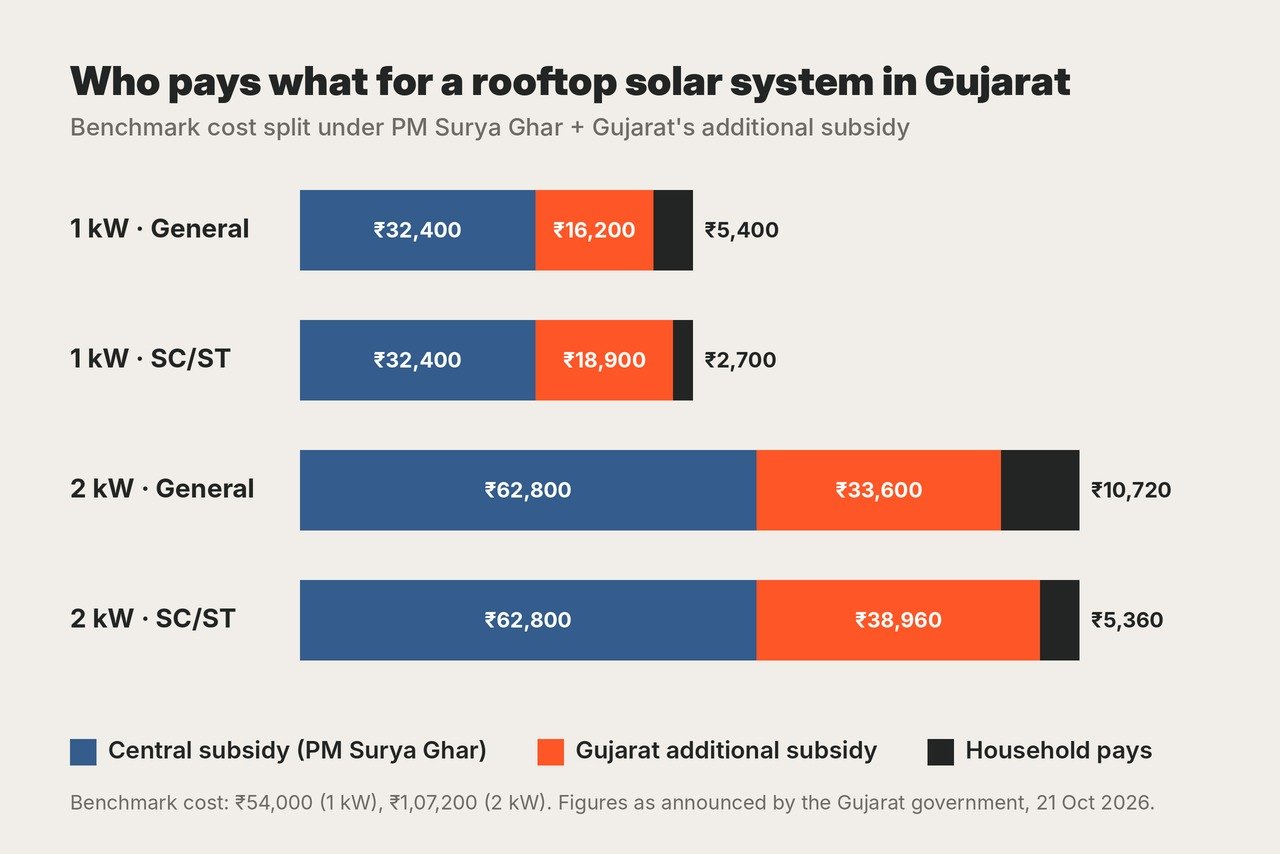
The benchmark cost for a 1 kW system is ₹54,000.
| Component | General | SC/ST |
|---|---|---|
| Benchmark cost | ₹54,000 | ₹54,000 |
| Central subsidy | ₹32,400 | ₹32,400 |
| Gujarat additional subsidy | ₹16,200 | ₹18,900 |
| Household pays | ₹5,400 | ₹2,700 |
2 kW rooftop solar system
The benchmark cost for a 2 kW system is ₹1,07,200.
| Component | General | SC/ST |
|---|---|---|
| Benchmark cost | ₹1,07,200 | ₹1,07,200 |
| Central subsidy | ₹62,800 | ₹62,800 |
| Gujarat additional subsidy | ₹33,600 | ₹38,960 |
| Household pays | ₹10,720 | ₹5,360 |
Figures as announced by the Gujarat government on 21 October 2026. For the 2 kW system, the announced parts add up to about ₹80 less than the benchmark cost. The final official notification should confirm exact amounts.
How much are you saving compared with before?
Before this decision, a household paid the full cost minus the central subsidy. That meant about ₹21,600 for a 1 kW system and ₹44,400 for a 2 kW system.
Now, compare that with the new amounts:
- 1 kW, General: from ₹21,600 down to ₹5,400 — a saving of ₹16,200
- 1 kW, SC/ST: from ₹21,600 down to ₹2,700 — a saving of ₹18,900
- 2 kW, General: from ₹44,400 down to ₹10,720 — a saving of about ₹33,680
- 2 kW, SC/ST: from ₹44,400 down to ₹5,360 — a saving of about ₹39,040
In other words, the upfront cost has fallen by roughly three-quarters or more. For many families, that changes rooftop solar from a “someday” plan into an affordable one.
A note on the central subsidy figures
Readers may have seen central subsidy figures of ₹30,000 for 1 kW and ₹60,000 for 2 kW. Those are the widely cited national amounts under PM Surya Ghar. The state’s worked examples use ₹32,400 and ₹62,800 instead.
The difference likely comes from how the benchmark cost and central share were calculated for Gujarat. Either way, the household’s share stays fixed at 10% or 5%. The state subsidy fills the gap. Final figures will be set out in the official government resolution (GR).
What Is PM Surya Ghar: Muft Bijli Yojana?
To understand Gujarat’s move, it helps to know the central scheme it builds on.
PM Surya Ghar: Muft Bijli Yojana is the Centre’s flagship rooftop solar scheme. It was launched in February 2024. Its goal is to put rooftop solar on one crore homes across India.
Here are its key features:
- Central subsidy: Support for residential rooftop solar, capped at ₹78,000 for systems of 3 kW and above
- Free power: Families can get up to 300 units of free electricity a month, depending on system size and use
- Easy loans: Low-interest, collateral-free loans for households that need help with their share
- Online process: Applications through the national portal at pmsuryaghar.gov.in
- Direct transfer: The subsidy is paid straight into the household’s bank account
The scheme is run by the Ministry of New and Renewable Energy (MNRE). Electricity distribution companies, or DISCOMs, handle the local process in each state.
Importantly, the central subsidy alone still left families with a sizeable bill. For lower-income households, ₹20,000 to ₹45,000 upfront was often too much. That is exactly the gap Gujarat’s additional subsidy is designed to close.
Who Is Eligible for the Additional Subsidy?
The state has shared the headline terms. The detailed rules will come in the official GR. Here is what we know so far.
What has been confirmed
- Residential households: The subsidy is for homes installing rooftop solar under PM Surya Ghar.
- System size up to 2 kW: The additional state support covers systems of up to 2 kW.
- Two categories: General-category households pay 10%. SC and ST households pay 5%.
General PM Surya Ghar requirements
Since the state subsidy runs through PM Surya Ghar, the central scheme’s basic rules apply too. Typically, these include:
- The applicant should be an Indian citizen.
- The household should own a house with a roof suitable for solar panels.
- The household should have a valid electricity connection in its name.
- The household should not have already taken another subsidy for rooftop solar.
What is still unclear
Several details have not yet been announced. These include:
- The exact date from which the additional subsidy applies
- Whether families who installed solar recently can claim it
- Whether there is any income or electricity-use limit
- What documents will prove SC/ST status for the lower share
- Whether any state support applies to systems larger than 2 kW
Therefore, if you are planning to install soon, it may be worth checking with your DISCOM first. Wait for the GR if your situation depends on any of the points above.
1 kW or 2 kW: Which System Is Right for Your Home?
Choosing the right size matters. A system that is too small will not cover your bill. On the other hand, one that is too large may not fit your roof or budget.
How much power does a rooftop system make?
As a rough guide, a 1 kW rooftop system in a sunny state like Gujarat can generate about 4 units of electricity a day. That is around 120 units a month on average. A 2 kW system can produce roughly double, or about 240 units a month.
Actual output will vary. It depends on roof direction, shading, dust, season and panel quality. Monsoon months usually produce less. Summer months usually produce more.
A simple way to decide
| Your average monthly use | Suggested system |
|---|---|
| Up to about 120–150 units | 1 kW |
| About 150–250 units | 2 kW |
| More than 250–300 units | 3 kW or more (central subsidy only, for now) |
Indicative guide only. Check your actual bills and ask your vendor for a site survey.
To find your average use, look at your last 12 electricity bills. Add up the units and divide by 12. This smooths out summer and winter swings.
How much roof space do you need?
A 1 kW system usually needs around 80 to 100 square feet of shadow-free roof space. A 2 kW system needs roughly double that. Flat concrete roofs, common in Gujarat, are generally well suited.
Before you apply, check for shade from water tanks, nearby buildings and trees. Even partial shade can cut output noticeably.
How Much Could You Save on Electricity Bills?
The real value of rooftop solar lies in long-term savings. Here is a simple illustration.
Let us assume a household pays about ₹5 per unit on average. This is only an example. Actual tariffs in Gujarat vary by DISCOM, slab and fixed charges.
| Detail | 1 kW system | 2 kW system |
|---|---|---|
| Approx. monthly generation | 120 units | 240 units |
| Approx. monthly saving (at ₹5/unit) | ₹600 | ₹1,200 |
| Approx. yearly saving | ₹7,200 | ₹14,400 |
| General household pays | ₹5,400 | ₹10,720 |
| Rough payback | Under 1 year | Under 1 year |
Illustrative Amdavad Gully estimate based on assumed generation and tariff. Your savings may be higher or lower.
Even with cautious assumptions, the payback looks short. Before the state subsidy, the same 2 kW system would have taken around three years to pay back on these numbers. Now, it could be under one year.
After that, the savings continue. Good-quality solar panels typically come with performance warranties of around 25 years. As a result, a family could save on bills for decades after a small upfront payment.
What about “free electricity”?
The central scheme is called “Muft Bijli”, or free electricity. However, how much free power you get depends on your system size and your usage.
If your system produces as much as you use, your bill may drop to only fixed charges. If you use more than you generate, you will still pay for the extra units. In short, a 1 kW or 2 kW system will not always make your bill zero. But it can cut it sharply.
Gujarat Rooftop Solar Subsidy in Practice: Three Example Households
Numbers are easier to grasp with real-life situations. The three households below are illustrative examples, not real families. They show how the Gujarat rooftop solar subsidy could work for different homes.
Example 1: A small family in a tenement
A family of four lives in a single-storey tenement on the edge of a city. They run fans, lights, a fridge and a TV. Their average use is about 110 units a month.
- Best fit: A 1 kW system
- Category: General
- Upfront cost: About ₹5,400
- Likely effect: Most of their monthly use could be covered by solar on sunny days
For this family, the upfront payment is roughly what they might spend on electricity over several months. After that, most of their bill could shrink to fixed charges.
Example 2: An SC/ST household in a village
A farming family in a village owns a pucca house with a flat roof. They use about 100 to 120 units a month.
- Best fit: A 1 kW system
- Category: SC/ST
- Upfront cost: About ₹2,700
- Likely effect: A large cut in monthly bills for a very small one-time payment
Here, the state’s higher support makes a clear difference. A household that could never have paid ₹21,600 can now install solar for less than ₹3,000.
Example 3: A middle-income family in a row house
A family in a row house uses an air conditioner in summer. Their use averages about 230 units a month, with higher bills from April to June.
- Best fit: A 2 kW system
- Category: General
- Upfront cost: About ₹10,720
- Likely effect: Solar could cover a large share of their use, especially in sunny months
For this family, a 3 kW system might cover even more. However, the additional state subsidy applies only up to 2 kW. They would need to weigh the extra cost of going bigger against the extra savings.
All three are hypothetical examples for illustration. Actual costs and savings depend on the final GR, your vendor and your usage.
Need Help Paying Your Share? Solar Loans
With the new subsidy, most families will pay only a few thousand rupees. Still, even that can be a stretch for some homes.
The central PM Surya Ghar scheme offers low-interest, collateral-free loans for rooftop solar. Several public sector banks take part. Households can apply for a loan through the national portal while filing their solar application.
Before taking a loan, consider these points:
- Check the interest rate and repayment period clearly.
- Compare your monthly loan payment with your expected bill savings.
- Avoid informal lenders or vendor-arranged loans with unclear terms.
- Remember that the subsidy goes to your bank account, so plan how it will be used.
For many families, the monthly savings on electricity could be larger than a small loan instalment. In that case, the system effectively pays for itself from day one.
Net Metering: Earn From Surplus Solar Power
Rooftop solar systems under PM Surya Ghar are connected to the grid through a net meter. This is what lets families benefit from surplus power.
Here is how it works, in simple terms:
- During the day, your panels produce electricity.
- Your home uses what it needs first.
- Any extra electricity flows back into the grid.
- The net meter records both what you take from the grid and what you send to it.
- At billing time, you pay only for the net units you consumed.
If you send more power than you use over a billing period, the surplus is credited or paid under the rules in force. The state government has highlighted that families can earn from surplus electricity, subject to applicable arrangements. Your DISCOM can explain the current terms.
How to Apply for the Gujarat Rooftop Solar Subsidy
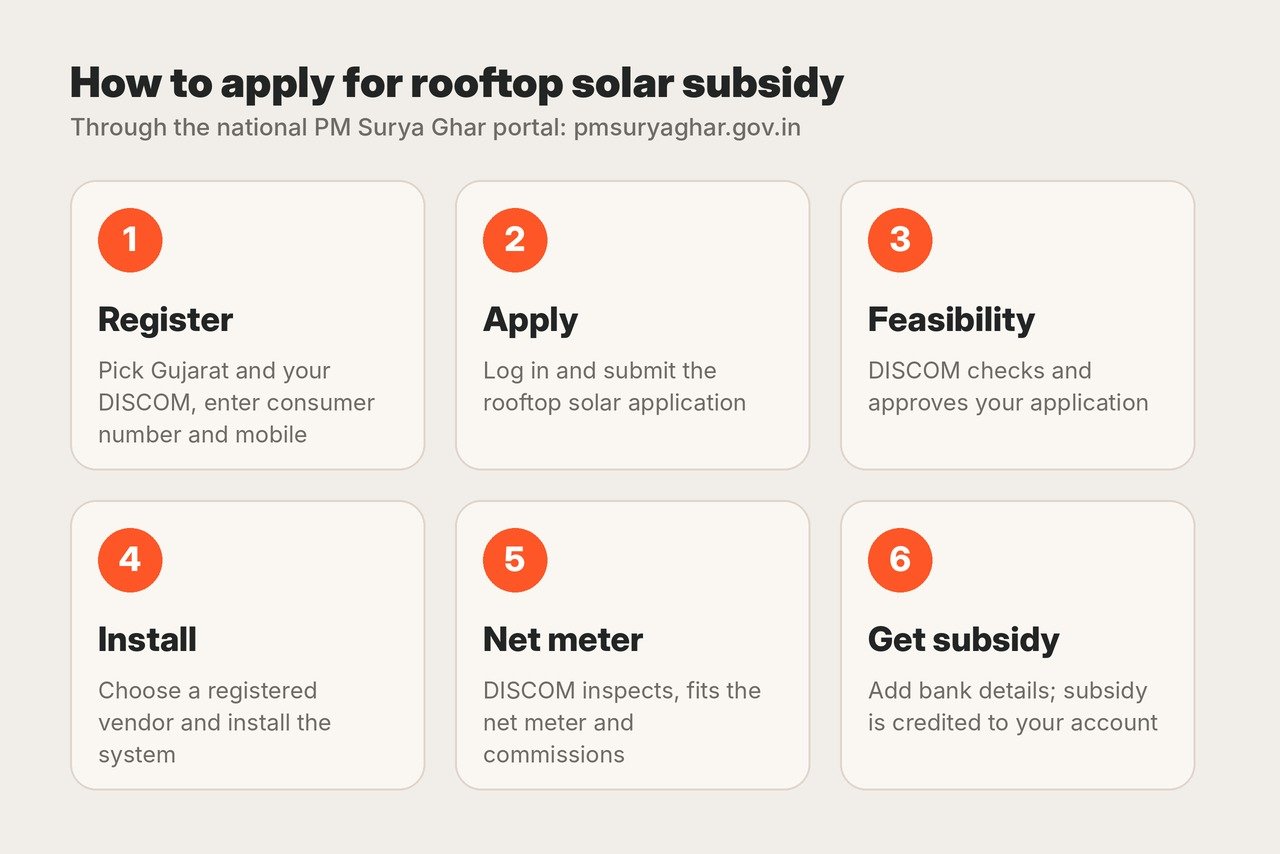
The application runs through the national PM Surya Ghar portal. The state subsidy is expected to be linked to this same process. Here are the steps.
Step 1: Register on the portal
Visit pmsuryaghar.gov.in. Select Gujarat as your state and choose your DISCOM. Then enter your electricity consumer number, mobile number and email address.
Step 2: Submit your application
Log in with your consumer number and mobile number. Then fill in and submit the rooftop solar application form.
Step 3: Wait for feasibility approval
Your DISCOM will review the application. It will check whether your connection and location are suitable. Once approved, you can move ahead.
Step 4: Choose a registered vendor and install
Pick a vendor registered with your DISCOM. The vendor will survey your roof and install the system. Make sure the panels and inverter meet the scheme’s requirements.
Step 5: Apply for the net meter
After installation, upload the plant details on the portal and apply for a net meter. The DISCOM will inspect the system and fit the net meter. After a successful inspection, the portal generates a commissioning certificate.
Step 6: Receive your subsidy
Submit your bank account details and a cancelled cheque on the portal. The subsidy is then credited directly to your account. The central scheme aims to release it within about 30 days of commissioning.
Tip: Keep copies of every document, invoice and certificate. They will help if there is any delay or query.
Documents You Will Typically Need
Exact requirements may vary. However, keep these ready before you start:
- A recent electricity bill showing your consumer number
- Aadhaar card or another valid photo ID
- Proof of ownership of the house, if asked
- Bank account details and a cancelled cheque
- A mobile number and email address for updates
- A photo of the roof, if requested
- Caste certificate, for SC/ST households claiming the lower 5% share (details awaited in the GR)
Having these ready can save time. It also reduces the chance of your application getting stuck.
How to Choose the Right Solar Vendor
Your vendor choice affects how well your system performs for the next 25 years. So, take time over it.
1. Use only registered vendors
Choose a vendor registered with your DISCOM under PM Surya Ghar. Unregistered installers may leave you unable to claim the subsidy.
2. Check the equipment
Under PM Surya Ghar, systems generally need to use made-in-India solar panels that meet the scheme’s standards. Ask your vendor to confirm this in writing.
3. Ask about warranties
Solar panels typically carry long performance warranties. Inverters usually have shorter warranties. Ask clearly what is covered, for how long, and who handles repairs.
4. Get a written quote
Ask for a clear, itemised quote. It should list the panel brand, inverter brand, mounting structure, wiring and any extra charges.
5. Ask about maintenance
Find out whether the vendor offers free maintenance for the first few years. Also ask how quickly they respond to complaints.
6. Compare at least two or three vendors
Prices and service can differ. Comparing a few options helps you spot unusually high charges or vague promises.
Looking After Your Rooftop Solar System
A rooftop solar system has no moving parts. Even so, a little care keeps it producing well for years.
Clean the panels regularly
Gujarat’s dry months bring a lot of dust. Dust on panels blocks sunlight and lowers output. Rinse the panels gently with plain water every two to four weeks. Clean them early in the morning or in the evening, when the panels are cool.
Do not use harsh tools
Avoid detergents, wire brushes or high-pressure jets. They can scratch the glass or damage the coating. A soft cloth or sponge with water is enough.
Watch your generation
Most inverters show daily generation. Many also connect to a mobile app. Check it once a week. A sudden drop may point to dirt, shade or a fault.
Keep the area around panels clear
Do not dry clothes or store items on the panels. Trim any tree branches that start to cast shade. Also make sure new water tanks or structures do not block sunlight.
Get annual check-ups
Ask your vendor for a yearly inspection of wiring, earthing and mounting. Before the monsoon, check that the structure is firm and that water drains properly from the roof.
Myths vs Facts About Rooftop Solar
Misconceptions often stop families from going solar. Here are a few common ones.
Myth: Solar does not work on cloudy days.
Fact: Panels still produce power on cloudy days, just less. Over a full year, Gujarat’s sunshine makes rooftop solar highly productive.
Myth: Solar panels need constant repairs.
Fact: Panels need little maintenance beyond cleaning. Inverters may need service over time, which is why warranties matter.
Myth: Rooftop solar means no electricity at night.
Fact: Grid-connected systems stay linked to the grid. At night, your home simply draws power from the grid as usual.
Myth: Only rich families can afford solar.
Fact: With the new Gujarat subsidy, a 1 kW system can cost about ₹5,400, or ₹2,700 for SC/ST households.
Myth: The subsidy process needs an agent.
Fact: The process is online and direct. Your subsidy is credited straight to your bank account.
Common Mistakes to Avoid
A little care can prevent costly problems later. Watch out for these common mistakes.
- Paying before registering: Register on the portal first. Do not pay a vendor before your application is approved.
- Ignoring shade: Panels in partial shade can lose a lot of output.
- Choosing the wrong size: Size your system to your actual use, not a guess.
- Trusting middlemen: Be wary of anyone promising faster subsidy for a fee. The process is online and direct.
- Skipping cleaning: Dust is common in Gujarat. Dirty panels produce less power. A simple water rinse every few weeks helps.
- Losing paperwork: Keep all documents safe until your subsidy arrives.
- Believing forwarded messages: Rely only on official government sources for subsidy amounts and dates.
Your Quick Checklist Before Installing
Before you go ahead, run through this simple checklist. It brings together the key points from this guide.
- Check your use: Add up the units on your last 12 bills and work out your monthly average.
- Pick the size: Choose 1 kW or 2 kW based on that average and your roof space.
- Inspect your roof: Make sure it is strong, mostly flat and free of shade for most of the day.
- Confirm ownership: Ensure the house and the electricity connection are in your name.
- Know your category: If you are claiming the SC/ST share, keep a valid caste certificate ready.
- Wait for the GR if unsure: If your eligibility depends on the start date or other rules, wait for the official notification.
- Register first: Apply on the portal before you pay any vendor.
- Compare vendors: Get written quotes from at least two or three registered vendors.
- Read the warranty: Know what is covered for panels and the inverter, and for how long.
- Plan upkeep: Decide who will clean the panels and how often.
Ticking off these points can make the process smoother. It also helps you get the most out of your system from the start.
Gujarat’s Rooftop Solar Record
Gujarat is not starting from scratch. In fact, it is already India’s leading state for rooftop solar.
According to the state government, more than 14 lakh households in Gujarat have installed rooftop solar so far. Of these, over 8.5 lakh installations are under PM Surya Ghar. The government says this puts Gujarat first in the country under the scheme.
Gujarat has also been recognised nationally. In June 2026, the state won five national awards for its performance under PM Surya Ghar. These covered applications, installations, DISCOM inspections and vendor registrations.
Moreover, the state’s solar push goes beyond rooftops. Gujarat has large solar parks, strong sunshine for much of the year and an active renewable energy policy. The rooftop scheme is one part of that wider plan.
The new subsidy aims to take this further. Until now, rooftop solar was easier for middle- and upper-income families. The additional subsidy is designed to bring lower-income households into the fold.
Why This Decision Matters Now
The timing of the announcement is significant. Several factors make it important.
1. Record electricity demand
Gujarat’s electricity demand has been rising fast. Reports show the state’s peak demand hit a record of about 29,822 MW on 16 October 2026. Rooftop solar helps by producing power right where it is used, during the day.
2. Relief for household budgets
Electricity bills are a steady monthly expense for every family. For lower-income households, even a few hundred rupees saved each month makes a real difference. The new subsidy makes that saving available for a very small upfront cost.
3. Reaching families who were left out
Despite Gujarat’s lead, many families could not afford their share under the central scheme. By capping the household share at 10% or 5%, the state is targeting exactly these homes. The lower 5% share for SC/ST households reflects that focus on inclusion.
4. Clean energy goals
India has set ambitious renewable energy targets. Every rooftop system adds clean power to the grid. Spread across 3 lakh homes, the impact adds up.
5. Strong value for public money
The state’s ₹1,000 crore budget for about 3 lakh families works out to roughly ₹33,000 per household on average. In return, each family could save on power bills for many years. That makes it a long-lasting form of support.
The Limits of Rooftop Solar
Rooftop solar is a powerful tool. Still, it is not a complete answer on its own. It is worth being clear about its limits.
- Evening demand: Solar panels produce power during the day. Evening peaks still need power from the grid. Without batteries, rooftop solar does not solve evening supply.
- Roof access: Families in rented homes or without roof rights may not be able to benefit directly.
- Apartments: Flat owners in multi-storey buildings often lack individual roof space. Shared or society-level systems may be needed.
- Seasonal output: Generation falls during the monsoon and on cloudy days.
- Maintenance: Panels need cleaning and occasional servicing to perform well.
Experts note that Gujarat still relies on conventional power for much of its base load. Rooftop solar complements that supply. It does not fully replace it.
What It Means for Ahmedabad
For Amdavadis, the new subsidy is both an opportunity and a practical puzzle.
Independent houses and bungalows: Families in independent homes, tenements and row houses can benefit most directly. Many such homes in areas across the city have flat roofs that suit solar panels.
Old city pols: Homes in the walled city often have small or shared rooftops. Shade from neighbouring buildings can also be a challenge. A careful site survey is essential here.
Apartments and societies: Most flats in Ahmedabad’s newer high-rises do not have individual roof space. For these residents, society-level solar for common areas, such as lifts, pumps and corridor lights, may be the more practical route. The central scheme has separate support for housing societies. Residents’ associations can explore this option.
Your DISCOM: Much of Ahmedabad city is served by a private distribution company, while other areas fall under state-owned DISCOMs. When you register on the portal, make sure you select the DISCOM named on your electricity bill.
Summer savings: Ahmedabad’s long, hot summers bring high air-conditioner use. They also bring strong sunshine. That makes rooftop solar especially useful in the months when bills are highest.
What Happens Next
The Cabinet decision is the first step. A few more steps will follow before families can claim the additional subsidy.
- Government resolution: The Energy and Petrochemicals Department is expected to issue a formal GR. It should confirm the start date, eligibility and process.
- Portal updates: The application process may be updated to capture the state subsidy and category details.
- DISCOM guidance: Gujarat’s DISCOMs are likely to issue instructions for applicants and vendors.
- Vendor readiness: Registered vendors will need to prepare for higher demand from smaller systems.
For official updates, keep an eye on the PM Surya Ghar portal, Gujarat Urja Vikas Nigam Limited (GUVNL), Gujarat Energy Development Agency (GEDA) and the Government of Gujarat portal.
Frequently Asked Questions
What is Gujarat’s additional subsidy on rooftop solar?
It is extra financial support from the Gujarat government for households installing rooftop solar under PM Surya Ghar. It comes on top of the central subsidy. General households pay 10% of the benchmark cost, and SC/ST households pay 5%.
How much will a 1 kW rooftop solar system cost in Gujarat now?
A 1 kW system will cost a general-category household about ₹5,400. SC/ST households will pay about ₹2,700. The benchmark cost is ₹54,000.
How much will a 2 kW rooftop solar system cost in Gujarat now?
A 2 kW system will cost a general-category household about ₹10,720. SC/ST households will pay about ₹5,360. The benchmark cost is ₹1,07,200.
Who announced the additional rooftop solar subsidy?
The decision was taken at a Cabinet meeting chaired by CM Bhupendra Patel. State spokesperson minister Jitu Vaghani announced it in Gandhinagar on 21 October 2026.
How many families will benefit from the scheme?
More than 3 lakh families are expected to benefit. The state plans to spend around ₹1,000 crore on the additional subsidy.
Is the additional subsidy available for 3 kW systems?
The announced additional support covers systems of up to 2 kW. Larger systems can still get the central PM Surya Ghar subsidy, which is capped at ₹78,000. Any state support beyond 2 kW would need to be confirmed in the official GR.
How do I apply for the rooftop solar subsidy in Gujarat?
Apply through the national portal at pmsuryaghar.gov.in. Register with your DISCOM and consumer number, submit the application, install through a registered vendor, get a net meter and then submit your bank details for the subsidy.
When will the additional subsidy start?
The start date has not been announced yet. It is expected in the formal government resolution. Check with your DISCOM or the official portals before installing.
Can I earn money from my rooftop solar system?
Yes, potentially. Surplus electricity can flow back to the grid through a net meter. You may receive credit or payment for surplus units under the applicable rules.
Can apartment residents get rooftop solar subsidy?
Individual flat owners usually lack separate roof space. However, housing societies can explore solar for common areas. The central scheme provides separate support for housing societies and residents’ associations.
Can I get a loan for my share of the cost?
Yes. PM Surya Ghar offers low-interest, collateral-free loans through participating banks. You can apply through the national portal along with your solar application.
Do I still need to pay my electricity bill after installing solar?
Usually, yes, but it may be much smaller. You will still pay fixed charges and for any units you use beyond what your panels produce.
How long do rooftop solar panels last?
Good-quality panels typically last 25 years or more. Most carry long performance warranties. Inverters may need replacing or servicing sooner.
How many units does a 1 kW solar system produce in Gujarat?
As a rough guide, a 1 kW system in Gujarat produces about 4 units a day, or around 120 units a month. Output varies with season, shading and maintenance.
The Bottom Line
Gujarat’s additional rooftop solar subsidy is one of the most generous solar support moves in the country. A 1 kW system for ₹5,400, or ₹2,700 for SC/ST families, puts clean power within reach of many more homes. With 3 lakh families in its sights, the scheme could reshape who benefits from the state’s solar boom.
For now, the key detail to watch is the official GR. Once it arrives, families will know the exact start date and rules. Until then, it is a good time to check your bills, inspect your roof and talk to registered vendors.
Amdavad Gully will update this guide as soon as the official notification is out.
Sources: Government of Gujarat Cabinet briefing, Gandhinagar, 21 October 2026. Useful links: PM Surya Ghar portal; Ministry of New and Renewable Energy; GUVNL; GEDA; Government of Gujarat. Images: Amdavad Gully original graphics.