The history of Gujarat stretches back more than 5,000 years. It begins with the planned Harappan cities of Lothal and Dholavira. It then moves through the golden age of the Solankis, the founding of Ahmedabad in 1411 and Gandhi’s march to Dandi. Finally, it reaches the birth of the modern state on 1 May 1960.
This guide covers every major chapter of Gujarat’s history in one place. You will find dates, dynasties, key people and the monuments they left behind. We have also added infographics, a quick timeline and answers to the most common questions. So whether you are a student, a GPSC aspirant or a curious Amdavadi, bookmark this page.
History of Gujarat: quick answers
- Oldest civilisation: Harappan (Indus Valley), c. 3500–1300 BCE, at sites such as Lothal and Dholavira.
- Origin of the name: From “Gurjaratra”, the land protected or ruled by the Gurjaras.
- Golden age: The Solanki (Chaulukya) dynasty, 942–1244 CE, ruling from Anhilwad Patan.
- Ahmedabad founded: 1411, by Sultan Ahmed Shah I of the Gujarat Sultanate.
- Freedom struggle: Kheda (1918), Bardoli (1928) and the Dandi March (1930).
- State formed: 1 May 1960, after the Mahagujarat Andolan split Bombay State.
- Capital: Ahmedabad (1960–1970), then Gandhinagar.
- UNESCO World Heritage Sites: Four, namely Champaner-Pavagadh, Rani ki Vav, Historic City of Ahmedabad and Dholavira.
In this guide:
- The name and geography of Gujarat
- Prehistoric Gujarat
- The Harappan civilisation in Gujarat
- Ancient Gujarat: Dwarka to the Guptas
- The Maitrakas of Valabhi
- The Solanki golden age
- The Gujarat Sultanate
- Mughal Gujarat
- Maratha rule and the Gaekwads
- Kutch and Saurashtra
- British rule and the princely states
- Gujarat in the freedom struggle
- The road to statehood
- Modern Gujarat since 1960
- Gujarat’s maritime history
- Culture, language and heritage
- Women who shaped Gujarat
- Ahmedabad’s place in Gujarat’s history
- Where to see Gujarat’s history today
- Key dates at a glance
- Frequently asked questions
How Did Gujarat Get Its Name?
The name Gujarat comes from the Gurjaras, a people who rose to power in western India from around the 6th century CE. Over time, the region became known as “Gurjaratra” or “Gurjara-desha”. These words roughly mean the land protected by, or belonging to, the Gurjaras.
However, the name took centuries to settle. In early texts, different parts of the region had separate names. For example, the north was called Anarta, the peninsula was Surashtra (later Saurashtra), and the south was known as Lata. Only by the time of the Solankis did “Gujarat” begin to describe the whole area. Later, the Sultanate and Mughal rulers used it for their province, and the name stuck.
So the word itself carries a piece of the history of Gujarat. It reminds us that the state grew from many smaller regions with their own stories.
How Geography Shaped Gujarat’s History
Few places in India show the link between land and history as clearly as Gujarat. Three features stand out.
The Longest Coastline in India
Gujarat has roughly 1,600 km of coastline, the longest of any Indian state. As a result, the sea has always been its highway. Lothal traded with Mesopotamia over 4,000 years ago. Later, Bharuch, Khambhat and Surat linked India to Arabia, Africa and Southeast Asia. In short, trade made Gujarat rich, and wealth attracted rulers from every direction.
Three Distinct Regions
The state has three natural regions. First, mainland Gujarat holds the fertile plains of the Sabarmati, Mahi, Narmada and Tapi rivers. Second, the Saurashtra peninsula, also called Kathiawar, has hills such as Girnar and a long, rocky coast. Third, Kutch is a land of salt marsh and desert, almost an island during the monsoon. Each region often had its own rulers, and this explains why the area was divided for so long.
A Natural Crossroads
Gujarat sits between the Indus valley, the Rajasthan desert and the Deccan plateau. Consequently, it became a meeting point for armies, merchants, saints and refugees. Parsis from Persia, Siddis from Africa, Arab traders and Jain monks all found a home here. This mix gives the history of Gujarat its unusual depth.
Prehistoric Gujarat: The Stone Age
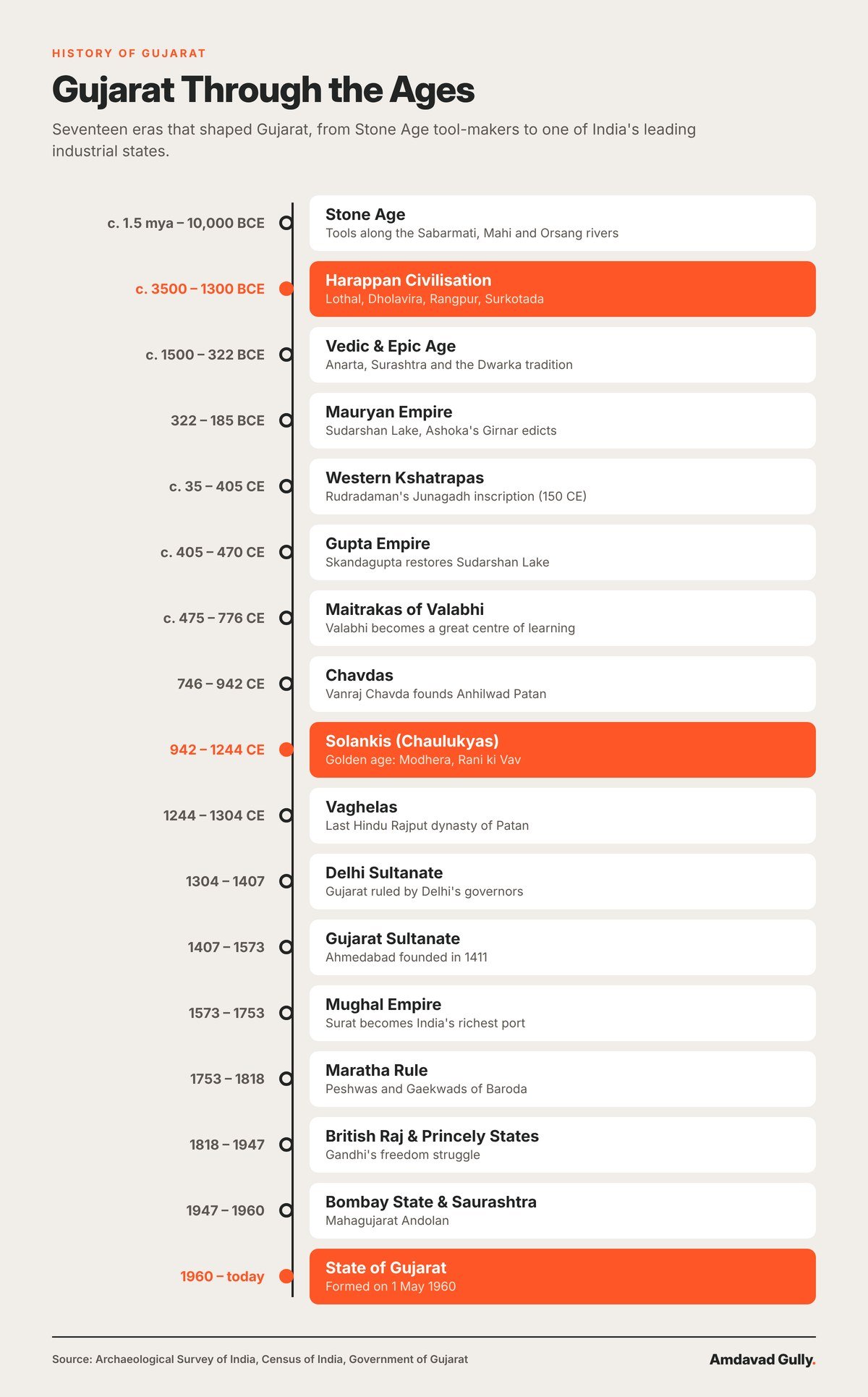
The story of human life in Gujarat begins long before cities. In 1893, the British geologist Robert Bruce Foote found stone tools on the banks of the Sabarmati. This was one of the first clues that early humans lived here hundreds of thousands of years ago.
Since then, archaeologists have found Lower, Middle and Upper Palaeolithic tools along several rivers. These include the Sabarmati, Mahi, Orsang, Bhadar and Narmada. Early humans used hand axes and cleavers to hunt and to cut meat and wood.
Langhnaj and the Mesolithic Age
The Mesolithic or Middle Stone Age left even clearer traces. Langhnaj, in Mehsana district, is the most famous site. Here, people lived on sandy dunes beside small lakes. They made tiny stone tools called microliths and hunted deer, wild cattle and fish. Archaeologists also found human burials at Langhnaj. These give us a rare look at the people themselves. As a result, Langhnaj is a key site for anyone studying the early history of Gujarat.
Furthermore, sites in north Gujarat show that these hunter-gatherers slowly began to keep animals. This shift set the stage for farming villages, and later, for one of the world’s first great civilisations.
The Harappan Civilisation in Gujarat
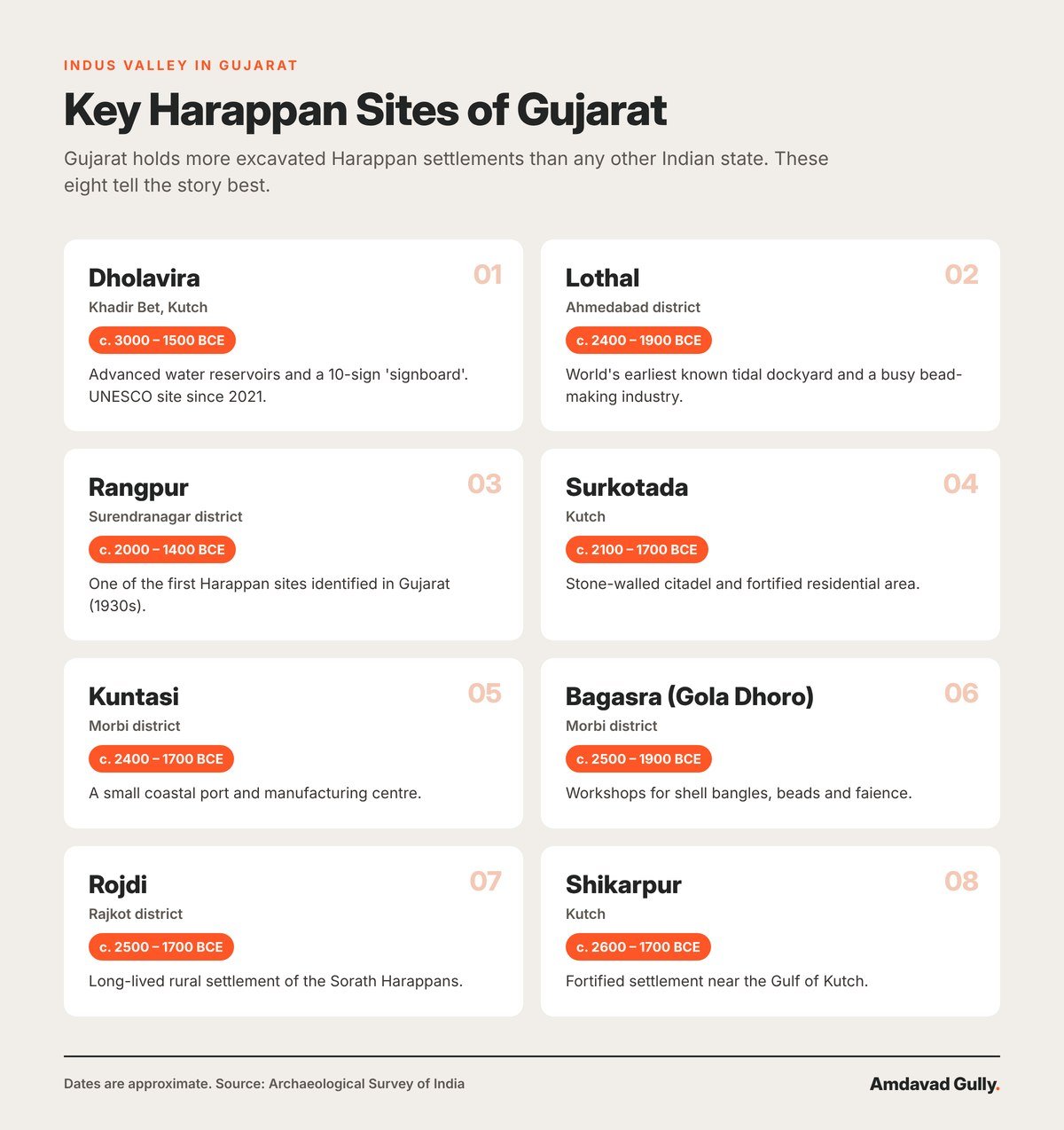
The most exciting chapter in the early history of Gujarat belongs to the Harappan or Indus Valley Civilisation. Today, Gujarat has more excavated Harappan sites than any other Indian state. Some of the most advanced cities of the Bronze Age stood on its soil.
The civilisation flourished here from about 3500 BCE to 1300 BCE. Its people built planned towns with straight streets, drains and fortifications. They also used standard weights, made fine beads and wrote in a script that nobody has yet deciphered.
Lothal: The Ancient Port City
Lothal lies about 80 km south-west of Ahmedabad, near the Gulf of Khambhat. The archaeologist S.R. Rao discovered it in 1954. Excavations then ran from 1955 to 1960.
Lothal is best known for its massive brick basin, which many scholars see as the world’s earliest known tidal dockyard. Ships could sail in from the Sabarmati, which once flowed nearby, to load and unload goods. Next to the dock stood a warehouse, a raised acropolis and a lower town for workers and craftspeople.
The city also ran a busy bead factory. Its artisans drilled carnelian and agate into beads that reached as far as Mesopotamia. In addition, a Persian Gulf-style seal found at Lothal proves its overseas links. In other words, Gujarat’s role as India’s trading gateway began here, more than 4,000 years ago.
Today, the Government of India is building the National Maritime Heritage Complex near Lothal. It is planned as one of the largest maritime museums in the world.
Dholavira: The Water City of Kutch
Dholavira stands on Khadir Bet, an island in the Great Rann of Kutch. Locally, people call it Kotada Timba. The archaeologist J.P. Joshi found it in 1967–68. Later, R.S. Bisht led major excavations from 1990 to 2005.
Dholavira was one of the five largest Harappan cities in the subcontinent. It was divided into a citadel, a middle town and a lower town, each with its own walls. Above all, the city is famous for its water system. Because Kutch is so dry, its people cut huge reservoirs into rock and built channels to store every drop of monsoon rain.
Dholavira also gave us the famous “signboard”. This is a row of ten large Harappan signs, once set into a wooden board above a city gate. It may be one of the oldest public inscriptions in the world.
In July 2021, UNESCO added “Dholavira: a Harappan City” to its World Heritage List. It became Gujarat’s fourth World Heritage Site and India’s 40th.
Other Harappan Sites in Gujarat
Lothal and Dholavira are the stars. However, many other sites help us complete the picture.
- Rangpur (Surendranagar): Excavated by M.S. Vats in the 1930s, it was among the first Harappan sites found in Gujarat. It also shows the later, post-urban phase.
- Surkotada (Kutch): A small fortified site with stone walls and a citadel.
- Kuntasi (Morbi): A coastal trading and manufacturing post.
- Bagasra or Gola Dhoro (Morbi): Known for shell bangle and bead workshops.
- Rojdi (Rajkot): A long-lived farming village of the Saurashtra Harappans.
- Shikarpur and Desalpur (Kutch): Fortified settlements near the Gulf of Kutch.
Why Did the Harappan Cities Decline?
From about 1900 BCE, the great cities began to shrink. Historians point to several causes. Rivers changed course, the climate became drier and sea trade slowed down. As a result, people moved away from the big cities into smaller villages.
In Gujarat, this “Late Harappan” phase lasted longer than in many other regions. Sites such as Rangpur show people still living there, making a distinctive pottery called Lustrous Red Ware. Thus, the Harappan way of life did not vanish overnight. Instead, it slowly blended into the farming cultures that followed.
Interestingly, recent studies at Vadnagar in Mehsana district have added another layer. Researchers have found evidence of a settlement there that goes back about 2,800 years. They argue it may be one of India’s oldest continuously inhabited towns. Debates continue, but such finds keep reshaping the early history of Gujarat.
Ancient Gujarat: Legends, Ports and Early Kingdoms
After the Harappan age, the history of Gujarat enters a period where legend and history mix. Ancient texts mention the region often, but hard evidence is thin until the Mauryan Empire.
Dwarka and the Krishna Tradition
According to the Mahabharata and the Puranas, Lord Krishna left Mathura and founded the city of Dwarka on the western coast. He ruled there with the Yadava clan. Later, the sea is said to have swallowed the city.
Today, Dwarka is one of the four Char Dham pilgrimage sites, and the Dwarkadhish Temple draws millions of devotees. In the 1980s, marine archaeologists led by S.R. Rao explored the sea off Dwarka. They recorded stone structures and anchors under the water. Scholars still debate their age. Even so, the Dwarka story shows how deeply Gujarat is woven into India’s sacred geography.
Somnath: The Eternal Shrine
On the southern coast of Saurashtra stands Somnath, the first of the twelve Jyotirlingas of Lord Shiva. Its story runs through almost every era of Gujarat’s history. Raiders destroyed it several times, and devotees rebuilt it each time.
The present temple was rebuilt after independence on the initiative of Sardar Vallabhbhai Patel. President Rajendra Prasad performed its consecration in May 1951. For many Indians, Somnath has therefore become a symbol of resilience.
Bharuch: Gujarat’s Oldest Port Town
Bharuch, on the Narmada, is one of the oldest continuously inhabited towns in Gujarat. Ancient Indian texts call it Bhrigukachchha. Greek and Roman sailors knew it as Barygaza.
A 1st-century Greek sailing guide, the Periplus of the Erythraean Sea, describes Barygaza as a busy port. It traded cotton, spices and precious stones for wine, silver and other goods. The guide even notes that old Indo-Greek coins were still in use in its markets. This is solid proof that Gujarat was part of a global trade network 2,000 years ago.
The Mauryan Empire in Gujarat (322–185 BCE)
The Mauryas brought Gujarat into India’s first great empire. With them, the written history of Gujarat truly begins. Our best source is not a Mauryan text, though. Instead, it is a later inscription carved on a rock at Junagadh, at the foot of Mount Girnar.
Sudarshan Lake
According to that inscription, Pushyagupta, a provincial governor under Chandragupta Maurya, built a dam to create a reservoir called Sudarshan Lake. Later, under Emperor Ashoka, an official named Tushaspha added water channels to it. This makes Sudarshan Lake one of the earliest recorded irrigation projects in India.
Ashoka’s Girnar Edicts
The same rock at Junagadh carries fourteen major rock edicts of Ashoka. In them, the emperor speaks about dhamma, kindness to animals, respect for all faiths and the welfare of his people. Remarkably, the same boulder later received inscriptions from two more dynasties. As a result, this single rock holds about 700 years of the history of Gujarat.
Indo-Greeks and the Western Kshatrapas
After the Mauryan Empire broke up, outsiders from the north-west moved in. Indo-Greek kings such as Menander and Apollodotus seem to have controlled parts of Gujarat in the 2nd and 1st centuries BCE. Their silver coins have been found in the region, as the Periplus also noted.
Rudradaman and the Junagadh Inscription
The next major power was the Western Kshatrapas, rulers of Saka (Scythian) origin. They governed much of Gujarat, Malwa and parts of Rajasthan from roughly the 1st century to around 400 CE.
Their greatest ruler was Rudradaman I, who reigned around 130–150 CE. In about 150 CE, he added his own inscription to the Junagadh rock. It records that a terrible storm had burst the Sudarshan dam. Rudradaman then repaired it from his own treasury, without forcing extra taxes or free labour on his people.
This inscription matters for another reason too. It is one of the earliest long inscriptions in classical Sanskrit. Before it, most royal records used Prakrit. Thus, a rock in Junagadh marks a turning point in India’s literary history as well.
The Gupta Empire in Gujarat (c. 405–470 CE)
Around 400 CE, the Gupta emperor Chandragupta II, also called Vikramaditya, defeated the last Western Kshatrapa ruler. Gujarat then became part of the Gupta Empire. Their rule was short, but it was largely a peaceful time in the history of Gujarat.
Once again, the Junagadh rock tells the story. An inscription of Emperor Skandagupta, from about 456 CE, says the Sudarshan dam had burst yet again. This time, the local official Chakrapalita, son of the governor Parnadatta, rebuilt it. So, one lake and one rock connect the Mauryas, the Kshatrapas and the Guptas. Few places in India record such a long chain of history.
The Maitrakas of Valabhi (c. 475–776 CE)
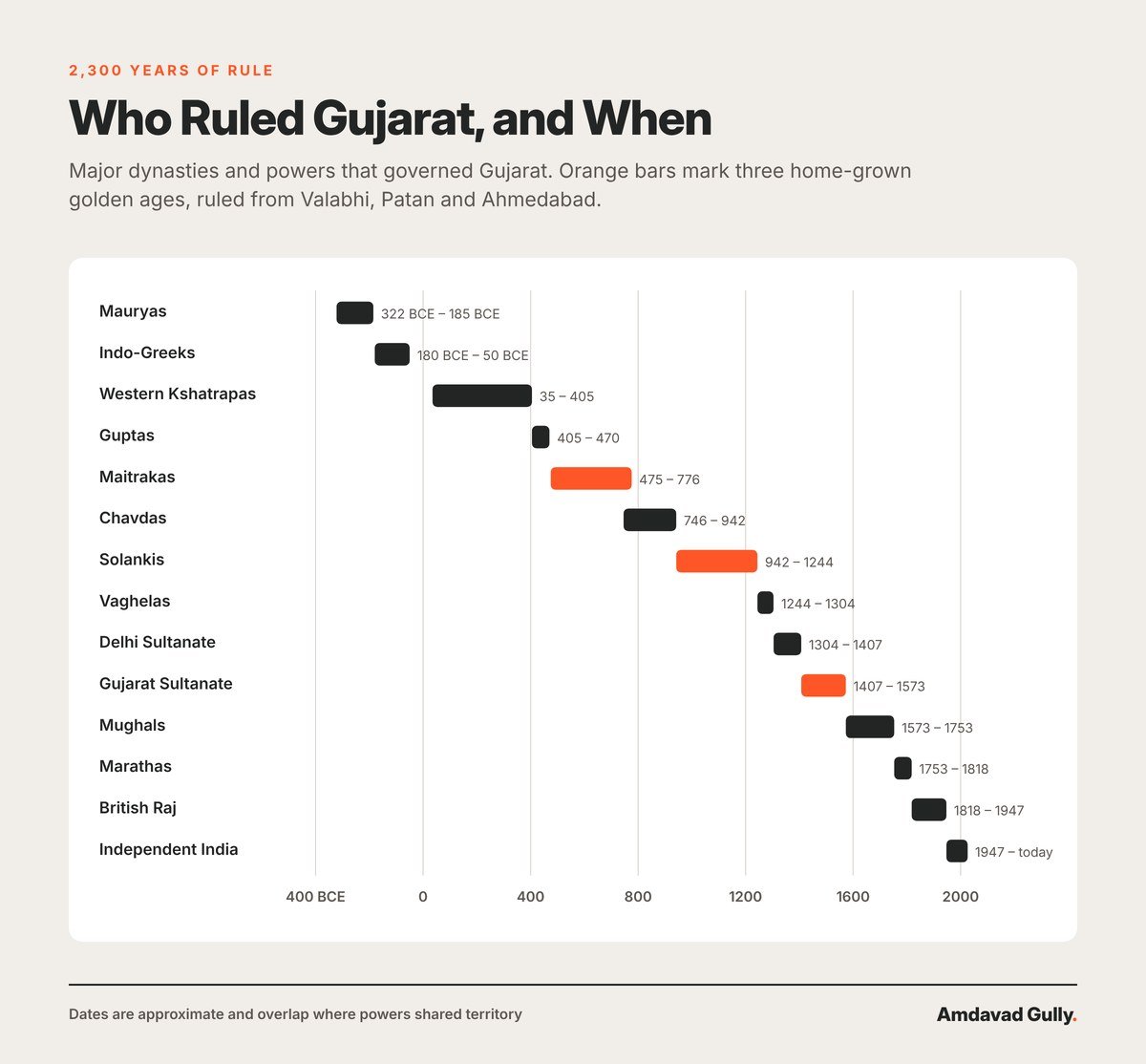
As Gupta power faded, one of their generals, Senapati Bhatarka, set up his own dynasty. His family, the Maitrakas, ruled from Valabhi, near present-day Vala in Bhavnagar district. Their rule lasted about 300 years, which makes it one of the longest in the history of Gujarat.
Valabhi: A Great Centre of Learning
Valabhi was more than a capital. It was also a famous university town. The Chinese traveller Xuanzang visited in the 7th century and described hundreds of Buddhist monasteries and thousands of monks. Later, another Chinese pilgrim, Yijing, ranked Valabhi alongside Nalanda as one of India’s top centres of study.
Students came from across India to study law, economics, logic and religion. Many Maitraka kings were Shaivas, but they also supported Buddhist and Jain institutions generously.
The Jain Council at Valabhi
Valabhi also holds a special place in Jain history. In the 5th century, a great council of Shvetambara Jain monks met here under Devarddhi Kshamashramana. At this council, the Jain scriptures, which had been passed down orally, were finally written down. As a result, Gujarat became, and remains, one of the most important regions for Jainism.
The Fall of Valabhi
By the mid-8th century, the Maitrakas faced new threats. Arab armies based in Sindh raided western India several times. Most historians link the end of Valabhi, around 776 CE, to these attacks, along with internal weakness. After that, the once-great city slowly faded into a small village.
Arab Raids and Regional Powers (8th–10th Century)
The 8th century was a turbulent time in the history of Gujarat. Several powers fought for control.
- Arab raids: In about 739 CE, an Arab army from Sindh pushed into south Gujarat. However, Avanijanashraya Pulakeshin of the local Chalukya branch defeated it near Navsari. This victory helped stop the Arab advance into India.
- Gurjara-Pratiharas: This powerful dynasty, based in Rajasthan and later Kannauj, controlled parts of north Gujarat.
- Rashtrakutas: The Deccan-based Rashtrakutas ruled south Gujarat, then called Lata, for long periods.
Amid this contest, a new local dynasty quietly built a capital that would become the heart of medieval Gujarat.
The Chavdas and the Founding of Anhilwad Patan (746–942 CE)
According to tradition, Vanraj Chavda founded the city of Anhilwad Patan in 746 CE. Legend says he named it after Anhil, a shepherd friend who showed him the site. Today, the town is simply called Patan.
The Chavdas ruled north Gujarat for nearly two centuries. Their kingdom was small, but Patan grew steadily as a trading and religious centre. Vanraj was also a patron of Jainism, and the Panchasara Parshvanath temple in Patan is linked to him.
Most importantly, the Chavdas gave Gujarat a capital that would last for over 500 years. In 942 CE, their last king was replaced by his nephew, Mularaja. With him, the golden age of Gujarat began. For this reason, Vanraj Chavda and his city hold an honoured place in the history of Gujarat.
The Solanki Golden Age (942–1244 CE)
Ask any historian to name the high point of medieval Gujarat, and most will say the Solanki or Chaulukya dynasty. For three centuries, these kings ruled from Patan. Under them, Gujarat became rich, powerful and culturally brilliant. Many of the state’s most beautiful monuments date from this era.
Mularaja I: The Founder
Mularaja I ruled from 942 to about 995 CE. He took over the Chavda kingdom and expanded it through wars with neighbours in Saurashtra, Kutch and Rajasthan. He also built temples and settled scholars in his capital. In short, he laid strong foundations for the dynasty.
Bhima I and the Raid on Somnath
During the reign of Bhima I (c. 1022–1064), Gujarat faced its greatest shock. Around the start of 1026, Mahmud of Ghazni marched across the desert and attacked Somnath. He plundered the temple’s vast wealth and destroyed its idol before returning to Afghanistan.
Yet the kingdom recovered quickly. In fact, Bhima’s reign also produced two of Gujarat’s finest monuments.
- Modhera Sun Temple (1026–27): Built in Mehsana district, it is dedicated to Surya, the sun god. Its stepped tank, the Surya Kund, holds over a hundred small shrines. At the equinoxes, the morning sun is said to light up the inner sanctum.
- Rani ki Vav, Patan: Queen Udayamati built this stepwell in memory of Bhima I, probably starting around 1063. It descends seven levels and holds about 500 major sculptures. Silt from the Saraswati river buried it for centuries, which kept the carvings in superb condition.
In 2014, UNESCO added Rani ki Vav to its World Heritage List. Since 2018, it has also appeared on the back of India’s ₹100 note.
Karna and Karnavati
Bhima’s son, Karna (c. 1064–1094), defeated the Bhil chief Asha Bhil of Ashaval, a settlement on the Sabarmati. According to tradition, he then founded a town nearby called Karnavati. Many historians see Ashaval and Karnavati as the forerunners of Ahmedabad. So the roots of Amdavad reach back to the Solanki age.
Siddharaj Jaysinh: The Great King
Siddharaj Jaysinh (1092–1142) is the most celebrated Solanki ruler. He defeated the Paramaras of Malwa and pushed Gujarat’s borders far beyond its old limits. In fact, under him the kingdom reached its greatest size. Many historians call him the greatest king in the medieval history of Gujarat.
He was also a great builder. He created the Sahastralinga Talav, a vast reservoir at Patan, and the Rudra Mahalaya temple at Siddhpur. In addition, he invited the Jain scholar Hemachandra to his court. Folk tales and songs about “Siddhraj” still survive across Gujarat.
Kumarapala and Hemachandra
Siddharaj had no son, so his relative Kumarapala (1143–1172) took the throne. Under Hemachandra’s influence, Kumarapala embraced Jain values. He discouraged animal slaughter and built many temples, including the grand Ajitnath temple at Taranga.
Hemachandra himself was a giant of Indian learning. He wrote on grammar, poetry, history and philosophy. His grammar, the Siddha-Hema-Shabdanushasana, includes rules for the Apabhramsha language from which Gujarati later grew. For this reason, many scholars call him a father figure of Gujarati literature.
Naikidevi Defeats Muhammad Ghori
One episode deserves special mention. In 1178, Muhammad of Ghor invaded Gujarat. At that time, the king, Mularaja II, was still a child. So his mother, Queen Naikidevi, led the army herself. She defeated Ghori at the Battle of Kasahrada, near Mount Abu. After this defeat, Ghori chose to enter India through Punjab instead.
Solanki Art and Architecture
The Solanki period created a distinct building style, often called the Maru-Gurjara style. It is known for richly carved temples with tall, curved spires. The style also produced elaborate stepwells, toranas (ceremonial gateways) and lakes. Moreover, Jain temples at Mount Abu, Girnar, Shatrunjaya and Taranga belong to this tradition. Today, temple architects in Gujarat and Rajasthan still follow its principles.
The Vaghelas: The Last Rajput Kings of Patan (1244–1304)
By the 13th century, Solanki power had weakened. A related family, the Vaghelas, took over. Visaladeva became king of Patan in 1244.
The Vaghela age is remembered for two remarkable ministers, the brothers Vastupal and Tejpal. They were Jain merchants, generals and patrons of art. They built the exquisite Luna Vasahi temple at Dilwara on Mount Abu and several shrines on Girnar. They also supported poets and scholars. Their generosity is legendary in the history of Gujarat.
However, the dynasty’s end came quickly. In 1299, the armies of Alauddin Khalji, Sultan of Delhi, invaded Gujarat. The last Vaghela king, Karna, often called Karan Ghelo, fled. Delhi’s generals sacked Patan, attacked Somnath again and plundered the port of Khambhat. Within a few years, Gujarat had become a province of the Delhi Sultanate. One era of the history of Gujarat had closed, and a very different one had begun.
Delhi Sultanate Rule (1304–1407)
For about a century, governors appointed by Delhi ruled Gujarat. The Khalji and then the Tughlaq sultans saw the province as a rich source of revenue, thanks to its ports and textiles.
Still, Delhi was far away. Governors often rebelled, and local Rajput chiefs kept their own power in many areas. Meanwhile, Muslim merchants, Sufi saints and scholars settled in towns across Gujarat. Their presence added a new layer to the region’s culture.
Then, in 1398, the Central Asian conqueror Timur sacked Delhi. The Tughlaq state collapsed, and its provinces broke away one by one. Gujarat was among the first to declare itself free.
The Gujarat Sultanate (1407–1573)
In 1391, the Tughlaqs had appointed Zafar Khan as governor of Gujarat. His family came from a local background, and he understood the region well. In 1407, he declared independence and took the title Muzaffar Shah I. With this, the Gujarat Sultanate was born.
The Sultanate lasted about 166 years. During that time, Gujarat became one of the wealthiest kingdoms in the world. Its ports were packed with ships, and its cloth reached markets from Cairo to Malacca.
Ahmed Shah I Founds Ahmedabad (1411)
Muzaffar Shah’s grandson, Ahmed Shah I, ruled from 1411 to 1442. He is the man every Amdavadi should know. In 1411, he founded a new capital on the east bank of the Sabarmati, next to old Ashaval and Karnavati. He named it Ahmedabad.
A popular legend says the Sultan saw a hare chasing a dog on the river bank. Impressed by this unusual courage, he chose the spot for his city. Another tradition says the foundation stone was laid by four men named Ahmed, guided by the Sufi saint Ahmed Khattu Ganj Baksh.
Ahmed Shah began building the Bhadra Fort and the royal square around it. In 1424, he completed the magnificent Jama Masjid, with its 260 pillars. The Teen Darwaza gateway soon followed. Over time, the walled city grew into a maze of pols, markets and mosques. This is the story at the heart of the history of Gujarat’s biggest city.
The Indo-Islamic Style of Gujarat
The Sultanate created a unique style of architecture. Its builders were largely local craftsmen, trained in the Solanki temple tradition. As a result, Gujarat’s mosques blended Islamic plans with Hindu and Jain carving. You can see lotus motifs, temple-style pillars and delicate stone jalis in many of them.
Ahmedabad is the best place to see this style. Examples include the Jama Masjid, Rani Rupmati’s Mosque, the Sarkhej Roza complex and the “shaking minarets” of Sidi Bashir. Later, this fusion inspired Mughal builders as well.
Mahmud Begada: The Greatest Sultan
Mahmud Shah I, known as Mahmud Begada, ruled from 1458 to 1511. He is the most famous ruler of the Gujarat Sultanate. Begada won two great fortresses, Girnar near Junagadh in about 1472 and Pavagadh in 1484. Because of these victories, legend says he earned the title “Begada”, meaning the conqueror of two forts.
After capturing Pavagadh, he built a new capital at its foot and named it Muhammadabad. Today, we know it as Champaner. The city had mosques, palaces, gardens and water systems. However, it was abandoned within a few decades of his death. That neglect preserved it, and in 2004 Champaner-Pavagadh Archaeological Park became Gujarat’s first UNESCO World Heritage Site.
Begada also completed the famous Adalaj stepwell near Ahmedabad, which Rana Veer Singh had begun. In addition, he expanded Sarkhej Roza and promoted trade. Foreign travellers wrote colourful tales about him, including claims that his diet included poison so that even flies died on him. These were surely exaggerations, but they show how famous he was.
The Portuguese Arrive
Begada’s reign also saw the arrival of a new power: the Portuguese. They wanted to control the Indian Ocean spice trade. In 1509, a Portuguese fleet defeated the combined navies of Gujarat, Egypt’s Mamluks and Calicut in the Battle of Diu. This battle changed maritime history. It marked the start of European naval dominance in Asian waters.
Bahadur Shah and the Decline of the Sultanate
Bahadur Shah (1526–1537) was the last powerful Sultan. He conquered Malwa and attacked Mewar’s fort of Chittor. However, his ambitions drew in the Mughal emperor Humayun, who invaded Gujarat in 1535 and captured Champaner.
Bahadur then sought Portuguese help and allowed them to build a fort at Diu. When relations broke down, he died in a scuffle aboard a Portuguese ship in 1537. Diu, along with Daman, stayed under Portuguese rule until 1961.
After Bahadur’s death, the Sultanate fell into chaos. Nobles fought each other, and child sultans sat on the throne. In 1572–73, it was conquered by a far stronger emperor.
Mughal Gujarat (1573–1753)
In 1572, the Mughal emperor Akbar marched into Gujarat and entered Ahmedabad. The following year, rebels rose against him. Akbar responded with a famous lightning march from Fatehpur Sikri, covering the distance in about eleven days. He crushed the revolt near Ahmedabad in 1573. To celebrate, he later built the towering Buland Darwaza at Fatehpur Sikri.
Gujarat now became a Mughal province, or subah, with Ahmedabad as its capital. The Mughals introduced their land revenue system and appointed governors called subahdars. Several princes, including future emperors, served in this post. Above all, this period marked a high point in the economic history of Gujarat.
Surat: The Gateway to Mecca
Under the Mughals, Surat became India’s greatest port. Every year, Hajj pilgrims sailed from here to Arabia, so the city earned the title Bab-ul-Mecca, or Gateway to Mecca. Merchants such as Virji Vora, a Jain trader, became some of the richest men in the world. He lent money to Indian and European traders alike.
Meanwhile, Ahmedabad grew into a giant of textile production and banking. Its silk, cotton and brocade went to Persia, Turkey and Europe. Its bankers, the sarrafs, issued hundis (bills of exchange) honoured across India.
The Europeans at Surat
Surat’s wealth attracted the European trading companies. In 1612, an English fleet defeated the Portuguese at the Battle of Swally, near Surat. Soon after, the English East India Company received permission from Emperor Jahangir to open a trading post, or “factory”, at Surat in 1613. In 1615, the English ambassador Sir Thomas Roe arrived at the Mughal court.
The Dutch, the French and others followed. For decades, Surat was the English Company’s main base in India. In other words, the British Empire in India began its journey in Gujarat.
Jahangir, Shah Jahan and Aurangzeb
Emperor Jahangir visited Ahmedabad in 1617–18. He was not fond of its dusty summer and called it Gardabad, the city of dust. In 1618, his grandson Aurangzeb was born at Dahod in eastern Gujarat. Later, Aurangzeb served briefly as governor of the province.
The Mughal period was not all prosperity, though. The terrible famine of 1630–32 killed huge numbers of people in Gujarat. Moreover, in 1664 and again in 1670, the Maratha king Shivaji raided Surat and carried off great wealth. These raids revealed the Mughals’ growing weakness.
Maratha Rule and the Gaekwads (1753–1818)
After Aurangzeb died in 1707, the Mughal Empire weakened fast. The Marathas filled the vacuum. From around 1705, Maratha armies began raiding Gujarat to collect tribute.
The Rise of the Gaekwads
One Maratha commander, Pilaji Gaekwad, set up a base at Songadh in south Gujarat in the early 1720s. In 1734, his family took Baroda, which soon became their capital. His son, Damaji Gaekwad, expanded their power further. The Gaekwads would stay a major force in Gujarat’s history for about 200 years.
In 1753, Damaji and the Peshwa’s forces captured Ahmedabad. This ended effective Mughal rule in Gujarat. The Mughals briefly retook the city, but the Marathas regained it in 1758. Afterwards, the Peshwa and the Gaekwads shared revenue from Ahmedabad, sometimes uneasily.
A Divided Land
The 18th century left Gujarat deeply divided. The Gaekwads ruled a large state around Baroda. The Peshwa controlled other areas. Nawabs held Junagadh, Cambay and Surat. In Saurashtra and Kutch, hundreds of Rajput and other chiefs ruled small states. This patchwork would shape Gujarat’s history right up to 1947.
Kutch and Saurashtra: Histories of Their Own
The mainland was not the whole story. Kutch and Saurashtra each had a separate history for centuries. To understand the history of Gujarat fully, you need to know both regions.
The Jadejas of Kutch
From the 16th century, the Jadeja Rajputs ruled Kutch. In 1549, Rao Khengarji I made Bhuj his capital. He also founded the port of Mandvi, which soon became famous for building wooden sailing ships.
Kutch’s rulers looked to the sea as much as the land. Kutchi merchants traded with Muscat, Zanzibar and the East African coast. In the 18th century, a Kutchi craftsman named Ram Singh Malam returned from Europe with new skills in glass, tiles and clockwork. He then helped Rao Lakhpatji build the dazzling Aina Mahal, or Palace of Mirrors, in Bhuj.
Kutch has also lived with earthquakes. In 1819, a huge quake raised a long ridge of land in the Rann, which locals named the Allah Bund. Then, in 2001, history repeated itself with even greater loss of life.
The Many Kingdoms of Saurashtra
Saurashtra, or Kathiawar, held dozens of princely families. Several of their capitals are major cities today.
- Jamnagar: Jam Rawal founded Nawanagar in 1540. Later, its ruler K.S. Ranjitsinhji became a world-famous cricketer. India’s national cricket championship, the Ranji Trophy, is named after him.
- Bhavnagar: Bhavsinhji Gohil founded this port city in 1723. His descendants built it into a busy trading hub.
- Junagadh: The Babi Nawabs ruled here from the 18th century until 1947. They left behind grand buildings such as the Mahabat Maqbara.
- Gondal: Its ruler, Maharaja Bhagvatsinhji, built roads, schools and railways. He also compiled the Bhagavadgomandal, a giant Gujarati encyclopaedic dictionary.
- Rajkot: From 1822, it hosted the British agency that supervised the Kathiawar states. Gandhi spent his school years here.
Because of this patchwork, Saurashtra developed a strong local identity. Its folk songs, dialect and food still differ from those of mainland Gujarat. In short, Kathiawar’s history is a rich chapter of its own.
British Rule and the Princely States (1818–1947)
The East India Company slowly turned its trading power into political control. In 1759, it seized Surat Castle. Then it signed a series of treaties with Maratha rulers that drew Gujarat into its orbit.
- 1802: The Treaty of Bassein made the Peshwa a British ally, and the Gaekwads signed similar agreements.
- 1803: The British captured Broach (Bharuch).
- 1807: Colonel Walker’s settlement fixed the tribute paid by the many Kathiawar states.
- 1817–18: After the final Anglo-Maratha war, the Peshwa’s lands in Gujarat, including Ahmedabad, passed to the British.
British Gujarat and the Princely States
After 1818, Gujarat was split into two very different parts. First, there was British Gujarat. This included the districts of Ahmedabad, Kheda (Kaira), Panchmahal, Broach and Surat, all governed as part of the Bombay Presidency.
Second, there were the princely states. These states were large in number and size. Kathiawar alone had more than 200 states, ranging from sizeable kingdoms to tiny estates of a few villages. Important states included Baroda, Junagadh, Nawanagar (Jamnagar), Bhavnagar, Porbandar, Gondal, Rajkot and Kutch.
Baroda Under Sayajirao Gaekwad III
Among the princely rulers, Maharaja Sayajirao Gaekwad III of Baroda (ruled 1875–1939) stands out. He made primary education free and compulsory, banned child marriage and opened public libraries across his state. He also founded what later became the Maharaja Sayajirao University. Furthermore, he funded the higher studies of the young B.R. Ambedkar. Many historians call him one of the most progressive rulers in the history of Gujarat.
Ahmedabad: The Manchester of the East
In 1861, Ranchhodlal Chhotalal started the Ahmedabad Spinning and Weaving Company, the city’s first textile mill. More mills soon followed. By the early 20th century, Ahmedabad was one of India’s biggest textile centres, earning the nickname “Manchester of the East”.
Notably, much of this industry was built by Indian capital, not British. Local mahajans and business families, such as the Sarabhais and Lalbhais, led the way. This tradition of local enterprise remains a key theme in the economic history of Gujarat.
A Literary and Social Awakening
The 19th century also saw a cultural revival. In 1848, the British official Alexander Kinloch Forbes helped found the Gujarat Vernacular Society in Ahmedabad. He also wrote Ras Mala, a famous collection of the region’s history and legends.
Meanwhile, the poet Narmad pioneered modern Gujarati poetry and prose. He campaigned for widow remarriage and against caste rules. Another poet, Dalpatram, wrote in a simpler, popular style. Later, Govardhanram Tripathi wrote Saraswatichandra, often called the greatest Gujarati novel.
Gujarat also produced early national leaders. Dadabhai Naoroji, a Parsi from Navsari, became the first Asian elected to the British Parliament in 1892. His “drain theory” exposed how British rule drained wealth from India.
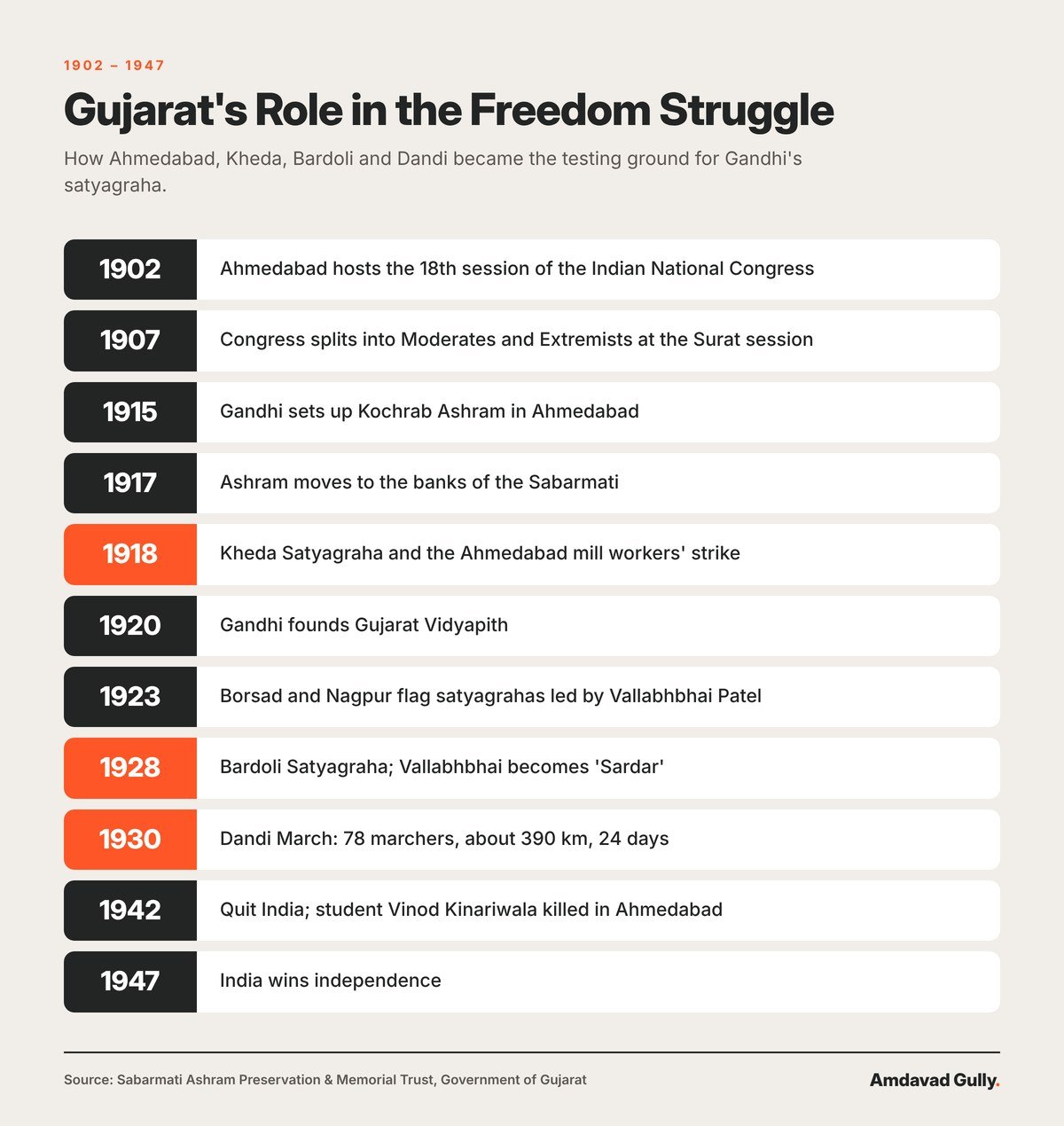
Gujarat in the Freedom Struggle (1885–1947)
No region played a bigger role in shaping the methods of India’s freedom struggle than Gujarat. This was the land of both Mahatma Gandhi and Sardar Vallabhbhai Patel. Together, they turned Gujarat into a laboratory for satyagraha, or non-violent resistance.
Early Congress Sessions
Gujarat was active from the start of the national movement. In 1902, Ahmedabad hosted the 18th session of the Indian National Congress. Then, in 1907, the Surat session became famous for the split between the Moderates and the Extremists. That split shaped Indian politics for the next decade.
Gandhi Comes Home
Mohandas Karamchand Gandhi was born in Porbandar on 2 October 1869. He grew up in Rajkot before studying law in London and working in South Africa. In January 1915, he returned to India for good.
Gandhi chose Ahmedabad as his base. In May 1915, he set up the Satyagraha Ashram at Kochrab. Two years later, in 1917, he moved it to the banks of the Sabarmati. The Sabarmati Ashram became the nerve centre of the national movement for the next 13 years.
1918: Kheda and the Ahmedabad Mill Strike
In 1918, crops failed in Kheda district, yet the government demanded full land revenue. Gandhi launched the Kheda Satyagraha and asked farmers not to pay. A young lawyer from Kheda named Vallabhbhai Patel left his practice to join him. Eventually, the government relaxed its demands for the poorest farmers.
That same year, Ahmedabad’s mill workers demanded higher wages. Anasuya Sarabhai, sister of the mill owner Ambalal Sarabhai, led the workers. Gandhi supported them and went on his first public fast in India. The dispute ended in a compromise, and it later gave rise to the Textile Labour Association.
Gujarat Vidyapith and Non-Cooperation
During the Non-Cooperation Movement, Gandhi founded Gujarat Vidyapith in Ahmedabad on 18 October 1920. It offered a national education, free from British control. Thousands of students and teachers left government schools to join such institutions.
1928: The Bardoli Satyagraha
In 1928, the government raised land revenue sharply in Bardoli taluka, near Surat. Vallabhbhai Patel organised the farmers into a disciplined, non-violent campaign. Not a single rupee of the increased tax was paid. Families faced seizures of land and cattle, yet they held firm.
Finally, the government appointed an inquiry and reduced the increase. The women of Bardoli honoured Patel with the title “Sardar”, meaning leader. He carried that name for the rest of his life. Today, Bardoli remains a landmark in the history of Gujarat and of Indian farmers.
1930: The Dandi March
The most famous event in the history of Gujarat’s freedom struggle began on 12 March 1930. Gandhi set out from Sabarmati Ashram with 78 chosen followers. They walked about 390 km to the coastal village of Dandi, near Navsari.
On 6 April 1930, Gandhi picked up a handful of natural salt and broke the British salt law. This simple act sparked the Civil Disobedience Movement across India. Thousands of people made salt illegally and courted arrest.
A few weeks later, volunteers marched on the Dharasana salt works. Police beat them brutally as they walked forward without resisting. Foreign journalists reported the scene, and it shocked the world.
Gandhi vowed not to return to Sabarmati Ashram until India was free. He never lived there again.
1942: Quit India
When Gandhi launched the Quit India Movement in August 1942, Ahmedabad responded strongly. On 9 August 1942, a young student named Vinod Kinariwala was shot dead by police near Gujarat College while carrying the national flag. Moreover, Ahmedabad’s mills stayed shut for over three months in protest. The city became one of the movement’s strongest centres.
The Road to Statehood (1947–1960)
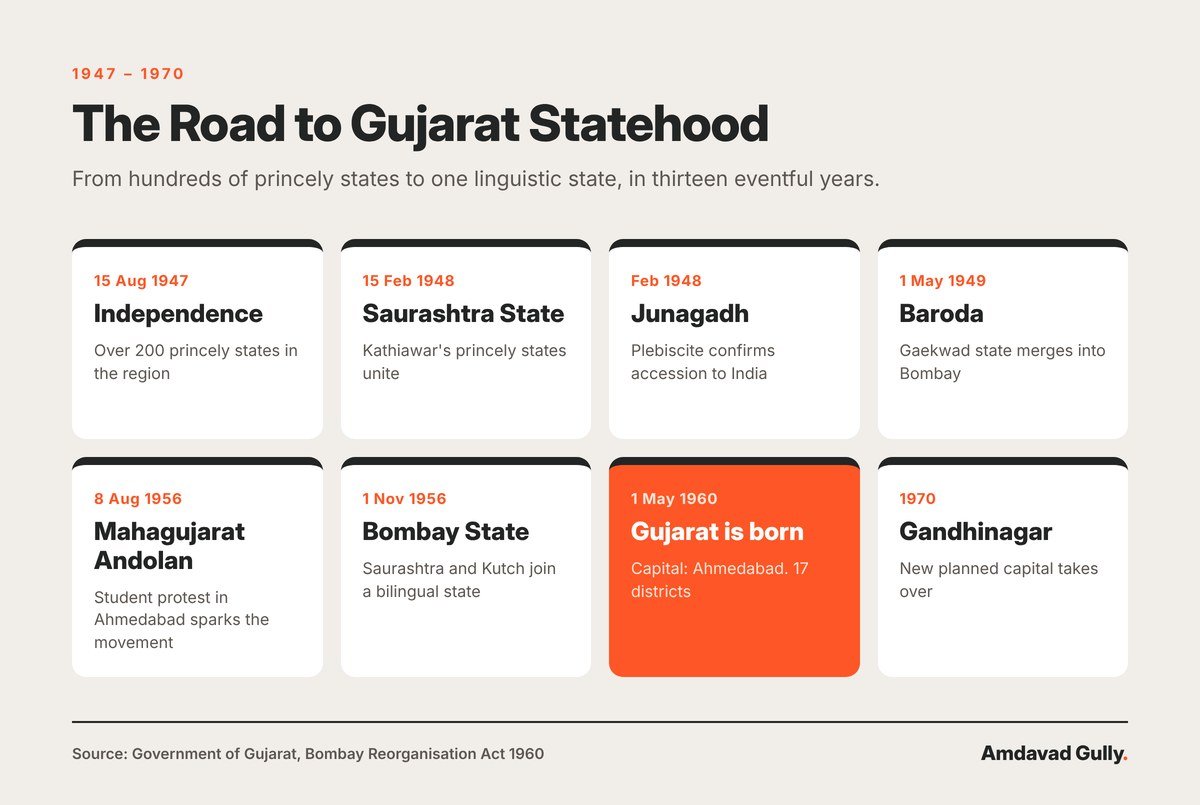
India became independent on 15 August 1947. However, the map of Gujarat looked nothing like today’s state. It was a jigsaw of British districts and hundreds of princely states. The next 13 years turned that jigsaw into a single state.
Integrating the Princely States
Sardar Patel, now India’s Home Minister, led the task of merging the princely states into the Indian Union. Gujarat, his home region, posed one of the toughest challenges because it had so many small states.
Many rulers cooperated willingly. For example, Maharaja Krishnakumarsinhji of Bhavnagar was among the first rulers in India to offer his state to the new government. Others followed. On 15 February 1948, the states of Kathiawar joined together to form the United State of Saurashtra, with Rajkot as its capital.
The Junagadh Crisis
Junagadh was different. Its Nawab, Muhammad Mahabat Khan III, announced that he would join Pakistan in September 1947. Yet most of his people were Hindu, and the state was surrounded by Indian territory.
Local leaders set up a parallel government, the Arzi Hukumat, led by Samaldas Gandhi. Under pressure, the Nawab fled to Pakistan, and India took over the administration in November 1947. Then, in February 1948, a plebiscite was held. The vote went overwhelmingly in favour of joining India. It remains one of the most dramatic episodes in the modern history of Gujarat.
Baroda and Kutch
The large state of Baroda merged into Bombay Province on 1 May 1949. Meanwhile, Kutch became a separate state directly governed by the Centre. Its strategic border with Pakistan made it special.
Bombay State (1956)
In 1956, the States Reorganisation Act redrew India’s internal map, largely along language lines. However, it made one big exception. On 1 November 1956, Saurashtra, Kutch and British Gujarat were merged with Marathi-speaking areas into a large, bilingual Bombay State. Neither Gujarati nor Marathi speakers were happy with this decision.
The Mahagujarat Andolan
Opposition exploded in Ahmedabad. On 8 August 1956, students gathered near the Congress House in Bhadra to demand a separate Gujarat. Police opened fire, and several young people were killed. Their deaths sparked a mass movement known as the Mahagujarat Andolan.
The veteran leader Indulal Yagnik, fondly called “Indu Chacha”, led the movement through the Mahagujarat Janata Parishad. For nearly four years, rallies, strikes and protests continued. At the same time, the Samyukta Maharashtra movement was demanding a Marathi state.
Finally, the Centre agreed. The Bombay Reorganisation Act, 1960 split Bombay State in two.
1 May 1960: Gujarat Is Born
On 1 May 1960, the State of Gujarat came into being. The respected Gandhian Ravishankar Maharaj inaugurated the new state. Dr. Jivraj Narayan Mehta became its first Chief Minister, and Ahmedabad became its first capital. At birth, Gujarat had 17 districts. It was the proudest moment in the modern history of Gujarat.
Every year, the state celebrates 1 May as Gujarat Sthapana Divas, or Gujarat Foundation Day. Read our full list of Chief Ministers of Gujarat to see who has led the state since then.
Modern Gujarat: 1960 to Today
The modern history of Gujarat is a story of rapid growth, hard lessons and big ambitions. In just over six decades, the young state has become one of India’s leading industrial and trading economies.
A New Capital: Gandhinagar
Ahmedabad served as the capital for the first decade. Meanwhile, a new planned city rose about 25 km to the north, on the banks of the Sabarmati. Named after Mahatma Gandhi, Gandhinagar was designed by the architects H.K. Mewada and Prakash Apte, who had worked on Chandigarh. The capital shifted to Gandhinagar in 1970.
Institutions That Shaped India
Gujarat, and Ahmedabad in particular, gave India several world-class institutions in this period.
- Physical Research Laboratory (1947): Founded by Dr. Vikram Sarabhai, the father of India’s space programme.
- Indian Institute of Management, Ahmedabad (1961): Set up with Sarabhai’s leadership and support from Ahmedabad’s business families.
- National Institute of Design (1961): India’s first design school.
- Space Applications Centre: A major ISRO centre in Ahmedabad.
The White Revolution
Gujarat’s farmers changed India’s food history too. In 1946, dairy farmers in Kheda district formed a cooperative, inspired by Sardar Patel and led by Tribhuvandas Patel. A young engineer, Dr. Verghese Kurien, joined them in Anand. Their brand, Amul, became a national household name.
The “Anand pattern” of cooperatives then spread across India through Operation Flood, launched in 1970. As a result, India grew into the world’s largest milk producer. This story is a proud part of the history of Gujarat.
Wars, Disasters and Movements
The young state also faced serious trials.
- 1965: Fighting broke out with Pakistan in the Rann of Kutch. During the war later that year, Chief Minister Balwantrai Mehta died when his aircraft was shot down.
- 1974: Students in Ahmedabad began the Nav Nirman Andolan against price rises and corruption. It forced the state government to resign and inspired protests across India.
- 1979: The Machchhu dam near Morbi collapsed, causing one of India’s worst dam disasters.
- 2001: On 26 January, a magnitude 7.7 earthquake struck Kutch. Around 20,000 people died, and Bhuj was badly damaged. It was one of the deadliest disasters in the history of Gujarat. Even so, the rebuilding of Kutch is now seen as a model of recovery.
Water, Industry and Infrastructure
Water has always been precious in Gujarat. So the Sardar Sarovar Dam on the Narmada is central to its modern story. Prime Minister Nehru laid its foundation stone in 1961, but legal battles and protests delayed it for decades. The dam was finally dedicated to the nation in 2017. Today, its canals carry water to Saurashtra, Kutch and north Gujarat.
Nearby stands the Statue of Unity, unveiled on 31 October 2018. At 182 metres, it is the world’s tallest statue and honours Sardar Patel. Fittingly, 31 October, his birth anniversary, is celebrated as Rashtriya Ekta Diwas, or National Unity Day.
In the 21st century, Gujarat has pushed hard on industry and investment. Key projects include:
- GIFT City near Gandhinagar, India’s first international financial services centre.
- Major ports such as Mundra and Kandla (Deendayal Port).
- The world’s largest oil refinery complex at Jamnagar.
- Semiconductor projects at Dholera and Sanand.
- The Ahmedabad Metro and the Mumbai–Ahmedabad high-speed rail corridor.
Ahmedabad on the World Stage
Amdavad has also made history of its own. In 2017, UNESCO named the Historic City of Ahmadabad India’s first World Heritage City. The Narendra Modi Stadium in Motera is the world’s largest cricket stadium. Most recently, in November 2025, Ahmedabad was confirmed as host of the centenary 2030 Commonwealth Games.
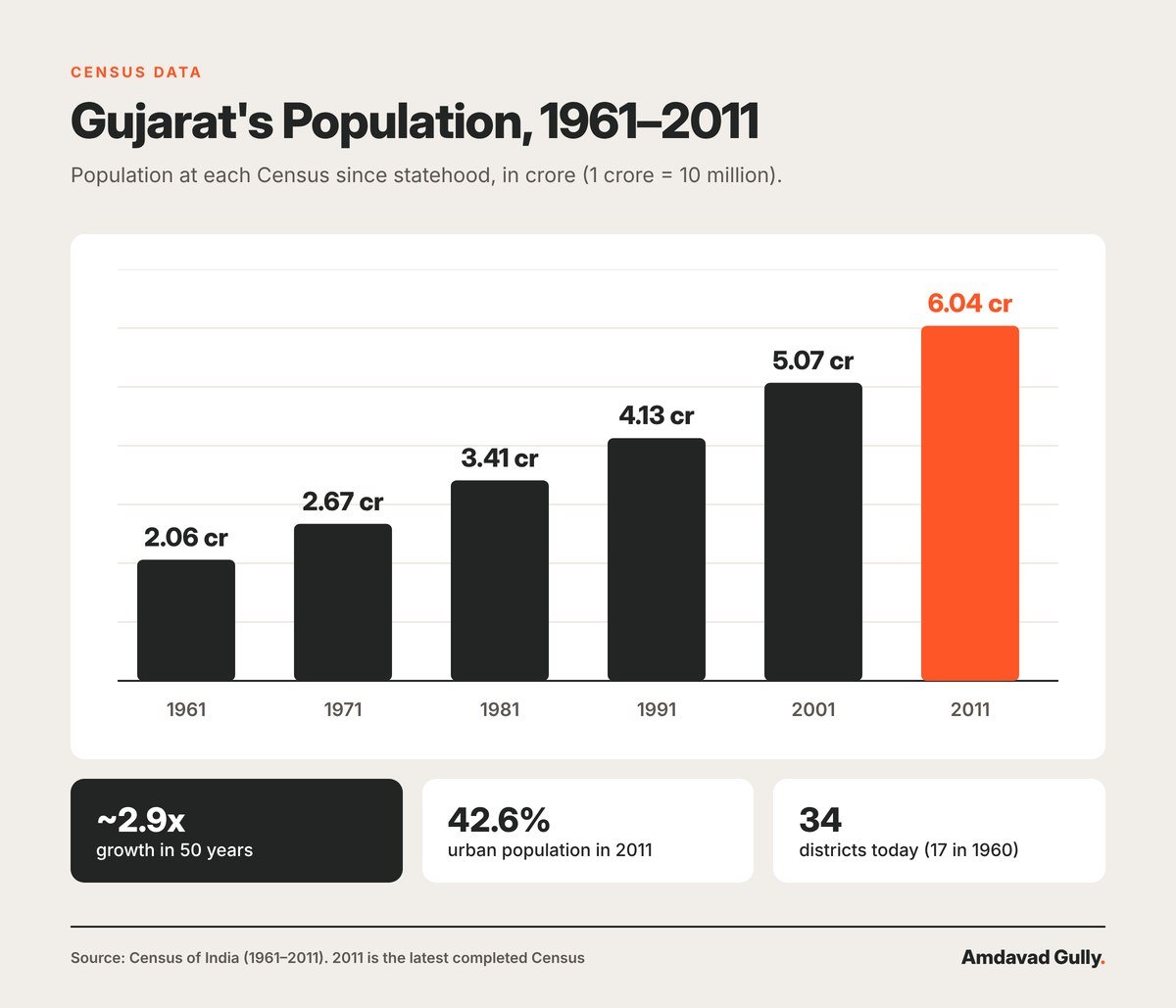
Today, Gujarat has 34 districts, after Vav-Tharad was carved out of Banaskantha in 2025. Its population has nearly tripled since 1960.
Gujarat and the Sea: A Maritime History
If one theme runs through every era, it is the sea. The maritime history of Gujarat is arguably the longest of any Indian region. Let us trace it from start to finish.
From Lothal to Barygaza
First came the Harappans, whose dock at Lothal shipped beads and cotton to Mesopotamia. Then, in the classical age, Bharuch, known to the Greeks as Barygaza, connected India with Egypt and the Roman world. Ships rode the monsoon winds across the Arabian Sea, sailing west in one season and returning in the next.
Khambhat: The Great Medieval Port
In the medieval period, Khambhat, or Cambay, took the lead. The Venetian traveller Marco Polo described it in the late 13th century. Later, the Moroccan traveller Ibn Battuta praised its fine houses and mosques.
In the early 1500s, the Portuguese writer Tomé Pires made a famous observation. He said Cambay stretched out two arms: one towards Aden and the other towards Malacca. In other words, Gujarat sat at the centre of the whole Indian Ocean trade. Indeed, Pires noted that around a thousand Gujarati merchants lived in Malacca alone.
Over time, however, silt filled the Gulf of Khambhat. Big ships could no longer reach the port, so trade shifted to Surat.
Surat, Mandvi and the Gujarati Diaspora
Surat dominated the 17th century, as we saw earlier. Meanwhile, Mandvi in Kutch kept building wooden dhows. Its craftsmen still make them today using skills passed down for generations.
These sea routes also carried people. Gujarati traders settled in Oman, Yemen, Zanzibar, Kenya and Uganda. In the 20th century, many of their descendants moved again, to Britain, the United States and Canada. As a result, the Gujarati diaspora is now one of the largest Indian communities abroad.
Modern Ports
After Partition in 1947, India lost the port of Karachi. To replace it, the government built Kandla in Kutch, which opened in the 1950s. Later, private ports such as Mundra grew rapidly. Today, Gujarat handles a large share of India’s sea cargo. Moreover, Alang, near Bhavnagar, has become one of the world’s largest ship-breaking yards.
So the history of Gujarat on the sea comes full circle. The coast that once welcomed Harappan boats now hosts some of Asia’s busiest harbours.
Cultural History of Gujarat
Kings and battles are only half the story. The cultural history of Gujarat is just as rich, shaped by trade, faith and centuries of exchange.
The Gujarati Language and Literature
Gujarati grew out of the Apabhramsha languages of western India. By the 12th century, scholars such as Hemachandra were recording its early forms. Old Gujarati, sometimes called Maru-Gurjar, was shared with Rajasthan for several centuries.
The 15th-century poet-saint Narsinh Mehta is called the Adi Kavi, or first poet, of Gujarati. His bhajan “Vaishnav Jan To” became Gandhi’s favourite hymn. Later poets include Premanand in the 17th century and Dayaram in the 18th.
Modern Gujarati literature has been just as strong. Zaverchand Meghani collected folk songs and stories, and Gandhi called him the “Rashtriya Shayar”, or national poet. K.M. Munshi wrote popular historical novels about the Solanki age. Four Gujarati writers have also won the Jnanpith Award: Umashankar Joshi, Pannalal Patel, Rajendra Shah and Raghuveer Chaudhari.
A Home for Many Faiths
Gujarat’s history is also a story of welcome. Hinduism, in its Shaiva, Vaishnava and Shakta forms, shaped temples from Somnath to Ambaji. Jainism has deep roots here, with the hill temples of Palitana and Girnar drawing pilgrims from across the world.
Islam arrived early through Arab traders and later through Sufi saints. Their shrines, such as Sarkhej Roza, remain popular with people of every faith. In addition, the Bohra, Khoja and Memon communities built global trading networks from Gujarat.
The Parsis have a special place in this story. According to the Qissa-i-Sanjan, Zoroastrians fleeing Persia landed at Sanjan on the south Gujarat coast many centuries ago. Legend says the local ruler, Jadi Rana, showed them a full bowl of milk to suggest there was no room. In reply, the Parsi priest stirred in sugar, showing they would sweeten the land without spilling over. Today, Udvada holds the oldest continuously burning sacred fire of the Parsis in India.
Gujarat is also home to the Siddis, a community of African descent. Their ancestors came as traders, soldiers and sailors. The famous Sidi Saiyyed Mosque in Ahmedabad, with its stone tree-of-life jali, is named after a Siddi noble.
Textiles: Gujarat’s Gift to the World
For thousands of years, cloth has been central to Gujarat’s history. Harappan sites show early cotton use. In medieval times, Gujarati block-printed cotton reached Egypt, East Africa and Indonesia. In fact, archaeologists have found Gujarati textiles in the old Cairo rubbish heaps at Fustat.
In short, cloth is the thread that ties together the long history of Gujarat. Several crafts are still alive today:
- Patan Patola: A double-ikat silk sari, where both warp and weft threads are tie-dyed before weaving. A single sari can take months.
- Bandhani: Tie-dye work from Kutch, Jamnagar and Saurashtra.
- Ajrakh: Block printing with natural dyes, practised in Kutch.
- Kutchi embroidery: Mirror work and colourful threadwork by communities such as the Rabaris and Ahirs.
Architecture Across the Ages
Walk through Gujarat, and you will see every era of its history in stone. There are Harappan brick cities, Buddhist caves at Junagadh and Khambhalida, and Solanki temples and stepwells. You will also find Sultanate mosques, Mughal tombs and the carved wooden havelis of Ahmedabad’s pols. Finally, colonial palaces such as Baroda’s Laxmi Vilas and modernist landmarks by Le Corbusier and Louis Kahn in Ahmedabad complete the picture.
Stepwells, or vavs, deserve a special mention. These deep, carved wells were both water stores and social spaces. Rani ki Vav and Adalaj are the most famous examples, but hundreds more dot the state.
Garba: A Living Heritage
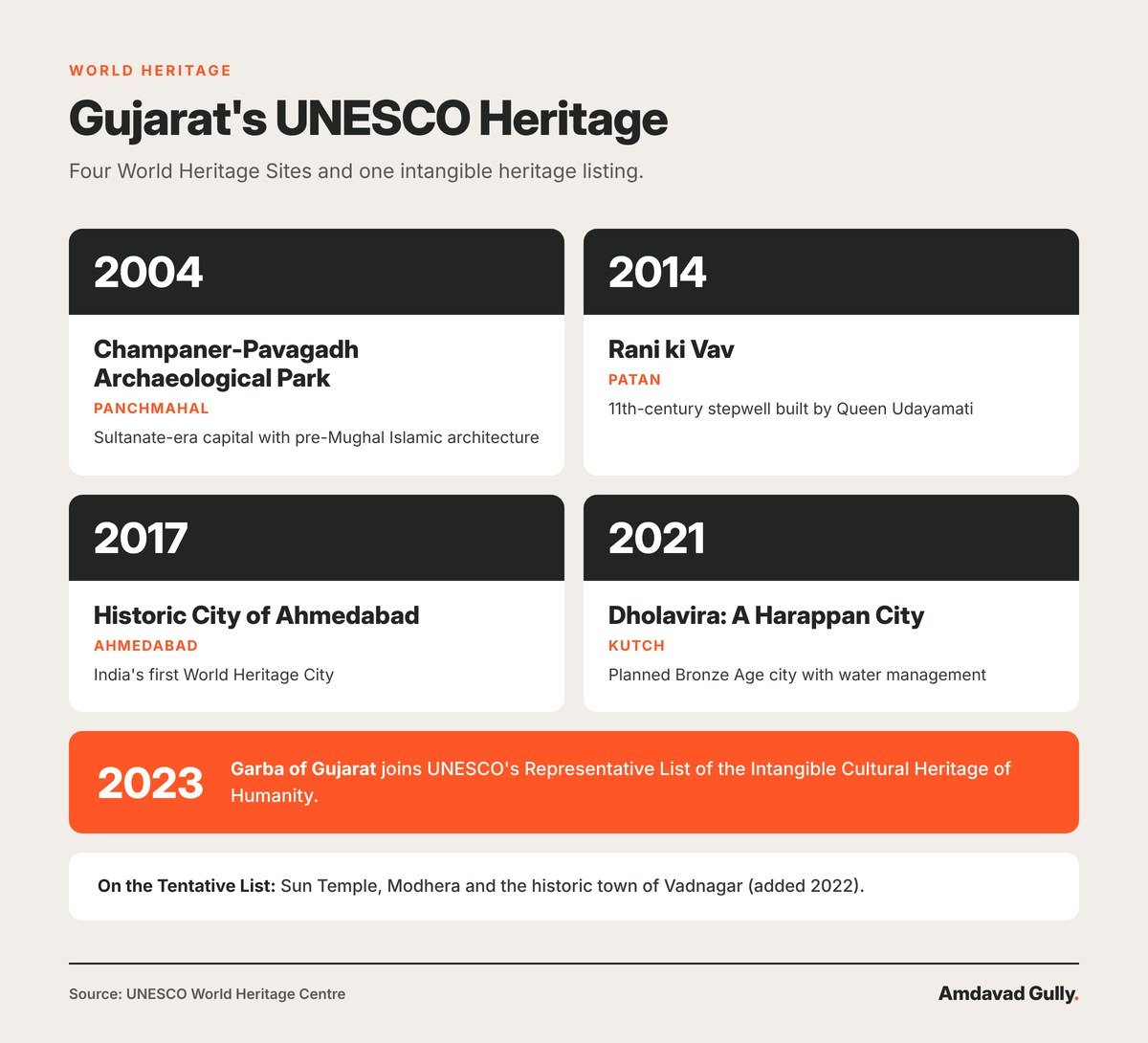
Every Navratri, millions of people across Gujarat dance garba in circles around a lamp or an image of the goddess. This tradition is centuries old. In December 2023, UNESCO added the Garba of Gujarat to its list of the Intangible Cultural Heritage of Humanity. It was India’s 15th entry on that list. Each garba night is a living link to the cultural history of Gujarat.
UNESCO Heritage Sites in Gujarat
The world recognises four places in Gujarat as World Heritage Sites. Each one captures a different chapter of the history of Gujarat.
- Champaner-Pavagadh Archaeological Park (2004): The Sultanate capital of Mahmud Begada.
- Rani ki Vav, Patan (2014): The Solanki queen’s stepwell.
- Historic City of Ahmedabad (2017): India’s first World Heritage City.
- Dholavira (2021): The Harappan city of Kutch.
In addition, the Sun Temple at Modhera and the historic town of Vadnagar joined UNESCO’s Tentative List in 2022. Find more about visiting these sites on Gujarat Tourism.
Women Who Shaped the History of Gujarat
History books often focus on kings and generals. Yet women have shaped Gujarat’s history at every turning point. Here are some names worth knowing.
- Minaldevi (11th–12th century): As regent for her young son Siddharaj Jaysinh, she ran the Solanki kingdom. She is remembered for abolishing a tax on pilgrims travelling to Somnath.
- Udayamati (11th century): The Solanki queen who built Rani ki Vav, now a World Heritage Site.
- Naikidevi (12th century): The queen mother who defeated Muhammad Ghori in 1178.
- Kasturba Gandhi (1869–1944): Born in Porbandar, she led women volunteers and went to jail many times during the freedom struggle.
- Anasuya Sarabhai (1885–1972): A pioneer of India’s labour movement, she led the 1918 Ahmedabad mill strike.
- Mithuben Petit (1892–1973): A Parsi freedom fighter who joined the salt satyagraha and later served tribal communities in south Gujarat.
- Hansa Mehta (1897–1995): A member of India’s Constituent Assembly. At the United Nations, she helped change the wording of the Universal Declaration of Human Rights from “all men” to “all human beings”.
- Ela Bhatt (1933–2022): She founded SEWA, the Self-Employed Women’s Association, in Ahmedabad in 1972. It became one of the world’s largest organisations of women workers.
- Anandiben Patel: She became Gujarat’s first woman Chief Minister in 2014.
Ahmedabad’s Place in the History of Gujarat
At Amdavad Gully, we naturally have a soft spot for our city. Still, it is fair to say that Ahmedabad sits at the centre of the history of Gujarat for the last 600 years.
Before 1411
Long before Ahmed Shah, people lived on this stretch of the Sabarmati. The Bhil settlement of Ashaval stood here. Then came Karnavati, linked to the Solanki king Karna. So when Ahmed Shah built his capital in 1411, he was adding to a very old place.
A City of Pols and Mahajans
The walled city grew around neighbourhoods called pols. A pol is a cluster of houses on a narrow street, often closed by a single gate. Families of the same caste or trade usually lived together. Each pol had its own bird feeder, called a chabutro, and often a temple or well.
Trade guilds called mahajans organised the city’s economy. Their leader, the Nagarsheth, spoke for the merchants to the rulers. In the 17th century, the jeweller Shantidas Jhaveri held this role and dealt directly with Mughal emperors. Remarkably, his family continued as Nagarsheths for generations.
From Mills to the World Stage
In the 19th and 20th centuries, mills made Ahmedabad an industrial city. Then Gandhi made it a political capital of the freedom struggle. After independence, the city’s institutions, from IIM to NID, put it on the world map.
In 2017, Ahmedabad became India’s first UNESCO World Heritage City. Next, the 2030 Commonwealth Games will bring the world to its doorstep. Few cities in India have played so many roles in one region’s history.
Where to See Gujarat’s History Today
Reading is a great start. However, nothing beats seeing history up close. Here are some of the best places to explore the history of Gujarat in person.
Museums
- Lothal Archaeological Site Museum: Beads, seals and pottery from the Harappan port.
- Calico Museum of Textiles, Ahmedabad: One of the world’s finest textile collections, founded by the Sarabhai family in 1949. Visits need advance booking.
- Kutch Museum, Bhuj: Founded in 1877, it is the oldest museum in Gujarat.
- Baroda Museum and Picture Gallery, Vadodara: Art and artefacts collected by the Gaekwads.
- Watson Museum, Rajkot: Treasures from the princely states of Saurashtra.
Heritage Sites
- Dholavira and Lothal: Walk through Harappan streets and see the dockyard.
- Junagadh: See Ashoka’s edicts, Uparkot fort and the Buddhist caves.
- Patan and Modhera: Visit Rani ki Vav, the Sun Temple and the Patola weavers’ workshops.
- Champaner-Pavagadh: Explore Begada’s abandoned capital.
- Dandi: Visit the National Salt Satyagraha Memorial.
- Bhuj: See the Aina Mahal and Smritivan, the 2001 earthquake memorial.
In Ahmedabad
Start with the morning heritage walk through the old city, run by the Ahmedabad Municipal Corporation. It winds through pols, temples and mosques. Next, visit Sabarmati Ashram, Sidi Saiyyed Mosque, Bhadra Fort and Adalaj stepwell. In one weekend, you will see over 600 years of Gujarat’s history.
History of Gujarat: Key Dates at a Glance
Here is a quick timeline of the most important dates in the history of Gujarat. It is handy for exam revision.
| Year | Event |
|---|---|
| c. 3500–1300 BCE | Harappan civilisation flourishes at Dholavira, Lothal and other sites |
| c. 322 BCE | Mauryan governor Pushyagupta builds Sudarshan Lake |
| c. 250 BCE | Ashoka’s edicts carved on the Girnar rock at Junagadh |
| c. 150 CE | Rudradaman’s Sanskrit inscription at Junagadh |
| c. 456 CE | Skandagupta’s governor repairs Sudarshan Lake |
| c. 475 CE | Maitraka dynasty founded at Valabhi |
| 746 CE | Vanraj Chavda founds Anhilwad Patan |
| 942 CE | Mularaja I founds the Solanki dynasty |
| 1026 CE | Mahmud of Ghazni raids Somnath; Modhera Sun Temple built |
| 1178 CE | Naikidevi defeats Muhammad Ghori at Kasahrada |
| 1299 CE | Alauddin Khalji’s armies conquer Gujarat |
| 1407 | Zafar Khan founds the Gujarat Sultanate |
| 1411 | Ahmed Shah I founds Ahmedabad |
| 1484 | Mahmud Begada captures Pavagadh and builds Champaner |
| 1509 | Portuguese win the Battle of Diu |
| 1573 | Akbar annexes Gujarat to the Mughal Empire |
| 1613 | English East India Company opens its factory at Surat |
| 1664 | Shivaji’s first raid on Surat |
| 1753 | Marathas capture Ahmedabad |
| 1818 | British take over the Peshwa’s territories in Gujarat |
| 1861 | Ahmedabad’s first textile mill opens |
| 1869 | Mahatma Gandhi born in Porbandar |
| 1915 | Gandhi sets up Kochrab Ashram in Ahmedabad |
| 1918 | Kheda Satyagraha and Ahmedabad mill strike |
| 1928 | Bardoli Satyagraha; Vallabhbhai Patel becomes “Sardar” |
| 1930 | Dandi March, 12 March to 6 April |
| 1948 | United State of Saurashtra formed; Junagadh plebiscite |
| 1956 | Bombay State formed; Mahagujarat Andolan begins |
| 1960 | State of Gujarat formed on 1 May |
| 1970 | Capital moves to Gandhinagar |
| 2001 | Kutch earthquake |
| 2017 | Ahmedabad becomes India’s first World Heritage City |
| 2018 | Statue of Unity unveiled |
| 2021 | Dholavira becomes a UNESCO World Heritage Site |
| 2023 | Garba added to UNESCO’s intangible heritage list |
Frequently Asked Questions on the History of Gujarat
What is the oldest civilisation in Gujarat?
The Harappan or Indus Valley Civilisation is the oldest urban civilisation in Gujarat. It flourished from about 3500 BCE to 1300 BCE at sites such as Dholavira, Lothal and Rangpur.
How did Gujarat get its name?
Gujarat gets its name from the Gurjaras, who ruled parts of western India from about the 6th century CE. The region came to be called “Gurjaratra”, meaning the land protected by the Gurjaras.
Which dynasty is called the golden age of Gujarat?
The Solanki or Chaulukya dynasty (942–1244 CE) is called the golden age of Gujarat. It ruled from Anhilwad Patan and built the Modhera Sun Temple and Rani ki Vav.
Who founded Ahmedabad and when?
Sultan Ahmed Shah I of the Gujarat Sultanate founded Ahmedabad in 1411. He built it on the east bank of the Sabarmati, near the older settlements of Ashaval and Karnavati.
When was Gujarat formed as a state?
Gujarat was formed on 1 May 1960, when the Bombay Reorganisation Act split the bilingual Bombay State into Gujarat and Maharashtra. The day is celebrated as Gujarat Sthapana Divas.
What was the Mahagujarat Andolan?
The Mahagujarat Andolan was a mass movement from 1956 to 1960 demanding a separate state for Gujarati speakers. It began after police fired on students in Ahmedabad on 8 August 1956 and was led by Indulal Yagnik.
What was the first capital of Gujarat?
Ahmedabad was the first capital of Gujarat, from 1960 to 1970. The capital then moved to the newly built city of Gandhinagar.
Why is Lothal famous?
Lothal is famous for what many scholars consider the world’s earliest known tidal dockyard. It was a Harappan port city near the Gulf of Khambhat, known for bead-making and overseas trade.
What happened at Somnath in 1026?
Around January 1026, Mahmud of Ghazni attacked and plundered the Somnath temple during the reign of the Solanki king Bhima I. The temple was rebuilt several times, most recently in 1951.
What role did Gujarat play in the freedom struggle?
Gujarat was the testing ground for Gandhi’s satyagraha. Key events include the Kheda Satyagraha (1918), the Bardoli Satyagraha (1928) and the Dandi March (1930), which began at Sabarmati Ashram.
How many UNESCO World Heritage Sites are in Gujarat?
Gujarat has four UNESCO World Heritage Sites: Champaner-Pavagadh, Rani ki Vav, the Historic City of Ahmedabad and Dholavira. Garba is also on UNESCO’s intangible heritage list.
How old is the history of Gujarat?
The history of Gujarat goes back hundreds of thousands of years to Stone Age tool-makers. Its urban history began about 5,000 years ago with Harappan cities such as Dholavira and Lothal.
Who built Rani ki Vav?
Queen Udayamati of the Solanki dynasty built Rani ki Vav in Patan in the 11th century, in memory of her husband, King Bhima I. UNESCO listed it as a World Heritage Site in 2014.
What was the capital of the Solanki dynasty?
The Solanki dynasty ruled from Anhilwad Patan, today called Patan, in north Gujarat. The city was founded by Vanraj Chavda in 746 CE.
Why was Surat called the Gateway to Mecca?
Under the Mughals, Hajj pilgrims sailed from Surat to Arabia, so the port was called Bab-ul-Mecca, or Gateway to Mecca. It was also India’s busiest trading port in the 17th century.
How many districts are there in Gujarat?
Gujarat has 34 districts. The newest, Vav-Tharad, was created from Banaskantha in 2025. The state had 17 districts when it was formed in 1960.
Conclusion: Why Gujarat’s History Still Matters
The history of Gujarat is, above all, a story of connection. Its harbours linked India to the world for 4,000 years. Its rulers came from every direction, yet its craftsmen blended their styles into something new. Moreover, its people welcomed traders, refugees and saints, and made them part of the land.
That spirit still shapes Gujarat today. You can see it in Ahmedabad’s pols, Patan’s patola looms, Kutch’s rebuilt villages and Gandhinagar’s tech towers. To understand modern Gujarat, therefore, you have to start with its past.
We will keep this guide updated as new discoveries and milestones arrive. For more stories about the people and places of our city, keep reading Amdavad Gully.