Gujarati movies have never been bigger. In 2025, the devotional drama Laalo – Krishna Sada Sahaayate became the first Gujarati film to cross ₹100 crore worldwide. In 2024, Bollywood remade the Gujarati horror hit Vash as Shaitaan, and it grossed over ₹200 crore. And in September 2026, the National Film Awards were held in Gujarat for the first time.
This is our complete guide to Gujarati movies. It covers the highest-grossing films, the most acclaimed classics, the films other industries chose to remake, and the audience favourites you should watch first. It also explains how Gujarati cinema began, why it nearly disappeared, and how it came roaring back. Every number here comes from a named source, and we date our figures so you know how fresh they are.
Gujarati movies: quick answers
- Highest-grossing Gujarati movie: Laalo – Krishna Sada Sahaayate (2025), about ₹120 crore worldwide.
- First Gujarati talkie: Narsinh Mehta, released on 9 April 1932.
- First Gujarati film to win the National Award for Best Feature Film: Hellaro (2019).
- Gujarati films sent to the Oscars: The Good Road (2013) and Chhello Show (2022). Chhello Show made the shortlist.
- Biggest Bollywood remake of a Gujarati film: Shaitaan (2024), remade from Vash (2023).
- Latest National Award for Best Gujarati Film: Maaran, at the 72nd National Film Awards (2026).
- Nickname of the industry: Dhollywood, also called Gollywood.
In this guide:
- What is Gujarati cinema?
- A short history of Gujarati movies
- Gujarati cinema in numbers
- Highest-grossing Gujarati movies
- Critically acclaimed Gujarati movies
- Gujarati movies remade by Bollywood and others
- Top-rated Gujarati movies and audience favourites
- Best Gujarati movies by genre
- Stars, directors and music
- Where to watch Gujarati movies
- Frequently asked questions
What Is Gujarati Cinema?
Gujarati cinema is the film industry that makes movies in the Gujarati language. It serves over five crore Gujarati speakers in Gujarat, Mumbai and across a large global diaspora. People also call it Dhollywood, a name inspired by the dhol, the drum heard in so many of its songs. Some trade writers prefer Gollywood.
However, unlike Bollywood, Gujarati movies do not have one central studio town. Instead, films are shot across Ahmedabad, Vadodara, Kutch, Saurashtra and Mumbai. In addition, many producers, writers and actors also work in Gujarati theatre, which has always fed talent into the film industry.
For most of its history, Gujarati cinema meant rural dramas, mythology and folk legends. Today, however, Gujarati movies range from urban comedies and family dramas to horror, thrillers and art-house films that travel to Cannes and the Oscars.
A Short History of Gujarati Movies
The story of Gujarati movies is one of early brilliance, a long slump and a dramatic revival. Here is how it unfolded.
The Silent Era: Gujaratis Behind the Camera (1913–1931)
Gujaratis were among the pioneers of Indian cinema. Between 1913 and 1931, Gujarati entrepreneurs owned around twenty leading film companies and studios. At least forty-four Gujarati directors worked during the silent era. However, most of their films were made in Bombay for audiences across India, not just for Gujarati speakers.
One early film made history for a different reason. Bhakta Vidur (1921), made by Kohinoor Film Company, is described as the first film banned in India by the British. At the time, its hero was widely read as a stand-in for Gandhi, and the authorities saw it as political.
In 1931, a short Gujarati sound film called Chav Chavno Murabbo was released. Notably, it came out before Alam Ara, India’s first full-length talkie.
The First Gujarati Talkie (1932)
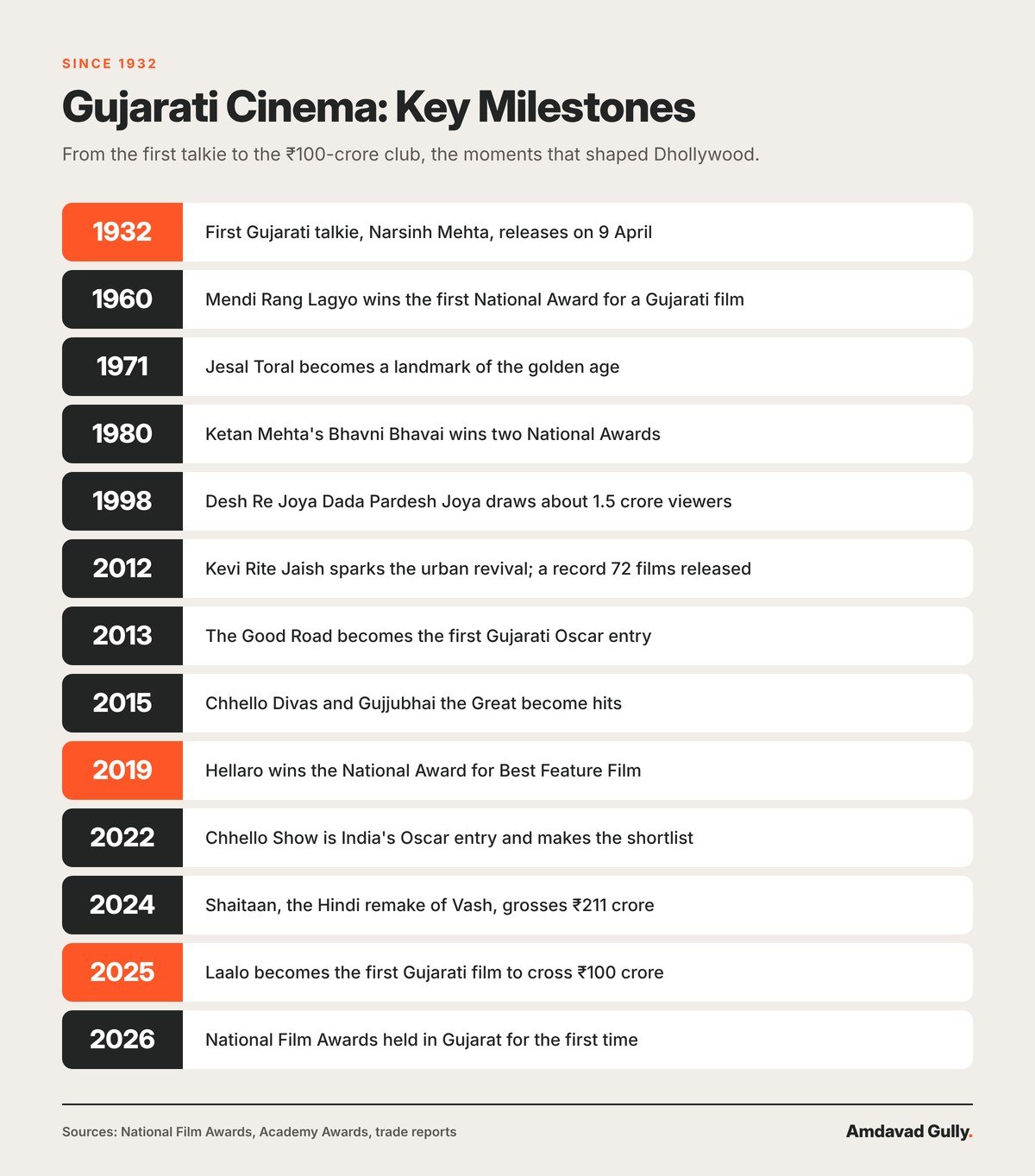
The true birth of Gujarati movies came on 9 April 1932. That day, Narsinh Mehta, directed by Nanubhai Vakil, became the first full-length Gujarati talkie. It told the story of the 15th-century poet-saint Narsinh Mehta, whose bhajan “Vaishnav Jan To” later became Gandhi’s favourite hymn.
Still, growth was slow. Only twelve Gujarati films were made between 1932 and 1940. In some years, such as 1933, 1937 and 1938, no Gujarati films were released at all. Then, from 1941 to 1946, production stopped completely during the war years.
After Independence (1947–1960)
Independence brought a burst of energy. In 1948 alone, 26 Gujarati films were released. Between 1946 and 1952, the number reached 74. Most of them, however, were mythological stories, saint biographies and folk tales.
However, the split of Bombay State in 1960 created a problem. Film studios stayed in Bombay, which went to Maharashtra. As a result, the new state of Gujarat had no major studios of its own. This hurt the quality and volume of Gujarati movies for years.
On the brighter side, 1960 also brought the first National Award for a Gujarati film. Mendi Rang Lagyo, directed by Manhar Raskapur, won the award for Best Feature Film in Gujarati.
The Golden Age (1960s–1980s)
From the 1960s to the 1980s, Gujarati cinema enjoyed its first golden age. Folk legends, devotional stories and rural romances packed single-screen theatres across the state.
Films such as Kanku (1969), based on a story by the great writer Pannalal Patel, won national recognition. Meanwhile, Jesal Toral (1971), directed by Ravindra Dave, became one of the era’s best-loved hits. Meanwhile, stars like Upendra Trivedi, Arvind Trivedi and Snehlata became household names.
In the 1970s, the state government offered tax breaks and subsidies to encourage production. Output rose sharply. However, critics felt quality fell, as producers rushed out quick, low-budget films to claim the benefits.
The decade also produced one of the finest Gujarati movies ever made. In 1980, Ketan Mehta directed Bhavni Bhavai, a sharp satire on caste told through the folk theatre form called bhavai. With Naseeruddin Shah, Smita Patil and Om Puri in the cast, it won two National Awards and travelled to international festivals.
The Long Decline (1980s–2000s)
By the late 1980s, Gujarati movies were in trouble. By then, urban audiences had moved to Hindi films and television. Theatres in cities rarely screened Gujarati titles. As a result, the industry survived mainly on rural audiences and small-town single screens.
There were still big moments. Superstar Naresh Kanodia ruled the 1980s and 1990s with action-packed rural dramas. Then, in 1998, Desh Re Joya Dada Pardesh Joya, directed by Govindbhai Patel, became a phenomenon. It reportedly drew around 1.5 crore viewers and grossed about ₹22 crore, a record that stood for over two decades.
Even so, the overall slide continued. By 2000, fewer than twenty new Gujarati films were being released in a year.
The Revival (2012–2019)
The turnaround began in 2012. That year, a record 72 Gujarati films were released. More importantly, a young director named Abhishek Jain released Kevi Rite Jaish. It was a witty, urban comedy about a Gujarati family’s dream of moving to America. City audiences, who had ignored Gujarati movies for years, suddenly showed up.
Jain followed it with Bey Yaar (2014), a buddy comedy starring Pratik Gandhi and Divyang Thakkar. Then, in 2015, two films changed everything. Krishnadev Yagnik’s college comedy Chhello Divas and Siddharth Randeria’s family comedy Gujjubhai the Great both became major hits.
The numbers tell the story. Screens showing Gujarati movies jumped from about 20–25 in 2011 to around 150–160 in 2015. Meanwhile, annual box office rose from roughly ₹7 crore in 2014 to about ₹55 crore in 2015.
Government support also helped. In 2016, Gujarat launched a new incentive policy that graded films and offered financial assistance based on quality. It also required multiplexes to screen Gujarati films a minimum number of times each year.
By 2019, the industry had found its biggest star yet. Vipul Mehta’s Chaal Jeevi Laiye!, a father-son road trip comedy, grossed over ₹50 crore. That same year, Abhishek Shah’s Hellaro became the first Gujarati film to win the National Award for Best Feature Film.
The Boom Years (2020–2026)
At first, the pandemic shut theatres in 2020. Still, Gujarati movies bounced back fast. In 2022, Chhello Show became India’s official Oscar entry and made the Academy’s shortlist. Comedies such as Fakt Mahilao Maate and Kehvatlal Parivar drew families back to cinemas.
In 2023, 3 Ekka became a blockbuster, and Vash proved Gujarati filmmakers could master horror. A year later, Bollywood’s Shaitaan, a remake of Vash, grossed over ₹211 crore worldwide.
Then came 2025, the biggest year in the history of Gujarati movies. According to Ormax Media, Gujarati films had already grossed ₹103 crore by early October 2025, with one crore footfalls. That made Gujarati the sixth-biggest Indian language at the box office, ahead of Marathi, Punjabi and Bengali.
After that, Laalo – Krishna Sada Sahaayate rewrote the record books. Made on a budget of about ₹50 lakh, it started slowly in October 2025 before word of mouth turned it into a sensation. It became the first Gujarati film to cross ₹100 crore worldwide. In 2026, it was even screened at the Cannes Film Festival.
Finally, in September 2026, the 72nd National Film Awards ceremony took place at Ekta Nagar in Gujarat. It was the first time the ceremony was held outside New Delhi in decades. Fittingly, Abhishek Jain, who started the revival, won Best Gujarati Film for Maaran.
Gujarati Cinema in Numbers
Numbers help show how far Gujarati movies have come. Here are the key data points, all drawn from published sources.
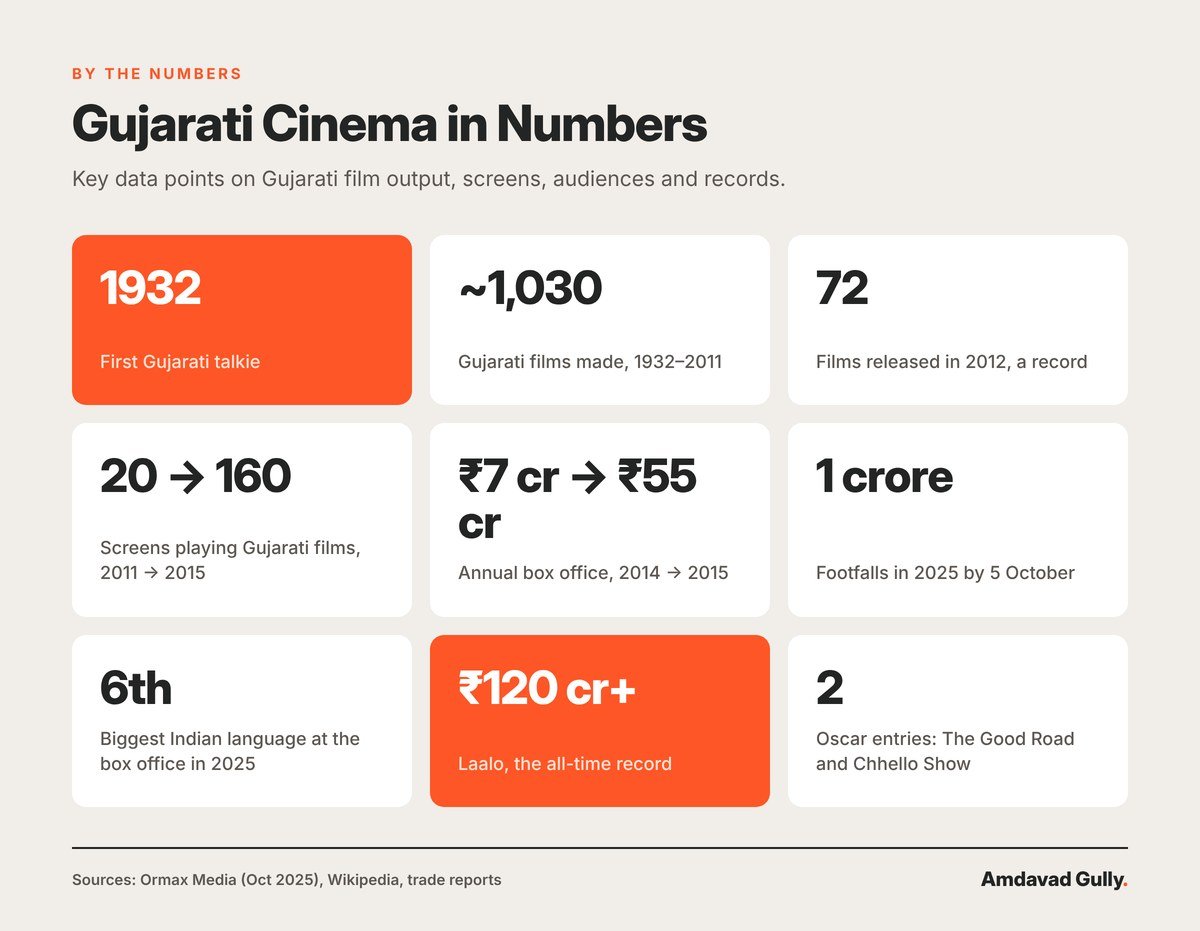
- About 1,030 Gujarati films were made between 1932 and 2011.
- 72 Gujarati films released in 2012, the highest in a single year.
- 50–80 Gujarati movies have been released in most years since 2014.
- Over ₹80 crore: total Gujarati box office in 2024, up about 66% on 2023.
- ₹103 crore gross and one crore footfalls by 5 October 2025, per Ormax Media.
- 60%: share of the 2023 Gujarati box office earned by 3 Ekka alone.
- ₹5–10 crore: typical earnings for a mid-sized Gujarati hit in 2024–25.
In short, Gujarati movies are no longer a niche. They now form one of India’s fastest-growing regional film markets.
Highest-Grossing Gujarati Movies of All Time
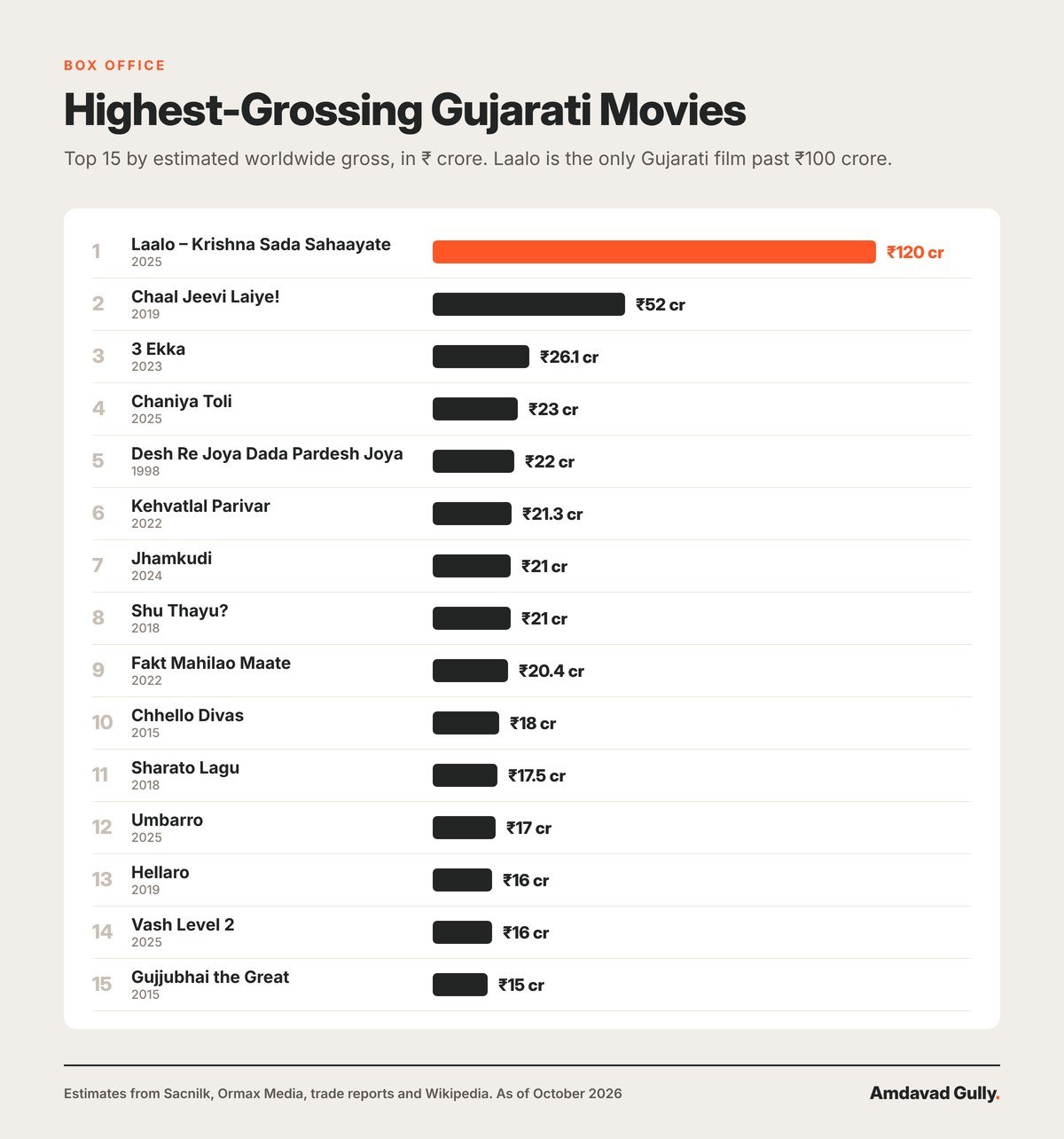
Unfortunately, box office data for Gujarati movies is patchy. Producers rarely publish official figures, and trackers often disagree. So we have built this list only from figures reported by named trade sources, such as Sacnilk, Ormax Media and industry reports collected on Wikipedia. Figures are estimated worldwide gross in ₹ crore, unless noted. They are accurate as of October 2026.
We found reliable figures for 23 Gujarati movies. Instead of padding the list with guesses, we have stopped there. We will add more films as verified numbers become available.
The Complete Box Office Table
| Rank | Movie | Year | Est. gross (₹ crore) | Director |
|---|---|---|---|---|
| 1 | Laalo – Krishna Sada Sahaayate | 2025 | ~120 | Ankit Sakhiya |
| 2 | Chaal Jeevi Laiye! | 2019 | ~52 | Vipul Mehta |
| 3 | 3 Ekka | 2023 | ~26 | Rajesh Sharma |
| 4 | Chaniya Toli | 2025 | ~22–23 | – |
| 5 | Desh Re Joya Dada Pardesh Joya | 1998 | ~22 | Govindbhai Patel |
| 6 | Kehvatlal Parivar | 2022 | ~21 | Vipul Mehta |
| 7 | Jhamkudi | 2024 | ~21 | – |
| 8 | Shu Thayu? | 2018 | ~21 | Krishnadev Yagnik |
| 9 | Fakt Mahilao Maate | 2022 | ~20.4 | – |
| 10 | Chhello Divas | 2015 | ~18 | Krishnadev Yagnik |
| 11 | Sharato Lagu | 2018 | ~17.5 | – |
| 12 | Umbarro | 2025 | ~17 | – |
| 13 | Hellaro | 2019 | ~16 | Abhishek Shah |
| 14 | Vash Level 2 | 2025 | ~16 | Krishnadev Yagnik |
| 15 | Gujjubhai the Great | 2015 | ~15 | – |
| 16 | Bachu Ni Benpani | 2025 | ~15 | – |
| 17 | All The Best Pandya | 2025 | ~14 | – |
| 18 | Naadi Dosh | 2022 | ~13.5 | Krishnadev Yagnik |
| 19 | Gujjubhai – Most Wanted | 2018 | ~10 | – |
| 20 | Golkeri | 2020 | ~9 | Viral Shah |
| 21 | Bey Yaar | 2014 | ~8.5 | Abhishek Jain |
| 22 | Karsandas Pay & Use | 2017 | ~8 | Krishnadev Yagnik |
| 23 | Jai Mata Ji – Let’s Rock | 2025 | ~8 | – |
Notes: A dash means we could not confirm the director from a reliable source. Desh Re Joya Dada Pardesh Joya’s 1998 gross would be far higher in today’s money. Golkeri’s run was cut short when theatres shut for COVID-19 in March 2020.
Understanding Gujarati Box Office Numbers
Before you compare these figures, it helps to know what they mean. Otherwise, it is easy to be misled by headlines.
- Net collection: This is the money earned at Indian theatres after taxes are removed. Trade trackers often quote net figures first.
- Gross collection: This includes taxes. Therefore, gross figures are always higher than net figures for the same film.
- Worldwide gross: This adds overseas earnings to the Indian gross. For most Gujarati movies, overseas income is small. However, it can matter for big hits with a strong diaspora audience.
- Footfalls: This is the number of tickets sold. Because ticket prices rise every year, footfalls are often a fairer way to compare films from different decades.
For example, Desh Re Joya Dada Pardesh Joya earned about ₹22 crore in 1998 from roughly 1.5 crore viewers. In comparison, Jhamkudi earned a similar ₹21 crore in 2024, but from about 25 lakh footfalls. In other words, the 1998 film was watched by about six times as many people. So, by footfalls, it may still be one of the most-watched Gujarati movies ever.
1. Laalo – Krishna Sada Sahaayate (2025)
No Gujarati movie has ever done what Laalo did. Directed by Ankit Sakhiya, it follows a rickshaw driver trapped at a farmhouse who must face his past. Along the way, he has visions of Lord Krishna, who guides him towards healing.
The film was made for only about ₹50 lakh and opened quietly on 10 October 2025. Then, in its fourth week, word of mouth exploded. Collections climbed week after week, which is very rare for any Indian film. By late November, it had crossed ₹100 crore worldwide, and estimates now place it around ₹120 crore. A Hindi dubbed version followed on 9 January 2026.
Why Did Laalo Succeed? Five Lessons
The rise of Laalo is the most surprising story in the history of Gujarati movies. So what can other filmmakers learn from it? Here are five lessons.
- First, budget is not destiny. The film cost about ₹50 lakh, far less than most Gujarati releases. Even so, it out-earned every Gujarati film before it.
- Second, word of mouth beats a big opening. The film started slowly. However, viewers kept recommending it, and collections actually grew in the fourth week. That kind of late surge is very rare.
- Third, faith and family still draw crowds. A devotional story about Krishna brought in families, including many people who rarely visit cinemas.
- Fourth, theatre support matters. According to reports cited on Wikipedia, major multiplex chains waived the usual virtual print fee for the film. As a result, it could stay on more screens for longer.
- Finally, a hit can travel. After its Gujarati run, the film was dubbed into Hindi, screened at Cannes and drew remake interest from South Indian producers.
In short, Laalo showed that a small Gujarati movie with a sincere story can reach audiences far beyond Gujarat. Many producers are now hoping to repeat that formula.
2. Chaal Jeevi Laiye! (2019)
For six years, Chaal Jeevi Laiye! was the undisputed king of Gujarati movies. Vipul Mehta directed this warm comedy-drama about a workaholic son, played by Yash Soni, and his fun-loving father, played by Siddharth Randeria. When the father gets bad news about his health, the two set off on a trip to the Himalayas.
The film released on 1 February 2019 and kept running for months. It grossed an estimated ₹50–52 crore and later released in Australia, New Zealand and the UK. In 2024, it was remade in Marathi as Ole Aale, starring Nana Patekar.
3. 3 Ekka (2023)
3 Ekka brought together three of the revival’s biggest young stars: Malhar Thakar, Yash Soni and Mitra Gadhavi. Directed by Rajesh Sharma, this comedy released on 25 August 2023. It grossed over ₹12 crore in its first week and became the second-highest-grossing Gujarati film at the time. According to Ormax Media, it alone accounted for about 60% of the Gujarati box office in 2023.
4. Chaniya Toli (2025)
Released on 21 October 2025, Chaniya Toli recorded the highest opening day for a Gujarati movie at the time. It went on to gross about ₹21.6 crore according to Sacnilk, with other estimates near ₹23 crore. Its success, alongside Laalo, made October 2025 the biggest month in Gujarati box office history.
5. Desh Re Joya Dada Pardesh Joya (1998)
This family drama by Govindbhai Patel is a legend of Gujarati movies. It drew an estimated 1.5 crore viewers at a time when urban audiences had largely abandoned Gujarati films. Its ₹22 crore gross stood as the record for over 20 years. Many families in Gujarat still remember watching it together in single-screen theatres.
6 to 10: The Comedy Powerhouses
The next five films show how much audiences love Gujarati comedy.
- Kehvatlal Parivar (2022): Vipul Mehta reunited with Siddharth Randeria, with Supriya Pathak, for this family comedy.
- Jhamkudi (2024): Starring Manasi Parekh and Viraj Ghelani, it was the top Gujarati film of 2024, with about ₹21 crore and 25 lakh footfalls per Ormax Media.
- Shu Thayu? (2018): Krishnadev Yagnik’s comedy, starring Malhar Thakar, was a remake of the Tamil film Naduvula Konjam Pakkatha Kaanom.
- Fakt Mahilao Maate (2022): Yash Soni plays a man who can suddenly hear women’s thoughts. Amitabh Bachchan made his Gujarati debut with a cameo. Sacnilk puts its worldwide gross at ₹20.4 crore.
- Chhello Divas (2015): Made on a budget of about ₹2.8 crore, this college comedy earned around ₹18 crore and ran for more than 50 days. It also launched the careers of Malhar Thakar, Yash Soni, Janki Bodiwala and several others.
11 to 23: The Rest of the List
The remaining films include several 2025 releases, which shows how fast the market is growing. Umbarro, Vash Level 2, Bachu Ni Benpani and All The Best Pandya all crossed ₹14 crore in a single year. Meanwhile, Hellaro is the rare art-house Gujarati movie that also succeeded at the box office.
Older hits such as Gujjubhai the Great, Bey Yaar and Karsandas Pay & Use earned less in absolute terms. Even so, they mattered more than their numbers suggest. They proved that city audiences would pay to watch Gujarati movies again.
The Biggest Gujarati Hit of Each Year
Another useful way to read the box office is year by year. The table below shows the biggest Gujarati movie of each year for which reliable figures exist. As you can see, the size of the top hit has grown sharply since the revival began.
| Year | Biggest Gujarati hit | Est. gross (₹ crore) |
|---|---|---|
| 1998 | Desh Re Joya Dada Pardesh Joya | ~22 |
| 2014 | Bey Yaar | ~8.5 |
| 2015 | Chhello Divas | ~18 |
| 2018 | Shu Thayu? | ~21 |
| 2019 | Chaal Jeevi Laiye! | ~52 |
| 2020 | Golkeri | ~9 |
| 2022 | Kehvatlal Parivar | ~21 |
| 2023 | 3 Ekka | ~26 |
| 2024 | Jhamkudi | ~21 |
| 2025 | Laalo – Krishna Sada Sahaayate | ~120 |
Note: Years without reliable data are left out. For 2014, we list the biggest hit among films with published figures.
Two patterns stand out. First, comedies dominate almost every year. Second, the ceiling keeps rising. In 2014, a hit Gujarati movie earned under ₹10 crore. By 2025, the top film had earned more than ten times that amount.
Which Gujarati Movies of 2026 Have Done Well?
As of October 2026, no 2026 Gujarati release has come close to Laalo. Dhabkaaro, backed by producer Sajid Nadiadwala, recorded around ₹2 crore worldwide in its opening weekend, the biggest Gujarati opening of 2026 at that point. Malhar Thakar’s Lagan Laagii Re had recovered about half its budget after 25 days, according to Koimoi. We will update this section as the year closes.
Critically Acclaimed Gujarati Movies
Of course, box office tells you what audiences loved. Awards and festivals tell you what critics and juries admired. This list covers Gujarati movies that won National Film Awards, represented India at the Oscars, or earned major international festival honours.
We have included only films with documented recognition, plus Kevi Rite Jaish, the landmark that critics credit with starting the revival. As a result, the list has 22 titles rather than 100. Every award below can be checked against official records.
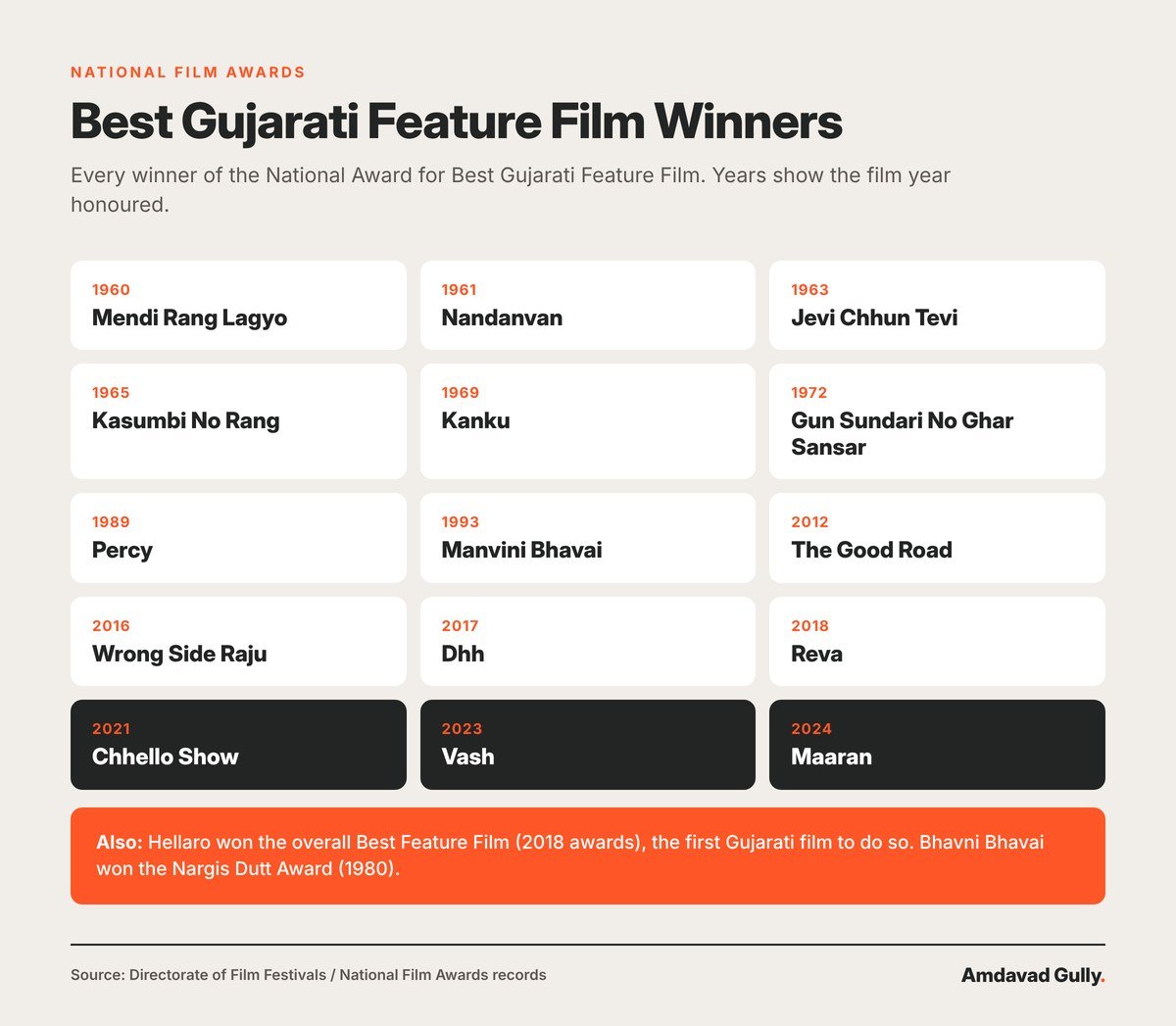
The Complete List of Acclaimed Gujarati Movies
| Movie | Year | Director | Key recognition |
|---|---|---|---|
| Mendi Rang Lagyo | 1960 | Manhar Raskapur | First National Award for Best Gujarati Film |
| Nandanvan | 1961 | Ganpatrao Brahmbhatt | National Award, Best Gujarati Film |
| Jevi Chhun Tevi | 1963 | Gajanan Mehta | National Award, Best Gujarati Film |
| Kasumbi No Rang | 1965 | G.K. Mehta | National Award, Best Gujarati Film |
| Kanku | 1969 | Kantilal Rathod | National Award, Best Gujarati Film |
| Gun Sundari No Ghar Sansar | 1972 | Govind Saraiya | National Award, Best Gujarati Film |
| Bhavni Bhavai | 1980 | Ketan Mehta | Nargis Dutt Award for National Integration; Best Production Design |
| Percy | 1989 | Pervez Merwanji | National Award, Best Gujarati Film |
| Manvini Bhavai | 1993 | Upendra Trivedi | National Award, Best Gujarati Film |
| Kevi Rite Jaish | 2012 | Abhishek Jain | Launched the urban revival |
| Veer Hamirji | 2012 | – | Shortlisted for India’s Oscar entry |
| The Good Road | 2013 | Gyan Correa | National Award; first Gujarati Oscar entry |
| Wrong Side Raju | 2016 | Mikhil Musale | National Award, Best Gujarati Film |
| Dhh | 2017 | Manish Saini | National Award, Best Gujarati Film |
| Reva | 2018 | Rahul Bhole, Vinit Kanojia | National Award, Best Gujarati Film |
| Hellaro | 2019 | Abhishek Shah | National Award, Best Feature Film; IFFI 2019 opening film |
| Chhello Show | 2021 | Pan Nalin | Oscar shortlist; Golden Spike at Valladolid; National Award |
| Gandhi & Co | 2022 | – | National Award, Best Children’s Film |
| Kutch Express | 2023 | – | Three National Awards, including Best Actress |
| Vash | 2023 | Krishnadev Yagnik | National Award, Best Gujarati Film; Best Supporting Actress |
| Maaran | 2024 | Abhishek Jain | National Award, Best Gujarati Film (72nd) |
| Laalo – Krishna Sada Sahaayate | 2025 | Ankit Sakhiya | First Gujarati film screened at Cannes (2026) |
Note: Years are release or certification years, not ceremony years.
Hellaro (2019): Gujarati Cinema’s Greatest Honour
Hellaro is the most decorated Gujarati movie ever made. Abhishek Shah‘s debut is set in a Kutch village in 1975, where women are forbidden from doing garba. When a dhol player arrives, the women begin to dance in secret, and their rebellion changes the village.
It won the National Award for Best Feature Film, the first Gujarati film to do so. Its 13 lead actresses also shared a Special Jury Award. In addition, it opened the 50th International Film Festival of India in Goa. Remarkably, it also grossed about ₹16 crore, proving that serious Gujarati movies can find a mass audience.
Chhello Show (2021): The Oscar Journey
Pan Nalin‘s semi-autobiographical film follows a nine-year-old boy in a Saurashtra village who falls in love with cinema. He befriends a projectionist and trades his lunch for a chance to watch films from the booth.
The film premiered at the Tribeca Film Festival in June 2021, the first Gujarati film in its Spotlight section. It won the Golden Spike for Best Picture at Spain’s Valladolid festival and the audience award at Mill Valley. Then it was selected as India’s official entry for the 95th Academy Awards and made the shortlist for Best International Feature Film. It also won the National Award for Best Gujarati Film. Internationally, it is known as Last Film Show.
Bhavni Bhavai (1980): The Classic
Even today, many critics consider Bhavni Bhavai the greatest Gujarati movie ever made. Ketan Mehta used the colourful folk theatre form of bhavai to tell a fable about caste and power. It stars Naseeruddin Shah, Smita Patil, Om Puri and Dina Pathak.
It won the Nargis Dutt Award for Best Feature Film on National Integration and the award for Best Production Design. Abroad, it was shown at the Museum of Modern Art in New York and won a human rights award at the Three Continents Festival in Nantes, France. More than four decades later, it still feels bold and fresh.
The Good Road (2013): First Oscar Entry
Gyan Correa’s The Good Road weaves together three stories along a highway in Kutch. A lost boy, a truck driver and a young girl cross paths in unexpected ways. It won the National Award for Best Gujarati Film. Later, it became the first Gujarati movie selected as India’s official entry to the Oscars.
Wrong Side Raju (2016)
Mikhil Musale’s thriller stars Pratik Gandhi as a driver caught up in a hit-and-run case involving a rich family. It was produced with Phantom Films and won the National Award for Best Gujarati Film. For many viewers, it was the first sign of the talent that later made Pratik Gandhi a national star.
Dhh (2017) and Reva (2018)
Manish Saini’s Dhh is a gentle children’s film about three schoolboys who fail their exams and try to find a magic shortcut. It won the National Award for Best Gujarati Film.
Reva is based on Dhruv Bhatt’s acclaimed novel Tatvamasi. It follows a young man from abroad who travels along the Narmada river and discovers a deeper sense of belonging. It won the National Award for Best Gujarati Film for 2018.
Vash (2023): Horror With a National Award
Krishnadev Yagnik’s Vash is a chilling story about a stranger who takes control of a teenage girl through black magic. It starred Hitu Kanodia, Niilam Paanchal, Janki Bodiwala and Hiten Kumar.
At the 71st National Film Awards, it won Best Gujarati Film, and Janki Bodiwala won Best Supporting Actress. It is also the most successful Gujarati movie ever remade by Bollywood, as you will see below.
Kutch Express (2023) and Maaran (2024)
Kutch Express, starring Manasi Parekh and Ratna Pathak Shah, won three National Awards at the 70th edition. These included Best Film Promoting National, Social and Environmental Values, Best Actress for Manasi Parekh (shared) and Best Costume Design.
Meanwhile, Abhishek Jain’s Maaran is a social thriller starring Yash Soni and Deeksha Joshi. It deals with the captivity of women, a theme rarely explored in Gujarati movies. It won at the Chicago South Asian Film Festival in 2024 and then the National Award for Best Gujarati Film at the 72nd awards in 2026.
Classic Gujarati Movies Every Fan Should Know
Of course, lists and box office tables only tell part of the story. So here is a closer look at the classic Gujarati movies that built the industry. Some are hard to find today, but all of them matter.
Narsinh Mehta (1932)
This is where Gujarati movies began. Nanubhai Vakil’s film told the life of Narsinh Mehta, the 15th-century poet-saint of Junagadh. Interestingly, the film avoided showing miracles, which was unusual for devotional films of that time. Instead, it focused on the saint’s devotion and the social challenges he faced.
Mendi Rang Lagyo (1960)
Directed by Manhar Raskapur, this film won the very first National Award for Best Gujarati Film. It arrived in the same year Gujarat became a separate state. As a result, it is often seen as the start of Gujarati cinema’s post-statehood era.
Kanku (1969)
Kanku was based on a story by Pannalal Patel, one of the giants of Gujarati literature. Directed by Kantilal Rathod, it is a sensitive rural drama centred on a woman’s life and choices. It won the National Award for Best Gujarati Film. Moreover, it showed that Gujarati movies could adapt serious literature with care.
Jesal Toral (1971)
Directed by Ravindra Dave, Jesal Toral retold a famous Saurashtra folk legend. A feared outlaw, Jesal, is transformed by the devotion of the saintly Toral. The film’s songs and story made it one of the most loved Gujarati movies of the golden age. Even today, many Gujarati families know its tale by heart.
Percy (1989)
Pervez Merwanji’s Percy is a rare Gujarati film set in Bombay’s Parsi community. It follows a shy, gentle young man and his quiet struggles. Produced by the National Film Development Corporation, it won the National Award for Best Gujarati Film. It also reminds us that Gujarati movies have always included many communities, not just one.
Manvini Bhavai (1993)
Upendra Trivedi directed and produced this adaptation of Pannalal Patel’s celebrated novel. The story is set against a terrible famine in rural Gujarat at the end of the 19th century. It won the National Award for Best Gujarati Film. For many critics, it is the finest literary adaptation in the history of Gujarati movies.
Kevi Rite Jaish (2012)
Simply put, without this film, the modern revival might never have happened. Abhishek Jain’s comedy follows a young man whose family is obsessed with getting him to the United States. It gently mocks the Gujarati dream of going abroad, while also taking it seriously. Above all, it spoke the language of young urban Gujaratis, and they responded by filling theatres.
Bey Yaar (2014)
Jain’s follow-up starred Pratik Gandhi and Divyang Thakkar as two lifelong friends from Ahmedabad’s old city. When one of them is cheated in a deal involving a valuable painting, the pair set out to get even. The film’s humour, warmth and Amdavadi flavour made it a favourite. In addition, it gave Pratik Gandhi his first major film role.
Gujjubhai the Great (2015)
Siddharth Randeria was already a stage legend when he brought his comic character to cinema. Gujjubhai the Great was a fast, loud family comedy, and audiences loved it. It grossed around ₹15 crore and led to a sequel, Gujjubhai – Most Wanted (2018). Together, the films proved that Gujarati theatre audiences would follow their stars into cinemas.
Recent Gujarati Hits Worth Knowing
The 2020s have been the busiest decade yet for Gujarati movies. Besides the record-breakers, several other films deserve a closer look.
Golkeri (2020)
Directed by Viral Shah, Golkeri stars Malhar Thakar and Manasi Parekh, with Sachin Khedekar and Vandana Pathak as the parents. It is a Gujarati remake of the Marathi hit Muramba. Unfortunately, its run was cut short in March 2020 when theatres closed for the pandemic. Even so, it had already earned about ₹9 crore in just 17 days.
Fakt Mahilao Maate (2022)
This fantasy comedy imagines a man who can suddenly hear what women are thinking. Yash Soni plays the lead. Moreover, the film made headlines because Amitabh Bachchan made his Gujarati-language debut in a cameo. It grossed about ₹20.4 crore worldwide, and a follow-up, Fakt Purusho Maate, arrived in 2024.
Kehvatlal Parivar (2022)
After Chaal Jeevi Laiye!, director Vipul Mehta and actor Siddharth Randeria teamed up again. This time, Supriya Pathak joined them for a comedy about a lovably chaotic family. Not surprisingly, family audiences turned up in large numbers, and the film earned about ₹21 crore.
Jhamkudi (2024)
Starring Manasi Parekh and Viraj Ghelani, Jhamkudi was the biggest Gujarati movie of 2024. According to Ormax Media, it earned about ₹21 crore from 25 lakh footfalls. As a result, it confirmed Manasi Parekh as one of the most bankable stars in Gujarati cinema.
Kasoombo (2024)
Directed by Vijaygiri Bava, Kasoombo is a historical drama set during Alauddin Khalji’s invasion of Gujarat. It was produced by Krishnadev Yagnik. According to Ormax Media, it drew more than 12 lakh viewers. In addition, it showed that Gujarati audiences will support large-scale historical stories, not just comedies.
Gandhi & Co (2022)
This children’s film won the National Award for Best Children’s Film. Its story uses Gandhian ideas in a playful, child-friendly way. Therefore, it is a good pick for families who want something both fun and meaningful.
Gujarati Movies Remade by Bollywood and Other Industries
For decades, Gujarati cinema borrowed stories from other industries. Recently, however, the flow has started to reverse. Bollywood and Marathi cinema have now bought the rights to Gujarati movies, and one of those remakes became a ₹200 crore hit.
Below are the Gujarati movies with confirmed remakes in other languages. We have excluded rumours and unconfirmed deals.
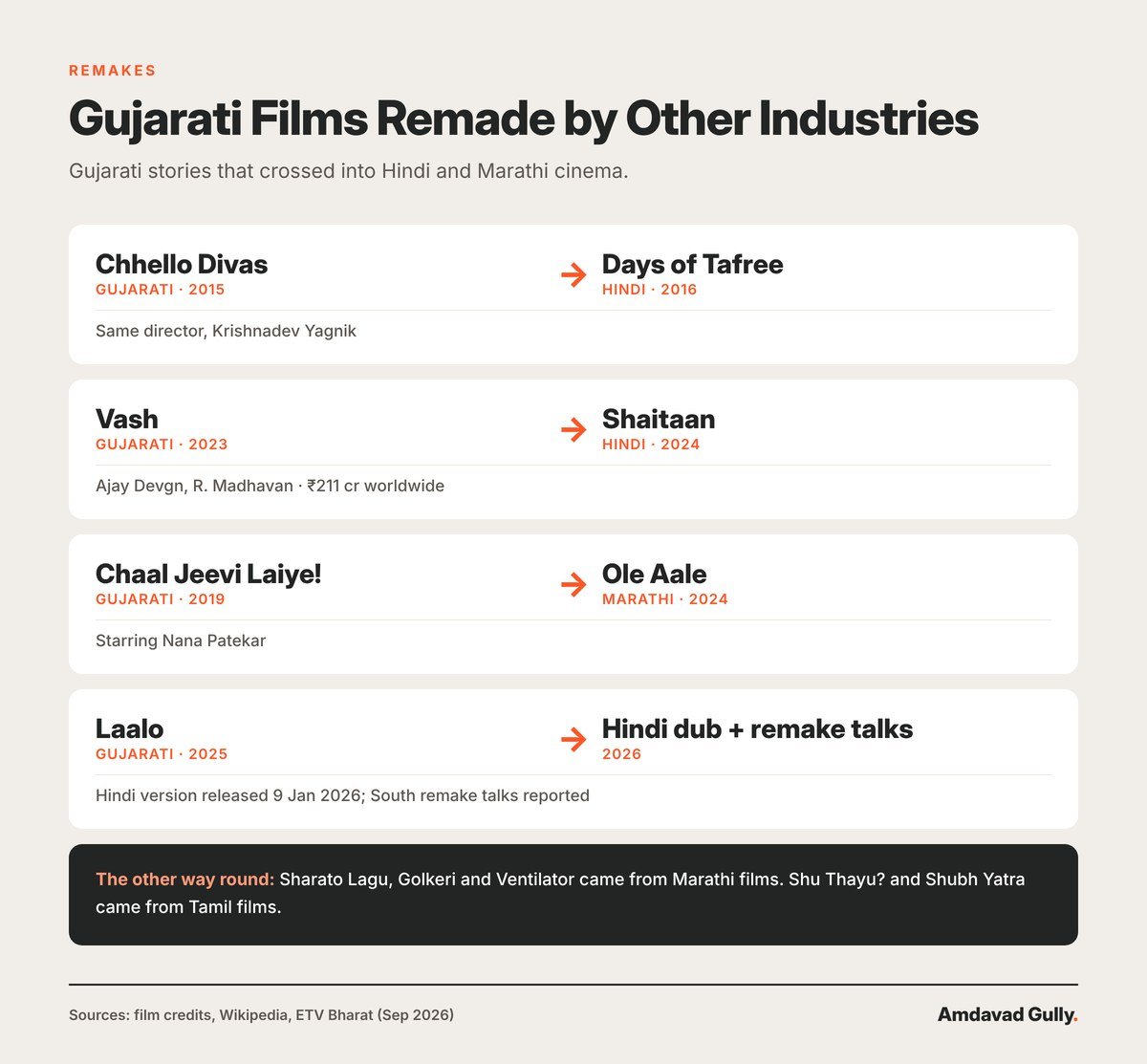
Confirmed Remakes at a Glance
| Original Gujarati movie | Remake | Language | Remake year | Notes |
|---|---|---|---|---|
| Chhello Divas (2015) | Days of Tafree | Hindi | 2016 | Same director, Krishnadev Yagnik |
| Vash (2023) | Shaitaan | Hindi | 2024 | Ajay Devgn, R. Madhavan, Jyothika; ₹211 crore worldwide |
| Chaal Jeevi Laiye! (2019) | Ole Aale | Marathi | 2024 | Starring Nana Patekar |
| Laalo (2025) | Hindi dubbed version | Hindi | 2026 | Dub, not a remake; South remake talks reported |
Vash → Shaitaan (2024): The Biggest Crossover
Above all, this is the remake that put Gujarati movies on Bollywood’s radar. In Vash (2023), a stranger enters a family’s farmhouse and takes control of their teenage daughter through black magic. The film was tense, tight and terrifying.
Soon, Bollywood took notice. Director Vikas Bahl remade it in Hindi as Shaitaan, starring Ajay Devgn, R. Madhavan and Jyothika. Notably, Janki Bodiwala reprised her role as the daughter. Released on 8 March 2024, Shaitaan grossed about ₹211 crore worldwide. In other words, a story born in Gujarati cinema became one of Bollywood’s biggest hits of the year.
Meanwhile, the Gujarati franchise continued too. Krishnadev Yagnik released a sequel, Vash Level 2, on 27 August 2025, and it grossed around ₹16 crore. Meanwhile, the original Vash won the National Award for Best Gujarati Film.
Chhello Divas → Days of Tafree (2016)
Chhello Divas follows a group of friends in their final days of college in Ahmedabad. Its humour, local slang and honest friendships made it a cult favourite among young Gujaratis.
A year later, Krishnadev Yagnik remade it in Hindi as Days of Tafree, with Yash Soni returning in the lead. Unlike Shaitaan, though, the Hindi version struggled at the box office. Its opening weekend brought in only about ₹60 lakh. This shows that a story’s local flavour doesn’t always travel easily.
Chaal Jeevi Laiye! → Ole Aale (2024)
The biggest Gujarati hit of the 2010s found a second life in Marathi cinema. Ole Aale retold the father-son road trip story with Nana Patekar, Siddharth Chandekar, Sayali Sanjeev and Makarand Anaspure. It marked a rare case of a Gujarati comedy being adapted by the larger Marathi industry.
Laalo: Hindi Release and South Remake Talks
After its record run, Laalo was dubbed into Hindi and released on 9 January 2026. This was not a remake, but it took the film to a much wider audience.
Next, remakes may follow. In September 2026, ETV Bharat reported that talks were underway for Telugu, Tamil and Kannada versions. However, the makers said the rights had not yet been sold to anyone. We will update this section if a deal is confirmed.
Gujarati Movies That Were Themselves Remakes
On the other hand, Gujarati cinema has borrowed plenty too. Several popular Gujarati movies of the revival were remakes of films from other languages.
- Sharato Lagu (2018): Remade from the Marathi film Chi Va Chi Sau Ka (2017).
- Shu Thayu? (2018): Remade from the Tamil film Naduvula Konjam Pakkatha Kaanom (2012).
- Ventilator (2018): A Gujarati version of the 2016 Marathi film of the same name, produced by Priyanka Chopra Jonas.
- Golkeri (2020): Remade from the Marathi film Muramba (2017).
- Shubh Yatra (2023): Remade from the Tamil film Aandavan Kattalai (2016).
This two-way traffic is healthy. It shows that Gujarati movies are now part of a wider Indian conversation, both giving and receiving stories.
Top-Rated Gujarati Movies on IMDb and Audience Favourites
Many readers search for the “IMDb top 100 Gujarati movies”. It’s a fair question, but there is a catch. IMDb ratings change every day as new votes come in. Also, many Gujarati movies have only a few hundred votes, so a handful of fans can push a rating very high or very low.
Because of this, we have chosen not to print rating numbers that would be out of date within weeks. Instead, you can see the live ranking yourself. Open IMDb’s list of Gujarati feature films sorted by rating. We have set it to show only films with at least 1,000 votes, which gives a fairer picture.
Audience Favourites: 25 Gujarati Movies Viewers Love
Below are 25 Gujarati movies that combine strong audience love with lasting popularity. We based this list on box office runs, award recognition, cult status and how often each film comes up in viewer conversations. It is a starting point for any new viewer.
- Laalo – Krishna Sada Sahaayate (2025): A slow-burn devotional drama that became a word-of-mouth phenomenon.
- Chaal Jeevi Laiye! (2019): A father-son road trip that makes families laugh and cry together.
- Hellaro (2019): Women, garba and freedom in 1970s Kutch.
- Chhello Show (2021): A love letter to cinema from rural Saurashtra.
- Chhello Divas (2015): The definitive Gujarati college comedy.
- Bey Yaar (2014): A buddy comedy about friendship and a stolen painting.
- Kevi Rite Jaish (2012): The film that brought city audiences back.
- Wrong Side Raju (2016): A gripping moral thriller with Pratik Gandhi.
- Vash (2023): Gujarati horror at its best.
- 3 Ekka (2023): Three friends, one big money mess.
- Fakt Mahilao Maate (2022): A comic twist on what women really think.
- Gujjubhai the Great (2015): Siddharth Randeria’s stage hit, brought to the screen.
Classics, Festival Picks and Hidden Gems
- Bhavni Bhavai (1980): The classic satire with Naseeruddin Shah and Smita Patil.
- Reva (2018): A spiritual journey along the Narmada.
- Dhh (2017): A sweet children’s film about failure and magic.
- Kehvatlal Parivar (2022): A noisy, lovable family comedy.
- Jhamkudi (2024): The biggest crowd-pleaser of 2024.
- Kutch Express (2023): An award-winning drama led by Manasi Parekh.
- Golkeri (2020): A warm family drama starring Malhar Thakar and Manasi Parekh.
- Chaniya Toli (2025): One of the two big hits of October 2025.
- Shu Thayu? (2018): A comedy of memory loss before a wedding.
- Sharato Lagu (2018): A modern take on love, conditions and marriage.
- Desh Re Joya Dada Pardesh Joya (1998): The family classic that filled theatres for months.
- Maaran (2024): A tense, award-winning social thriller.
- The Good Road (2013): Three lives intersect on a Kutch highway.
Tip: Check each film’s current IMDb rating with the link above before you watch. Ratings for newer Gujarati movies tend to start high and settle over time.
Best Gujarati Movies by Genre
Not sure where to start? Pick a mood, and we will point you to the right Gujarati movies.
Comedy
Without doubt, comedy is the backbone of modern Gujarati movies. The humour usually comes from family life, Gujarati quirks and the eternal question of money.
- Chhello Divas (2015): college life and friendship.
- Gujjubhai the Great (2015) and Gujjubhai – Most Wanted (2018): Siddharth Randeria’s comic franchise.
- 3 Ekka (2023): a caper comedy with the revival’s biggest stars.
- Fakt Mahilao Maate (2022): a fantasy comedy about hearing women’s thoughts.
- Shu Thayu? (2018): a pre-wedding memory-loss comedy.
Family Drama
Likewise, Gujarati audiences love films they can watch with three generations in one row.
- Chaal Jeevi Laiye! (2019): a father and son rediscover each other.
- Desh Re Joya Dada Pardesh Joya (1998): the classic family weepie.
- Kehvatlal Parivar (2022): a chaotic joint family.
- Golkeri (2020): parents, a son and a breakup.
Horror and Thriller
Meanwhile, this genre has exploded since 2020, led by Krishnadev Yagnik.
- Vash (2023) and Vash Level 2 (2025): black-magic horror.
- Wrong Side Raju (2016): a hit-and-run moral thriller.
- Maaran (2024): a social thriller about women’s captivity.
Devotional and Mythological
Devotional stories have been part of Gujarati movies since the first talkie, Narsinh Mehta. Today, the genre is back in a big way.
- Laalo – Krishna Sada Sahaayate (2025): the record-breaking Krishna drama.
- Narsinh Mehta (1932): the very first Gujarati talkie.
Historical and Folk
- Hellaro (2019): folk tradition and women’s freedom.
- Kasoombo (2024): a historical drama set during Alauddin Khalji’s invasion of Gujarat, directed by Vijaygiri Bava.
- Jesal Toral (1971): a beloved folk legend.
- Bhavni Bhavai (1980): a fable told through folk theatre.
Art-House and Festival Films
- Chhello Show (2021): India’s Oscar entry and a festival winner.
- The Good Road (2013): India’s first Gujarati Oscar entry.
- Reva (2018): based on Dhruv Bhatt’s novel.
- Manvini Bhavai (1993): Upendra Trivedi’s National Award winner, based on Pannalal Patel’s novel.
Children’s Films
- Dhh (2017): three boys and a magic shortcut.
- Gandhi & Co (2022): winner of the National Award for Best Children’s Film.
- Chhello Show (2021): seen through the eyes of a nine-year-old.
The Stars, Directors and Music Behind Gujarati Movies
Every great film industry is built by people. Here are the names that shaped Gujarati movies, past and present.
Legends of the Golden Age
- Upendra Trivedi: An actor, director and producer, he starred in many classics and directed the National Award winner Manvini Bhavai (1993).
- Arvind Trivedi: A popular Gujarati film actor, later famous nationwide as Ravan in the TV series Ramayan.
- Naresh Kanodia: The superstar of the 1980s and 1990s, known for rural action dramas.
- Snehlata: One of the leading heroines of the 1970s and 1980s.
- Ramesh Mehta: A much-loved comedian of the golden age.
- Hiten Kumar and Vikram Thakor: Major stars of the 2000s, popular with rural and small-town audiences.
Several Bollywood greats also came from Gujarati backgrounds or worked in Gujarati movies. These include Dina Pathak, Nirupa Roy, Asha Parekh and Sanjeev Kumar.
Stars of the New Wave
The revival created a new generation of stars, many of whom started on stage.
- Pratik Gandhi: From Bey Yaar and Wrong Side Raju to national fame in the web series Scam 1992.
- Malhar Thakar: The face of hits such as Chhello Divas, Shu Thayu?, Sharato Lagu and 3 Ekka.
- Yash Soni: The lead of Chaal Jeevi Laiye!, Fakt Mahilao Maate and the award-winning Maaran.
- Siddharth Randeria: The theatre veteran behind the Gujjubhai films and Chaal Jeevi Laiye!.
- Manasi Parekh: A National Award winner for Kutch Express and star of Golkeri and Jhamkudi.
- Janki Bodiwala: A National Award winner for Vash, who also starred in its Hindi remake, Shaitaan.
- Deeksha Joshi, Mitra Gadhavi and Kinjal Rajpriya: Regular faces in the biggest hits of the last decade.
Directors to Know
- Nanubhai Vakil: Director of the first Gujarati talkie, Narsinh Mehta (1932).
- Ketan Mehta: Director of Bhavni Bhavai (1980).
- Govindbhai Patel: Director of Desh Re Joya Dada Pardesh Joya (1998).
- Abhishek Jain: Started the revival with Kevi Rite Jaish and won the 2026 National Award for Maaran.
- Krishnadev Yagnik: The most commercially successful director of the revival, with Chhello Divas, Shu Thayu?, Vash and Vash Level 2.
- Vipul Mehta: Director of Chaal Jeevi Laiye!.
- Abhishek Shah: Director of Hellaro.
- Pan Nalin: Director of Chhello Show.
- Ankit Sakhiya: Director of the record-breaking Laalo.
Music: The Soul of Gujarati Movies
Above all, music has always been central to Gujarati movies. The composer Avinash Vyas scored around 168 Gujarati films and 61 Hindi films, and many of his songs became folk standards. Garba numbers from Gujarati movies still fill Navratri grounds every year.
Today, Gujarati film music mixes folk, garba, Sufi and pop. A hit song can now go viral on Instagram reels long before the film releases. As a result, music has become one of the main ways Gujarati movies reach young audiences.
What Makes Gujarati Movies Different?
Every regional film industry has its own flavour. Here is what makes Gujarati movies stand out.
Family First
First of all, most hit Gujarati movies are built for families. Stories revolve around parents, children, in-laws and the joint family. Vulgar humour is rare, and many films carry a U or U/A certificate. This is one reason grandparents and grandchildren often watch Gujarati films together.
Theatre Roots
Second, Gujarati theatre is one of India’s liveliest stage traditions. Many stars, writers and directors started in plays before moving to films. For example, the Gujjubhai films began as stage comedies. This theatre training shows in the sharp dialogue and comic timing of many Gujarati movies.
Business and the Diaspora
Third, money, business and the dream of going abroad are recurring themes. Kevi Rite Jaish was about a family desperate to settle in America. Meanwhile, the large Gujarati diaspora in the US, UK, Canada, Australia and Africa forms a valuable overseas market. Big hits such as Chaal Jeevi Laiye! have released in several countries.
Small Budgets, Big Hearts
Finally, Gujarati movies are usually made on modest budgets. Chhello Divas cost about ₹2.8 crore, and Laalo was made for roughly ₹50 lakh. Because of this, a strong story and good word of mouth matter far more than star power or spectacle. That is exactly how Laalo turned ₹50 lakh into over ₹100 crore.
Gujarati Movies and Ahmedabad
At Amdavad Gully, we naturally watch Gujarati movies with a local eye. And there is plenty to spot. Ahmedabad has been the setting for many of the revival’s biggest films.
For example, Chhello Divas captured Ahmedabad’s college culture, from canteen gossip to late-night bike rides. Bey Yaar found its heart in the old city’s pols and friendships. Meanwhile, Wrong Side Raju used the city’s roads and its rich business families as the backdrop for a moral thriller.
The city also drives the business of Gujarati movies. Ahmedabad’s multiplexes are often where a film’s fate is decided in the first weekend. If a Gujarati movie does well here, word quickly spreads to Surat, Vadodara, Rajkot and smaller towns. On the other hand, a weak Ahmedabad opening can end a film’s run within days.
Finally, Ahmedabad is home to much of the talent. Many actors, writers and technicians of the revival studied, trained or started in theatre here. In short, Amdavad is both the stage and the audience for modern Gujarati cinema.
Gujarati Movies on the Global Stage
For a long time, Gujarati movies rarely travelled beyond India. That has changed fast in the last decade.
- Oscars: The Good Road was India’s entry in 2013. Later, Chhello Show was India’s entry in 2022 and made the shortlist.
- Tribeca: Chhello Show premiered at New York’s Tribeca Film Festival in 2021.
- Valladolid: Chhello Show won the Golden Spike, the top prize at the Spanish festival.
- Chicago: Maaran won at the Chicago South Asian Film Festival in 2024.
- Cannes: Laalo became the first Gujarati film screened at the Cannes Film Festival, in May 2026.
- International releases: Chaal Jeevi Laiye! released in Australia, New Zealand and the UK. Laalo became the first Gujarati film released in Poland.
Earlier, Bhavni Bhavai had shown at New York’s Museum of Modern Art and won an award in Nantes, France. So the global journey of Gujarati movies is not entirely new. However, it has never moved as fast as it is moving now.
How Government Policy Shaped Gujarati Movies
Government support has played a big role in the ups and downs of Gujarati cinema. Here is a quick summary.
- 1970s: The state offered tax exemptions and subsidies. Production rose, but critics felt quality suffered as producers chased the benefits.
- 1980: The tax exemption was cut to 70%.
- 2005: Gujarat granted a 100% entertainment tax exemption for films certified U or U/A, along with a ₹5 lakh subsidy. The subsidy ended in August 2013.
- 2016: A new incentive policy graded films from A to D based on quality. Assistance ranged from ₹50 lakh for grade A films to ₹5 lakh for grade D, or 75% of production cost if lower. Multiplexes also had to screen Gujarati films a minimum number of times each year.
- 2017: The arrival of GST ended the old entertainment tax exemption.
The 2016 policy is important because it rewarded quality rather than quantity. Consequently, it encouraged producers to invest in better scripts and production values. Many of the strongest Gujarati movies of the late 2010s were made under this system.
Learning Gujarati Through Movies
Gujarati movies are also a great way to learn or improve your Gujarati. This is especially true for children of the diaspora who understand the language but rarely speak it.
Start with family comedies such as Chaal Jeevi Laiye! or Gujjubhai the Great. Their everyday dialogue and clear storylines are easy to follow. Next, try Chhello Divas or Bey Yaar for modern, informal Gujarati slang. Then move on to Hellaro or Bhavni Bhavai for richer, more traditional language and folk expressions.
Turn on subtitles at first, if your platform offers them. After a few films, try watching without them. You will be surprised how quickly the language comes back.
Gujarati Movies vs Other Regional Industries
How do Gujarati movies compare with other Indian language industries? For a long time, the answer was simple: they trailed far behind. However, recent data tells a very different story.
According to Ormax Media, Gujarati cinema overtook Bengali cinema at the box office in 2024. Then, in 2025, it also moved ahead of Punjabi and Marathi cinema, both in box office and footfalls. As a result, Gujarati became the sixth-biggest Indian language at the box office, behind only Hindi and the four major South Indian languages.
Of course, the gap with the giants remains huge. A single big Hindi or Telugu film can earn more than the entire Gujarati industry does in a year. Even so, the direction is clear. Gujarati movies are growing faster than most regional industries, and the success of Laalo suggests there is still plenty of room to grow.
10 Fascinating Facts About Gujarati Movies
Finally, here are some facts that even keen fans of Gujarati movies may not know.
- A short Gujarati sound film, Chav Chavno Murabbo, was released in February 1931, before India’s first full-length talkie, Alam Ara.
- Bhakta Vidur (1921), made by a Gujarati-owned studio, is described as the first film banned in India by the British.
- No Gujarati films at all were made between 1941 and 1946.
- Composer Avinash Vyas scored around 168 Gujarati films, more than almost anyone else.
- Desh Re Joya Dada Pardesh Joya (1998) drew an estimated 1.5 crore viewers.
- Chaal Jeevi Laiye! is described as the first film of this century to enter its eighth year in cinemas.
- Laalo was made for about ₹50 lakh and earned more than 200 times its budget.
- Hellaro‘s 13 lead actresses shared a single Special Jury Award at the National Film Awards.
- Janki Bodiwala played the same role in both Vash and its Hindi remake, Shaitaan.
- The 72nd National Film Awards in 2026 were held at Ekta Nagar, Gujarat, the first time in decades the ceremony left New Delhi.
Where to Watch Gujarati Movies
You can watch Gujarati movies in three main ways.
In Theatres
Today, multiplexes across Gujarat and Mumbai screen new Gujarati movies every Friday. In Ahmedabad, you will find Gujarati shows in most major multiplex chains. Big releases also open in cities with large Gujarati communities, such as Pune, Bengaluru and Delhi, and in overseas markets.
On Streaming Platforms
Gujarati-focused apps such as ShemarooMe and OHO Gujarati have large catalogues of new and old Gujarati movies. For example, Vash premiered on ShemarooMe in April 2024. Major national platforms also carry selected Gujarati films. Because streaming rights change often, check each app for current availability before you plan a movie night.
On Television and YouTube
Similarly, Gujarati TV channels regularly show classic and recent films. In addition, many older Gujarati movies are available on the official YouTube channels of their producers and music labels. Always choose official channels, so the makers get paid for their work.
What’s Next for Gujarati Movies?
The future of Gujarati movies looks brighter than ever. Here is what to watch for.
- Bigger budgets: Bollywood producers such as Sajid Nadiadwala are now backing Gujarati films, as with Dhabkaaro (2026).
- More remakes: After Shaitaan, other industries are actively scouting Gujarati stories. Laalo‘s South Indian remake rights were under discussion as of September 2026.
- Franchises: Vash has already produced a Gujarati sequel and a Hindi remake, and more follow-ups are reportedly in the works.
- Global festivals: After Chhello Show at the Oscars and Laalo at Cannes, Gujarati filmmakers are aiming higher.
- National attention: Hosting the 72nd National Film Awards at Ekta Nagar in 2026 put Gujarat at the centre of Indian cinema.
Still, the challenge now is consistency. The industry needs a steady flow of good scripts, more screens in smaller towns and fair theatre deals for small films. If it gets those right, the next ₹100 crore Gujarati movie may not be far away.
Common Myths About Gujarati Movies
Many people still carry old ideas about Gujarati cinema. However, most of these ideas are now out of date. Here are five common myths, along with the facts.
Myth 1: Gujarati movies are only for villages
This was partly true in the 1990s and 2000s. Since 2012, however, the biggest Gujarati movies have been urban stories made for city multiplexes. In fact, films like Chhello Divas, Bey Yaar and 3 Ekka are set firmly in modern city life.
Myth 2: Gujarati films don’t make money
On the contrary, the numbers have grown fast. In 2025, Gujarati movies crossed ₹100 crore at the box office by early October, according to Ormax Media. Moreover, Laalo alone earned about ₹120 crore. Clearly, the market is no longer small.
Myth 3: Gujarati cinema only makes comedies
Comedy does dominate the box office. Even so, the industry now makes horror, thrillers, historical dramas, children’s films and art-house cinema too. For example, Vash is a horror film, Maaran is a social thriller and Kasoombo is a historical drama.
Myth 4: Gujarati movies never win big awards
Actually, Gujarati films have won the National Award for Best Feature Film, reached the Oscar shortlist and screened at Cannes. In addition, actresses such as Manasi Parekh and Janki Bodiwala have won National Awards in recent years.
Myth 5: Good Gujarati stories only work in Gujarati
Finally, the remake record proves otherwise. Vash became Shaitaan, a ₹211 crore Hindi hit. Similarly, Chaal Jeevi Laiye! became Ole Aale in Marathi. Therefore, a strong Gujarati story can clearly travel.
How to Start Watching Gujarati Movies: A Beginner’s Plan
New to Gujarati movies? Then follow this simple plan. It takes you from easy crowd-pleasers to the most celebrated classics in about ten films.
- First, start with a family comedy. Watch Chaal Jeevi Laiye!. It is warm, funny and easy to follow, even with limited Gujarati.
- Next, add a youth comedy. Try Chhello Divas to understand why the revival took off.
- Then, watch the record-breaker. See Laalo to find out why audiences kept returning for weeks.
- After that, try a thriller. Pick Wrong Side Raju or Vash for something darker.
- Now, move to award winners. Watch Hellaro and Chhello Show, two of the finest Gujarati movies of the decade.
- Finally, go back to the classics. End with Bhavni Bhavai and, if you can find it, Manvini Bhavai.
By the end, you will have seen comedy, drama, horror, folk and art-house Gujarati cinema. More importantly, you will have a feel for how the industry has changed over four decades.
How We Built This Guide
We want this to be the most trustworthy guide to Gujarati movies on the web. So here is how we put it together.
- Box office: We used figures from named trade trackers and reports, mainly Sacnilk, Ormax Media and industry figures compiled on Wikipedia. Where sources differ, we show a range.
- Awards: We checked National Film Award winners against official award records and leading news reports.
- Remakes: We only included remakes confirmed by film credits or official announcements.
- Ratings: We link to IMDb’s live ranking rather than printing numbers that change daily.
Spotted an error, or have verified box office data for a film we missed? Write to us at amdavadgully@gmail.com, and we will update the guide.
Frequently Asked Questions About Gujarati Movies
Which is the highest-grossing Gujarati movie of all time?
Laalo – Krishna Sada Sahaayate (2025), directed by Ankit Sakhiya, is the highest-grossing Gujarati movie. It grossed an estimated ₹120 crore worldwide and was the first Gujarati film to cross ₹100 crore.
Which was the first Gujarati movie?
The first full-length Gujarati talkie was Narsinh Mehta, directed by Nanubhai Vakil and released on 9 April 1932. A short Gujarati sound film, Chav Chavno Murabbo, was released earlier, in 1931.
Which Gujarati movie was remade as Shaitaan?
The Bollywood film Shaitaan (2024), starring Ajay Devgn and R. Madhavan, is a remake of the Gujarati horror film Vash (2023), directed by Krishnadev Yagnik.
Which Gujarati movies have been remade in Hindi?
Confirmed Hindi remakes of Gujarati movies include Chhello Divas (remade as Days of Tafree, 2016) and Vash (remade as Shaitaan, 2024). Chaal Jeevi Laiye! was remade in Marathi as Ole Aale.
Which Gujarati movie went to the Oscars?
Two Gujarati movies were India’s official Oscar entries: The Good Road (2013) and Chhello Show (2022). Chhello Show made the shortlist for Best International Feature Film.
Which Gujarati movie won the National Award for Best Feature Film?
Hellaro (2019), directed by Abhishek Shah, is the only Gujarati movie to win the National Award for Best Feature Film. Its 13 lead actresses also shared a Special Jury Award.
Which film won the latest National Award for Best Gujarati Film?
Maaran, directed by Abhishek Jain and starring Yash Soni, won Best Gujarati Film at the 72nd National Film Awards, held at Ekta Nagar, Gujarat, in September 2026.
What is the best Gujarati movie of all time?
There is no single answer, but critics most often name Bhavni Bhavai (1980), Hellaro (2019) and Chhello Show (2021). Audiences tend to pick Chaal Jeevi Laiye!, Chhello Divas and Laalo.
What is the story of Laalo – Krishna Sada Sahaayate?
Laalo follows a rickshaw driver who becomes trapped at a farmhouse and must face his past. During this time, he has visions of Lord Krishna, who guides him towards healing and self-discovery.
What is the best Gujarati comedy movie?
Popular choices include Chhello Divas (2015), Chaal Jeevi Laiye! (2019), 3 Ekka (2023) and Gujjubhai the Great (2015). All four were major box office hits.
What is the best Gujarati horror movie?
Vash (2023) is widely seen as the best Gujarati horror movie. It won the National Award for Best Gujarati Film and was remade in Hindi as Shaitaan. Its sequel, Vash Level 2, released in 2025.
Is Gujarati cinema bigger than Marathi cinema?
In 2025, yes. According to Ormax Media, Gujarati cinema overtook Marathi and Punjabi cinema in box office and footfalls in 2025, becoming the sixth-biggest Indian language at the box office.
Who directed Chhello Divas?
Krishnadev Yagnik wrote, produced and directed Chhello Divas (2015). He also directed its Hindi remake, Days of Tafree (2016), as well as Vash and Vash Level 2.
What is Hellaro about?
Hellaro (2019) is set in a Kutch village in 1975, where women are forbidden to dance garba. When a dhol player arrives, the women secretly begin to dance, and their small rebellion changes the village. It won the National Award for Best Feature Film.
What is Chhello Show about?
Chhello Show (2021), known internationally as Last Film Show, follows a nine-year-old boy in a Saurashtra village who falls in love with cinema. He befriends a projectionist at the local theatre. Directed by Pan Nalin, it was India’s Oscar entry in 2022.
Who directed Laalo?
Ankit Sakhiya directed Laalo – Krishna Sada Sahaayate (2025). He also co-wrote it with Krushansh Vaja and Vicky Poornima. The film stars Reeva Rachh, Shruhad Goswami and Karan Joshi.
Why is Gujarati cinema called Dhollywood?
Gujarati cinema is called Dhollywood after the dhol, a traditional drum used heavily in Gujarati film music and garba. It is also sometimes called Gollywood.
How many Gujarati movies are released each year?
Between 50 and 80 Gujarati movies have been released in most years since 2014. The record is 72 films in 2012, according to industry data.
Which Gujarati movie started the modern revival?
Kevi Rite Jaish (2012), directed by Abhishek Jain, is widely credited with starting the revival. It brought urban audiences back to Gujarati movies, and Bey Yaar and Chhello Divas built on its success.
Where can I watch Gujarati movies online?
Gujarati-focused apps such as ShemarooMe and OHO Gujarati carry large libraries of Gujarati movies. Major national streaming platforms also carry selected titles. Availability changes often, so check each app before watching.
Who is the biggest star of Gujarati movies today?
Malhar Thakar and Yash Soni have led the most box office hits of the revival. Pratik Gandhi, Manasi Parekh and Janki Bodiwala have also won national recognition, with Manasi and Janki winning National Awards.
Conclusion: The Golden Age of Gujarati Movies Is Now
Gujarati movies have travelled a long road. They began with a saint’s story in 1932, flourished in the 1960s and 1970s, and nearly vanished by 2000. Then a new generation of filmmakers brought city audiences back, one comedy at a time.
Today, Gujarati films win National Awards, compete at the Oscars and screen at Cannes. Bollywood now remakes them. And a ₹50 lakh devotional drama has earned over ₹100 crore. In short, this is the best time ever to be a fan of Gujarati movies.
We will keep this guide updated as new hits and records arrive. For more stories about Ahmedabad’s people, places and culture, keep reading Amdavad Gully.