The Ahmedabad population has crossed an estimated 92 lakh in 2026. That makes Amdavad one of the fastest-growing big cities in India. According to United Nations estimates, the city and its surrounding urban areas have added nearly 20 lakh people in just ten years.
Yet there is a twist. India has not counted its people since 2011. So every figure for today’s Ahmedabad population is an estimate, not a headcount. The real number will only arrive after Census 2027, when enumerators count every household in February 2027.
In this guide, we break down what the data actually says. You will find the latest estimates, the 2011 census figures, the history since 1951, and how Ahmedabad compares with other Indian cities. We also explain why different sources give different numbers, and what a city heading for 1 crore people needs next.
Ahmedabad Population 2026: Key Takeaways
- 2026 estimate: about 92.7 lakh people in the Ahmedabad urban area, according to UN estimates.
- Last official count: 55.8 lakh within city limits and 63.6 lakh in the urban agglomeration, Census 2011.
- 10-year growth: roughly +19.8 lakh people, or +27%, between 2016 and 2026.
- Daily pace: about 540 new residents every day, on average.
- Next milestone: the UN projects the Ahmedabad population will cross 1 crore by 2030.
- Rank: India’s 7th-largest urban area at the 2011 Census, and Gujarat’s largest by far.
- The catch: there has been no census since 2011. Census 2027 will give the first real count in 16 years.
What Is the Population of Ahmedabad in 2026?
Short answer: the Ahmedabad population is estimated at about 92.7 lakh (9.27 million) in 2026. This figure covers the urban agglomeration, which means the city plus its continuous built-up suburbs. It comes from the UN’s World Urbanization Prospects, 2018 revision.
However, that number needs context. First, it is a model-based estimate, not a census count. Second, it covers more than the area run by the Amdavad Municipal Corporation (AMC). Third, the UN’s newer 2025 revision uses a different method and gives a lower figure, which we explain later in this article.
So the honest answer is a range. Depending on the definition and the source, today’s Ahmedabad population sits somewhere between about 76 lakh and 93 lakh. Either way, it is far higher than the 63.6 lakh the Census counted in 2011.
Ahmedabad population at a glance
| Measure | Figure | Source |
|---|---|---|
| City (AMC) population, 2011 | 55,77,940 | Census of India 2011 |
| Urban agglomeration, 2011 | 63,57,693 | Census of India 2011 |
| Ahmedabad district, 2011 | 72,14,225 | Census of India 2011 |
| Urban agglomeration, 2016 (estimate) | 72.95 lakh | UN WUP, 2018 revision |
| Urban agglomeration, 2026 (estimate) | 92.73 lakh | UN WUP, 2018 revision |
| Urban area, 2025 (new method) | 76.32 lakh | UN WUP, 2025 revision |
| Projection for 2030 | 1.01 crore | UN WUP, 2018 revision |
Why There Is No Official Ahmedabad Population Figure Since 2011
India normally runs a census every ten years. The last one took place in 2011. The next was due in 2021, but the COVID-19 pandemic forced the government to postpone it. As a result, the country has gone more than 15 years without a fresh headcount.
That gap matters a lot for fast-growing cities like Ahmedabad. In 2011, smartphones were still new, the Metro did not exist, and GIFT City was a plan on paper. Since then, the city has changed shape. Even so, the official books still describe the Ahmedabad of 2011.
Because of this, planners, businesses and journalists rely on estimates. The most widely used are the UN’s World Urbanization Prospects, which model city growth year by year. Other figures, such as voter rolls or Aadhaar counts, measure different things and do not equal population.
Census 2027 will finally change that
The wait is nearly over. Census 2027 is India’s 16th census and its first since 2011. In Gujarat, the first phase has already happened. Residents could fill in household details online from May 17 to 31, 2026, and houselisting teams visited homes from June 1 to 30, 2026.
The main event, population enumeration, runs from February 9 to 28, 2027. That is when enumerators will record every person. The results will give Ahmedabad its first official population figure in 16 years. We explain what to expect from Census 2027 in a dedicated section below.
Three Ways to Measure the Ahmedabad Population
One reason Ahmedabad population figures vary so much is simple: people measure different areas. “Ahmedabad” can mean the municipal city, the wider urban agglomeration, the district, or the metropolitan region. Each gives a different number.
1. The city: Amdavad Municipal Corporation (AMC)
This is the area governed by the AMC. At the 2011 Census, it had 55,77,940 residents. Since then, its boundary has grown. In 2020, the state approved adding fast-growing fringe areas such as Bopal, Ghuma, Chiloda, Naroda, Kathwada and Sanathal. Today the AMC covers about 505 sq km, with 48 wards and 192 elected corporators.
2. The urban agglomeration (UA)
An urban agglomeration combines a city with the continuous built-up areas around it. In 2011, the Ahmedabad UA had 63,57,693 people. This is the measure most often used to compare cities, and the one behind the UN estimates in this article.
3. The district and the metro region
Ahmedabad district is wider still. It includes rural talukas and smaller towns, and had 72,14,225 people in 2011. Meanwhile, the Ahmedabad Urban Development Authority (AUDA) plans for an even larger metropolitan region around the city.
Why this matters for you
When you read that “Ahmedabad has 60 lakh people” or “1 crore people”, always check the area. A figure for the AMC will be lower than one for the UA. Similarly, a projection for the metro region will be higher still. In this article, we say clearly which measure each number uses.
Ahmedabad’s Share of Gujarat’s Population
Ahmedabad is not just Gujarat’s biggest city. It is also a large slice of the whole state. At the 2011 Census, Gujarat had about 6.04 crore people. Of those, roughly one in ten lived in the Ahmedabad urban agglomeration.
The district share was even higher. Ahmedabad district, with 72.1 lakh people, held about 12% of Gujarat’s population in 2011. In short, more than one in every nine Gujaratis lived in the district.
A more urban Gujarat
Gujarat is also one of India’s more urbanised states. In 2011, about 43% of Gujaratis lived in towns and cities, well above the national level of about 31%. Since then, the shift to cities has continued. As a result, Ahmedabad’s share of the state’s people has most likely grown too.
Census 2027 will confirm by how much. For now, the trend is clear. As Gujarat urbanises, Ahmedabad remains the first stop for many people leaving villages and small towns.
Ahmedabad Population Growth in the Last 10 Years
Over the past decade, Ahmedabad population growth has been steady and strong. According to UN estimates, the urban agglomeration grew from about 72.95 lakh in 2016 to 92.73 lakh in 2026. That is an increase of nearly 19.8 lakh people, or about 27%.
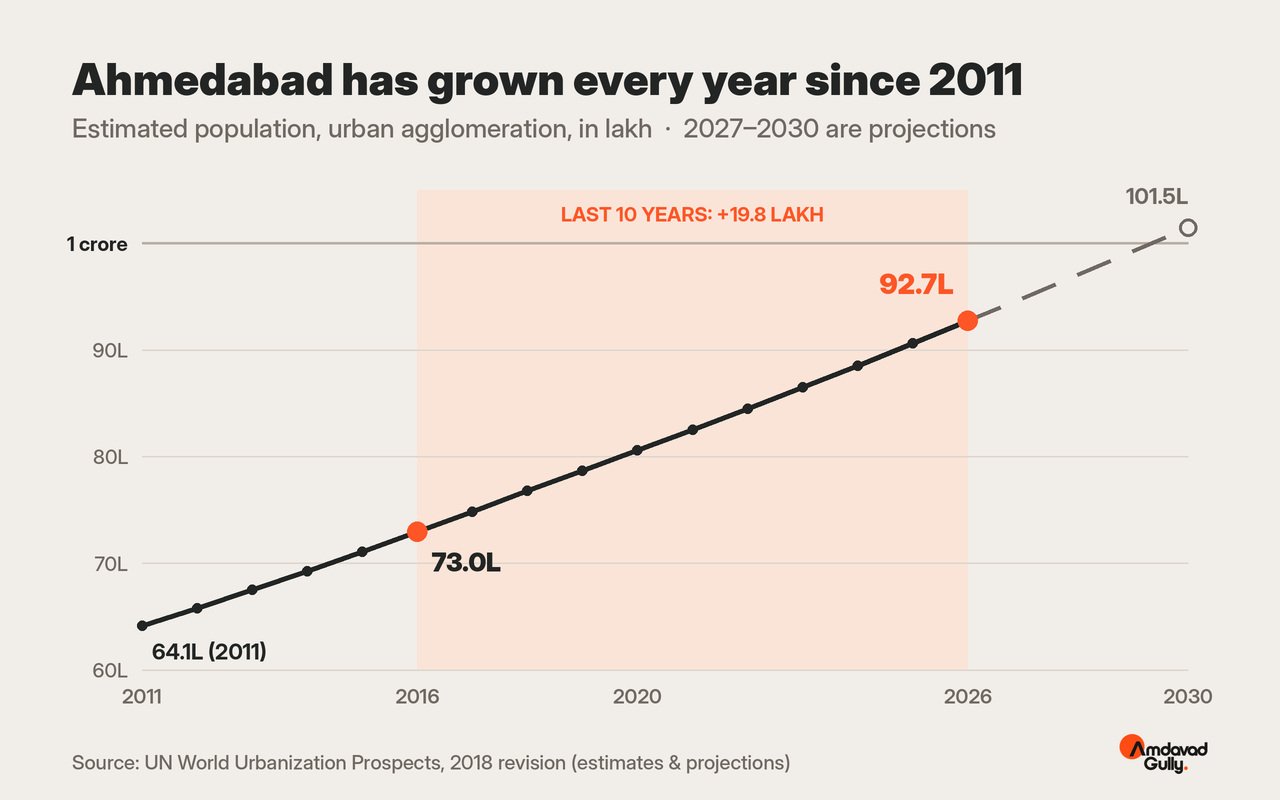
The growth has also been remarkably even. In most years, the city added close to 2 lakh people. The annual growth rate has eased slightly, from about 2.6% in 2017 to about 2.3% in 2026. Still, because the base keeps getting bigger, the number of people added each year has actually risen.
Ahmedabad population by year, 2016 to 2026
| Year | Estimated population (lakh) | Added that year (lakh) | Growth rate |
|---|---|---|---|
| 2016 | 72.95 | – | – |
| 2017 | 74.85 | +1.90 | 2.6% |
| 2018 | 76.81 | +1.96 | 2.6% |
| 2019 | 78.69 | +1.88 | 2.4% |
| 2020 | 80.59 | +1.90 | 2.4% |
| 2021 | 82.53 | +1.94 | 2.4% |
| 2022 | 84.50 | +1.97 | 2.4% |
| 2023 | 86.51 | +2.01 | 2.4% |
| 2024 | 88.54 | +2.03 | 2.3% |
| 2025 | 90.62 | +2.08 | 2.3% |
| 2026 | 92.73 | +2.11 | 2.3% |
Source: UN World Urbanization Prospects, 2018 revision (urban agglomeration estimates). Growth figures are Amdavad Gully calculations.
What 20 lakh new people looks like
Big numbers can feel abstract. So let us break the Ahmedabad population growth down into everyday terms.
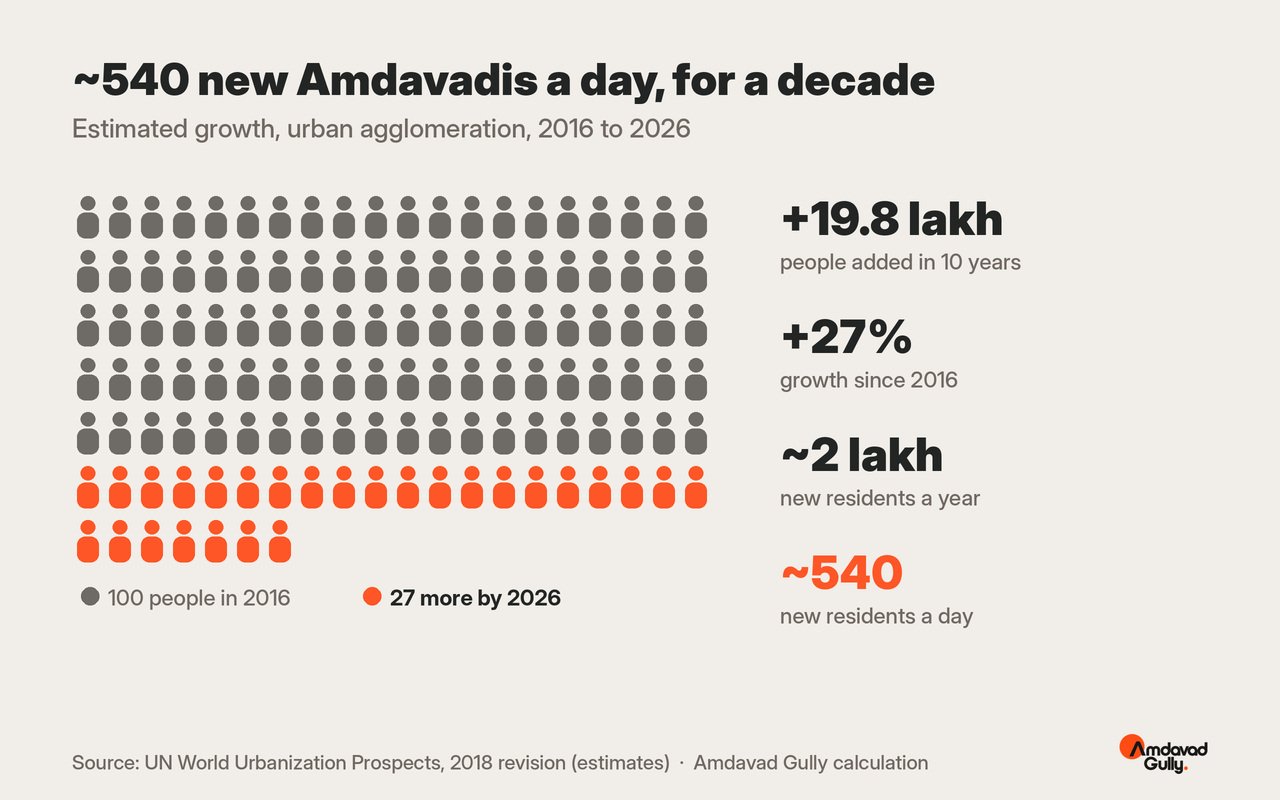
- Every day: about 540 new residents, on average, for ten straight years.
- Every year: close to 2 lakh new people. That is like adding a whole new town to the city every year.
- Every decade: nearly 20 lakh people. In other words, Ahmedabad has added a city bigger than Vadodara’s 2011 urban area in just ten years.
Put simply, for every 100 people who lived in Ahmedabad in 2016, there were about 127 by 2026.
Ahmedabad Population History: From 9 Lakh to Over 90 Lakh
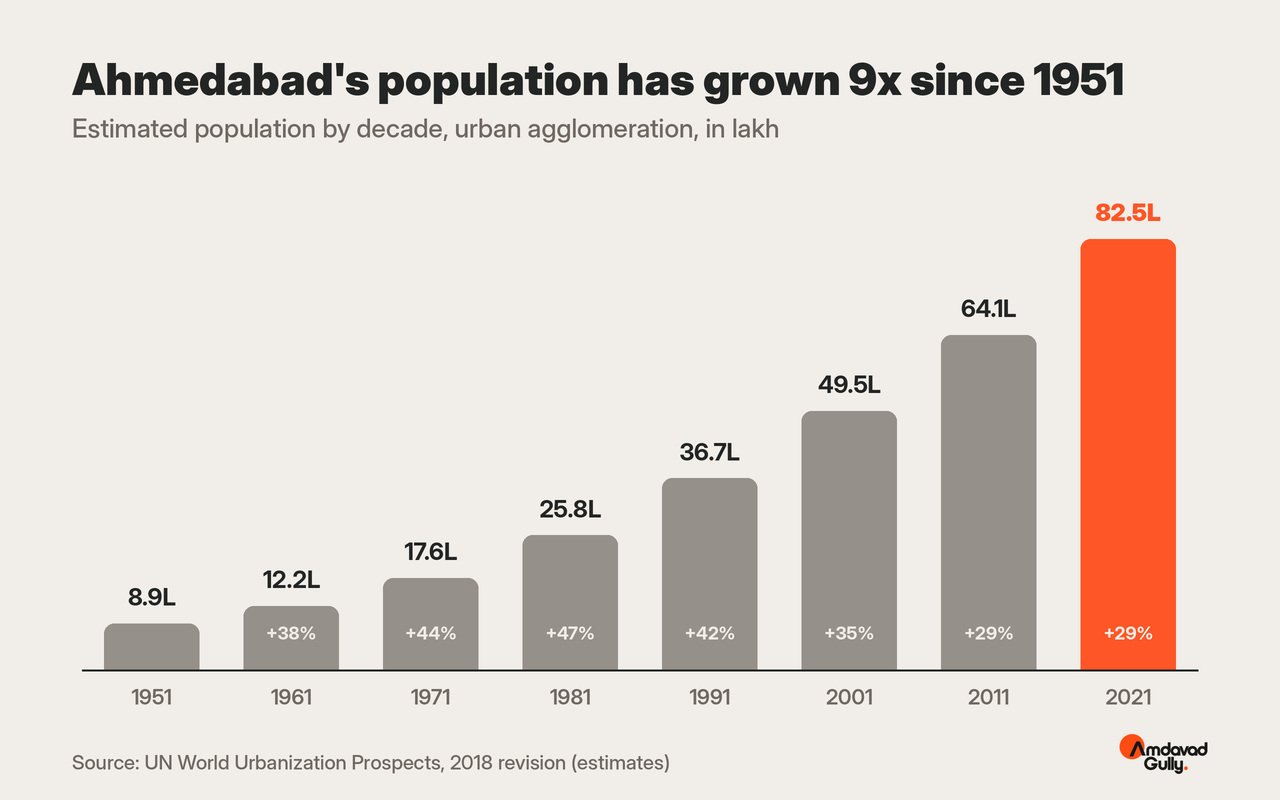
To understand today’s Ahmedabad population, it helps to look back. In 1951, just after Independence, the Ahmedabad urban area had fewer than 9 lakh people. By 2021, UN estimates put it above 82 lakh. That is more than nine times bigger in 70 years.
Ahmedabad population by decade
| Year | Estimated population (lakh) | Growth over the decade |
|---|---|---|
| 1951 | 8.87 | – |
| 1961 | 12.21 | +38% |
| 1971 | 17.58 | +44% |
| 1981 | 25.78 | +47% |
| 1991 | 36.68 | +42% |
| 2001 | 49.55 | +35% |
| 2011 | 64.13 | +29% |
| 2021 | 82.53 | +29% |
Source: UN World Urbanization Prospects, 2018 revision. Growth figures are Amdavad Gully calculations.
The mill city years: 1950s to 1980s
For decades, Ahmedabad was known as the “Manchester of the East” because of its textile mills. The mills drew workers from across Gujarat and beyond. As a result, the city grew fast, by more than 40% a decade through the 1960s and 1970s.
Change and new industries: 1980s to 2000s
Many large mills closed in the 1980s and 1990s. However, the city did not stop growing. Instead, new industries took over, including chemicals, pharmaceuticals, engineering and trade. Growth stayed high, though the percentage rate began to ease as the base got bigger.
The modern boom: 2010s to today
Since 2011, Ahmedabad has added people at a steady 2.3% to 2.6% a year. In percentage terms, that is slower than in the mill era. In absolute terms, however, it is the biggest growth in the city’s history. Today, Ahmedabad adds more people in one decade than its entire population in 1961.
Key moments in Ahmedabad’s growth
Several turning points shaped the city’s population story. Here are the most important ones.
- 1411: Sultan Ahmed Shah founds Ahmedabad on the banks of the Sabarmati.
- 1861: The city’s first textile mill opens, starting its era as a mill town.
- 1960: Gujarat becomes a separate state, with Ahmedabad as its first capital.
- 1970: The capital moves to Gandhinagar, but Ahmedabad remains the state’s economic hub.
- 1980s–1990s: Many mills close, and new industries replace them.
- 2011: The last census counts 63.6 lakh people in the urban agglomeration.
- 2017: UNESCO names the walled city India’s first World Heritage City.
- 2020: City limits expand to include Bopal, Ghuma, Chiloda, Naroda and other areas.
- 2022: The first phase of the Ahmedabad Metro is completed.
- 2030: Ahmedabad hosts the Commonwealth Games, around the time it could cross 1 crore people.
How Ahmedabad Compares With Other Indian Cities
At the 2011 Census, the Ahmedabad urban agglomeration ranked 7th in India. Only Mumbai, Delhi, Kolkata, Chennai, Bengaluru and Hyderabad were bigger. Meanwhile, the AMC itself ranked among the five most populous cities in the country.
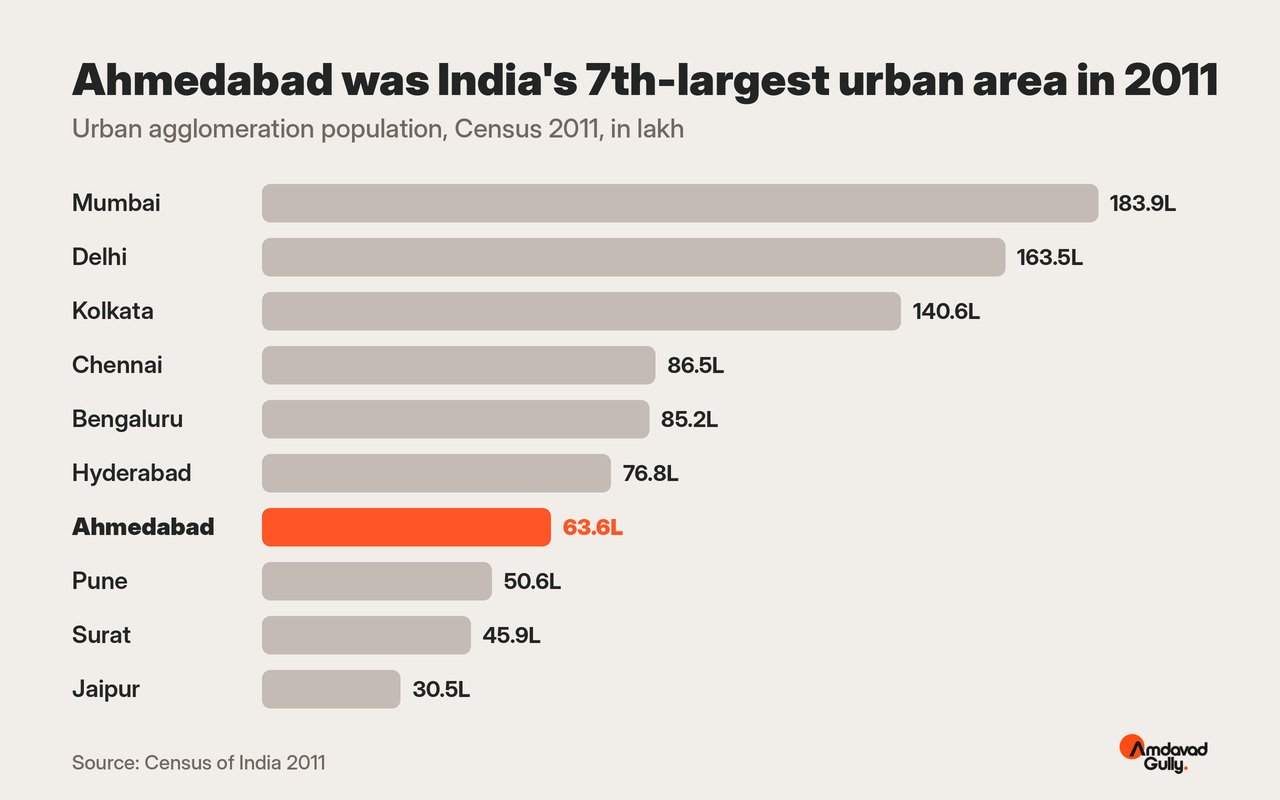
| Rank (2011) | Urban agglomeration | Population (2011) |
|---|---|---|
| 1 | Mumbai | 1,83,94,912 |
| 2 | Delhi | 1,63,49,831 |
| 3 | Kolkata | 1,40,57,991 |
| 4 | Chennai | 86,53,521 |
| 5 | Bengaluru | 85,20,435 |
| 6 | Hyderabad | 76,77,018 |
| 7 | Ahmedabad | 63,57,693 |
| 8 | Pune | 50,57,709 |
| 9 | Surat | 45,91,246 |
| 10 | Jaipur | 30,46,163 |
Source: Census of India 2011.
Ahmedabad vs other Gujarat cities
Within Gujarat, Ahmedabad is the clear leader. In 2011, it was about 1.4 times the size of Surat, the state’s second-biggest urban area. It was also more than three times the size of Vadodara and over four times the size of Rajkot.
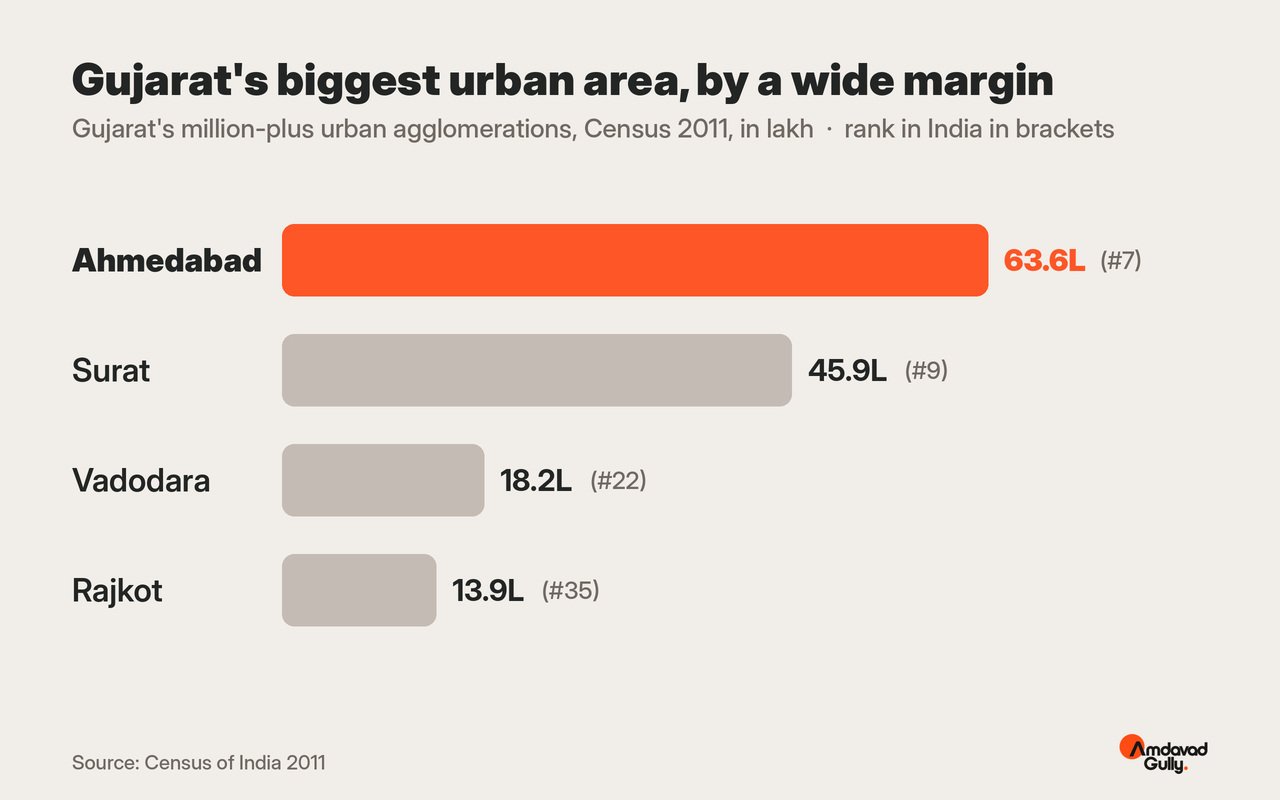
| Urban agglomeration | Population (2011) | Rank in India |
|---|---|---|
| Ahmedabad | 63,57,693 | 7 |
| Surat | 45,91,246 | 9 |
| Vadodara | 18,22,221 | 22 |
| Rajkot | 13,90,640 | 35 |
Source: Census of India 2011.
Notably, Surat has also grown very fast since 2011. So the gap between Gujarat’s two biggest cities is one of the things Census 2027 will settle.
The UN’s New Estimate: Why Some Sources Show a Lower Number
If you search for the Ahmedabad population online, you may see figures in the 70-lakh range as well as the 90-lakh range. Both can come from the UN. The difference lies in method, not in error.
The 2018 revision: the urban agglomeration
The figures in most of this article come from the UN’s World Urbanization Prospects, 2018 revision. That edition follows each country’s own definitions. For India, it uses the census idea of an urban agglomeration. On this basis, the Ahmedabad population is about 92.7 lakh in 2026.
The 2025 revision: a satellite-based footprint
In 2025, the UN released a new revision with a different approach. It uses a global method called the Degree of Urbanisation. Instead of official boundaries, it maps cities by population density and built-up area. On this measure, Ahmedabad had about 76.3 lakh people in 2025.
Under the new method, Ahmedabad ranks 44th among the world’s cities. Among Indian cities, only Delhi, Kolkata, Mumbai, Bengaluru, Chennai, Hajipur and Hyderabad rank higher. Hajipur appears because the method merges dense settlements across a wide region of Bihar into one footprint.
Which number should you use?
Neither is “wrong”. The 2018 series is better for tracking Ahmedabad’s growth over time, because it gives a consistent yearly series and matches census definitions. The 2025 series is better for comparing cities across countries, because it measures every city the same way. Ultimately, Census 2027 will give the most reliable count for the city itself.
How the UN estimates a city’s population
It is worth knowing how these estimates work. First, the UN starts from each country’s official census counts. Next, it looks at how fast each city grew between past censuses. Then, it projects that growth forward, in line with national trends in births, deaths and the shift from villages to cities.
This method works well for steady trends. However, it cannot see sudden changes on the ground, such as a new industrial zone or a boundary change. That is why a real census remains essential. Once Census 2027 data arrives, the UN and other agencies will update their models for Ahmedabad.
Ahmedabad Population Profile: What Census 2011 Tells Us
While the total Ahmedabad population has changed a lot since 2011, the last census still gives the best detailed picture of who lives in the city. Here are the key numbers for the urban agglomeration.
| Indicator (urban agglomeration) | Ahmedabad, 2011 | India urban average, 2011 |
|---|---|---|
| Total population | 63.6 lakh | – |
| Sex ratio (women per 1,000 men) | 899 | 926 |
| Child sex ratio (girls per 1,000 boys, age 0–6) | 846 | 902 (all-India) |
| Children aged 0–6 | 11.2% of population | 10.9% |
| Literacy rate | 88.2% | 85% |
| Male literacy | 92.4% | – |
| Female literacy | 83.5% | – |
Source: Census of India 2011.
A literate, working-age city
Ahmedabad’s literacy rate of about 88% was above the national urban average. Moreover, the gap between men and women was relatively narrow for an Indian city at the time. A large share of residents were of working age, which fits a city that attracts people for jobs.
The sex ratio gap
However, the census also flagged a concern. Ahmedabad had only 899 women for every 1,000 men, below the national urban average. The child sex ratio was even lower, at 846 girls per 1,000 boys. Part of the overall gap reflects male migrants who come to the city for work. Still, the low child sex ratio drew attention from policymakers. Census 2027 will show whether it has improved.
What Is Driving Ahmedabad Population Growth?
No single factor explains the rise in the Ahmedabad population. Instead, several forces work together. Here are the main ones.
1. Jobs and industry
Ahmedabad remains one of western India’s biggest job markets. Traditional sectors like textiles, chemicals and pharmaceuticals still employ lakhs of people. In addition, nearby industrial belts such as Sanand, Changodar and Vatva draw workers who live in and around the city.
2. GIFT City and finance
GIFT City, India’s first international financial services centre, sits between Ahmedabad and Gandhinagar. According to its official website, it has created more than 20,000 jobs. Many of those workers live in Ahmedabad. Global finance firms are now eyeing expansion there too, as our report on BlackRock’s GIFT City talks shows.
3. Migration from across Gujarat and India
Ahmedabad is a magnet for people from smaller towns and villages in Gujarat. It also attracts workers and students from Rajasthan, Uttar Pradesh, Bihar, Madhya Pradesh and beyond. For many, the city offers better wages, education and services than home.
4. Education and startups
The city hosts well-known institutions in management, design, technology and planning. As a result, thousands of students arrive every year, and many stay on to work. Meanwhile, a growing startup scene gives young graduates more reasons to make Ahmedabad home.
5. Infrastructure that makes the city livable
Big infrastructure projects have also made it easier to live farther out. The Ahmedabad Metro’s first phase was completed in 2022. The BRTS, the Sabarmati Riverfront and new ring roads have opened up fresh neighbourhoods. In turn, that has pushed growth into the city’s fringes.
6. Natural growth
Finally, people already living in the city have families. Although birth rates in urban Gujarat have fallen over time, natural growth still adds a steady number of new Amdavadis each year.
Where Is Ahmedabad Growing the Fastest?
Ward-level population data will only come with Census 2027. Even so, the city’s own decisions show where growth has been concentrated. Most of it has happened at the edges, not in the old walled city.
The 2020 expansion of city limits
In 2020, the state government approved a major expansion of AMC limits. It brought in fast-growing areas such as Bopal, Ghuma, Chiloda, Naroda, Kathwada and Sanathal. These areas had grown into the city in practice. The merger made them part of it on paper too.
The west and the fringes
Much of the new housing has come up in the western and outer areas of the city. Tall residential towers now stand where there were open fields a decade ago. At the same time, industrial suburbs in the east continue to house large numbers of workers.
The old city
By contrast, the historic walled city is already dense. In 2017, UNESCO declared it India’s first World Heritage City. There, the challenge is not growth but preservation, as families move out to newer neighbourhoods and old pols face redevelopment pressure.
Population vs Voters: Why the Numbers Differ
Sometimes, people use voter numbers as a stand-in for the Ahmedabad population. That is a mistake. Voter rolls and population counts measure very different things.
Voters are only adults
First, only Indian citizens aged 18 and over can vote. Children, who made up more than one in ten Amdavadis in 2011, are not on the rolls. Neither are many recent migrants who are still registered to vote in their home towns.
Rolls change for other reasons
Second, voter lists go up and down for administrative reasons. Election officials regularly remove duplicate, shifted or deceased voters. Therefore, a fall in registered voters does not mean the city has fewer people. Likewise, a rise does not prove the population grew by the same amount.
The right tool for the job
In short, voter rolls tell us who can vote. The census tells us who lives in the city. For the true Ahmedabad population, only a census, or a careful estimate based on one, will do.
Will Ahmedabad Cross 1 Crore People?
Yes, if current trends hold. The UN projects the Ahmedabad population will reach about 99.3 lakh in 2029 and 1.01 crore in 2030. By 2035, it could reach about 1.13 crore.
| Year | Projected population |
|---|---|
| 2027 | 94.9 lakh |
| 2028 | 97.0 lakh |
| 2029 | 99.3 lakh |
| 2030 | 1.01 crore |
| 2035 | 1.13 crore |
Source: UN World Urbanization Prospects, 2018 revision (urban agglomeration projections).
Ahmedabad as a megacity
The UN calls any city with 10 million (1 crore) or more people a megacity. So, by around 2030, Ahmedabad could join that club on the 2018-revision measure. That would put it alongside Mumbai, Delhi, Kolkata, Bengaluru, Chennai and Hyderabad.
Coincidentally, 2030 is also the year Ahmedabad hosts the Commonwealth Games. In other words, the city could welcome the world just as it crosses the 1-crore mark.
What a 1-Crore Ahmedabad Will Need
Population growth brings opportunity. However, it also puts pressure on every system the city runs. Here is where the strain will show most.
Housing
Two lakh new people a year need tens of thousands of new homes every year. Affordable housing near jobs is the biggest gap. Without it, more families end up in informal settlements or in distant suburbs with long commutes.
Transport
The Metro, BRTS and AMTS buses carry lakhs of people daily. Still, private vehicles continue to grow fast. To keep traffic moving, the city will need more Metro lines, better last-mile links and safer roads for walking and cycling.
Water
Ahmedabad relies heavily on Narmada water and the Sabarmati. A bigger population means higher demand every summer. Therefore, reusing treated wastewater and reducing leaks will become ever more important.
Heat and green cover
More concrete also means more heat. As our report on Ahmedabad’s October heat record showed, the urban heat island effect is already real. More trees, cool roofs and shaded streets will matter as the city grows.
Schools, hospitals and services
Finally, every new neighbourhood needs schools, health centres, parks and waste collection. Planning these early, before areas fill up, is far cheaper than fixing gaps later.
What Ahmedabad Population Growth Means for Businesses
For businesses, a growing Ahmedabad population means a growing market. Every year, close to 2 lakh new customers arrive. They need homes, food, transport, schools, healthcare and entertainment.
A bigger consumer market
New residents tend to be young and working. As a result, demand rises for everything from groceries and two-wheelers to cafés, gyms and coaching classes. Brands that open early in fast-growing neighbourhoods often build loyal customers before competitors arrive.
Real estate and retail
Population growth also drives demand for housing and shop space. In particular, the fringe areas merged into the city in 2020 have seen a wave of new projects. Retailers follow residents, so new high streets and malls tend to appear where new housing goes up.
Talent and hiring
Meanwhile, a bigger city means a bigger talent pool. Employers in GIFT City, manufacturing belts and the startup scene can draw on more skilled workers. On the other hand, competition for top talent also rises, which pushes up wages in some fields.
Better data, better decisions
Finally, Census 2027 will be a gift for planners and marketers. Fresh ward-level data will show exactly where people live, how old they are and how they earn. Businesses that read this data closely will be able to plan stores, services and campaigns far more precisely.
What It Means for Everyday Amdavadis
For residents, population growth shows up in daily life. Some changes are welcome. Others are harder to live with.
More choice, more opportunity
A bigger city brings more jobs, more restaurants, more events and better connectivity. For example, the Metro and new ring roads have made far-off areas easier to reach. In addition, more people means more demand for the city’s arts, food and festival culture.
More pressure on daily life
At the same time, growth brings longer commutes, busier roads and higher rents in popular areas. Schools and hospitals in new neighbourhoods often lag behind the housing. Summer water demand also rises with every new household.
What residents can watch for
Keep an eye on new Metro routes, AMC budgets and town planning schemes. These decide where the city grows next and how well it copes. Also, take part in Census 2027 when enumerators visit. An accurate count helps the city plan for the services you need.
Census 2027: What It Will Tell Us About Ahmedabad
Census 2027 is the moment of truth for every Ahmedabad population estimate. It will replace 16 years of modelling with a real count.
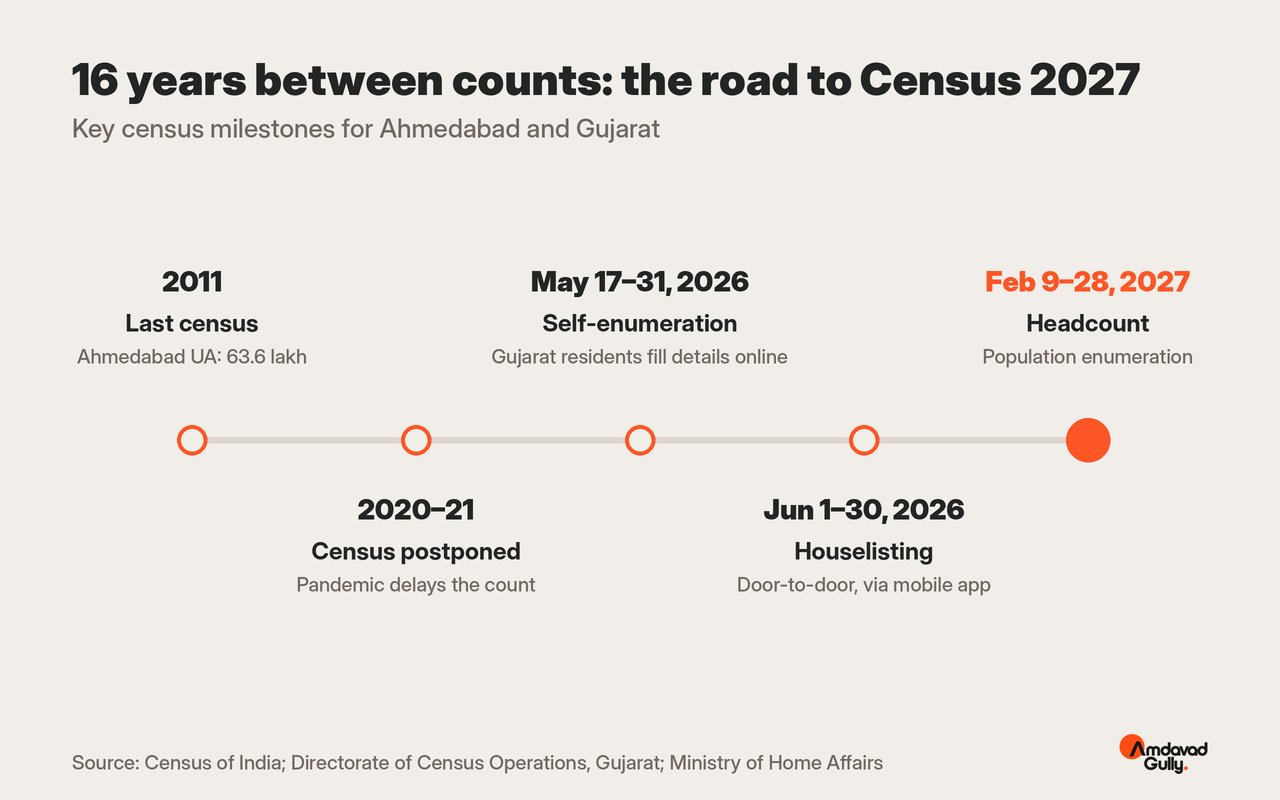
Census 2027 timeline for Gujarat
| Phase | Dates | What happens |
|---|---|---|
| Self-enumeration | May 17–31, 2026 | Residents fill household details online |
| Houselisting | June 1–30, 2026 | Officials visit homes and record housing details |
| Population enumeration | February 9–28, 2027 | Every person is counted |
What is new this time
- Digital first: for the first time, citizens could count themselves online, and houselisting teams used a mobile app.
- Caste data: the government has included caste among the census questions, the first such count in decades.
- Fresh boundaries: the count will reflect Ahmedabad’s expanded city limits after 2020.
What Ahmedabad will learn
Once results arrive, we will finally know the true Ahmedabad population, ward by ward. We will also see how the city’s sex ratio, literacy, housing and migration have changed. Above all, we will learn how close the estimates in this article really were.
Glossary: Population Terms Explained
Population data comes with its own jargon. Here are the key terms used in this article, in plain language.
Census
A census is a complete count of every person in the country, carried out by the government. India’s census is run by the Office of the Registrar General and Census Commissioner. It normally takes place every ten years.
Urban agglomeration (UA)
An urban agglomeration is a city together with the continuous built-up areas around it. It can include nearby towns and outgrowths that function as one urban area. Most city-to-city comparisons in India use this measure.
Municipal corporation
A municipal corporation is the elected local body that runs a large city. In Ahmedabad, this is the Amdavad Municipal Corporation (AMC). Its population counts only people living within its official limits.
Estimate and projection
An estimate is a calculated figure for a past or present year when no direct count exists. A projection is a calculated figure for a future year. Both rely on past census data and assumptions about growth.
Sex ratio
The sex ratio is the number of women for every 1,000 men. The child sex ratio counts girls for every 1,000 boys aged 0 to 6.
Megacity
The UN uses the term megacity for any city with 10 million (1 crore) or more people.
Frequently Asked Questions About the Ahmedabad Population
What is the population of Ahmedabad in 2026?
The Ahmedabad population is estimated at about 92.7 lakh in 2026 for the urban agglomeration, according to UN estimates (2018 revision). There is no official 2026 count because India has not held a census since 2011.
What was Ahmedabad’s population in the 2011 Census?
The 2011 Census counted 55,77,940 people within Ahmedabad city (AMC limits) and 63,57,693 in the Ahmedabad urban agglomeration. Ahmedabad district had 72,14,225 people.
How much has Ahmedabad’s population grown in 10 years?
According to UN estimates, the Ahmedabad urban area grew from about 72.95 lakh in 2016 to 92.73 lakh in 2026. That is an increase of nearly 19.8 lakh people, or about 27%.
How many people move to Ahmedabad every day?
On average, the Ahmedabad population grew by about 540 people a day between 2016 and 2026. This includes both migration and births, based on UN estimates.
Will Ahmedabad’s population cross 1 crore?
Yes, if current trends continue. The UN projects the Ahmedabad urban agglomeration will reach about 1.01 crore people by 2030, making it a megacity.
Is Ahmedabad bigger than Surat?
Yes. At the 2011 Census, the Ahmedabad urban agglomeration had 63.6 lakh people, compared with 45.9 lakh in Surat. Ahmedabad is Gujarat’s largest urban area.
What is Ahmedabad’s rank among Indian cities by population?
Ahmedabad was India’s 7th-largest urban agglomeration in the 2011 Census, after Mumbai, Delhi, Kolkata, Chennai, Bengaluru and Hyderabad.
Why do different websites show different Ahmedabad population figures?
Sources measure different areas, such as the AMC city, the urban agglomeration or the district. They also use different methods. For example, the UN’s 2025 revision maps cities by density and gives about 76.3 lakh, while its 2018 revision gives about 90.6 lakh for 2025.
When will the next census count Ahmedabad’s population?
Population enumeration for Census 2027 takes place from February 9 to 28, 2027. In Gujarat, houselisting already took place in June 2026.
What is Ahmedabad’s sex ratio?
At the 2011 Census, the Ahmedabad urban agglomeration had 899 women per 1,000 men. The child sex ratio was 846 girls per 1,000 boys.
What is the literacy rate in Ahmedabad?
The Ahmedabad urban agglomeration had a literacy rate of about 88.2% in 2011, with 92.4% for men and 83.5% for women.
Is Ahmedabad a megacity?
Not yet. The UN defines a megacity as a city with 10 million (1 crore) or more people. On the UN’s 2018-revision estimates, the Ahmedabad population is about 92.7 lakh in 2026 and should cross 1 crore around 2030.
What is the population of Ahmedabad district?
Ahmedabad district had 72,14,225 people at the 2011 Census. The district includes the city as well as rural talukas and smaller towns. There is no official district figure since 2011.
Was Ahmedabad ever the capital of Gujarat?
Yes. Ahmedabad was Gujarat’s first capital when the state was formed in 1960. The capital moved to Gandhinagar in 1970, but Ahmedabad remains the state’s largest city and economic hub.
Can voter numbers tell us Ahmedabad’s population?
No. Voter rolls include only adult citizens registered in the city, and they change with administrative clean-ups. Only a census, or an estimate based on one, can tell us the true Ahmedabad population.
The Bottom Line
The Ahmedabad population has grown by nearly 20 lakh people in ten years, and it shows no sign of slowing. On current trends, Amdavad will cross 1 crore people around 2030, just as it hosts the Commonwealth Games.
Still, every figure for today’s Ahmedabad population remains an estimate. Census 2027 will finally replace the models with a real count. Until then, the direction is clear, even if the exact number is not: Ahmedabad is bigger, busier and growing faster than ever.
Follow Amdavad Gully for more data stories about the city you live in. We will update this guide as soon as Census 2027 results arrive.
Sources
- Office of the Registrar General & Census Commissioner, India: Census of India (Census 2011 figures; Census 2027 schedule)
- United Nations, Department of Economic and Social Affairs: World Urbanization Prospects (2018 and 2025 revisions)
- News On AIR (Prasar Bharati): Gujarat census first phase schedule
- GIFT City: official website
- Amdavad Municipal Corporation: official website