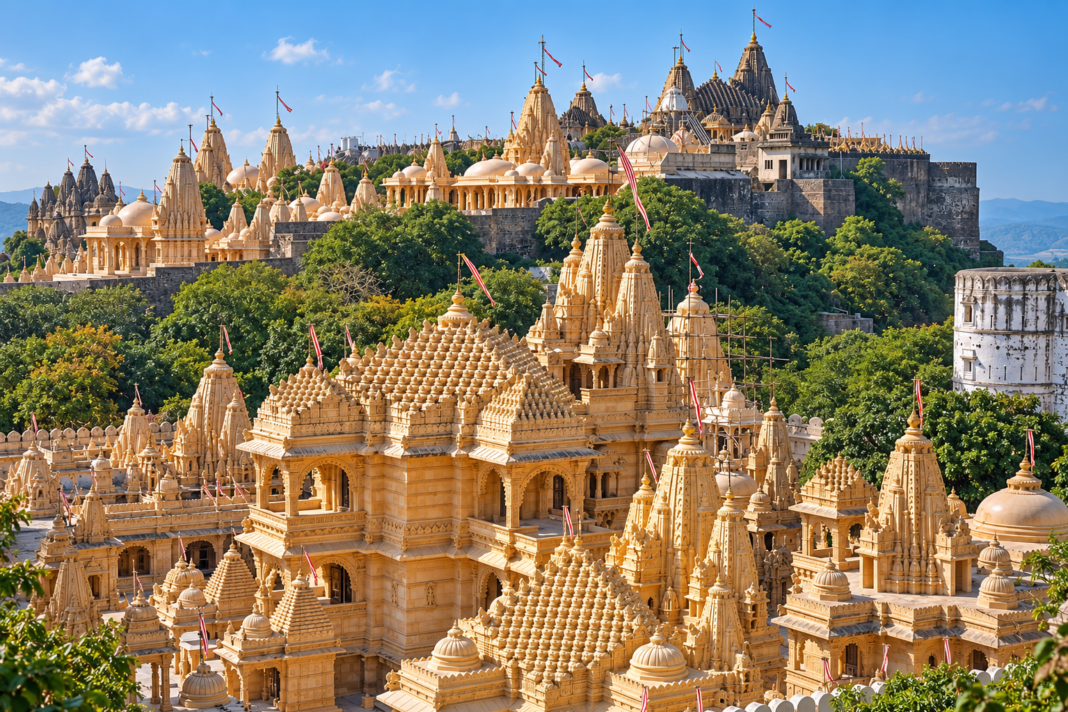
Quick answer: The most famous temples in Gujarat are Somnath (the first of Shiva’s 12 Jyotirlingas), Dwarkadhish in Dwarka (one of the four Char Dham), Ambaji and Pavagadh Kalika Mata (both Shakti Peethas), Akshardham in Gandhinagar, the Palitana Jain temples on Shatrunjaya Hill, and the Modhera Sun Temple. Together they cover Shiva, Krishna, the Goddess, Jain tirthankaras and Surya, which makes Gujarat one of India’s richest temple states.
Gujarat is often described through its food, its business sense or its Navratri. Its temples say more about the place. On one coast, a Shiva temple faces the Arabian Sea on a spot where nothing but water lies between it and Antarctica. On another, a Shiva linga disappears under the tide twice a day. In between are hilltop Shakti Peethas, a mountain covered in more than 900 Jain shrines, and a thousand-year-old sun temple built to catch the equinox sunrise.
This guide covers the 16 most famous temples in Gujarat, with what each is known for, how to reach it, the best time to visit and practical tips. Everything is grouped so you can plan a pilgrimage circuit, a weekend drive from Ahmedabad or a first trip to the state.
Famous Temples in Gujarat at a Glance
| Temple | Deity | Location | Best known for |
|---|---|---|---|
| Somnath Temple | Shiva | Prabhas Patan, Gir Somnath | First of the 12 Jyotirlingas |
| Dwarkadhish Temple | Krishna | Dwarka | One of the Char Dham |
| Nageshwar Jyotirlinga | Shiva | Near Dwarka | One of the 12 Jyotirlingas |
| Bet Dwarka | Krishna | Bet Dwarka island, near Okha | Krishna’s island home, Sudarshan Setu |
| Ambaji Temple | Amba (Shakti) | Banaskantha | Shakti Peetha, worship of a yantra, not an idol |
| Kalika Mata Temple | Kali (Shakti) | Pavagadh, Panchmahal | Hilltop Shakti Peetha in a UNESCO site |
| Swaminarayan Akshardham | Swaminarayan | Gandhinagar | Pink sandstone monument, water show |
| Palitana Jain Temples | Adinath (Rishabhanatha) | Shatrunjaya Hill, Bhavnagar | 900+ temples on one hill |
| Girnar Temples | Jain tirthankaras, Amba, Dattatreya | Junagadh | Mountain pilgrimage, Asia’s longest temple ropeway |
| Modhera Sun Temple | Surya | Mehsana | 11th-century Solanki architecture |
| Kashtabhanjan Hanuman | Hanuman | Salangpur, Botad | 54-foot “King of Salangpur” statue |
| Stambheshwar Mahadev | Shiva | Kavi Kamboi, Bharuch | Disappears under the sea at high tide |
| Ranchhodraiji Temple | Krishna | Dakor, Kheda | Major Krishna pilgrimage near Ahmedabad |
| Shamlaji Temple | Vishnu | Aravalli district | Ancient Vishnu shrine, Kartik fair |
| Bahucharaji Temple | Bahuchara Mata | Mehsana | Shakti shrine, revered by the transgender community |
| Swaminarayan Mandir, Kalupur | Swaminarayan | Ahmedabad | First temple of the Swaminarayan faith |
The Jyotirlinga and Char Dham Temples
1. Somnath Temple, Gir Somnath
Somnath is the most famous temple in Gujarat and, for many Hindus, the most emotionally significant. It is revered as the first of Lord Shiva’s twelve Jyotirlingas and stands at Prabhas Patan, right on the edge of the Arabian Sea.
The temple’s history is a story of resilience. It was attacked and rebuilt many times over the centuries, and the present structure, completed after Independence in 1951 with the backing of Sardar Vallabhbhai Patel, follows the Chalukya (Solanki) style with a tall, richly carved shikhara. An arrow-shaped pillar on the sea wall, the Baan Stambh, marks the idea that there is no land in a straight line between Somnath and the South Pole.
- Darshan timings: Usually 6:00 AM to 10:00 PM, every day
- Aarti: 7:00 AM, 12:00 noon and 7:00 PM
- Entry: Free for general darshan; paid pujas are optional
- Don’t miss: The evening sound-and-light show on the temple’s history
- Nearest railway station: Veraval, a short drive away
Tip: Mondays, the month of Shravan and Maha Shivratri bring very large crowds. For a calmer darshan, go on a weekday morning soon after the temple opens. Details on pujas and guest houses are on the Shree Somnath Trust website.
2. Dwarkadhish Temple (Jagat Mandir), Dwarka
Dwarka is where Krishna is believed to have ruled as king, and the Dwarkadhish Temple is one of the four Char Dham pilgrimage sites of Hinduism. Locally it is called Jagat Mandir, the “temple of the universe”. Its five-storey spire rises over Gomti Ghat, where the Gomti river meets the sea, and the temple’s flag is changed several times a day, a ritual devotees sponsor.
- Darshan timings: Roughly 6:30 AM to 1:00 PM and 5:00 PM to 9:30 PM
- Entry: Free
- Rules: Mobile phones, cameras and bags are generally not allowed inside, so use the deposit counters
- Nearby: Gomti Ghat, Rukmini Devi Temple (about 2 km away), Bhadkeshwar Mahadev on the shore
Tip: Darshan pauses briefly for rituals through the day. Arriving for the morning Mangla aarti or right when the temple reopens at 5 PM usually means shorter queues. Timings change on Janmashtami and other festivals.
3. Nageshwar Jyotirlinga, near Dwarka
About 17 km from Dwarka, on the road to Okha, Nageshwar is another of Shiva’s twelve Jyotirlingas. It is easy to spot from the highway because of the large seated Shiva statue in the complex. Most pilgrims visit Dwarkadhish, Nageshwar and Bet Dwarka on the same day, which makes Dwarka one of the few places in India where you can visit a Char Dham and a Jyotirlinga in a single trip.
4. Bet Dwarka
Bet Dwarka is an island in the Gulf of Kutch, believed to have been Krishna’s residence. Until recently, the only way across was a crowded boat from Okha jetty. That changed with the Sudarshan Setu, a cable-stayed bridge about 2.3 km long, inaugurated on 25 February 2024 and described as India’s longest cable-stayed bridge. Its footpaths are decorated with verses from the Bhagavad Gita and images of Krishna, and it has become a sight in its own right.
Tip: Bet Dwarka’s temple follows its own timings with an afternoon break, so plan the island for the morning or late afternoon.
The Shakti Peethas: Temples of the Goddess
5. Ambaji Temple, Banaskantha
Ambaji, near the Rajasthan border in the Aravalli hills, is one of the most visited Shakti Peethas in India. Tradition holds that the heart of Goddess Sati fell here.
What makes Ambaji unusual is that the sanctum has no idol. Devotees worship a sacred Shree Yantra kept in a small niche. By tradition the yantra is never photographed, and priests decorate the space so that it appears as the Goddess to devotees.
- Gabbar Hill: The original seat of the Goddess, reached by 999 steps or by ropeway
- 51 Shakti Peetha Parikrama: A path around Gabbar with replicas of all 51 Shakti Peethas
- Biggest event: The Bhadarvi Poonam fair on the full moon of Bhadrapad (usually September), which draws millions of walking pilgrims
- Nearest railway station: Abu Road, about 20 km away
Tip: The ropeway runs during the day and closes periodically for maintenance. Check live updates on the official Ambaji Temple website before you go.
6. Kalika Mata Temple, Pavagadh
Perched on Pavagadh Hill in Panchmahal district, the Kalika Mata Temple is a Shakti Peetha and the oldest temple on the hill, dating to around the 10th–11th century. It sits inside the Champaner-Pavagadh Archaeological Park, a UNESCO World Heritage Site, so a visit mixes pilgrimage with history.
- How to reach the top: Drive to Machi, then take the ropeway (a few minutes) or climb roughly 1,800–2,000 steps
- After the ropeway: There are still around 250 steps to the shrine
- Navratri: The busiest time of year, with extended darshan hours
- From Ahmedabad: About 150 km; Vadodara is the nearest big city
Tip: Combine the temple with Champaner’s mosques, the Jami Masjid especially, for a full-day trip.
7. Bahucharaji Temple, Mehsana
Bahuchara Mata is one of the principal goddesses of North Gujarat, and her temple in Becharaji town draws huge crowds on full-moon days and during Navratri. She is also especially revered by India’s transgender (hijra) community, who consider her their patron goddess. It is often combined with Modhera, which is close by.
Modern Marvels and the Swaminarayan Temples
8. Swaminarayan Akshardham, Gandhinagar
Akshardham in Gandhinagar’s Sector 20 is one of the most visited temples in Gujarat and the easiest to reach from Ahmedabad (about 30 km). Built by BAPS and opened in 1992, the central monument is carved from about 6,000 tonnes of pink sandstone, without steel.
- Closed: Every Monday
- Mandir darshan: 10:00 AM to 7:30 PM
- Aarti: 10:00 AM and 6:30 PM
- Entry: Free to the temple; tickets for exhibitions and the evening water show
- Rules: Phones and cameras must be deposited
Tip: Arrive by mid-afternoon to see the exhibitions and stay for the Sat-Chit-Anand water show after sunset. Current timings are on the official Akshardham visitor page.
9. Kashtabhanjan Hanuman Temple, Salangpur
Salangpur (also spelled Sarangpur), in Botad district about 160 km from Ahmedabad, is Gujarat’s best-known Hanuman temple. It belongs to the Vadtal branch of the Swaminarayan faith, and its idol was installed by Gopalanand Swami. “Kashtabhanjan” means “crusher of sorrows”, and devotees come here seeking relief from troubles of every kind. The idol is distinctive: a moustached Hanuman standing on Shani Dev.
Since April 2023, the temple has also had a 54-foot metal statue called the “King of Salangpur”, visible from several kilometres away, along with a large community kitchen.
Tip: Saturdays and Tuesdays are the busiest days. The temple has rooms and a dining hall for pilgrims; details are on the Salangpur temple’s official site.
10. Swaminarayan Mandir, Kalupur, Ahmedabad
In the heart of Ahmedabad’s old walled city, the Kalupur Swaminarayan Mandir is the first temple of the Swaminarayan faith, consecrated in 1822. Its burst of colour, Burmese teak carvings and pol-style surroundings make it a highlight of Ahmedabad’s heritage walk, which begins here every morning.
The Great Jain Tirths
11. Palitana Jain Temples, Shatrunjaya Hill
Palitana in Bhavnagar district is one of the holiest places in Jainism. Shatrunjaya Hill above the town holds more than 900 intricately carved marble temples built over about 900 years. The main shrine is dedicated to Adinath (Rishabhanatha), the first tirthankara.
- The climb: More than 3,500 stone steps; most people take 2–3 hours
- When to start: Very early morning, before the heat
- Important: The hill is closed at night, and pilgrims must come down before evening
- Monsoon: The pilgrimage pauses during the rainy season (Chaturmas)
- Help: Palanquins (dolis) are available for those who can’t climb
Tip: Carry water and avoid bringing food up the hill, because eating on the sacred hill is not permitted. Leather items are also best left behind.
12. Girnar Temples, Junagadh
Mount Girnar outside Junagadh is sacred to Jains and Hindus alike. Jain temples, including one dedicated to Neminath, cluster on its slopes, while the higher peaks hold the Amba Mata temple and the Dattatreya shrine. The traditional climb is around 10,000 steps.
Since 2020, the Girnar Ropeway, often called Asia’s longest temple ropeway, has cut the ascent to the Amba Mata temple to minutes. An adult ticket costs about ₹700, and online booking is suspended during the Maha Shivratri fair.
Tip: Visit in winter. The Girnar Parikrama during Kartik (around Dev Diwali) and the Maha Shivratri fair are the peak pilgrimage events.
13. Hutheesing Jain Temple, Ahmedabad
Built in 1848 by the merchant Sheth Hutheesing, this white marble temple outside Delhi Darwaza is dedicated to Dharmanatha, the 15th tirthankara. It is one of the best examples of the craftsmanship of Gujarat’s old guilds and an easy stop in the city.
Unique and Heritage Temples
14. Modhera Sun Temple, Mehsana
Built in 1026–27 CE by King Bhima I of the Solanki dynasty, the Modhera Sun Temple is one of Gujarat’s finest monuments. The complex has three parts: the Surya Kund (a large stepped tank with 108 small shrines), the Sabha Mandapa (assembly hall) and the Guda Mandapa (sanctum). The sanctum was aligned so that the rising sun lit the image of Surya on the equinoxes.
This is no longer an active place of worship. It is a protected monument run by the Archaeological Survey of India.
- Timings: Open daily, roughly 7:00 AM to 6:00 PM
- Entry: Small ASI ticket for Indians, higher for foreign nationals; children enter free
- Don’t miss: The Modhera Dance Festival, held each January against the temple
- From Ahmedabad: About 100 km
Tip: Modhera village was declared India’s first round-the-clock solar-powered village in 2022, which pairs nicely with a sun temple. Add Rani ki Vav in Patan (a UNESCO stepwell) for a full day.
15. Stambheshwar Mahadev, Kavi Kamboi
Gujarat’s “disappearing temple” sits on the shore of the Gulf of Khambhat in Bharuch district. Twice a day, the rising tide covers the shrine and its roughly four-foot Shiva linga completely, leaving only the flag visible. When the water pulls back, devotees can walk in again. Believers see it as the sea performing abhishek on Shiva.
According to the Skanda Purana, the linga was established by Kartikeya after he killed the demon Tarakasura, who had been a devotee of Shiva.
- How to reach: About 75 km from Vadodara, via Jambusar
- When to visit: Only at low tide. Tide times change every day with the lunar calendar
Tip: Check the day’s tide timings with the temple before you set out, then plan to arrive at low tide and stay to watch the water come in.
16. Ranchhodraiji Temple, Dakor, and Shamlaji Temple
Dakor in Kheda district, about 95 km from Ahmedabad, is one of Gujarat’s most important Krishna temples. The deity is worshipped as Ranchhodrai, and tradition holds that the idol was brought here from Dwarka by the devotee Bodana. Full-moon days, especially Sharad Purnima and the Holi-time Phagun Purnima, bring huge crowds, many on foot.
Shamlaji in Aravalli district, on the highway to Rajasthan, is an ancient Vishnu temple where the deity is worshipped as Gadadhar. The Kartik Purnima fair here is one of the most important tribal fairs in Gujarat.
Temple Circuits: How to Plan Your Trip
Gujarat’s temples are spread across the state, so group them by region.
| Circuit | Temples | Suggested time |
|---|---|---|
| Saurashtra coast | Dwarkadhish, Nageshwar, Bet Dwarka, Somnath (and Girnar via Junagadh) | 4–5 days |
| North Gujarat | Modhera, Bahucharaji, Ambaji, Shamlaji | 2–3 days |
| Ahmedabad day trips | Akshardham, Kalupur Swaminarayan, Hutheesing, Dakor | 1–2 days |
| Central Gujarat | Pavagadh, Stambheshwar Mahadev | 2 days (from Vadodara) |
| Jain tirth circuit | Palitana, Girnar | 2–3 days |
| Hanuman and Swaminarayan | Salangpur, Kalupur, Akshardham | 1–2 days |
Approximate distances from Ahmedabad by road
- Akshardham, Gandhinagar: about 30 km
- Dakor: about 95 km
- Modhera: about 100 km
- Pavagadh: about 150 km
- Salangpur: about 160 km
- Ambaji: about 180 km
- Palitana: about 215 km
- Somnath: about 400 km
- Dwarka: about 440 km
Best Time to Visit Temples in Gujarat
- October to March: The best season. Days are pleasant, which matters for hill climbs at Pavagadh, Palitana and Girnar.
- April to June: Very hot, especially on the coast and on steps. Plan darshan for early mornings and evenings.
- July to September: Monsoon. The landscape turns green, but sea crossings and climbs can be slippery, and the Palitana pilgrimage pauses.
Festival highlights: Maha Shivratri and Shravan at Somnath, Janmashtami at Dwarka and Dakor, Navratri at Ambaji and Pavagadh, Bhadarvi Poonam at Ambaji, Kartik Purnima at Shamlaji and Palitana, and the Modhera Dance Festival in January.
Temple Etiquette and Practical Tips
- Dress modestly. Cover shoulders and knees. Some temples may turn away visitors in shorts.
- Leave footwear outside. Most temples have free or low-cost shoe counters.
- Expect phone restrictions. Dwarkadhish, Akshardham and several others do not allow phones or cameras inside.
- Respect Jain customs. At Palitana and Girnar, avoid leather and don’t carry food onto the sacred hill.
- Plan around closures. Many temples close in the afternoon, and Akshardham is closed every Monday.
- Book ropeways ahead. On festival days at Ambaji, Pavagadh and Girnar, online booking saves hours.
- Use official channels. Book pujas, rooms and VIP darshan only through temple trusts, not agents.
- Remember Gujarat is a dry state. Pilgrimage towns in particular are strictly vegetarian and alcohol-free.
Frequently Asked Questions
Which is the most famous temple in Gujarat?
Somnath Temple is the most famous temple in Gujarat. It is revered as the first of Lord Shiva’s 12 Jyotirlingas and stands on the Arabian Sea coast at Prabhas Patan.
How many Jyotirlingas are there in Gujarat?
Gujarat has two of the 12 Jyotirlingas: Somnath in Gir Somnath district and Nageshwar near Dwarka.
Which temple in Gujarat is part of the Char Dham?
The Dwarkadhish Temple in Dwarka is one of the four Char Dham pilgrimage sites, along with Badrinath, Puri and Rameswaram.
What are the Shakti Peethas in Gujarat?
The best-known Shakti Peethas in Gujarat are Ambaji in Banaskantha district and Kalika Mata on Pavagadh Hill in Panchmahal district.
Which temple in Gujarat disappears in the sea?
Stambheshwar Mahadev at Kavi Kamboi in Bharuch district is submerged by the high tide twice a day and reappears at low tide. Visitors can enter only at low tide.
Is Akshardham in Gandhinagar open on Monday?
No. Swaminarayan Akshardham in Gandhinagar is closed every Monday. On other days, the mandir is open for darshan from 10 AM to 7:30 PM.
How many steps are there at Palitana?
The climb to the Palitana temples on Shatrunjaya Hill is over 3,500 steps and usually takes two to three hours.
Is there a ropeway at Pavagadh, Ambaji and Girnar?
Yes. All three have ropeways. At Pavagadh you still climb about 250 steps after the ropeway, Ambaji’s ropeway goes up Gabbar Hill, and Girnar has Asia’s longest temple ropeway.
Is worship still performed at the Modhera Sun Temple?
No. The Modhera Sun Temple is a protected monument managed by the Archaeological Survey of India and is no longer an active place of worship.
What is the best time to visit temples in Gujarat?
October to March is the best time, with pleasant weather for travel and hill climbs. Festivals such as Navratri, Janmashtami and Maha Shivratri are memorable but very crowded.
The Bottom Line
If you only have time for a few, start with Somnath and Dwarka for the big pilgrimage, Ambaji or Pavagadh for the Goddess, and Akshardham if you’re based in Ahmedabad. If you want something you won’t see anywhere else, watch the sea swallow Stambheshwar Mahadev, climb the marble city of Palitana at dawn, or stand in the Modhera sabha mandapa and imagine the equinox sun reaching the sanctum a thousand years ago.
References
- Shree Somnath Trust – Official website
- Shri Arasuri Ambaji Mata Devasthan Trust – Official website
- Swaminarayan Akshardham, Gandhinagar – Visitor information
- Shree Kashtabhanjan Dev Hanumanji Temple, Salangpur – Official website
- Incredible India – Sudarshan Setu, Dwarka
- Gujarat Tourism – Official website
Information is accurate as of September 2026. Temple timings, ropeway schedules and ticket prices change, particularly during festivals, so check with the temple trust before you travel. Spotted an update? Write to us at amdavadgully@gmail.com.