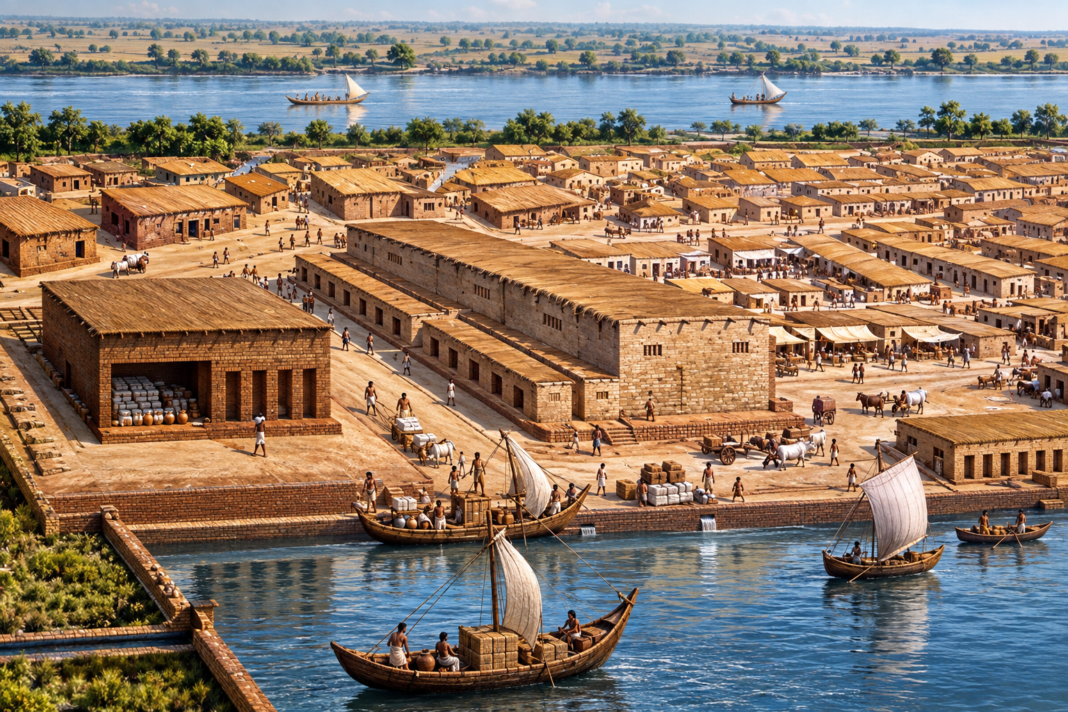
Quick answer: Lothal is a 4,500-year-old port town of the Harappan (Indus Valley) Civilisation in Saragwala village, Dholka taluka, about 80 to 85 km south-west of Ahmedabad. It’s famous for what many experts call the world’s oldest known dockyard, a brick basin about 215 m long and 35 m wide. The town thrived from about 2400 to 1900 BCE, traded beads and goods as far as Mesopotamia, and was excavated by the Archaeological Survey of India from 1955 to 1960. The site is closed on Fridays. Right next door, India’s huge National Maritime Heritage Complex is being built.
A Harbour Town Lost in Time
Imagine a busy harbour town more than four thousand years ago. Boats glide in from the sea. Workers unload cargo at a long brick wharf. Nearby, craftsmen drill tiny holes in shiny red beads. Meanwhile, traders stamp clay seals to mark their goods for faraway lands.
That town was Lothal. Today, it sits quietly in the flat fields of the Bhal region, south of Ahmedabad. At first glance, it’s just low brick walls and a big empty basin. But once you know its story, Lothal becomes one of the most exciting places in India.
In this complete guide, we tell you everything about Lothal. You’ll learn what it was, who found it, how its famous dock worked, what people made and traded, and why the town faded away. Then, we cover the practical side: timings, how to reach, what to see, where to eat and nearby places. Finally, we explain the giant new maritime museum rising next door.
A quick note on sources: We’ve based this guide on the Archaeological Survey of India (ASI), Gujarat Tourism, UNESCO and published research. Some details about Lothal, such as exact dates and the purpose of the dock, are still debated by experts. So, where scholars disagree, we say so.
Lothal: Quick Facts
| Detail | Information |
|---|---|
| What it is | A port town of the Harappan (Indus Valley) Civilisation |
| Location | Saragwala village, Dholka taluka, Ahmedabad district, Gujarat |
| Distance from Ahmedabad | About 80 to 85 km |
| Age | Main Harappan phase about 2400–1900 BCE |
| Famous for | One of the world’s oldest known dockyards |
| Dock size | About 215 m long and 35 m wide |
| Site area | About 7 hectares (roughly 285 m by 228 m) |
| Discovered | 1954, by the Archaeological Survey of India |
| Main excavation | 13 February 1955 to 19 May 1960, led by S.R. Rao |
| Seals found | 213, the third-highest of any Indus site |
| Meaning of name | “Mound of the dead” in Gujarati |
| UNESCO status | On India’s tentative list since April 2014 |
| Closed | Fridays |
| Nearest railway station | Lothal–Bhurkhi, about 6 km away |
| Next door | National Maritime Heritage Complex (under construction) |
What Is Lothal?
Lothal is the ruins of an ancient town built by the people of the Harappan Civilisation, also called the Indus Valley Civilisation. This was one of the world’s first great urban cultures, alongside ancient Egypt and Mesopotamia.
Most Harappan cities, like Harappa and Mohenjo-daro, are now in Pakistan. However, many important sites lie in Gujarat too. Among them, Lothal stands out for one simple reason: it was a port. In other words, it was a gateway between the Harappan world and the sea.
The town sat near the Sabarmati and Bhogavo rivers, not far from the Gulf of Khambhat. Back then, boats could sail up the river to reach it. So, Lothal became a busy trading hub. From here, goods like beads, shell ornaments and copper items travelled to other Harappan towns and to lands across the Arabian Sea.
What Does “Lothal” Mean?
In Gujarati, “Lothal” is usually explained as a mix of two words: loth and (s)thal. Together, they mean “the mound of the dead”. Interestingly, the ancient Harappan city of Mohenjo-daro in Sindh has a very similar meaning in Sindhi. So, both names came from local people who saw old mounds of ruins long before anyone dug them up.
Where Is Lothal?
Lothal sits in Saragwala village, in the Dholka taluka of Ahmedabad district. It’s about 80 to 85 km south-west of Ahmedabad city. The nearest railway station, Lothal–Bhurkhi, is about 6 km to the north-west.
The site lies in the Bhal region, a flat, low-lying stretch of land between the Sabarmati River and the Gulf of Khambhat. Today, the sea is some distance away. However, thousands of years ago, the coastline and river courses were quite different. As a result, the town had easy access to the water.
The Harappan Civilisation: A Quick Background
To understand Lothal, it helps to know a little about the wider civilisation it belonged to.
The Harappan Civilisation grew along the Indus River and its neighbours, in what is now Pakistan and north-west India. It’s named after Harappa, the first site to be dug in the 1920s. At its peak, from roughly 2600 to 1900 BCE, it covered a huge area. In fact, it was larger than ancient Egypt and Mesopotamia combined.
Harappan people were remarkable planners. For example, they built cities on grid patterns, with straight streets and covered drains. They used standard-sized bricks and standard weights. They also made fine beads, seals with animal carvings and a script that nobody has fully read yet.
Gujarat was an important part of this world. Today, the state has dozens of Harappan sites. The most famous are Dholavira in Kutch, now a UNESCO World Heritage Site, and Lothal near Ahmedabad. Others include Rangpur, Surkotada, Kuntasi and Rojdi.
How Lothal Was Discovered
After India’s independence in 1947, the main Harappan cities of Harappa and Mohenjo-daro fell inside Pakistan. So, Indian archaeologists began searching for Harappan sites within India’s borders.
In 1954, a team from the Archaeological Survey of India found Lothal. The excavations were led by the archaeologist S.R. Rao (Shikaripura Ranganatha Rao). Digging began on 13 February 1955 and continued until 19 May 1960. Then, more work followed in the early 1960s.
Rao’s team uncovered a planned town with a raised citadel, a lower town, a bead factory, a warehouse and, most famously, a large brick-lined basin. Rao argued that this basin was a dockyard for ships. That claim made Lothal world-famous. Later, Rao became known as a pioneer of marine archaeology in India.
Since then, more studies have been carried out at Lothal. In recent years, the ASI has again been excavating parts of the site, linked to the new maritime heritage project next door.
How Old Is Lothal? Dates and Phases
Dating ancient sites is tricky. So, you’ll see slightly different dates in different books. Broadly, though, most sources agree on this outline.
- Before about 2400 BCE: A small village may have existed here, possibly linked to earlier local cultures.
- About 2400–1900 BCE: The main Harappan town. This is when the planned streets, dock, warehouse and workshops were built and used.
- Around 1900 BCE: Major floods badly damaged the town.
- After about 1900 BCE: Life continued on a smaller scale, often called the “Late Harappan” phase, before the site was finally left.
In other words, Lothal was an active Harappan town for roughly 500 years. That’s longer than the entire history of many modern cities.
Why Lothal Matters
Lothal isn’t the biggest Harappan site. Yet it’s one of the most important. Here’s why.
- Sea trade: Lothal shows that Harappan people traded by sea, not just by land.
- World first? Its basin is often called the oldest known dockyard in the world.
- Craft centre: Its bead factory shows how Harappan beads, found as far as Iraq, were made.
- Clever engineering: The town’s walls, drains and dock show a strong grasp of water and tides.
- Found in India: After 1947, Lothal became one of India’s key sites for studying this civilisation.
So, when you stand at Lothal, you’re standing at the edge of one of the world’s oldest trade networks.
Why Lothal Was Built Here
Why would anyone build a town on low, flood-prone land? At first, it seems like a strange choice. However, the location had big advantages.
First, Lothal sat between rivers and the sea. So, boats could reach it from the Gulf of Khambhat, while river routes led inland. Next, the nearby coasts of Saurashtra and Kutch offered shells, and hills further away offered stones like carnelian and agate. Also, the flat land around it was good for farming and grazing. Finally, Lothal sat on the way between Sindh in the north-west and the rich lands to the south and east. In short, it was the perfect spot for a trading post, even if floods were a constant risk.
The Gulf of Khambhat and Its Tides
To understand Lothal’s dock, you need to know about tides. The Gulf of Khambhat, also called the Gulf of Cambay, has some of the highest tides in India. Twice a day, the sea rushes in and then pulls back out.
For sailors, this is both a help and a danger. On the one hand, high tide lets boats float far inland. On the other hand, low tide can leave them stuck in mud. So, a harbour here needs a way to hold water when the tide drops.
That’s exactly what the Lothal dock seems to have done. Boats came in at high tide. Then, gates held the water inside. As a result, boats could stay afloat until the next tide. Even today, this idea is used in modern “wet docks” around the world.
How Harappan Boats May Have Looked
No full Harappan boat has ever been found. However, we have clues. For example, some seals and clay models from Harappan sites show boats. Also, Lothal has yielded terracotta models that many experts think show small boats.
From these, experts believe Harappan boats were fairly flat, built of wood or reeds, and possibly fitted with a mast and a simple sail. They likely hugged the coast rather than crossing open ocean. So, a trip from Lothal to the Persian Gulf would have followed the coastline, stopping at ports along the way.
Is Lothal Really the World’s Oldest Dock?
You’ll often read that Lothal has “the world’s oldest dock”. It’s a catchy claim, and it’s widely used. However, the full picture is a little more complex.
For example, archaeologists have found ancient harbour works at Wadi al-Jarf in Egypt, also dating to around 2500 BCE. So, Lothal isn’t the only very old harbour. Still, Lothal’s brick-lined basin, with its inlet, wharf and water control, remains one of the oldest known structures of its kind. In other words, it’s safest to call it “one of the oldest known dockyards in the world”. Either way, it’s an amazing achievement.
Harappan Weights and Measures
Trade depends on fair measures. So, the Harappans built a smart system. They used small, cube-shaped stone weights, often made of chert. These weights followed a pattern. The smaller ones doubled in size, like 1, 2, 4, 8, 16 and so on. Then, larger ones followed a different step pattern.
Weights like these have been found at Lothal and across the Harappan world. As a result, a trader in Lothal and a trader in a city hundreds of kilometres away could use the same standards. Along with the fine ivory scale from Lothal, this shows how much Harappans cared about accuracy.
Carnelian: The Red Stone of Gujarat
Carnelian is a reddish stone that glows when light passes through it. For thousands of years, it’s been prized for beads. And Gujarat has long been one of the world’s great carnelian regions.
The raw stone is found in areas of south Gujarat, such as the Ratanpur area near Rajpipla. Then, it’s heated to deepen its red colour. The bead makers of Lothal used this very process more than 4,000 years ago.
Amazingly, the craft never fully died. Even today, the town of Khambhat, on the Gulf of Khambhat, is famous for agate and carnelian bead-making. So, when you buy a bead necklace in Gujarat, you may be holding a craft with roots that go back to Lothal.
The Town Plan of Lothal
Lothal was small but carefully planned. The main town covered about 7 hectares. It stretched about 285 m from north to south and about 228 m from east to west. Around it, a thick wall of mud bricks guarded against floods.
Like other Harappan towns, Lothal had two main parts. First, there was a raised area called the acropolis (or upper town). Then, there was a lower town, where most people lived and worked. Next to the town lay the dock, with a long wharf along its side.
| Part of town | What it was for |
|---|---|
| Acropolis (upper town) | Homes of leaders or wealthy families, baths, drains |
| Lower town | Homes, shops and craft workshops |
| Dockyard | A large brick basin, likely for boats |
| Wharf | A long platform for loading and unloading |
| Warehouse | Storage for goods before shipping |
| Bead factory | A workshop for making beads |
| Cemetery | A burial ground outside the town |
The Acropolis (Upper Town)
The acropolis was the heart of Lothal. It measured roughly 127 m from east to west and 61 m from north to south. It stood on a raised brick platform, which kept it safe from floods.
Here, archaeologists found larger houses, paved baths and a network of drains. So, many experts think that leaders or rich merchants lived here. Also, the town’s big warehouse stood on the acropolis, close to the dock.
The drainage here was impressive. Bathrooms had brick floors that sloped towards outlets. Then, the water flowed into covered drains and on to larger sewers. In fact, some sewer blocks measured about 86 × 68 × 33 cm. For a town built over 4,000 years ago, that’s remarkable.
The Lower Town
The lower town was where most people lived and worked. It had a main street running through it, lined with houses and shops. Smaller lanes branched off, much like a modern neighbourhood.
Houses were built of mud bricks and fired bricks. Many had several rooms, a courtyard and their own bathing area. Also, some had wells. For example, one well found at Lothal was about 2.4 m wide and 6.7 m deep.
The lower town also had workshops. Here, craftsmen worked on beads, shells, copper and more. In fact, the bead factory, one of Lothal’s most famous finds, sat in this area.
Bricks, Walls and Flood Protection
Floods were a constant danger at Lothal. The town sat on low ground near rivers and the sea. So, its builders took no chances.
First, they raised important buildings on high brick platforms. Next, they built a thick wall of mud bricks around the town. Also, they used standard brick sizes, just like other Harappan cities. This made building faster and repairs easier.
However, even these measures weren’t always enough. Big floods struck Lothal more than once. In fact, one early flood damaged its foundations. Then, around 1900 BCE, a major flood caused serious harm. Each time, people rebuilt, until finally the town declined.
The Dockyard: Lothal’s Most Famous Feature
The dockyard is the star of Lothal. It’s a large rectangular basin lined with fired bricks. It measures about 215 m from north to south and about 35 m from east to west. Many experts call it the oldest known dockyard in the world.
How the Dock Worked
According to S.R. Rao, the dock worked like this. Boats entered the basin through an inlet from the river. Meanwhile, a spillway and a sluice gate helped control the water level. So, even when the tide went out, enough water stayed inside to keep boats afloat.
Along the eastern side ran a long brick wharf, about 220 m long. Here, workers could load and unload cargo. Then, goods moved to the nearby warehouse on the acropolis.
Rao also found that the river later changed course. So, the people of Lothal dug a channel, about 7 m wide and 2 km long, to reach the new river path. This shows just how much they depended on water access.
Why the Dock Was So Clever
The Gulf of Khambhat has some of the strongest tides in India. So, building a harbour here was tricky. However, the builders of Lothal seem to have understood tides well. They placed the dock to use high tides to bring boats in. Then, they used gates to hold the water inside.
In other words, they solved a hard engineering problem thousands of years before modern tools. That’s why engineers and historians still study Lothal today.
Dock or Water Tank? The Great Debate
Not everyone agrees that the basin was a dock. In fact, this is one of the most interesting debates in Indian archaeology.
The doubters: In 1968, scholar Lawrence Leshnik argued that the basin was more likely a water tank for fresh water and farming. Later, in 1982, Paul Yule raised similar doubts. They pointed out, for example, that the inlet seemed too narrow and shallow for sea-going ships.
The supporters: On the other hand, later studies found signs of sea water. For example, scientists at the National Institute of Oceanography in Goa found tiny marine creatures called foraminifera, along with salt and gypsum crystals, in the basin. These finds suggest that sea water once filled it. Also, stone anchors found nearby point to boats.
Today, many experts accept that the basin served boats, at least for part of its life. However, the debate isn’t fully closed. So, when you visit, look at the inlet and the wharf, and decide for yourself.
The Warehouse
The warehouse was one of Lothal’s most important buildings. It stood on a raised platform made of 64 cube-shaped blocks, each about 3.6 m square. Air could flow through gaps between the blocks. As a result, goods stayed dry and cool.
Sadly, fire and floods damaged the warehouse. Today, only 12 of the 64 blocks survive. Still, archaeologists found sealed clay tags, or sealings, in the ruins. These tags had once marked bundles of goods. Some even show marks of the cloth or reed packing they sealed. So, they give us a rare glimpse of how Harappan traders packed and labelled their goods.
The Bead Factory
Lothal was famous for its beads. In fact, its bead factory is one of the best-studied ancient workshops in South Asia.
The factory had eleven rooms around a central space. It also had a round kiln with two chambers and four flues, used to heat stones. Heating changed the colour of stones like carnelian, turning them a deep, glowing red.
Workers cut, shaped, polished and drilled the beads. Drilling was the hardest part. Using special drill bits, they bored tiny holes through hard stones. Also, some Lothal beads are astonishingly small. For example, gold micro-beads found here are less than 0.25 mm across.
Beads like these travelled far. In fact, Harappan-style beads have been found at Kish and Ur in Iraq, at Susa in Iran and in Afghanistan. So, Lothal’s bead makers were part of a trade network that stretched across much of West Asia.
Other Crafts at Lothal
Beads weren’t the only skill here. The people of Lothal were busy makers.
- Shell work: They made bangles, inlays and ornaments from sea shells.
- Copper and bronze: They made tools, fish-hooks, spearheads and ornaments.
- Pottery: They made both plain and painted pots in many shapes.
- Ivory work: They carved ivory, including a finely marked measuring scale.
- Weights: They used standard stone weights, just like other Harappan towns.
The Ivory Scale
One of Lothal’s most amazing finds is a small ivory scale. It has fine marks about 1.7 mm apart. On the surviving piece, 27 marks cover about 46 mm. In other words, the people of Lothal could measure very small lengths with great accuracy. For builders and bead makers, that was essential.
Seals and the Harappan Script
Harappan seals are small, flat squares, usually carved from soft stone. They often show an animal, such as a bull or a “unicorn”, along with a line of symbols from the Harappan script.
Lothal has yielded 213 seals. That’s the third-highest number from any Harappan site. Traders likely used them to stamp clay tags on goods. So, the seals helped mark ownership and quality.
However, nobody has yet fully deciphered the Harappan script. As a result, we still don’t know exactly what the symbols say. Perhaps, one day, a find like those at Lothal will help crack the code.
The Persian Gulf Seal
One special find at Lothal is a round seal of a type known from the Persian Gulf, especially Bahrain. This area was known in ancient times as Dilmun. The seal shows a dragon-like creature between jumping gazelles. Its presence suggests that traders from the Gulf may have visited Lothal, or that Lothal traders visited the Gulf.
The Harappan Script: What We Know
The seals of Lothal carry signs from the Harappan script. So, what do we actually know about it? Here are the basics.
- Number of signs: Experts count roughly 400 or more different signs.
- Direction: Most texts seem to run from right to left.
- Length: Most inscriptions are very short, often just a few signs.
- Where found: On seals, tags, pottery, tools and more.
- Status: Despite many attempts, no one has fully deciphered it.
Because the texts are so short, and there’s no known bilingual inscription, cracking the code is very hard. Still, every new find, including those from sites like Lothal, adds another clue.
Lessons From Lothal for Today
Lothal isn’t just about the past. In fact, it has lessons for modern life too.
- Plan cities well: Straight streets and good drains made Lothal clean and liveable.
- Respect water: Its builders understood tides and floods. Today, climate change makes this skill more important than ever.
- Trade connects people: Beads and seals linked Lothal with lands far away.
- Craft has lasting value: Bead-making skills from Lothal still live on in Gujarat.
- Nature always wins: In the end, floods and a moving river ended the port. So, we must plan with nature, not against it.
Lothal Site, Museum and Maritime Complex: What’s What?
Visitors often mix these up. So, here’s a quick guide.
- Lothal archaeological site: The ancient ruins, including the dock, acropolis and lower town. It’s looked after by the ASI.
- Archaeological Site Museum: The ASI’s small museum of finds, next to the ruins.
- National Maritime Heritage Complex (NMHC): The new, very large maritime museum and park being built nearby by the Ministry of Ports, Shipping and Waterways.
In short, the first two show the real ancient town. Meanwhile, the third will tell India’s wider sea story, with modern galleries and recreations.
Lothal’s Trade Network
Lothal sat at a crossroads. On one side lay the rich farmland and cities of the Harappan world. On the other side lay the sea, leading to the Persian Gulf and Mesopotamia.
- Inland: Goods travelled between Lothal and other Harappan towns in Gujarat, Sindh and beyond. Mohenjo-daro, for example, lay about 670 km away.
- Saurashtra and Kutch: Lothal likely drew raw materials, such as shells and stones, from nearby coasts and hills.
- Overseas: Beads, and possibly other goods, reached Mesopotamia and the Gulf.
Mesopotamian texts mention a land called “Meluhha”, which many scholars link with the Harappan world. So, some of the goods Mesopotamians bought from Meluhha may well have passed through ports like Lothal.
Daily Life in Ancient Lothal
What was life like here, 4,000 years ago? Of course, we can’t know everything. Still, the finds give us plenty of clues.
Food and Farming
People grew crops like wheat and millets, and early reports also mention rice. Also, they kept cattle, sheep and goats, and they fished in the rivers and sea. So, their diet likely included grains, milk, meat and fish.
Homes and Hygiene
Many homes had bathrooms and drains. So, the people of Lothal cared a lot about cleanliness. Also, their streets were planned, and waste water was carried away from homes.
Games and Toys
Children played with clay toys, such as small animals and carts. Also, archaeologists found game pieces, which suggest that adults enjoyed board games too.
Art and Stories
Lothal’s painted pottery is lively and full of life. One famous jar seems to show a story. In it, a crow drinks from a narrow-necked jar, while a deer can’t. Many people link this to the old fable of the “thirsty crow”, who drops stones into a pot to raise the water. If this reading is right, it’s one of the oldest pictures of a story still told to children in India today.
Religion and Beliefs
We know less about the beliefs of Lothal’s people than about their crafts. However, a few finds give hints.
For example, archaeologists found what appear to be fire altars. These suggest that fire rituals may have been part of religious life. Also, terracotta figures of animals may have had religious meaning. Still, without being able to read the script, much of their faith remains a mystery.
Burials at Lothal
A cemetery lay outside the town. Surprisingly, very few burials have been found: only 17, compared with an estimated population of around 15,000. So, the people may have used other ways to deal with their dead, such as cremation.
Some of the graves held two bodies together, known as double burials. These have puzzled experts for years. In any case, they remind us that Lothal was a real community, with families, grief and customs of its own.
What Harappan People Wore
Harappan people are among the earliest known users of cotton. In fact, traces of cotton cloth have been found at Harappan sites. So, many people at Lothal likely wore simple cotton garments, suited to Gujarat’s warm climate.
Jewellery was hugely popular. Men and women wore beads, bangles, necklaces and earrings. For example, shell bangles and stone beads were common. Richer people may have worn gold and fine carnelian. Given that Lothal made beads and shell ornaments, its people probably had plenty of jewellery to choose from.
Imagining Lothal 4,000 Years Ago
The following is an imagined scene, based on what archaeologists have found. It’s here to help you picture the town, not as a record of real events.
It’s early morning. The tide is rising in the river. Down at the dock, workers open the gate, and a small wooden boat slides in, loaded with shells from the Saurashtra coast. On the wharf, men haul baskets onto their shoulders and carry them towards the warehouse.
Up on the acropolis, a merchant checks a bundle of goods. Then, he presses his carved seal into a clay tag and ties it to the bundle. Meanwhile, in the lower town, smoke rises from the bead factory. Inside, a craftsman carefully drills a tiny hole through a glowing red carnelian bead.
Along the main street, children chase each other past houses with brick walls. A potter paints a crow on a jar. Somewhere, a family draws water from a deep well. And far out at sea, another boat is already on its way, heading for the distant lands of the Gulf.
A Day in the Life of a Bead Maker
Again, this is an imagined picture, drawn from finds at Lothal and other Harappan sites.
First, the bead maker picks out raw stones. Next, he heats them in the kiln to deepen their colour. Then, he chips each stone into a rough shape. After that, he grinds and polishes it until it’s smooth and shiny.
Finally comes the hardest step: drilling. Using a special drill, he slowly bores a hole through the bead. For long beads, this could take many hours. By the end of the day, he may have finished only a few pieces. Yet those few beads might one day travel all the way to Mesopotamia.
How the Coastline Has Changed
Today, Lothal sits inland, surrounded by fields. So, how was it once a port? The answer lies in how rivers and coastlines change over time.
Rivers carry silt, which slowly builds up land at their mouths. Also, rivers shift their courses, especially after big floods. Over thousands of years, these changes pushed the water away from Lothal. As a result, a town that once stood by the water now sits far from the sea. In fact, this same process helped end Lothal’s life as a port.
What Archaeologists Are Learning Now
Lothal isn’t a closed book. In fact, new work is under way. Alongside the maritime complex, the ASI has been carrying out fresh excavations at the site. According to reports in September 2026, this work was around 70% complete.
Modern science also helps. For example, experts now use tools like carbon dating, soil studies and satellite images. These can reveal old river channels, ancient crops and even trade links. So, the coming years may bring new answers about how Lothal’s people lived, traded and survived.
Lothal and Gujarat’s Long Sea Story
Lothal was just the start. Over the next 4,000 years, Gujarat remained one of India’s great sea-trading regions.
- Ancient times: Bharuch, known to Greek and Roman traders as Barygaza, was a major port.
- Medieval times: Khambhat (Cambay) was one of the busiest ports on the Indian Ocean.
- Mughal era: Surat became a world-famous trading city.
- Later centuries: Mandvi in Kutch built ocean-going wooden ships, a craft still alive today.
- Modern times: Gujarat’s big ports, like Kandla (Deendayal) and Mundra, handle a large share of India’s cargo.
So, the new maritime complex at Lothal fits well. It stands where Gujarat’s sea story began.
Why Lothal Declined
Like many Harappan towns, Lothal slowly faded. Experts point to several causes that worked together.
- Floods and storms: Repeated floods damaged walls, houses and the dock.
- A changing river: The river shifted course, which cut off easy access for boats.
- A drier climate: Many studies suggest weaker monsoons over time, which made farming harder.
- Wider changes: Across the Harappan world, big cities declined after about 1900 BCE.
After the major flood of around 1900 BCE, Lothal never fully recovered. People stayed on for a while in a simpler way of life. Eventually, however, they left. Then, over time, the town sank beneath layers of silt, until the “mound of the dead” gave up its secrets in the 1950s.
Lothal Timeline
| Date | Event |
|---|---|
| Before c. 2400 BCE | Early settlement at the site |
| c. 2400 BCE | Harappan town takes shape |
| c. 2400–1900 BCE | Lothal thrives as a port and craft centre |
| c. 1900 BCE | A major flood badly damages the town |
| After c. 1900 BCE | Smaller Late Harappan settlement; the site is later abandoned |
| 1954 | ASI identifies the site |
| 1955–1960 | Main excavations led by S.R. Rao |
| 1961 onwards | Further work at the site |
| April 2014 | Lothal added to India’s UNESCO tentative list |
| 4 March 2019 | Foundation stone laid for the National Maritime Heritage Complex |
| 2026 | Phase 1A of the complex nears completion |
How Archaeologists Dig a Site Like Lothal
Ever wondered how experts uncover a buried town? It’s slow, careful work. First, they survey the land and pick spots to dig. Next, they mark out neat squares, called trenches. Then, they remove soil layer by layer, often with small tools and brushes.
Each layer tells a story. Usually, deeper layers are older. So, by recording exactly where each find lies, experts can work out what came first. Also, they draw plans, take photos and label every object. Later, labs test samples to find dates. In short, digging is less like treasure hunting and more like reading a very old book, one page at a time.
The People Behind Lothal’s Story
S.R. Rao
Shikaripura Ranganatha Rao led the main excavations at Lothal. He argued strongly that the basin was a dockyard, and he wrote widely about the site. Later, he became known as a pioneer of marine archaeology in India. So, much of what we know about Lothal began with his work.
The Doubters
Scholars like Lawrence Leshnik and Paul Yule questioned the dock theory. They suggested it may have been a water tank. Although not everyone agreed, their doubts pushed others to test the idea more closely. In the end, that made the science stronger.
Ocean Scientists
Scientists from the National Institute of Oceanography in Goa later studied samples from the basin. Their finds of marine microfossils, salt and gypsum gave strong support to the idea that sea water once filled it.
Lothal’s Pottery
Pottery is one of the most common finds at any ancient site. At Lothal, it’s also one of the most beautiful. Many pots are made of red clay and painted with black designs. Some show plants and geometric patterns. Others, like the famous crow jar, show animals and scenes.
Over time, styles changed. For example, experts have noted a shiny red pottery in the later phases at Lothal and nearby sites like Rangpur. These changes help archaeologists date layers and track how the town’s culture shifted after its peak.
Animals at Lothal
Clay figurines from Lothal show many animals. For instance, there are models of bulls, dogs and other creatures. Also, animal bones found at the site suggest that people kept cattle, sheep and goats, and that they fished.
Some finds have sparked debate. For example, a few people have claimed that certain figurines show horses. However, most experts are cautious about such claims. So, as with many details, it’s best to keep an open mind.
The Late Harappan Phase at Lothal
After the big flood of around 1900 BCE, Lothal changed. The grand planning of earlier years faded. Instead, people lived in a simpler way. Houses became smaller, and the dock seems to have lost its old role.
Still, people didn’t leave at once. They stayed on, farmed and made pottery in new styles. Across Gujarat, similar changes took place at other Harappan sites. So, rather than a sudden end, Lothal’s story closed slowly, over many generations.
Protecting Lothal: Conservation Challenges
Keeping a 4,000-year-old site safe isn’t easy. Lothal faces several threats.
- Salt: The soil in this coastal area is salty. Over time, salt can eat away at old bricks.
- Rain and floods: Heavy rain can wash away soil and weaken walls.
- Heat: Strong sun dries and cracks the bricks.
- Visitors: Walking on walls or touching bricks causes slow damage.
- Nearby building work: Big projects nearby must be planned with care.
The ASI works to repair and protect the site. You can help too, simply by staying on paths and leaving everything as you found it.
Lothal, Harappa and Mohenjo-daro Compared
| Feature | Lothal | Harappa | Mohenjo-daro |
|---|---|---|---|
| Country today | India (Gujarat) | Pakistan (Punjab) | Pakistan (Sindh) |
| Size | Small town | Large city | Large city |
| Famous for | Dockyard, beads | Granaries, first site found | Great Bath, planned streets |
| Main role | Port and craft centre | Major city | Major city |
Ten Things Most Visitors Miss
- The narrow inlet of the dock, where boats entered.
- A spillway, which helped control water levels.
- The long wharf running beside the dock.
- Brick drains on the acropolis.
- Square blocks of the warehouse base.
- Traces of the main street in the lower town.
- Old wells lined with bricks.
- The bead factory area.
- Tiny beads in the museum cases, some smaller than a grain of rice.
- The painted crow jar, if it’s on display.
Explaining Lothal to Kids in Five Sentences
Long, long ago, people built a small town called Lothal near the sea. Next, they made a big pool with brick walls so boats could come in and stay safe. Also, they made shiny red beads and sent them to faraway lands on boats. Their streets were clean and had drains, just like modern towns. Then, floods came and the river moved away, so the people slowly left.
Visiting Lothal Today
Now for the practical part. Here’s everything you need to plan your trip.
Timings
- Open: About 10 AM to 5 PM
- Closed: Every Friday
- Time needed: About 1.5 to 2 hours for the site and museum
Entry Fee
Lothal is looked after by the Archaeological Survey of India. In the past, visitors paid a small ASI fee for the museum. However, recent visitors report that entry has been free during the ongoing work linked to the new maritime complex. So, carry a little cash or a UPI app, just in case. Also, check the ASI website or Gujarat Tourism for the latest details.
Important: Ongoing Work at the Site
Lothal is changing fast. The ASI has been carrying out fresh excavations, and a huge maritime museum is rising next door. As a result, some visitors report confusing signs, closed areas and, at times, a closed museum. So, before you set out, call ahead or check recent reviews. That way, you won’t be disappointed.
How to Reach Lothal
By Car (Best Option)
The easiest way to reach Lothal is by car. It’s about 80 to 85 km from Ahmedabad. Thanks to the new Ahmedabad–Dholera Expressway, the drive now takes around 1.5 hours in good traffic. Alternatively, you can take the older route via Sarkhej and Bagodara.
Along the way, the landscape turns flat and rural. So, keep water and snacks in the car, since shops near the site are few.
By Train
Several local trains run from Ahmedabad’s Gandhigram station to Lothal–Bhurkhi station. From there, the site is about 6 km away. You can take a local auto or a shared vehicle. However, transport at the station can be limited. So, plan your return trip before you leave.
- Lothal–Bhurkhi station: Open map
By Bus
State buses run from Ahmedabad towards Dholka and Bhavnagar. You can get off at the nearest stop and take a local auto. However, this takes longer and needs some planning. So, a car or cab is usually better.
By Air
The nearest major airport is Sardar Vallabhbhai Patel International Airport in Ahmedabad. From there, take a cab to Lothal.
Lothal in World History
It helps to see Lothal next to other famous ancient places. Around the time Lothal was growing, the Great Pyramid of Giza had already been built in Egypt, around 2560 BCE. Meanwhile, in Mesopotamia, cities like Ur were busy trading hubs. Later, around 2100 BCE, the great ziggurat of Ur rose.
In other words, Lothal belonged to the same age as these famous wonders. And, as the beads and seals show, these distant worlds were connected. So, Lothal wasn’t a lonely village. Instead, it was part of a lively network that linked South Asia with West Asia more than 4,000 years ago.
Road Trip Guide: Ahmedabad to Lothal
Driving is the easiest way to reach Lothal. Here’s what to expect.
- Route 1, expressway: The Ahmedabad–Dholera Expressway is the fastest option. It’s smooth and quick, and it’s handy if you’re coming from the east or south of the city.
- Route 2, highway: Alternatively, take the Sarkhej–Bavla road towards Bagodara, then turn off towards Lothal. This route passes more towns and food stops.
- Fuel and food: Fill up in the city or on the highway. Near the site, pumps and eateries are few.
- Signs: Some visitors say signs near the site can be confusing during construction. So, keep Google Maps open.
- Parking: There’s usually plenty of parking at the site.
Visiting Lothal by Train: Step by Step
- Check train times. First, look up local trains from Ahmedabad’s Gandhigram station to Lothal–Bhurkhi.
- Buy a ticket. Next, get your ticket at the station or on the railway app.
- Ride south. Then, enjoy the slow ride through the countryside.
- Find a ride. At Lothal–Bhurkhi, look for an auto or shared vehicle for the last 6 km.
- Book your return. Finally, fix a time with the driver to take you back, since rides can be scarce.
Travellers often praise the small station for being calm and helpful. Still, trains are few. So, plan the whole day around the timetable.
How Much Does a Trip Cost?
A trip to Lothal is fairly cheap. The main cost is travel. For example, a cab for the day from Ahmedabad is the biggest expense, while a train is very cheap. Entry to the site has been free or very low in recent times. Also, highway meals are budget-friendly. So, a group sharing a car can see Lothal for very little per person.
Lothal and the Dholera Region
Lothal sits close to Dholera, where Gujarat is building a large new smart city and industrial region. The new expressway links this whole area to Ahmedabad. As a result, the region around Lothal is changing fast.
For visitors, this means better roads and, in time, more hotels and services. However, it also means more building work nearby. So, the ancient site and the new city will need careful balance in the years ahead.
Lothal Through the Seasons
- Winter (November to February): Cool, sunny and ideal. Also, it’s peak season for birds at nearby Nal Sarovar.
- Summer (March to June): Hot and dry. So, go early and keep your visit short.
- Monsoon (July to September): Green fields and, sometimes, water in the dock. But roads and paths can get muddy.
- October: Warm but drying out, and a good time for smaller crowds.
What to See at Lothal: A Walking Guide
The site is small, so you can see it all on foot. Here’s a simple route to follow.
- Start at the museum. First, see the models and finds. They’ll help you picture the town.
- Walk to the dockyard. Next, stand at the edge of the great brick basin. Look for the inlet and the spillway.
- Follow the wharf. Then, walk along the long brick platform where boats once unloaded.
- Climb to the acropolis. After that, see the raised platform, the drains and the remains of baths.
- See the warehouse blocks. Look for the square brick blocks that once held up the storehouse.
- Explore the lower town. Walk the main street and look for house walls and wells.
- Find the bead factory. Finally, look for the workshop area where beads were made.
Tip: Signboards explain each area. However, guides aren’t always available. So, reading this guide before you go will help a lot.
The Archaeological Site Museum
The ASI’s site museum at Lothal displays finds from the excavations. It’s small, but it’s packed with treasures.
- Beads: Carnelian, agate and other stone beads, plus tools used to make them.
- Seals and sealings: Carved seals and clay tags used in trade.
- Pottery: Plain and painted pots, including storytelling scenes.
- Tools and ornaments: Copper items, shell bangles and more.
- Models: A model of the ancient town and dock, which helps you picture it all.
- Toys and games: Clay animals, carts and game pieces.
In the future, many of these objects may move to, or be shared with, the new maritime museum next door. So, check what’s on display when you visit.
Best Time to Visit Lothal
- November to February: The best time. Days are cool and pleasant, so walking around the open site is comfortable.
- March to June: Very hot. The site has little shade, so avoid midday visits.
- July to September: The monsoon cools things down, and the dock may hold water. However, paths can be muddy.
Whatever the season, go early in the morning. That way, you’ll beat the heat and enjoy softer light for photos.
A Day Trip Plan From Ahmedabad
| Time | Plan |
|---|---|
| 7:30 AM | Leave Ahmedabad by car |
| 9:00 AM | Breakfast stop on the way |
| 10:00 AM | Reach Lothal as it opens; visit the museum |
| 11:00 AM | Walk the dock, acropolis and lower town |
| 12:30 PM | See the maritime complex from outside (or visit, if open) |
| 1:30 PM | Lunch at a highway restaurant near Bagodara |
| 3:00 PM | Optional: Nal Sarovar in winter, or head back |
| 5:00 PM | Return to Ahmedabad |
Where to Eat Near Lothal
There are almost no food options right at the site. So, plan your meals.
- Carry snacks and water. This is the simplest option.
- Eat on the highway. Bagodara, on the Ahmedabad–Rajkot highway, has several restaurants. For example, Hotel Amber near the Bagodara bus station is a popular stop.
- Pack a picnic. Then, eat outside the site area, and take your rubbish with you.
Where to Stay Near Lothal
Most people visit Lothal as a day trip from Ahmedabad. However, if you’d like to stay nearby, there’s a special option. The Palace Utelia, a heritage palace in the nearby village of Utelia, offers rooms in an old royal setting. The palace was built in the Indo-Saracenic style. It sits close to the Bhogavo River. Check the latest status before you book, since it has had periods of renovation.
- The Palace Utelia: Open map
Places to Visit Near Lothal
- Nal Sarovar Bird Sanctuary: Gujarat’s largest wetland bird sanctuary, great in winter. Open map.
- Utelia: A quiet village with its heritage palace.
- Dholka: An old town with historic mosques and temples.
- Dholera: India’s upcoming smart city, easy to reach on the new expressway.
- Ahmedabad: Explore the old city and more. See our guide to the best tourist places in Ahmedabad.
Lothal vs Dholavira: What’s the Difference?
Gujarat has two famous Harappan sites. So, which should you visit? Ideally, both. Here’s how they compare.
| Feature | Lothal | Dholavira |
|---|---|---|
| Location | Near Ahmedabad | Khadir Bet island, Kutch |
| Known for | Dockyard and bead-making | Water reservoirs and a huge planned city |
| Size | Small town | Large city |
| UNESCO status | Tentative list (2014) | World Heritage Site (2021) |
| Access | Easy day trip from Ahmedabad | Long trip; best with an overnight stay |
Learn more about Dholavira on the UNESCO website.
Other Harappan Sites in Gujarat
Lothal is part of a wider story. In fact, Gujarat has many Harappan sites. Here are a few well-known ones.
- Dholavira (Kutch): A large city famous for its water management.
- Rangpur (near Limbdi): One of the first Harappan sites found in Gujarat.
- Surkotada (Kutch): A fortified site near the Rann.
- Kuntasi (near Morbi): A small coastal site linked to trade.
- Rojdi (Rajkot district): A site known for its farming evidence.
The National Maritime Heritage Complex (NMHC)
Right next to the ancient site, a giant new project is rising. It’s called the National Maritime Heritage Complex, or NMHC. When finished, it aims to be one of the world’s largest maritime museums.
Key Facts
- Foundation stone: Laid by Prime Minister Narendra Modi on 4 March 2019.
- Area: About 400 acres, including space for staff homes.
- Estimated cost: About ₹3,500 to ₹4,500 crore.
- Ministry: Ministry of Ports, Shipping and Waterways, under the Sagarmala programme.
- Implementing agency: Indian Port, Rail and Ropeway Corporation Limited (IPRCL).
- Phase 1A contractor: Tata Projects.
What It Will Include
- National Maritime Heritage Museum with 14 galleries
- Lighthouse museum, which could become the world’s tallest
- 5D dome theatre
- Recreations of ancient Lothal and Dholavira
- Theme parks on maritime and naval history, monuments, climate change and adventure
- Pavilions for India’s coastal states
- Maritime research institute with the Indian Maritime University
- Hotels and an eco-resort
Progress So Far
The project has moved in phases. In September 2026, the Union Minister for Ports, Shipping and Waterways, Sarbananda Sonowal, reviewed its progress. According to DD India, Phase 1A had crossed about 82% physical progress, with a revised target of 31 October 2026. Also, around 1,492 artefacts had been readied for display, and 13 countries had signed agreements to collaborate.
Phase 1A includes some of the galleries, a recreated Lothal town and water-themed features. Later phases will add the lighthouse museum, more galleries, the dome theatre and the coastal state pavilions. Dates can slip on big projects like this. So, check the latest news before you plan a visit.
- NMHC site: Open map
Why the NMHC Matters
For decades, Lothal was a quiet site that few tourists visited. The NMHC could change that. For one thing, it will tell India’s 4,500-year sea story, from Lothal to modern ports. For another, it will draw visitors from India and abroad. As a result, the ancient town may finally get the attention it deserves.
Lothal and UNESCO
In April 2014, India added Lothal to its tentative list for UNESCO World Heritage status. The nomination is titled “Archaeological remains of a Harappa port-town, Lothal”. Being on the tentative list is the first step. However, it doesn’t yet mean full World Heritage status. With the new museum and fresh excavations, many hope Lothal will one day join Dholavira on the full list.
Photography Tips
- Go early: Morning light is soft and makes the brickwork glow.
- Use a wide lens: The dock is large, so a wide shot shows its scale.
- Shoot low: Crouch down to capture the walls against the sky.
- Look for details: Drains, brick patterns and steps make great close-ups.
- Check museum rules: Photography inside may be limited, so ask first.
Visiting Lothal With Kids
Lothal is a great outdoor classroom for children. Before you go, tell them the story of the thirsty crow. Then, at the site, ask them to spot the dock, the drains and the bead workshop. Also, let them imagine boats sailing in. However, the site has little shade, so bring hats, water and snacks. And keep an eye on them near the edges of the dock.
For Students and School Trips
Lothal appears in many school history books. So, it’s a popular spot for school trips. To get the most out of a visit, teachers can:
- Share a simple map of the site before the trip.
- Give students a checklist: dock, wharf, acropolis, warehouse, bead factory.
- Ask them to sketch one feature and explain how it worked.
- Discuss the dock-or-tank debate in class afterwards.
- Link the visit to lessons on trade, engineering and early cities.
Rules and Etiquette
- Stay on paths. The walls are over 4,000 years old and easily damaged.
- Don’t climb walls. Also, never remove bricks or pottery pieces.
- Keep it clean. Take your rubbish with you.
- Respect digs. Stay away from active excavation areas.
- Follow staff instructions. Especially near the dock edges.
Tips for Visiting Lothal
- Don’t go on a Friday. The site is closed.
- Start early. The site has little shade.
- Carry water, snacks and sunscreen. Shops are rare nearby.
- Wear good shoes. Paths can be uneven or muddy.
- Read up first. Guides aren’t always available.
- Check for closures. Work on the site and the museum can change access.
- Plan transport back. Autos can be scarce, especially from the station.
- Combine trips. Add Nal Sarovar in winter for a full day out.
Set the Right Expectations
Let’s be honest. Lothal isn’t a grand palace or a towering temple. Instead, it’s mostly low brick walls, a large basin and quiet fields. So, some visitors leave a little puzzled. However, those who come prepared often find it deeply moving.
The trick is to use your imagination. First, read about the town before you go. Then, at the site, picture boats, workers and busy workshops. Once you do, the bricks come alive. In fact, that’s the real magic of Lothal.
Who Will Love Lothal Most?
- History lovers: It’s one of India’s key Harappan sites.
- Students and teachers: It brings textbook lessons to life.
- Engineers and architects: The dock and drains are fascinating to study.
- Families: Kids enjoy the open space and the story of the thirsty crow.
- Photographers: Early light on old bricks makes for great images.
- Slow travellers: It’s calm, rural and far from crowds.
A Final Planning Checklist
- I’m not visiting on a Friday.
- I’ve checked for any closures linked to ongoing work.
- I’m leaving early to beat the heat.
- I’ve packed water, snacks and sun protection.
- I know how I’ll get back.
- I’ve read up on the dock, the acropolis and the bead factory.
Myths and Facts About Lothal
- Myth: Lothal was a huge city. Fact: It was a small but important town of about 7 hectares.
- Myth: Everyone agrees the basin was a dock. Fact: Most experts accept it, but some have argued it was a water tank.
- Myth: Lothal is already a UNESCO site. Fact: It’s on India’s tentative list; Dholavira is the full World Heritage Site.
- Myth: We can read Lothal’s seals. Fact: The Harappan script hasn’t been fully deciphered.
- Myth: Lothal is on the coast today. Fact: The sea and rivers have moved, so it now sits inland.
Lothal in Numbers
- About 4,500 years: The age of the Harappan town.
- 215 m × 35 m: The approximate size of the dock.
- About 220 m: The length of the wharf.
- 7 hectares: The size of the town.
- 213: Seals found at the site.
- 64: Blocks under the warehouse, of which 12 survive.
- 17: Burials found in the cemetery.
- 0.25 mm: The size of the tiniest gold beads.
- About 670 km: The distance to Mohenjo-daro.
- 400 acres: The area of the new maritime complex.
A Quick Guide to Key Terms
- Harappan Civilisation: Also called the Indus Valley Civilisation, a Bronze Age culture of South Asia.
- Acropolis: The raised upper part of a town.
- Dockyard: A basin where boats are kept, loaded and repaired.
- Wharf: A platform beside water for loading and unloading.
- Seal: A carved stamp used to mark goods.
- Sealing: A clay tag stamped with a seal.
- Carnelian: A reddish stone used for beads.
- Meluhha: A name in Mesopotamian texts that many link to the Harappan world.
- Dilmun: An ancient name for the Bahrain region in the Persian Gulf.
- ASI: The Archaeological Survey of India, which looks after the site.
A Harappan Heritage Weekend
Got two days? Then turn Lothal into a longer heritage and nature trip.
Day 1: Ancient Ports and Wetlands
- Morning: Drive from Ahmedabad to Lothal, and explore the site and museum.
- Midday: Lunch on the highway near Bagodara.
- Afternoon: In winter, visit Nal Sarovar for birdwatching.
- Night: Stay at a heritage property nearby, or return to Ahmedabad.
Day 2: More History
- Back to the city: Head back to Ahmedabad, and join the old city’s heritage walk the next morning.
- On to the coast: Drive on towards Bhavnagar and explore the coast and its wildlife.
- Plan ahead: Plan a bigger trip later to Dholavira in Kutch, to see a full Harappan city.
Accessibility
The site is mostly flat, which helps. However, paths are often uneven, dusty or muddy. Also, there are few ramps or shaded seats. So, visitors with limited mobility may find parts of the site hard. If possible, call ahead to ask about access. And bring someone who can help on rough ground.
Your Lothal Packing List
- Water bottles, at least two per person
- Hats, sunglasses and sunscreen
- Comfortable walking shoes
- Light snacks
- Some cash and a UPI app
- A charged phone and a power bank
- This guide, saved offline
Revision Notes: Lothal for Students
Studying for an exam? Here are 20 key points to remember.
- Lothal was a Harappan (Indus Valley) site in Gujarat.
- It lies in Saragwala village, Dholka taluka, Ahmedabad district.
- It sits near the Sabarmati and Bhogavo rivers.
- The main town dates to about 2400–1900 BCE.
- The ASI found it in 1954.
- S.R. Rao led the excavations from 1955 to 1960.
- The name is often explained as “mound of the dead”.
- Its most famous feature is a dockyard.
- The dock is about 215 m long and 35 m wide.
- A wharf about 220 m long ran beside it.
- The town had an acropolis and a lower town.
- It had covered drains and planned streets.
- A warehouse stood on 64 brick blocks.
- A bead factory made carnelian and other beads.
- 213 seals were found here.
- A Persian Gulf seal shows links with the Gulf region.
- A painted jar seems to show the thirsty crow story.
- Floods and a shifting river helped end the town.
- Lothal joined India’s UNESCO tentative list in 2014.
- A National Maritime Heritage Complex is being built next door.
Harappan Civilisation Timeline
| Period | What happened |
|---|---|
| Before c. 3300 BCE | Early farming villages in the region |
| c. 3300–2600 BCE | Early Harappan phase; towns begin to grow |
| c. 2600–1900 BCE | Mature Harappan phase; great cities flourish |
| c. 2400–1900 BCE | Lothal thrives as a port |
| c. 1900–1300 BCE | Late Harappan phase; cities decline |
| 1920s CE | Harappa and Mohenjo-daro are excavated |
| 1950s CE | Lothal is found and dug |
| 2021 CE | Dholavira becomes a UNESCO World Heritage Site |
Common Questions Visitors Ask at the Site
Where is the water?
For most of the year, the dock is dry. However, after good monsoon rains, it can hold some water. So, if you visit in the rainy season, you may see it looking a little more like a harbour.
Why are the walls so low?
Over 4,000 years, most of the upper walls fell or were buried. So, what you see today are mainly the foundations and lower parts of buildings.
Are the bricks original?
Many of them are. However, some areas have been repaired to protect them. So, you may notice newer bricks in places.
Can I touch the ruins?
It’s best not to. The ancient bricks are fragile. So, enjoy them with your eyes, and stay on the paths.
Frequently Asked Questions
What is Lothal famous for?
Lothal is famous for its ancient dockyard, often called the oldest known dock in the world. It was a port town of the Harappan (Indus Valley) Civilisation, known for trade and bead-making, about 4,500 years ago.
Where is Lothal located?
Lothal is in Saragwala village, Dholka taluka, Ahmedabad district, Gujarat. It’s about 80 to 85 km south-west of Ahmedabad, and about 6 km from Lothal–Bhurkhi railway station.
How old is Lothal?
The main Harappan town at Lothal flourished from about 2400 to 1900 BCE. That makes it roughly 4,000 to 4,500 years old.
Who discovered Lothal?
The Archaeological Survey of India found Lothal in 1954. Excavations were led by archaeologist S.R. Rao from 1955 to 1960.
What does the name Lothal mean?
In Gujarati, Lothal is usually explained as “the mound of the dead”, from the words loth and (s)thal.
How big is the Lothal dockyard?
The dockyard is about 215 m long and 35 m wide. A long brick wharf, about 220 m long, runs beside it.
Was Lothal’s basin really a dock?
Most experts accept that it served boats, supported by finds of marine microfossils and salt. However, some scholars have argued it was a water tank. The debate isn’t fully settled.
What are Lothal’s timings?
Lothal is usually open from about 10 AM to 5 PM and is closed on Fridays. Work at the site can affect access, so check before you go.
Is there an entry fee at Lothal?
In the past, the ASI charged a small fee for the museum. Recently, visitors report free entry during redevelopment work. Check the ASI or Gujarat Tourism websites for the latest details.
How can I reach Lothal from Ahmedabad?
The easiest way is by car, about 1.5 hours via the Ahmedabad–Dholera Expressway. You can also take a local train from Gandhigram to Lothal–Bhurkhi station, then an auto for the last 6 km.
What is the National Maritime Heritage Complex at Lothal?
It’s a huge maritime museum and heritage park being built next to Lothal by the Ministry of Ports, Shipping and Waterways. It will have 14 galleries, a lighthouse museum, a recreated Lothal and theme parks.
When will the Lothal maritime museum open?
In September 2026, Phase 1A was reported to be over 82% complete, with a revised target of 31 October 2026. Later phases will follow. Check the latest news before visiting.
Is Lothal a UNESCO World Heritage Site?
Not yet. Lothal was added to India’s UNESCO tentative list in April 2014. Dholavira, another Harappan site in Gujarat, became a World Heritage Site in 2021.
What is the best time to visit Lothal?
November to February is the best time, with cool, pleasant weather. Visit early in the morning, since the site has little shade.
What is the thirsty crow painting at Lothal?
A painted jar from Lothal seems to show a crow drinking from a narrow-necked jar while a deer cannot. Many link it to the thirsty crow fable, making it one of the oldest known story images in India.
The Bottom Line
Lothal may look like a few old walls in a quiet field. However, it tells one of the greatest stories in human history. Here, more than 4,000 years ago, people built a planned town, a clever dock and busy workshops. Then, they traded beads and goods across the sea to faraway lands.
Today, the site is waking up again. Fresh digs are uncovering new secrets, and a world-class maritime museum is rising next door. So, there’s never been a better time to visit. Pack some water, leave early, skip Friday and go stand at the edge of one of the world’s oldest harbours.
Run a business near Lothal or on the Ahmedabad–Dholera route? Get featured on Amdavad Gully. Write to us at amdavadgully@gmail.com.
References
- Gujarat Tourism – Lothal
- Archaeological Survey of India – Official website
- UNESCO – Dholavira: a Harappan City
- DD India – NMHC Lothal Phase 1A progress (September 2026)
- Wikipedia – Lothal
- Wikipedia – National Maritime Heritage Complex
Timings, entry rules and access can change, especially while excavation and museum work continue. So, check official sources before you visit. Historical dates and interpretations may vary between scholars.