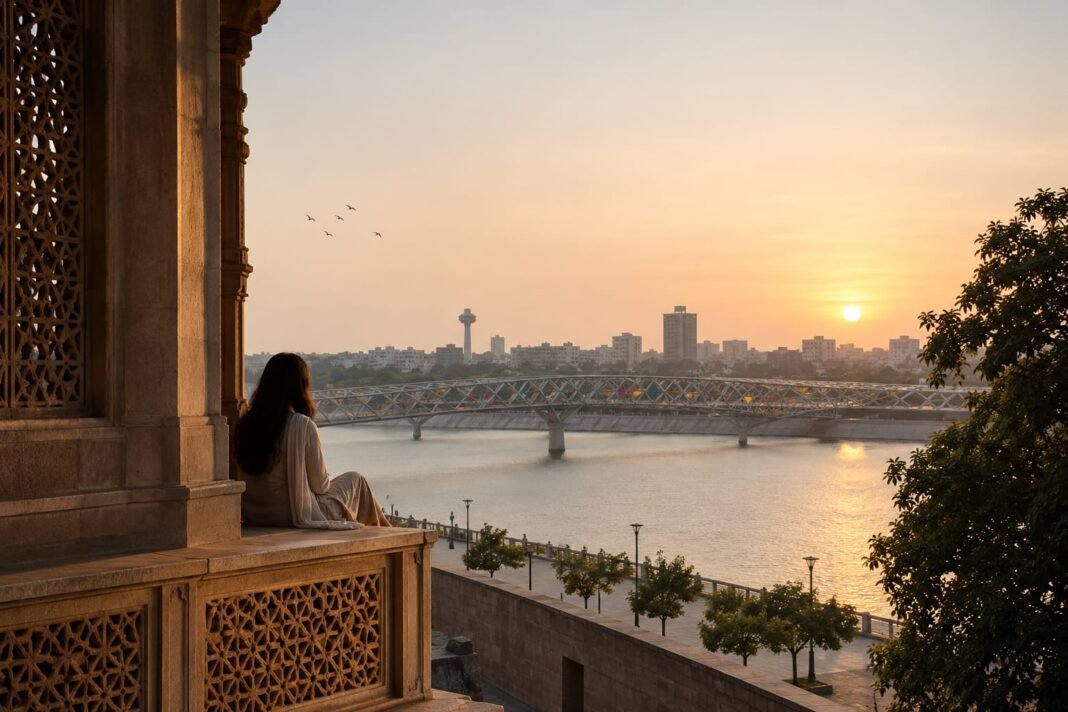
Most guides to Ahmedabad read like they were written by someone who spent forty minutes here between flights. They list the same eight monuments, tell you the city is “the Manchester of the East,” and move on.
We live here. So this guide is different. These are the places to visit in Ahmedabad that we actually take our own visiting cousins to — with real timings, real ticket prices, and honest notes about which ones deserve two hours and which ones deserve twenty minutes.
Ahmedabad became India’s first UNESCO World Heritage City in 2017, and the walled city is still the best argument for visiting. But the city is bigger than its monuments now. There’s a riverfront that changed how Amdavadis spend their evenings, a Le Corbusier building most tourists walk straight past, and a night market where the bargaining is half the entertainment.
Here’s how to see it properly.
Quick Answer: The Top 5 Places to Visit in Ahmedabad
Short on time? Start here.
- The Old City pols — the walled city’s residential lanes, best seen on the morning heritage walk
- Sabarmati Ashram — free, quiet, and genuinely moving
- Adalaj Stepwell — five storeys underground, and the single most photogenic thing near the city
- Manek Chowk — jewellery market by day, street food chaos by night
- Sabarmati Riverfront & Atal Bridge — where the city goes to breathe
Now the full list.
Heritage: The Walled City and Its Monuments
1. Sidi Saiyyed Mosque (The Jali That Became a City Symbol)
You’ve seen this even if you don’t know it. The stone lattice window carved into a tree with intertwining branches is the Sidi Saiyyed Jali, and it’s on everything from IIM Ahmedabad’s logo to the back of auto-rickshaws.
Built in 1573, in the last year of the Gujarat Sultanate, the mosque is small — you’ll spend fifteen minutes here. But that jali is worth the stop, and it sits right at Lal Darwaza, so it slots easily into any old-city route.
Timings: Open through the day, closed to visitors during namaz Entry: Free Amdavad Gully tip: Go around 8 AM. The light comes through the jali from the west side and you’ll get the shot everyone else is queuing for at noon.
2. Jama Masjid
Completed in 1424 by Ahmed Shah I, this is one of the most impressive mosques in western India, and one of the most underrated places to visit in Ahmedabad. The courtyard holds 260 pillars. Look closely at the carving and you’ll spot Jain and Hindu motifs — lotus rosettes, bell-and-chain patterns — absorbed into an Islamic building. That fusion is the whole story of medieval Ahmedabad in one place.
Timings: Roughly 6 AM to 8 PM, closed to visitors during prayer Entry: Free Time needed: 30–45 minutes Dress code:Cover shoulders and knees. Shoes off at the courtyard.
3. Bhadra Fort and Teen Darwaza
Bhadra Fort is where Ahmedabad started, built in 1411. Teen Darwaza, the triple-arched gateway just east of it, is the ceremonial entrance to the old royal square and one of the oldest gateways still standing in India.
Be honest with yourself about this one: the area is congested, commercial, and not especially well maintained. Come for the history and the street life, not for a serene monument experience. The rooftop of Bhadra Fort gives you a decent view over the old city if the access is open.
Timings: 9 AM to 5 PM (fort) Entry: Free
4. The Pols of Old Ahmedabad
This is the reason Ahmedabad has UNESCO status, and it’s the part most visitors miss entirely.
Pols are the walled residential clusters of the old city — self-contained neighbourhoods with shared courtyards, secret passages between houses, communal bird feeders called chabutras, and carved wooden facades that are 150 to 250 years old. Doshivada ni Pol, Haja Patel ni Pol, Lambeshwar ni Pol — each one has its own character.
You can wander in yourself, but you’ll miss almost everything without a guide. The AMC heritage walk is the answer.
The Ahmedabad Heritage Walk: starts around 7:45 AM daily from Kalupur Swaminarayan Mandir, ends at Jama Masjid around 10:30 AM. Roughly 2 km on foot, about 20 stops. Register at the temple in the morning or book ahead through the official heritage walk website.
Amdavad Gully tip: There’s also a night heritage walk from Sidi Saiyyed Mosque and a Jain heritage walk starting at Shantinath Derasar. The night walk ends at Manek Chowk, which means you finish with food. Do that one.
5. Manek Chowk
Manek Chowk works three shifts. Vegetable market in the morning, jewellery market through the day — one of India’s busiest bullion markets — and then around 8 PM the whole square converts into a street food bazaar that runs past midnight.
Order the ghee-heavy sandwiches, the pav bhaji, the kulfi, and the chocolate-cheese dosas that food purists complain about and everyone eats anyway. It’s loud, crowded, not especially hygienic by nervous-stomach standards, and completely essential.
Best time: 9:30 PM onwards Budget: ₹200–400 per person, easily
6. Rani no Hajiro and Badshah no Hajiro
Two tomb complexes a few minutes from Manek Chowk. Badshah no Hajiro holds the tomb of Ahmed Shah I, the city’s founder. Rani no Hajiro, the queens’ tombs, is now surrounded by a textile market selling bandhani and mirror-work — one of the better places in the city to buy fabric.
Access rules differ by gender at the tombs themselves, so check at the gate.
Entry: Free
7. Hutheesing Jain Temple
Built in 1848 by a wealthy Jain trading family, this is the most beautiful temple in the city and one of the calmest places to visit in Ahmedabad. White marble, 52 shrines around a central courtyard, and carving so fine it looks machine-cut. The Mahavir Stambh outside, a 78-foot tower modelled on the one at Chittor, was added much later.
Timings: Roughly 10 AM to 12:30 PM and 4 PM to 7 PM Entry: Free Note: Leather items are not permitted inside.
8. Dada Harir Vav
A five-storey stepwell from 1499 in Asarwa, built by a woman in the household of Sultan Mahmud Begada. Descending it feels like walking into a cool inverted temple. It gets a fraction of Adalaj’s crowds, which is exactly why we like it.
Timings: Around 9 AM to 5 PM Entry: Free Amdavad Gully tip: Bring a fast lens. It’s dark down there and flash photography ruins the atmosphere for everyone else.
9. Sarkhej Roza
Often called the Acropolis of Ahmedabad. A 15th-century complex of mosque, tombs, palace and tank, built without a single arch or minaret — the whole thing rests on pillars and beams. Le Corbusier admired it. It’s about 8 km southwest of the centre.
Come at golden hour. The tank reflects the pavilions and the whole complex empties out.
Timings: Around 9 AM to 6 PM Entry: Free
Gandhi, the River, and Modern Ahmedabad
10. Sabarmati Ashram
Gandhi lived here from 1917 to 1930, and it was from this campus that he set out on the Dandi March in 1930. What survives is deliberately modest: Hriday Kunj, his cottage, with a charkha and a writing desk. A museum designed by Charles Correa. Open verandas facing the river.
It takes an hour and it’s free. Of all the tourist places in Ahmedabad, this is the one that people talk about afterwards.
Timings: Around 8:30 AM to 6:30 PM, open daily Entry: Free Note: A large redevelopment of the wider precinct has been underway, so parts of the surrounding campus may be fenced or altered. The core memorial and museum remain open.
11. Sabarmati Riverfront
Before 2012, the Sabarmati was a seasonal riverbed with slums along its edges. The riverfront project rebuilt 11 km of both banks into promenades, parks and event grounds. Whatever you think of the politics of it, it changed the city’s evenings.
Walk the lower promenade at sunset. There’s a flower park on the west bank, boating, cycle tracks, and the Sunday market under the bridges where you can buy anything from socks to secondhand novels.
Entry: Free (promenade) Best time: 5:30 PM to 8 PM
12. Atal Bridge
The pedestrian bridge that opened in 2022, designed with a kite-inspired lattice roof — a nod to Uttarayan. 300 metres long, coloured LED lighting after dark, and a glass-floor section that people queue to stand on.
Timings: 9 AM to 9 PM (extended hours in the summer months) Entry: ₹30 for ages 12–59; ₹15 for children 3–12 and senior citizens; free for children under 3 and for differently-abled visitors Note: Visits are capped at 30 minutes and outside food isn’t allowed on the bridge. Nearest metro: Gandhigram
13. Kankaria Lake
A 34-sided artificial lake built in 1451, now Ahmedabad’s biggest family recreation zone. Around the 2 km promenade you’ll find Kamla Nehru Zoo, a toy train, a balloon ride, boating, Kids City, and food stalls. In late December, Kankaria Carnival takes over the whole lakefront.
Timings: 9 AM to 10 PM, Tuesday to Sunday. Closed Mondays. Entry: Around ₹25 for adults, ₹10 for children; individual attractions cost extra Free window: Walkers and joggers enter free from about 4 AM to 8 AM Amdavad Gully tip: The Monday closure catches people out constantly. Check before you go.
14. Gujarat Science City
On S.G. Highway, and the best half-day in the city if you have children with you. The Aquatic Gallery has a 28-metre shark tunnel and is among the largest public aquariums in India. The Robotics Gallery is genuinely fun. There’s also an Astronomy and Space Science Gallery, an IMAX 3D theatre, and a laser and fountain show after sunset.
Timings: Closed every Monday. Last entry to the main galleries is 7 PM. Entry ticket: ₹50 (covers Hall of Science, Hall of Space, Energy Park, Life Science Park, Nature Park, Climate Change Learning Lab) Galleries: Aquatic Gallery ₹200, Robotics Gallery ₹200, Astronomy Gallery ₹200 — each charged separately, and you need the base entry ticket firstExtras: IMAX 3D ₹150, Planetarium ₹150, 5D theatre ₹150, Laser & Fountain Show ₹90 Parking: ₹20 two-wheeler, ₹50 car, ₹100 bus Book online. Weekend slots sell out and the counters don’t take cash.
15. Calico Museum of Textiles
One of the finest textile collections in the world, housed in a Sarabhai family haveli in Shahibaug. Mughal-era brocades, Patola, Kalamkari temple hangings, a 300-year-old tent.
The catch: entry is by guided tour only, group sizes are capped at around 20, advance booking is mandatory, no photography is allowed, and young children generally aren’t permitted. Tours are typically in the morning and the museum is closed on Wednesdays and public holidays.
Entry: Free Book: Several weeks ahead. Not a walk-in. People are turned away daily.
16. Amdavad ni Gufa
An underground art gallery designed by architect B.V. Doshi to house M.F. Husain’s work — a cave-like structure of interlocking domes covered in mosaic tiles, with Husain’s murals painted directly onto the curved interior walls. Two Pritzker-adjacent legends in one small building.
Location: CEPT University campus, Navrangpura Entry: Nominal Time needed: 30 minutes, plus a coffee at the campus café
17. IIM Ahmedabad (Louis Kahn’s Campus)
The old campus, designed by Louis Kahn in the 1960s, is one of the great works of modern architecture in India — exposed brick, monumental circular cutouts, corridors that frame light like a camera. Architecture students travel here specifically for it.
Public access is restricted and depends on security at the gate. Ask politely, carry ID, don’t wander into academic buildings. If you’re serious about seeing it, try contacting the institute in advance.
18. Auto World Vintage Car Museum
Around 100 restored vintage cars in Kathwada — Rolls-Royces, Bentleys, Cadillacs, a Maybach, plus vintage motorcycles and buggies. Some are drivable for a fee. It’s a 20-minute drive from the centre and a genuine surprise for anyone who likes cars.
19. Law Garden Night Market
Stalls selling chaniya choli, bandhani dupattas, mirror-work bags and Kutchi embroidery, open every evening but at absolute peak in the weeks before Navratri. Prices start high. Counter with about 40% of the asking price and settle somewhere in the middle.
Timings: Roughly 6 PM to 11 PM Amdavad Gully tip: The bhelpuri and sandwich stalls along the garden’s edge are the real reason locals come.
Day Trips: The Best Places Near Ahmedabad
20. Adalaj Stepwell
Eighteen kilometres north of the city, and worth the drive on its own. Built in 1499 by Queen Rudabai, this octagonal stepwell descends five storeys into the ground, every surface carved — Islamic geometry beside Hindu and Jain motifs, and a navagraha frieze near the well shaft that’s said to protect the site.
The temperature drops noticeably as you descend. It was designed that way.
Timings: Around 8 AM to 6 PM Entry: Free Best time: Early morning, before tour buses arrive around 10 AM
21. Akshardham Temple, Gandhinagar
A vast pink sandstone temple complex about 25 km away, with landscaped gardens, an exhibition on Indian culture, and a water show in the evening.
Timings: Around 9:30 AM to 7:30 PM, closed Mondays Entry: Free to the temple; exhibitions and the water show are ticketed Important: Phones, cameras and electronics are not permitted inside. Security is airport-grade. Budget extra time.
Best Time to Visit Ahmedabad
| Season | Months | What to Expect |
|---|---|---|
| Winter | Nov – Feb | The best window. Days around 25–30°C, cool mornings. Peak season. |
| Uttarayan | Mid-January | Kite festival. The sky fills up for two days. Book accommodation months ahead. |
| Summer | Mar – Jun | 40°C+ regularly. Sightseeing only before 10 AM and after 6 PM. |
| Monsoon | Jul – Sep | Green, humid, atmospheric. Stepwells can flood at the lower levels. |
| Navratri | Sep – Oct | Nine nights of garba across the city. The most alive Ahmedabad ever feels. |
If you can only come once, come in January. If you can come twice, come again during Navratri.
Getting Around
Metro — clean, cheap, air-conditioned, and useful along the east-west corridor. Gandhigram station puts you near the riverfront and Atal Bridge.
Auto-rickshaw — everywhere, and mostly metered. Insist on the meter.
Uber and Ola — reliable and often cheaper than an auto for longer distances.
Walking — the only way to see the old city. Everything else, don’t try.
Ahmedabad Darshan bus — AMTS runs a full-day sightseeing bus that covers the major tourist attractions in Ahmedabad cheaply. Rushed, but efficient if you have one day.
A 2-Day Ahmedabad Itinerary
Day 1 — Heritage Morning heritage walk from Kalupur Swaminarayan Mandir (7:45 AM). Jama Masjid and Sidi Saiyyed after. Lunch — a Gujarati thali at Agashiye or Gordhan Thal. Afternoon at Hutheesing Temple and Dada Harir Vav. Evening at Manek Chowk.
Day 2 — River, Modern, Beyond Sabarmati Ashram early. Adalaj Stepwell mid-morning. Back for lunch. Afternoon at Amdavad ni Gufa or the Calico Museum if you booked ahead. Sunset on the Sabarmati Riverfront, then Atal Bridge lit up after dark.
With a third day, add Gujarat Science City and Sarkhej Roza.
Frequently Asked Questions
How many days are enough for Ahmedabad? Two days covers the essential places to visit in Ahmedabad. Three days lets you add Science City, Sarkhej Roza and a proper food crawl without rushing.
Which places in Ahmedabad are free to enter? Most of them. Sabarmati Ashram, Jama Masjid, Sidi Saiyyed Mosque, Hutheesing Temple, Sarkhej Roza, Adalaj Stepwell, Dada Harir Vav and the riverfront promenade are all free. Even the Calico Museum is free — it’s just extremely hard to get into.
Is Ahmedabad worth visiting? Yes, if you’re interested in architecture, history or food. It’s a working city rather than a resort town, so it rewards curiosity more than it rewards passivity.
What is Ahmedabad most famous for? Its UNESCO-listed walled city, its role in the independence movement through Sabarmati Ashram, its textile heritage, the Uttarayan kite festival, and street food.
Is alcohol available in Ahmedabad? Gujarat is a dry state. Visitors from outside Gujarat can apply for a temporary liquor permit, usually through licensed hotels.
Which day are attractions closed? Monday catches out the most people — Kankaria Lake, Gujarat Science City and Akshardham are all closed. The Calico Museum closes on Wednesdays.
Timings and ticket prices change. We update this guide regularly, but check official sites before you travel — and if you spot something out of date, tell us. We’d rather fix it than have you turn up on a Monday.
Found a place we’ve missed? Amdavad Gully is written by people who live here, and we’re always listening. Drop us a line.