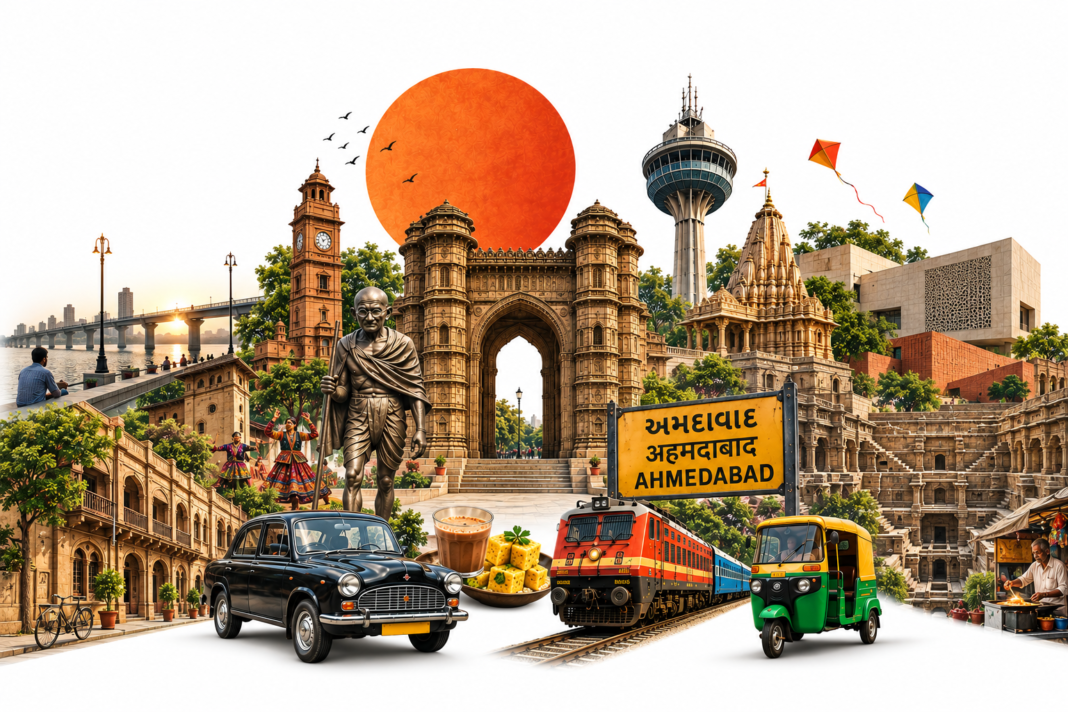
Ask a Punekar what to do in their city and you’ll get a list. Ask an Amdavadi and you’ll get an argument.
Because everyone here has a different Ahmedabad. There’s the Ahmedabad of the pols — those tangled, secretive lanes of the old city where a 200-year-old haveli sits behind a bird feeder and a scooter repair shop. There’s the Ahmedabad of Louis Kahn’s brick arches and Le Corbusier’s raw concrete, a city that quietly became one of the world’s great modern architecture destinations. There’s the Ahmedabad that eats — dal vada at 8 am, ghee-drowned thali at 8 pm, cheese pav bhaji at midnight. And there’s the new one: coffee roasteries on Sindhu Bhavan Road, startup offices in GIFT City, a riverfront that didn’t exist twenty years ago.
Most guides on things to do in Ahmedabad give you the same nine bullet points and a stock photo. This one is different. It’s written from the inside, it tells you when a place is actually worth your time, and it tells you when it isn’t.
Grab a chai. This is going to take a minute.
Quick answer: the best things to do in Ahmedabad
If you only have time to skim, here’s the short list:
- Walk the old city at dawn — the AMC Heritage Walk from Kalupur to Jama Masjid
- Sidi Saiyyed Mosque — the tree-of-life jali that became the city’s logo
- Sabarmati Ashram — Gandhi’s headquarters for 13 years
- Manek Chowk after 9 pm — jewellery market by day, food carnival by night
- Adalaj Stepwell — five storeys of carved stone going down
- Sarkhej Roza — the most peaceful place in the city, and free
- Atal Bridge and the Sabarmati Riverfront at golden hour
- Amdavad ni Gufa — a Doshi cave gallery with Husain murals
- Kankaria Lake — the city’s great democratic hangout
- A proper Gujarati thali — the meal you’ll still be thinking about in six months
Now the real guide.
1. The Old City: where Ahmedabad actually begins
In 2017, Ahmedabad became India’s first UNESCO World Heritage City — before Delhi, before Jaipur, before Varanasi. A lot of Indians still don’t know this. A lot of Amdavadis are quietly smug about it.
The reason isn’t a single monument. It’s the urban fabric — roughly 600 years of continuously inhabited neighbourhoods called pols, each one a self-contained micro-village with its own gate, its own well, its own chabutro (bird feeder), and secret passages built for exactly the kind of emergencies a medieval trading city expects.
Do the Heritage Walk (yes, really)
The Ahmedabad Municipal Corporation’s heritage walk starts early — around 8 am from the Kalupur Swaminarayan Temple, and finishes about two and a half hours later at Jama Masjid. Roughly two kilometres, around twenty stops, a guide who knows which doorway hides a 180-year-old haveli.
Why it beats doing it yourself: the pols are genuinely confusing, and half the good stuff is behind unmarked doors you’d never push open. The walk gets you inside.
Local tips:
- Arrive 15 minutes early. It leaves on time and it does not wait.
- Book through the official heritage walk website; timings shift seasonally.
- There’s also a night heritage walk starting near Sidi Saiyyed and ending at Manek Chowk, and a Jain heritage walk covering the old city’s derasars. The night walk is the underrated one.
- Eat before, not after. You’ll be too full for lunch and too early for it anyway.
The monuments you shouldn’t skip
Sidi Saiyyed Mosque — The tree-of-life stone lattice here is the single most reproduced image in Gujarat. IIM Ahmedabad uses it as its logo. You can see it in ten minutes; it’s worth the detour even in traffic. Go mid-morning when light comes through the jali properly.
Jama Masjid (1424) — Built by Ahmed Shah I, and one of the most beautiful mosque courtyards in India. Over 250 pillars, no two quite alike. Take your shoes off, sit down for ten minutes, don’t just photograph and leave.
Bhadra Fort and Teen Darwaza — The 1411 origin point of the city. The fort itself is more of an atmospheric ruin-plus-market than a manicured monument, and the surrounding chaos is half the experience.
Rani Sipri’s Mosque — Locally called Masjid-e-Nagina, the jewel of a mosque. Small, delicate, almost always empty. This is the one to visit if you’re tired of crowds.
Jhulta Minara (Shaking Minarets) — Near Kalupur station. Structurally fascinating, visually modest, and honestly a five-minute stop rather than a destination.
Hutheesing Jain Temple (1848) — White marble, immaculate, and paired with a soaring Mahavir Stambh. Beautiful in late afternoon light.
Dada Harir Vav, Asarwa — A 15th-century stepwell most tourists miss because Adalaj gets all the attention. Fewer people, same octagonal descent into cool darkness, and often you’ll have it to yourself.
2. Gandhi’s Ahmedabad
Sabarmati Ashram was Gandhi’s base from 1917 to 1930, and the Dandi March began here. Entry is free, the grounds are shaded and quiet, and Hriday Kunj — the room where he and Kasturba lived — is startlingly small.
One important note if you’re planning a 2026 visit: the ashram precinct is in the middle of a large, much-debated ₹1,200 crore redevelopment, with dozens of surrounding structures being restored and the visitor area expanded well beyond the original core. Road access and parking around Gandhi Ashram Road has been rerouted at various points during construction. Check before you go, and budget extra travel time.
Nearby, Kochrab Ashram — Gandhi’s first Ahmedabad home after returning from South Africa in 1915 — has been restored and is a quieter, less crowded alternative.
3. The architecture pilgrimage most visitors don’t know about
This is Ahmedabad’s genuinely world-class secret. In the mid-20th century, the city’s mill-owning families invited some of the greatest architects alive to build here. The result is a concentration of modernist masterpieces you’d normally have to cross continents to see.
IIM Ahmedabad (Louis Kahn) — Those enormous circular openings in exposed brick are on every architecture syllabus on earth. Access to the campus is restricted, so write ahead to the institute rather than turning up hopefully at the gate.
Sanskar Kendra (Le Corbusier) — The city museum, built on Corbusier’s “museum of unlimited growth” idea. It also houses the Kite Museum, which is more charming than it sounds.
Mill Owners’ Association Building (Le Corbusier) — Raw concrete, brise-soleil, sitting right by the river. Viewable from outside; interiors require arrangement.
Amdavad ni Gufa — B.V. Doshi’s underground, blob-shaped cave gallery, with murals by M.F. Husain inside. Half-buried domes covered in mosaic tile, an interior like standing inside a lung. Free or near-free, ten minutes from CEPT, and one of the most surprising spaces in India. Check the day’s timings — it’s not open every day.
CEPT University campus — Also Doshi. Wander the campus in the evening if you can; it’s a masterclass in shade, brick and stepped levels.
If you’re into design at all, this cluster alone justifies the trip. Nowhere else in India gives you Kahn, Corbusier and Doshi within a 30-minute rickshaw radius.
4. Sarkhej Roza: the best hour you’ll spend in Ahmedabad
Ten kilometres southwest of the centre, a 15th-century complex of mosque, tombs, pavilions and a vast rectangular tank. No towering gateway, no ticket queue, no guide shouting facts at you. Corbusier compared its proportions to the Acropolis.
Go about an hour before sunset. Sit on the steps by the tank. Watch the light change on the stone and the birds come down to the water. It’s free, it’s serene, and it is the single most underrated thing to do in Ahmedabad.
5. The Sabarmati Riverfront and Atal Bridge
Twenty years ago the Sabarmati’s banks were informal settlements and dust. Today there’s an 11-km promenade on both sides — walking, cycling, kite-flying, evening crowds, food kiosks, and a genuinely good flower park.
Atal Bridge is the headline act: a 300-metre pedestrian-only steel bridge with a kite-inspired canopy, colour-shifting LEDs at night, and a glass floor section over the water. Tickets run around ₹30 for adults and ₹15 for children and senior citizens, with the Flower Park ticketed separately or as a small combo. It’s open roughly 9 am to 9 pm (later in the summer months), and visitors are technically limited to about 30 minutes on the bridge.
How to actually enjoy it:
- Go at dusk, roughly 6:30–8 pm, when you get daylight, sunset and the LEDs in one visit.
- Weekday evenings are far calmer than weekends.
- Nearest metro: Gandhigram. Parking near the riverfront is available for a small fee.
- Skip the middle of the afternoon. There’s very little shade and the steel radiates heat.
Walk the promenade afterwards. The riverfront at night — families, cyclists, corn vendors, the bridge glowing behind you — is Ahmedabad at its most contented.
6. Kankaria Lake: the city’s living room
A 76-acre, 34-sided polygonal lake built in 1451, now the biggest family recreation zone in the city. Kamla Nehru Zoo, the Atal Express toy train, a tethered balloon ride, boating, Nagina Wadi island garden, an evening laser show, a butterfly park, Kids City, and an outer walking loop that fills up every evening.
Practicalities: open Tuesday to Sunday, roughly 9 am to 10 pm, closed Mondays for maintenance. Entry is around ₹25 for adults and ₹10 for children, with individual rides ticketed separately. There’s a free early-morning walking window before the paid gates open — which is when the serious walkers and the laughing clubs take over.
Every December–January the Kankaria Carnival turns the whole thing into a week-long festival of performances, food stalls and shows.
Honest take: if you’re a solo traveller chasing heritage, Kankaria is skippable. If you’re with kids, grandparents, or you want to see how the city actually spends its Sunday evening, it’s essential.
7. Eating your way through Ahmedabad
Let’s be clear about something. You could ignore every monument in this guide and come to Ahmedabad purely to eat, and the trip would still be worth it.
Breakfast is a competitive sport
Fafda-jalebi on a Sunday morning is not a snack, it’s a civic ritual — crisp gram-flour strips, hot jalebi, raw papaya chutney and fried chillies, best from an old Gandhi Road institution with a queue outside. Dal vada, khaman, methi na gota in monsoon, poha with sev. Start at a legacy shop, not a hotel buffet.
Manek Chowk, after dark
By day, one of India’s busiest jewellery markets. By around 9 pm, the shutters come down and food carts roll in, and the same square becomes a full-blown street food carnival until well past midnight.
What to order: cheese pav bhaji (yes, an unreasonable amount of cheese — that’s the point), Gwalia sandwich, kulhad pizza, bhaji pau, and then kulfi from a stall that’s been doing it for generations.
Tips: go hungry, go after 10 pm for peak atmosphere, carry cash, and share plates across three or four carts instead of committing to one.
The thali experience
A proper Gujarati thali is unlimited, slightly sweet, ghee-forward, and served by people who will keep refilling your plate until you physically cover it with your hand.
- Agashiye at House of MG — rooftop, heritage hotel, seasonal menu, the polished version. Book ahead.
- Vishalla — a recreated village setting, dinner only, eaten on the floor by lamplight, with the excellent Vechaar Utensils Museum attached.
- Gordhan Thal / Rajwadu / Toran Dining Hall — the everyday-great tier, where locals actually go.
Come hungry. Skip lunch. This is not an exaggeration.
The non-vegetarian city nobody mentions
Ahmedabad has a reputation as a strictly vegetarian city. That’s only half true. Bhatiyar Gully, near Teen Darwaza, comes alive late at night with kebabs, bheja fry, nalli nihari and gravies simmered for hours — a Mughlai street-food culture that’s been here for centuries. Best after 10 pm, best with someone who knows the lanes.
The old cafés and the new ones
Lucky Tea Stall is the famous one — a café built around old graves that the owners refused to move, with an M.F. Husain painting on the wall. Bun maska and chai, and a story you’ll retell.
For contemporary café culture, head to Sindhu Bhavan Road — the city’s newest food-and-coffee strip, packed with specialty roasters, dessert bars and rooftop restaurants. CG Road, Prahlad Nagar and Bodakdev fill in the rest.
And two things worth knowing:
- Gujarat is a dry state. No bars, no alcohol in restaurants. Visitors from outside Gujarat can apply for a temporary permit, but honestly — plan an evening around food and coffee instead, because that’s what the city has optimised for.
- Nightlife here means late dinners, dessert runs and drives, not clubs. Once you accept that, the city gets much more fun.
8. Shopping: textiles, bandhani and bargaining
Ahmedabad built its wealth on cotton. The textile obsession never left.
Law Garden Night Market — Stalls of bandhani dupattas, mirror-work chaniya cholis, embroidered bags and juttis, open into the evening. Bargain hard; the first quote is a conversation starter, not a price.
Rani no Hajiro — Tucked behind Manek Chowk, a lane of traditional textiles, chaniya cholis and dress materials at better prices than the tourist-facing markets.
Gurjari and Gramshree — Fixed-price, government and NGO-run outlets for authentic Gujarati handicrafts. Go here if bargaining stresses you out, or if you want to know your money reaches the artisan.
Calico Museum of Textiles, Shahibaug — Not shopping, but the natural companion to all of it: arguably the finest collection of Indian textiles in the world. It’s also the strictest museum you’ll ever visit. Entry is by pre-booked guided tour only, groups are tiny, spaces fill weeks ahead, no phones, cameras or bags inside, and young children aren’t admitted. Book through the official Calico Museum website well before your trip, and confirm the day — it’s closed one day a week and on public holidays. For textile lovers, it’s a bucket-list visit. For everyone else, it’s a two-hour commitment, so be honest with yourself.
9. Day trips from Ahmedabad
Some of the best things to do in Ahmedabad are technically not in Ahmedabad.
Adalaj Stepwell (~18 km) — Built in 1499, five storeys descending into the earth, every pillar and wall surface carved. Cool even in peak summer, because that’s exactly what it was engineered to do. Go early to beat both heat and crowds. Easily combined with a Gandhinagar trip.
Akshardham, Gandhinagar (~25 km) — Vast, immaculate, sandstone temple complex with gardens and an evening show. Security is strict; leave phones and bags in the car. Closed Mondays.
Modhera Sun Temple + Rani ki Vav, Patan (~100–125 km) — The great Gujarat day trip. An 11th-century sun temple with a stepped water tank, and a UNESCO-listed stepwell so spectacular it’s printed on the ₹100 note. Add a stop at a Patan Patola weaving house to watch double-ikat being made by hand. Leave by 7 am.
Lothal (~80 km) — A 4,500-year-old Indus Valley port town with the world’s earliest known dockyard. The site is modest to the untrained eye — go with a guide or read up first, and it becomes extraordinary.
Nalsarovar Bird Sanctuary (~65 km) — Best from November to February, when migratory flamingos, pelicans and cranes arrive. Sunrise boat rides. Skip it in monsoon and peak summer.
Statue of Unity, Kevadia (~200 km) — The world’s tallest statue, a viewing gallery in Sardar Patel’s chest, plus a jungle safari, cactus garden and river rafting. A long day trip at 3.5–4 hours each way; better as an overnight.
Polo Forest (~150 km) — Monsoon and post-monsoon greenery, 15th-century ruins in the forest, and a weekend camping culture. Best July to November.
10. With kids? Start here
- Gujarat Science City — Aquatic Gallery with its shark tunnel, Robotics Gallery, nature park. A genuinely well-executed half-day.
- Kankaria Lake — toy train, zoo, balloon ride, Kids City.
- Auto World Vintage Car Museum — a private collection of vintage cars, some of which you can ride in.
- Sabarmati Riverfront — cycling and open space, best in winter evenings.
11. Time your visit to a festival
Uttarayan / International Kite Festival (14–15 January) — The single best time to be in Ahmedabad. The sky physically disappears behind kites. Rooftops turn into all-day parties with undhiyu and jalebi, everyone shouts “kai po che!” when a rival’s string is cut, and at night the tukkals — paper lanterns — go up. If you visit once, visit now. Book accommodation months ahead.
Navratri (Sept–Oct) — Nine nights of garba, recognised by UNESCO on its intangible cultural heritage list. Community grounds, giant commercial venues, and neighbourhood circles that anyone can join. Learn the basic three-clap step in advance; someone will teach you if you don’t.
Rath Yatra (June/July) — The Jagannath temple procession through the old city. Enormous crowds, huge cultural significance, heavy security. Plan around it rather than through it.
Kankaria Carnival (late December) and the Ahmedabad Flower Show at the riverfront (January) round out the winter calendar.
12. Free things to do in Ahmedabad
Because a good city shouldn’t require a wallet:
- Sabarmati Ashram
- Sarkhej Roza
- Jama Masjid, Sidi Saiyyed, Rani Sipri’s Mosque
- Walking the riverfront promenade (the bridge is ticketed; the promenade isn’t)
- Early-morning walking hours at Kankaria
- Wandering the pols yourself
- The Calico Museum tour, if you can get a booking
- Watching kites on any January rooftop you’re invited onto
Practical guide: getting around, when to go, where to stay
When to visit
November to February is the answer. Days in the mid-20s°C, cool evenings, festival season, and the only period when walking the old city for three hours is pleasant rather than punishing.
March to June gets genuinely brutal — 40°C+ is routine. July to September brings monsoon, which is atmospheric and green (great for Polo Forest and gota) but disruptive.
Getting around
- Metro — Two lines crossing near the Old High Court, connecting east–west and north–south, with extensions running towards Gandhinagar and GIFT City. Cheap, air-conditioned, and now genuinely useful for tourists moving between the old city and the western suburbs.
- Auto-rickshaws — Metered, and drivers here are more likely to actually use the meter than in most Indian cities. Insist politely.
- Uber/Ola — Reliable across the city.
- BRTS (Janmarg) — Dedicated bus corridors, cheap, good for longer stretches.
- Walking — The old city only works on foot. Everywhere else, don’t try.
Where to stay
- Old city (Lal Darwaja / Bhadra area) — Heritage hotels and havelis, walking distance to everything historic. Atmospheric, noisier.
- Ashram Road / riverfront — Central, good midrange hotels, easy access to both banks.
- SG Highway / Prahlad Nagar / Sindhu Bhavan Road — Modern, business-friendly, great food and cafés, further from heritage.
- Near Kalupur station — Convenient for early trains, not much else.
Small things that make a big difference
- Carry cash for street food and markets; UPI works nearly everywhere else.
- Cover shoulders and knees at religious sites; carry socks for hot marble.
- Drink sealed bottled water.
- Sunday mornings are the best time for old-city food; Monday is the worst day for museums and Kankaria.
- Learn two words: “Kem cho?” (how are you) and “Majama” (all good). They will earn you more goodwill than anything else in this guide.
Suggested itineraries
24 hours in Ahmedabad
Morning: Heritage Walk → Jama Masjid → fafda-jalebi breakfast Afternoon: Sabarmati Ashram → Amdavad ni Gufa Evening: Sarkhej Roza at sunset → Atal Bridge → Manek Chowk for dinner
A weekend (48 hours)
Day 1: Heritage Walk → Sidi Saiyyed → Bhadra Fort → thali lunch → Calico Museum (pre-booked) → riverfront and Atal Bridge at dusk → Manek Chowk Day 2: Adalaj Stepwell → Akshardham, Gandhinagar → back for Amdavad ni Gufa and CEPT → Law Garden shopping → dinner at Vishalla
Three days
Add a full day trip: Modhera + Patan for heritage, Lothal for archaeology, or Nalsarovar for birds in winter. Fill the gaps with Kankaria, Science City or Sarkhej Roza.
Frequently asked questions
What is Ahmedabad most famous for? Being India’s first UNESCO World Heritage City, its old-city pols, its Gandhi connection through Sabarmati Ashram, its textile heritage, its modernist architecture by Kahn, Le Corbusier and Doshi, and its street food.
How many days do you need in Ahmedabad? Two days covers the essentials. Three lets you add a day trip. Four or more if you’re serious about architecture, textiles or food.
Is Ahmedabad worth visiting? Yes — and especially if you like cities with layers rather than single showpiece monuments. It rewards curiosity more than checklist tourism.
What’s the best time to visit Ahmedabad? November to February. January if you want the kite festival.
Is alcohol available in Ahmedabad? Gujarat is a dry state. Visitors from outside Gujarat can apply for temporary permits, but there are no bars in the ordinary sense.
Is Ahmedabad safe for solo and women travellers? It’s widely considered one of India’s safer large cities, with busy, well-lit public spaces well into the night. Standard urban precautions still apply.
What food is Ahmedabad known for? Gujarati thali, fafda-jalebi, dhokla and khaman, dal vada, undhiyu in winter, cheese pav bhaji at Manek Chowk, and late-night Mughlai food in Bhatiyar Gully.
One last thing
The mistake most visitors make is treating Ahmedabad as a stopover — a night before Kutch, a layover before the Statue of Unity, a work trip with a half-day to kill.
Give it three days and it stops being a stopover. You start noticing that the same city that built stepwells as engineering poetry in 1499 was hiring Louis Kahn in 1961, and is now building a financial district out of a floodplain. That’s not three different cities. That’s one city with a very long attention span.
Come hungry. Wear good shoes. Say yes to the second serving.
Amdavad Gully is Ahmedabad’s own — city news, street-level stories and the people building things here. Follow us for more guides, and tell us in the comments what we left out. We know you have opinions.