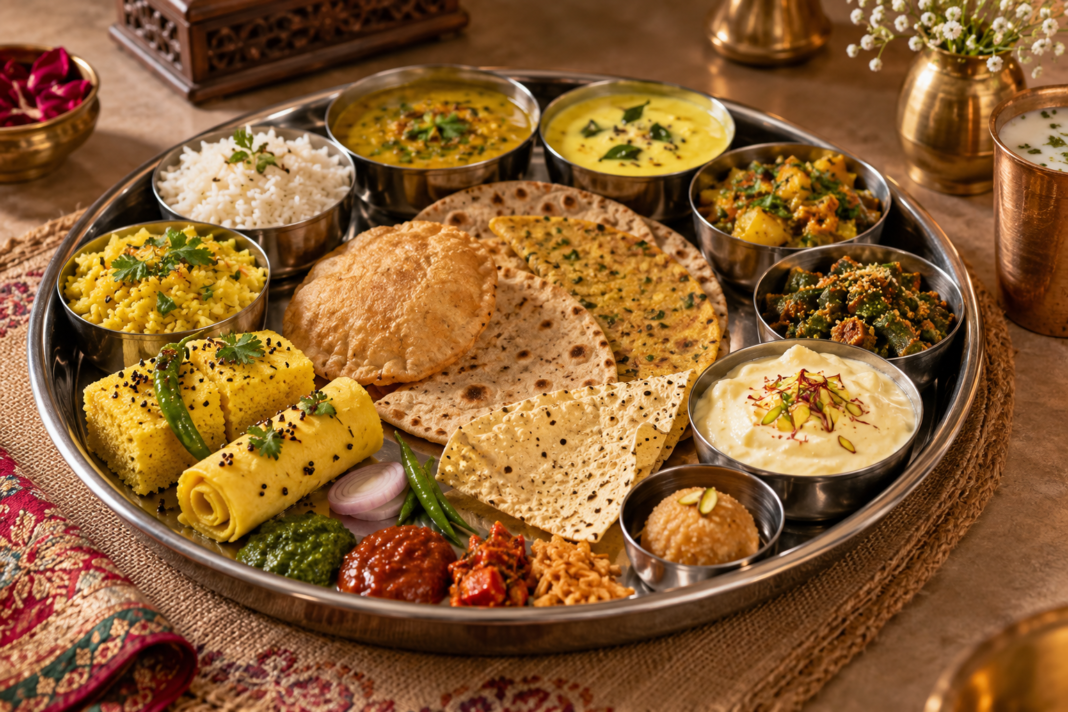
Best Gujarati Thali in Ahmedabad: 10 Places, Every Budget, and How to Eat One Properly
The first thing to understand about a Gujarati thali is that it is not a meal. It’s a system.
Somewhere between fifteen and twenty-five items arrive on one plate. Then men with buckets circle the room, refilling everything you’ve finished before you’ve noticed you finished it. You will eat more than you intended. You will be offered a fourth rotli after you have surrendered. And at some point — usually around the third helping of shrikhand — you will understand why this city takes its lunch break seriously.
Ahmedabad does this better than anywhere else in India. It’s the one food experience here that visitors consistently underestimate and then talk about for years.
This guide covers ten thali restaurants across every budget, from a ₹190 unlimited plate near the railway station to a ₹1,500-a-head heritage rooftop. But it also covers the part every other list skips: what’s actually on the plate, when to go, how the refills work, and how not to be full after twenty minutes.
Skip breakfast. Genuinely.
The tiers, at a glance
| Restaurant | Area | Rough price/head | Best for |
|---|---|---|---|
| Agashiye | Lal Darwaja | ₹1,000–1,500 | Heritage experience, visitors |
| Vishalla | Vasna | Premium | Village setting, dinner only |
| Rajwadu | Vejalpur | Mid–premium | Families, folk performances |
| Gordhan Thal | Bodakdev | Under ₹500 | Food-first value |
| Iscon Thal | SG Highway | Under ₹500 | Consistency, comfort |
| The Grand Thakar | SG Highway | Mid | Kathiyawadi leanings |
| Atithi Dining Hall | SG Highway | Mid | Big families, portions |
| Gopi Dining Hall | Ellisbridge | Mid | Old-school, no onion-garlic |
| Rotlo Gujarati Rasthal | Vastrapur | Mid | Rustic Kathiyawadi |
| Dadi / Jayvijay Dining Hall | City / near station | ₹190–320 | Budget, everyday |
Prices move faster than menus in this category. Treat these as bands, not quotes.
First: what’s actually on a Gujarati thali?
Most guides list restaurants without explaining the plate. Here’s the structure, which is remarkably consistent across every place on this list.
Farsan — the steamed and fried snacks that open the meal. Dhokla, khaman, patra, khandvi, muthiya, fafda. This is where first-timers make their fatal error. See the strategy section.
Shaak — two to four vegetable preparations, usually one dry and one gravied. Seasonal, and the best indicator of a kitchen’s quality.
Kathol — sprouted or boiled pulses, lightly spiced.
Dal and kadhi — you get both. Gujarati dal is thin, sweet-sour and tempered with jaggery, peanuts and kokum. Kadhi is a yoghurt-and-gram-flour soup, served warm. Better places let you choose between the sweet Gujarati dal and a plainer tadka version.
Breads — rotli (thin, ghee-brushed), bhakri (thick, rustic), puri, thepla, and in Kathiyawadi-leaning places, bajra no rotlo with white butter.
Rice and khichdi — served at the end, with kadhi poured over. This is the closing ritual, not a filler.
Accompaniments — chutneys, pickle, papad, salad, and chaas (buttermilk), which is the point rather than a side.
Mishtaan — the sweet. Shrikhand, basundi, mohanthal, gulab jamun, doodhpak, or seasonal specials. Traditionally served with the meal, not after it.
The seasonal items that decide when you should go
This is the single most useful thing in this article.
- April to June: aamras. Fresh alphonso and kesar mango pulp, served unlimited with puri. This is peak thali season in Gujarat and nothing else comes close. If you can only eat one thali in your life, eat it in May.
- Winter (roughly November–February): undhiyu. The slow-cooked mixed winter vegetable dish, plus green garlic, ponk and fresh greens across the shaak.
- Monsoon: gota and bhajiya in the farsan, and heavier fried items generally.
A thali in September is good. A thali in May with unlimited aamras is a different event entirely.
The 10
1. Agashiye, House of MG — the one to take visitors to
Where: rooftop of the House of MG, Lal Darwaja, opposite the Sidi Saiyyed Mosque Hours: roughly 12:00–3:30 pm and 7:00–11:00 pm Price: premium — expect roughly ₹1,000–1,500 per head depending on format
Agashiye means “on the terrace,” and that’s exactly what it is: two large terraces atop the restored Mangaldas Girdhardas family haveli in the old city, open since 1999.
The format is unusual and worth knowing. There are two service styles — Heritage Grand and Heritage Classic — served in silver and kansa thalis respectively. You’re received in a waiting area with a welcome drink and starters before being seated. The menu changes daily and seasonally, so nobody can tell you in advance what you’ll eat, which is the point.
The honest assessment: Agashiye is the best experience on this list and not necessarily the best food. Regular thali eaters will tell you the cooking at Gordhan Thal is more consistent for a third of the price, and reviews do flag service variability. What Agashiye has that nobody else does is the setting — a heritage rooftop in the walled city, five minutes from Sidi Saiyyed and the heritage walk route.
Verdict: for a visitor’s first or last night in Ahmedabad, it’s the correct choice and worth the money. For your fourth thali of the month, it isn’t. Book ahead.
2. Vishalla, Vasna — dinner in a village that isn’t there
Where: Vasna, on the southwestern edge of the city Format: dinner only, eaten seated on the floor by lamplight in a recreated rural setting, served on leaf platters Price: premium
Vishalla is the most atmospheric meal in Ahmedabad — mud-walled structures, oil lamps, folk musicians and puppeteers, food served on leaves in the open air. It’s theatrical in a way that could easily be tacky and somehow isn’t.
The bonus nobody uses properly: the Vechaar Utensils Museum on site, a serious collection of traditional Indian metal vessels. It’s excellent, it’s right there, and most diners walk straight past it.
Practical: dinner only, no lunch. Arrive early. It gets cold in December — carry a layer, because you’re eating outdoors.
Verdict: the best pick if you want the meal to be an evening rather than a lunch. Ideal for out-of-town guests and anyone who’s already done Agashiye.
3. Rajwadu, Vejalpur — the family option
Where: Vejalpur / Jivraj Park side Price: mid to premium
Village-themed like Vishalla but larger, louder and more family-oriented, with folk performances and open courtyards. The entertainment during the wait is genuinely the differentiator: children who would melt down in a queue elsewhere are fine here.
Verdict: the strongest choice for a large mixed group with kids and grandparents in it. Go for the setting; the food is good rather than exceptional.
4. Gordhan Thal, Bodakdev — where locals actually go
Where: Bodakdev, with other outlets Price: typically under ₹500 per head
If you want to know what a great Gujarati thali tastes like without paying for a haveli or a puppet show, this is the answer. Traditional decor, unlimited service, and a reputation built on consistency — the same flavours, every visit, for years.
The sweets are a particular strength; the basundi has a following.
The catch: parking is limited and the decor is dated. Neither of these will matter after the first course.
Verdict: the best food-per-rupee thali in Ahmedabad, and the one most locals would name if you removed tourism from the equation.
5. Iscon Thal, SG Highway — the reliable one
Where: SG Highway Price: typically under ₹500 per head
Large, well-organised, air-conditioned and consistent. It doesn’t have a story, and it doesn’t need one — it does a full unlimited thali competently, handles crowds well, and never surprises you.
Verdict: the safest booking on this list. If you’re feeding eight people who all want different things, this is where you go.
6. The Grand Thakar, SG Highway — for the Kathiyawadi lean
Where: SG Highway Price: mid
Worth understanding the distinction here. Standard Gujarati thali is sweeter and gentler. Kathiyawadi food, from the Saurashtra region, is spicier, more garlic-forward, and built on bajra rotlo with white butter, sev-tameta and fiery chutneys.
The Grand Thakar leans that way, and if you’ve eaten two sweet Gujarati thalis and want your third to hit differently, this is the correction.
Verdict: best for people who found the standard thali too sweet — which is a very common and entirely valid reaction.
7. Atithi Dining Hall, SG Highway — portions and service
Where: SG Highway / Bodakdev side Price: mid
Popular with families for exactly two reasons: generous serving sizes and attentive staff who keep the buckets moving. Nothing about it is designed to impress a photographer. Everything about it is designed to feed people.
Verdict: an unglamorous, dependable pick when the priority is a full room leaving satisfied.
8. Gopi Dining Hall, Ellisbridge — the old-school choice
Where: Ellisbridge Price: mid
One of the older thali institutions in the city, and notable for a specific reason: it serves food without onion and garlic, which makes it one of the few places you can take strictly Jain or satvik-eating family without a negotiation.
The item count is smaller than the SG Highway giants. The kitchen has been doing this for a long time and it shows.
Practical: there is almost always a wait at peak hours, and the courtyard outside is where you’ll spend it. Go at opening.
Verdict: the pick for traditionalists, and the default for no-onion-no-garlic diners.
9. Rotlo Gujarati Rasthal, Vastrapur — rustic, west side
Where: Vastrapur Price: mid
Rustic-styled, Kathiyawadi-leaning, and conveniently placed for anyone in Vastrapur, Satellite or the university belt who doesn’t want the SG Highway drive.
Verdict: solid neighbourhood choice, and a good introduction to bajra rotlo if you’ve never had it.
10. The budget tier: Dadi Dining Hall and Jayvijay
This is the category every glossy list ignores, and it’s where most of this city actually eats.
Dadi Dining Hall runs two options — a limited thali at around ₹210 and an unlimited at around ₹320 — in a large hall with quick, efficient service. The sitafal basundi in season is the thing people come back for.
Jayvijay Dining Hall, within walking distance of Ahmedabad railway station, does an unlimited Gujarati thali at around ₹190: hot chapatis, three shaak, dal, rice, kadhi, khichdi, farsan, gulab jamun, papad and chaas, in an air-conditioned hall, with a choice between sweet Gujarati dal and a north Indian tadka dal. For anyone arriving or departing by train, this is the single most useful restaurant in Ahmedabad.
Verdict: proof that a good thali is a ₹200 proposition, not a ₹1,200 one. The expensive places sell setting; these sell lunch.
Also worth knowing
Toran Dining Hall — long-running, unfussy, city-centre. Sasuji, Navrangpura — well-balanced between sweet and spicy, popular locally. Gwal Bhog, Chandkheda — the north Ahmedabad option. Maruti, Vastrapur — dependable west-side alternative. Patang Revolving Restaurant, Ashram Road — thali with a rotating city view. Go for the view; judge the food accordingly.
How to actually eat a thali (the strategy)
This matters. Most first-timers are defeated in twenty minutes and blame the food.
1. Skip the meal before. Not a light breakfast — no breakfast. This is not an exaggeration and every local will tell you the same thing.
2. Do not fill up on farsan. The dhokla and khaman arrive first, they’re delicious, and they are a trap. Take two pieces. The good stuff comes later.
3. Pace to the shaak. The vegetable preparations are where the kitchen shows its ability. Spend your appetite there.
4. Ask for rotli fresh. Good places bring them hot off the tawa on request rather than stacked. Ask.
5. Mix, don’t sequence. Gujarati food is designed to be eaten with sweet, sour, salty and spicy in the same mouthful. Tear rotli, take shaak, add a little dal, add a little chutney. Eating each bowl separately misses the entire design.
6. Khichdi-kadhi closes the meal. Don’t skip it because you’re full — it’s the intended ending, and it’s the most comforting thing on the plate.
7. Know how to stop. Servers will keep filling. To decline politely, cover the bowl with your hand or say “bas, bas”(enough). A firm smile and a covered plate is universally understood and nobody is offended.
8. Don’t waste. Unlimited means unlimited refills, not unlimited leftovers. Take small servings and ask for more. Some places charge for significant waste, and all of them notice.
Timing, cost and practicalities
Lunch: most open between 11:00 and 11:30 am, with the crush from 12:30 to 2:00 pm. Dinner: most open around 7:00 pm, with peak from 7:30 to 9:00 pm.
Go at opening. Arriving at 11:15 am or 7:00 pm means no wait, hotter food, and staff who aren’t yet running at full stretch. Arriving at 1 pm on a Sunday means standing in a courtyard for forty minutes.
Reservations: essential at Agashiye and Vishalla. Most others don’t take them, which is another argument for going early.
Sundays and festivals are the busiest. Weekday lunch is the best possible slot.
Everything on this list is 100% vegetarian. All of it. Gujarati thali has no non-veg version, and none of these restaurants serve meat.
Jain and no-onion-garlic: Gopi Dining Hall excludes onion and garlic entirely. Most others will accommodate a Jain request if you say so when ordering — mention it before service starts, not halfway through.
Alcohol: none, anywhere. Gujarat is a dry state. Chaas is the pairing, and it’s better than you’d expect.
Payment: the premium places take cards; the budget dining halls run on cash and UPI.
Dress: floor seating at Vishalla and some village-style places. Wear something you can sit cross-legged in for two hours.
Which one should you pick?
- First time in Ahmedabad, one thali only: Agashiye
- Best food regardless of setting: Gordhan Thal
- Best evening out: Vishalla
- Big family with children: Rajwadu
- Large mixed group, no drama: Iscon Thal
- You found Gujarati food too sweet: The Grand Thakar
- Jain or no onion-garlic: Gopi Dining Hall
- Catching a train: Jayvijay, near the station
- Under ₹350 and still excellent: Dadi Dining Hall
- Best month to do any of this: May, for the aamras
Frequently asked questions
Which is the best Gujarati thali in Ahmedabad? Agashiye at the House of MG for the overall experience, and Gordhan Thal for the best food-to-price ratio. Vishalla is the strongest choice for atmosphere.
How much does a Gujarati thali cost in Ahmedabad? Anywhere from about ₹190 at a budget dining hall to ₹1,000–1,500 per head at Agashiye. Most well-regarded mid-range places sit under ₹500.
Is Gujarati thali unlimited? Almost always, yes. Refills of every item are included. Some places also offer a cheaper limited thali — Dadi Dining Hall, for instance, runs limited at around ₹210 and unlimited at around ₹320.
Is Gujarati thali vegetarian? Entirely. There is no non-vegetarian version, and none of the restaurants in this guide serve meat.
What’s the difference between Gujarati and Kathiyawadi thali? Standard Gujarati is sweeter and milder. Kathiyawadi, from Saurashtra, is spicier and more garlic-forward, built around bajra rotlo with white butter and fiery chutneys.
When is the best time of year to eat a Gujarati thali? April to June, for unlimited aamras with puri. Winter is a close second for undhiyu.
Do I need to book? Yes for Agashiye and Vishalla. Elsewhere, arrive at opening rather than booking.
What are typical thali restaurant timings in Ahmedabad? Lunch service generally starts between 11:00 and 11:30 am with peak around 12:30–2:00 pm; dinner opens around 7:00 pm with peak from 7:30–9:00 pm.
Are there Jain thali options? Yes. Gopi Dining Hall cooks without onion and garlic as standard, and most other restaurants will prepare a Jain thali on request if you specify before the meal begins.
How full will I get? Extremely. Plan nothing demanding for two hours afterwards, and don’t schedule a thali and a Manek Chowk food crawl on the same day.
One last thing
There’s a reason the thali survived here while it faded elsewhere. It isn’t nostalgia and it isn’t tourism.
It’s that a Gujarati thali is one of the few meals in India engineered around balance — sweet against sour, fried against steamed, heavy against buttermilk — and around the assumption that nobody should leave a table hungry regardless of what they can pay. That’s why a ₹190 plate near the railway station and a ₹1,400 plate on a heritage rooftop are recognisably the same meal.
Eat the expensive one for the story. Eat the cheap one for the food.
And come back in May.
Amdavad Gully covers this city street by street — food, heritage, business and the people cooking behind the counter. Think we’ve missed the thali that actually deserves the top spot? Tell us where, and we’ll go eat it.