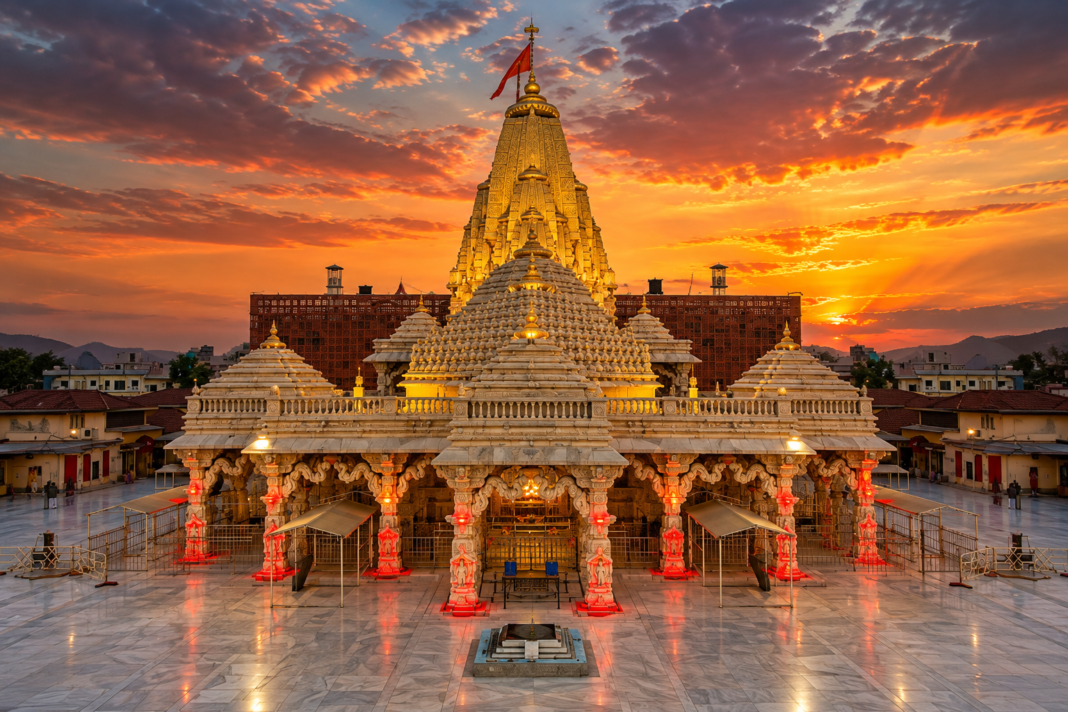
Quick answer: According to the official website of the Shri Arasuri Ambaji Mata Devasthan Trust, a typical day of Ambaji Temple timings runs like this. The morning aarti is from 7:30 am to 8 am, followed by darshan from 8 am to 11:30 am. Afternoon darshan is from 12:30 pm to 4:30 pm. The evening aarti is from 7 pm to 7:30 pm, followed by darshan until 9 pm. The temple is closed for short periods in between. Entry is free, and mobile phones and cameras aren’t allowed inside. Timings change during Navratri, Bhadarvi Poonam and other festivals, so check before you go.
Planning Your Ambaji Darshan
High in the Aravalli hills, on the Gujarat–Rajasthan border, stands one of India’s most loved shrines of the Mother Goddess. Every day, thousands of pilgrims climb the steps of the Ambaji Temple, chanting “Jai Ambe!” On big festival days, that number rises to lakhs.
Ambaji is one of the 51 Shakti Peethas. So, for pilgrims across Gujarat, Rajasthan and beyond, a darshan of Maa Amba is a lifelong wish. But to make the most of your visit, you need to know when the temple is open.
In this guide, we explain everything about Ambaji Temple timings. First, we share the official daily schedule and aarti times. Next, we cover the best time for darshan, festival changes, Gabbar Hill and the ropeway. Then, we look at temple rules, how to reach and where to stay. Finally, we answer the questions pilgrims ask most.
A note on sources: The timings in this guide come from the official website of the Shri Arasuri Ambaji Mata Devasthan Trust. The website shows the day’s timings, which can vary with seasons and festivals. So, please check it on the day of your visit.
Ambaji Temple Timings at a Glance
| Detail | Timing or information |
|---|---|
| Morning aarti | 7:30 am to 8:00 am |
| Morning darshan | 8:00 am to 11:30 am |
| Midday break | 11:30 am to 12:30 pm |
| Afternoon darshan | 12:30 pm to 4:30 pm |
| Evening break | 4:30 pm to 7:00 pm |
| Evening aarti | 7:00 pm to 7:30 pm |
| Evening darshan | 7:30 pm to 9:00 pm |
| Open days | All seven days |
| Entry fee | Free |
| Mobile phones and cameras | Not allowed inside |
| Managed by | Shri Arasuri Ambaji Mata Devasthan Trust |
| Temple contact | 02749-262236 |
Source: Official Ambaji Temple website, schedule shown for 30 September 2026. Timings may differ on other days.
Find the temple: Open map
About the Ambaji Temple
The Ambaji Temple stands in the town of Ambaji, in the Danta taluka of Banaskantha district, north Gujarat. It sits in the Arasur hills, part of the Aravalli range, close to the Rajasthan border. That’s why the goddess here is also called Arasuri Amba.
Ambaji is revered as one of the 51 Shakti Peethas. According to Hindu tradition, these are places where parts of the goddess Sati’s body fell. At Ambaji, pilgrims believe her heart fell on nearby Gabbar Hill. So, the town is one of the most sacred places for worshippers of the Mother Goddess.
One thing makes Ambaji very special. There’s no idol of the goddess in the main shrine. Instead, a sacred geometric yantra, known as the Shri Visa Yantra, is worshipped. It’s decorated so that it looks like the goddess from a distance. According to tradition, the yantra must not be photographed or looked at directly by the naked eye.
The temple is managed by the Shri Arasuri Ambaji Mata Devasthan Trust. Over the years, the Trust has renovated the temple with white marble and a gold-plated spire, and built facilities for pilgrims.
The Story of Sati and the Shakti Peethas
Why is Ambaji so sacred? The answer lies in an old story. Here it is, in short.
Sati was the wife of Lord Shiva. Her father, King Daksha, did not like Shiva. One day, he held a great fire ritual. He asked all the gods but left out Shiva. Sati went anyway. There, her father insulted her husband. Hurt and angry, Sati gave up her life in the fire.
Shiva was filled with grief. He lifted her body and began a wild dance of sorrow. The whole world shook. So, to calm him, Lord Vishnu used his discus. It cut Sati’s body into many parts, and they fell to earth in different places.
Each place where a part fell became a Shakti Peetha, a seat of the goddess. At Ambaji, people believe her heart fell on Gabbar Hill. That’s why this place is so dear to her pilgrims.
Note: This is a story from Hindu scripture and faith. Lists of the Shakti Peethas also differ from text to text.
Official Ambaji Temple Timings Explained
The official website of the Devasthan Trust publishes the day’s darshan and aarti timings. Here’s the schedule shown on the site for a regular day in late September 2026.
| Time | What happens | Darshan |
|---|---|---|
| 7:30 am to 8:00 am | Morning aarti | Open (aarti) |
| 8:00 am to 11:30 am | Morning darshan | Open |
| 11:30 am to 12:30 pm | Midday break | Closed |
| 12:30 pm to 4:30 pm | Afternoon darshan | Open |
| 4:30 pm to 7:00 pm | Evening break | Closed |
| 7:00 pm to 7:30 pm | Evening aarti | Open (aarti) |
| 7:30 pm to 9:00 pm | Evening darshan | Open |
| After 9:00 pm | Temple closes | Closed |
Note: The official site doesn’t name the rituals held during the two breaks. Many sources say the midday break is for Rajbhog, the noon food offering to the goddess. However, we couldn’t confirm this from the Trust’s site.
Ambaji Mandir Timing in Simple Words
If the table feels like a lot, here’s the simple version of the Ambaji mandir timing.
- Morning: Aarti at 7:30 am, then darshan until 11:30 am.
- Midday: A one-hour break from 11:30 am to 12:30 pm.
- Afternoon: Darshan from 12:30 pm to 4:30 pm.
- Evening: A break from 4:30 pm, then aarti at 7 pm and darshan until 9 pm.
In other words, you have three windows for darshan each day. Also, unlike some temples, Ambaji is open for a good part of the afternoon. That makes it easier to fit in a visit if you’re driving from Ahmedabad.
Ambaji Aarti Timings
The Ambaji Temple holds two main public aartis every day. Both are powerful, joyful experiences, with lamps, bells, drums and the crowd singing the famous aarti “Jai Adhya Shakti”.
1. Morning Aarti: 7:30 am to 8:00 am
The morning aarti opens the day at Ambaji. Devotees gather early, and the hall fills with the sound of bells and chanting. Many consider it the most blessed darshan of the day.
So, if you want a good spot, reach the temple by around 7 am. Also, give yourself extra time to deposit your phone and footwear.
2. Evening Aarti: 7:00 pm to 7:30 pm
The evening aarti is the grandest moment of the day. As night falls over the hills, lamps glow before the goddess, and the whole temple rings with devotion. It’s often the most crowded time.
Therefore, arrive by 6:30 pm. After the aarti, darshan continues until 9 pm, so you can stay on for a calmer look.
| Aarti | Time | Feel | Typical crowd |
|---|---|---|---|
| Morning aarti | 7:30 am to 8:00 am | Fresh and devotional | Medium to high |
| Evening aarti | 7:00 pm to 7:30 pm | Grand and lively | High |
Note: Aarti times at Ambaji can shift with the seasons. For example, some sources say the times are a little earlier in winter. So, check the Trust’s website on the day. Crowd levels are a general guide, not official data.
What Is “Jai Adhya Shakti”?
“Jai Adhya Shakti” is one of the most famous aartis of the Mother Goddess in Gujarat. It’s sung at Ambaji and in countless homes and temples, mainly during Navratri. Its verses praise the many forms and powers of the goddess.
If you’d like to join in, it’s a good idea to learn the first few lines before your visit. Even if you don’t know the words, though, clapping along is part of the joy.
Ambaji Live Darshan
Can’t travel to Ambaji? The official Trust website offers live darshan, including the Gabbar Jyot, through its website and app. So, pilgrims can join the aartis from anywhere.
For the latest links, visit the Trust’s website. Also, be careful of fake pages or agents asking for money. Always use official Trust sources.
Official website: ambajitemple.in
Best Time for Darshan at Ambaji
Your best time for darshan depends on what you want from the visit. Here’s a simple guide based on the regular schedule.
| If you want… | Best time | Why |
|---|---|---|
| The morning aarti | 7:30 am | A sacred start to the day |
| A calm morning darshan | 9:30 am to 11:00 am | After the aarti rush settles |
| A quieter visit | 1:00 pm to 4:00 pm on weekdays | Often fewer people |
| The grandest experience | 7:00 pm | Evening aarti in the glow of lamps |
| A relaxed night darshan | 8:00 pm to 8:45 pm | After the aarti crowd thins |
Times to Avoid
- 11:30 am to 12:30 pm: Darshan is closed.
- 4:30 pm to 7:00 pm: Darshan is closed until the evening aarti.
- After 8:45 pm: Very little time remains before closing at 9 pm.
- Bhadarvi Poonam and Navratri: Huge crowds, with changed timings.
- Tuesdays, Fridays and Sundays: These days are often busier, as many pilgrims visit on days linked with the goddess and on weekends.
Our tip: If you’re driving from Ahmedabad for a day trip, aim to reach by 12:30 pm for the afternoon darshan. Then, visit Gabbar Hill and return for the 7 pm aarti if you can stay.
Morning or Evening Darshan: Which Is Better?
| Feature | Morning | Evening |
|---|---|---|
| Aarti | 7:30 am | 7:00 pm |
| Weather | Cool and fresh | Cool after sunset |
| Mood | Calm and quiet | Grand and lively |
| After darshan | Time for Gabbar | Time for dinner and rest |
| Best for | Early risers | Families and first-time visitors |
Ideally, do both. Go to the morning aarti, see Gabbar in the day and come back for the evening aarti. That way, you see Maa Amba in two very different moods.
Ambaji Darshan for a Short Visit
Short on time? Here’s how to plan.
- Just one hour: Come on a weekday between 1 pm and 4 pm.
- Morning only: Reach by 7 am for the aarti, and leave by 9 am.
- Evening only: Reach by 6:30 pm for the 7 pm aarti.
- Late arrival: Get there before 8:30 pm, as darshan ends at 9 pm.
Also, keep 20 to 30 minutes extra for security and for leaving your phone and shoes.
How Long Does Darshan Take?
On a normal weekday, darshan often takes 30 minutes to an hour, including security and depositing your items. However, on weekends, Poonam days and festivals, it can take much longer.
- Weekday, non-festival: About 30 to 60 minutes.
- Weekend or Poonam: About 1 to 2 hours.
- Bhadarvi Poonam and Navratri: Several hours at peak times.
Note: These are general estimates from common visitor experience, not official figures.
Ambaji Temple Timings by Day of the Week
The temple follows the same basic pattern of aartis and darshan every day. However, crowds change through the week.
| Day | Temple open? | Typical crowd |
|---|---|---|
| Monday, Wednesday, Thursday | Yes, regular schedule | Lighter |
| Tuesday and Friday | Yes, regular schedule | Moderate to heavy |
| Saturday and Sunday | Yes, regular schedule | Heavy |
| Poonam (full moon) | Yes, timings may change | Heavy |
Ambaji Temple Timings on Festivals
On festivals, the Ambaji Temple often changes its timings. Usually, it opens earlier and closes later to handle the crowds. So, for festival visits, always check the Trust’s website or call the temple office.
Bhadarvi Poonam
Bhadarvi Poonam, the full moon of the Hindu month of Bhadarvo, is the biggest event of the year at Ambaji. It often falls in September. In the days before it, lakhs of pilgrims walk to Ambaji on foot from across Gujarat and Rajasthan. This pilgrimage is known as a padyatra. Along the way, volunteers set up camps offering free food, water and rest.
During the Bhadarvi Poonam fair, the temple often stays open for longer hours. Also, roads, buses and hotels get extremely busy. So, plan well ahead, or avoid these dates if you dislike crowds.
Navratri
Navratri, the nine nights of the goddess, is hugely important at Ambaji. Both Sharad Navratri (usually September or October) and Chaitra Navratri (usually March or April) bring large crowds. Special aartis, garba and decorations fill the town.
Poshi Poonam
Poshi Poonam, the full moon of the month of Posh, often in January, is marked as the prakatya din, or day of the goddess’s appearance, at Ambaji. Special rituals and a festive procession are commonly held.
Other Special Days
Other days that may affect timings include every Poonam, Diwali, the Gujarati New Year and eclipse days. Temples often close during an eclipse and reopen after purification rituals.
| Festival | Usual month | What to expect |
|---|---|---|
| Bhadarvi Poonam | September | Lakhs of padyatris; longer hours; very heavy crowds |
| Sharad Navratri | September or October | Special aartis and garba |
| Chaitra Navratri | March or April | Large crowds |
| Poshi Poonam | January | Goddess’s appearance day celebrations |
| Diwali and New Year | October or November | Holiday crowds |
| Eclipse days | Varies | Temple may close during the eclipse |
Important: Festival dates follow the Hindu calendar, so they change every year. Always check the current year’s dates and timings.
Walking to Ambaji: The Padyatra
Every year, before Bhadarvi Poonam, a sea of people walks to Ambaji. Some walk for days. They come from Ahmedabad, Gandhinagar, Mehsana and far beyond. Many carry red flags and sing songs to the goddess as they go.
Along the roads, kind people set up camps. They give free food, tea, water and a place to rest. Some even offer free medical help. As a result, the whole route feels like one long festival.
If you drive at this time, go slowly. Walkers fill the roads, day and night. Also, expect traffic changes near Ambaji.
Gabbar Hill Timings and the Ropeway
No visit to Ambaji is complete without Gabbar Hill. It lies about 4 km from the main temple. Devotees believe it’s the original seat of the goddess, where Sati’s heart fell. A small shrine on top holds an ever-burning lamp, the akhand jyot, which can be seen from the Ambaji Temple.
Find it: Open map
Climbing Gabbar
You can climb Gabbar on foot by a long flight of steps. Visitors describe around 1,000 steps or more. The climb can take 45 minutes to over an hour, depending on your fitness. Along the way, stalls sell water, juice and snacks.
Gabbar Ropeway
If the steps feel too much, take the Gabbar ropeway, or udan khatola. It takes you most of the way up in a few minutes, with lovely views of the Aravalli hills.
- Timings: Map listings show roughly 7 am to 7 pm.
- Fare: Recent visitors mention around ₹125 for a return ride, but fares change. So, check at the counter.
- Booking: Visitors say online booking can help reduce waiting time.
- Security: Security checks are done before the ride.
Ropeway: Open map
Tip: Climb Gabbar in the morning or late afternoon, when it’s cooler. Also, carry water, mainly in summer.
The 51 Shaktipeeth Parikrama
Around the base of Gabbar Hill, the Trust has built a special walking route called the 51 Shaktipeeth Parikrama. Here, you’ll find replica temples of all the Shakti Peethas, including ones now in Pakistan, Bangladesh, Nepal, Tibet and Sri Lanka. Each has details about the original shrine.
The full walk is about 3 to 4 km and takes 2 to 3 hours. So, it’s best done in the morning or evening. It’s a wonderful way to “visit” all the Shakti Peethas in one place.
Find it: Open map
Temple Rules You Should Know
Mobile Phones and Cameras
According to the Trust’s website, carrying mobile phones, cameras or electronic gadgets inside the temple premises is strictly prohibited. So, leave them at your hotel or at the deposit counters near the entrance.
No Photography of the Yantra
According to tradition, the sacred Visa Yantra must not be photographed. So, respect this rule and simply take darshan with devotion.
Plastic-Free Pilgrimage
The Trust describes Ambaji as a plastic-free pilgrimage site. Therefore, carry cloth bags instead of plastic ones.
Dress and Footwear
Wear modest, traditional clothes. Also, remove your footwear before entering. Footwear counters are available near the gates.
Security
There’s a security check at the entrance. Large bags may not be allowed inside, so travel light.
Is There VIP or Paid Darshan at Ambaji?
Darshan at the Ambaji Temple is free for everyone. Some websites and agents claim to sell “VIP darshan”. However, we couldn’t find any such paid option on the Trust’s website.
So, don’t pay agents for darshan passes. For donations, prasad, poojas or stays, use only official Trust channels.
Ambaji Prasad: The Famous Mohanthal
Ambaji is famous for its mohanthal prasad, a rich sweet made from gram flour, ghee and sugar. Devotees buy it from the temple’s prasad counters to take home for family and friends.
Prices and pack sizes change over time. Therefore, buy only from official Trust counters, and keep the prasad in a clean, dry bag for your journey.
A Simple Guide for First-Time Visitors
Visiting Ambaji for the first time? Don’t worry. It’s easy if you follow a few simple steps.
First, check the day’s timings on the Trust’s website. Then, plan to reach at least 30 minutes before the aarti you want. Next, leave your phone and bag at your hotel, so you don’t need to queue at a counter.
After that, take off your shoes at the gate and pass the security check. Then, join the line and move slowly with the crowd. When you reach the goddess, fold your hands, say a short prayer and keep moving, so others can have their turn too.
Once you’re done, buy a box of mohanthal from the prasad counter. Then, rest for a while and have a meal. Finally, head to Gabbar Hill to see the flame and finish your yatra.
That’s it. In short, plan ahead, travel light and stay calm. As a result, your darshan will be smooth and joyful.
How Darshan Works: Step by Step
- Check the time: Make sure darshan is open when you arrive.
- Deposit your items: Leave phones, cameras and bags at your hotel or the counters.
- Leave your footwear: Use the counters near the entrance.
- Pass security: Go through the security check.
- Join the queue: Follow the line into the temple.
- Take darshan: Offer your prayers to Maa Amba.
- Collect prasad: Buy mohanthal from the official counter if you wish.
- Visit Gabbar: Head to Gabbar Hill to complete your pilgrimage.
A One-Day Ambaji Plan Around the Timings
Because the temple has two breaks, it helps to plan your day around them. Here’s a simple plan for a full day in Ambaji.
| Time | Plan |
|---|---|
| 7:00 am | Deposit your phone and shoes, and join the queue |
| 7:30 am | Morning aarti |
| 8:30 am | Breakfast in town |
| 9:30 am | Gabbar Hill by ropeway or steps |
| 11:30 am | 51 Shaktipeeth Parikrama (part or full) |
| 1:30 pm | Lunch and rest |
| 3:30 pm | Kumbhariya Jain Temples |
| 4:30 pm | Koteshwar Mahadev |
| 6:30 pm | Return to the temple |
| 7:00 pm | Evening aarti |
| 8:00 pm | Evening darshan, then dinner |
This plan uses the breaks well. As a result, you won’t waste time waiting at closed doors.
Timings of Places Near Ambaji
Most pilgrims visit a few other sacred spots around Ambaji. Their timings differ from the main temple. The times below are rough, based on common listings, so please confirm locally.
| Place | Distance from Ambaji Temple | Approximate timings |
|---|---|---|
| Gabbar Hill | About 4 km | Daylight hours are best |
| Gabbar ropeway | At the foot of Gabbar | Roughly 7 am to 7 pm |
| Mansarovar | Near the temple | Roughly 5:30 am to 9:30 pm |
| Kumbhariya Jain Temples | About 2 km | Roughly 6:30 am to 7:30 pm |
| Koteshwar Mahadev | About 6 to 8 km | Daytime |
| Mount Abu | About 45 km | Hill station; open all day |
Mansarovar
Mansarovar is a sacred pond close to the main temple. Many families perform the mundan, or first head-shaving, of their children here. According to tradition, it’s also linked with Lord Krishna’s own mundan ceremony.
Find it: Open map
Kumbhariya Jain Temples
Just outside Ambaji, the Kumbhariya Jain Temples are known for their beautiful marble carvings, dating back to around the 11th century. They’re peaceful and often uncrowded. So, they make a lovely stop after the busy main temple.
Find it: Open map
Koteshwar Mahadev
This Shiva temple sits among the Aravalli hills near Ambaji. Local tradition links it with the source of the Saraswati river. It’s a calm, green spot, mainly after the monsoon.
Find it: Open map
Mount Abu
Rajasthan’s only hill station is about 45 km from Ambaji. So, many visitors add it to their trip. The Dilwara Jain temples and Nakki Lake are its best-known sights.
How to Reach the Ambaji Temple
By Train
Ambaji doesn’t have a railway station of its own. The nearest major station is Abu Road in Rajasthan, about 20 to 25 km away, on the Delhi–Ahmedabad line. Alternatively, Palanpur Junction in Gujarat is about 60 to 65 km away. From either, take a bus, shared jeep or taxi to Ambaji.
Abu Road station: Open map
Palanpur station: Open map
By Air
The nearest major airport is Ahmedabad’s Sardar Vallabhbhai Patel International Airport, about 180 km away. Udaipur airport in Rajasthan is another option, roughly 170 km away. From either, hire a taxi to Ambaji.
By Road
Ambaji is well connected by road. GSRTC runs frequent buses from Ahmedabad, Gandhinagar, Palanpur and other cities. The Ambaji bus station is within walking distance of the temple.
Ambaji bus station: Open map
| From | Approx. distance | Approx. road time |
|---|---|---|
| Ahmedabad | About 180 to 185 km | 3.5 to 4 hours |
| Gandhinagar | About 160 km | 3 to 3.5 hours |
| Palanpur | About 60 to 65 km | 1.5 hours |
| Abu Road | About 20 to 25 km | 40 minutes |
| Mount Abu | About 45 km | 1.5 hours |
| Udaipur | About 170 km | 3.5 to 4 hours |
Timing tip: If you leave Ahmedabad at 7 am, you’ll reach Ambaji around 11 am. That’s close to the midday break. So, either leave by 6 am to catch the morning darshan, or plan for the 12:30 pm opening.
Where to Stay in Ambaji
Ambaji has a wide range of stays, from simple dharamshalas to mid-range hotels. The Trust also runs pilgrim accommodation, and many community trusts offer rooms for pilgrims. Most stays are within walking distance of the temple.
- Near the temple: Best for early aartis and evening darshan.
- Dharamshalas and trust bhavans: Budget-friendly and popular with families.
- Hotels on the main roads: More choice of private rooms.
Tip: Book very early for Bhadarvi Poonam and Navratri, when rooms fill up fast.
Ambaji Through the Year
The daily pattern stays much the same. However, the weather and crowds change a lot through the year.
| Months | Weather | What to expect |
|---|---|---|
| November to February | Cool and pleasant | Best time for darshan and Gabbar |
| January | Cold mornings | Poshi Poonam celebrations |
| March to April | Warming up | Chaitra Navratri crowds |
| May to June | Very hot | Visit early or late in the day |
| July to August | Rainy and green | Lovely hills, slippery steps |
| September | Warm and humid | Bhadarvi Poonam padyatra and fair |
| October | Clearing skies | Navratri and Diwali holidays |
So, if you want a calm trip, pick a weekday between November and February. But if you want to feel the full energy of Ambaji, go during Navratri or Bhadarvi Poonam.
Best Time of Year to Visit Ambaji
The best time to visit Ambaji is from October to March, when the weather in the Aravalli hills is pleasant. Summers, from April to June, are hot, which makes the Gabbar climb tiring. The monsoon, from July to September, turns the hills green and beautiful, but paths can be slippery.
- Comfortable weather: November to February.
- Festival energy: Bhadarvi Poonam (September) and Navratri.
- Green hills: Late monsoon, in August and September.
- Quieter darshan: Weekdays outside festival seasons.
What to Pack
- Modest, comfortable clothes
- Easy slip-on shoes, since you’ll take them off often
- Good walking shoes if you plan to climb Gabbar
- Cap, sunglasses and sunscreen
- Light shawl for winter mornings and nights
- Water bottle
- Cloth bags, since Ambaji is plastic-free
- Some cash for prasad and offerings
Tips for a Smooth Darshan
- Check the day’s timings: The official website shows them daily.
- Travel light: Leave phones and bags at your hotel.
- Arrive early for aartis: Reach 20 to 30 minutes before.
- Plan around the breaks: Use them for Gabbar and nearby temples.
- Carry cloth bags: Ambaji is a plastic-free site.
- Stay hydrated: Especially if you climb Gabbar.
- Avoid touts: Darshan is free.
- Check festival notices: Timings change on special days.
Visiting With Elders and Kids
- Choose calmer slots, such as weekday afternoons.
- Use the ropeway at Gabbar instead of the steps.
- Ask temple staff about help for senior citizens or people with disabilities.
- Keep children close in crowds, and agree on a meeting point.
- Carry water, snacks and any needed medicines.
Common Mistakes Pilgrims Make
- Arriving at 5 pm. Darshan is closed from 4:30 pm to 7 pm. So, plan for before or after.
- Arriving at 11:45 am. The midday break runs until 12:30 pm. Instead, come a little earlier or later.
- Carrying a phone inside. It’s prohibited. Therefore, leave it at your hotel or the counter.
- Visiting on Bhadarvi Poonam unprepared. Crowds are enormous. Hence, book stays early and expect long waits.
- Skipping Gabbar. Many pilgrims feel the pilgrimage isn’t complete without it. So, set aside time.
Myths and Facts About Ambaji Temple Timings
| Myth | Fact |
|---|---|
| The temple is open all day without breaks. | It closes briefly at midday and from 4:30 pm to 7 pm. |
| Timings are the same all year. | They can shift with seasons and festivals. |
| You need a ticket for darshan. | Entry is free. |
| There’s an idol of the goddess inside. | The sacred Visa Yantra is worshipped, not an idol. |
| You can take photos inside. | Phones and cameras are prohibited inside. |
A Quick Pilgrim’s Checklist
- Check the day’s timings on the Trust’s website.
- Pick your aarti: 7:30 am or 7 pm.
- Plan Gabbar for a time when the temple is closed.
- Book a room early for festivals.
- Leave your phone at the hotel.
- Save the temple’s number: 02749-262236.
Quick Recap: Ambaji Temple Timings
- Morning aarti: 7:30 am to 8 am.
- Morning darshan: 8 am to 11:30 am.
- Afternoon darshan: 12:30 pm to 4:30 pm.
- Evening aarti: 7 pm to 7:30 pm.
- Evening darshan: 7:30 pm to 9 pm.
- Entry: Free.
- Phones: Not allowed inside.
- Festivals: Timings change, so check first.
More Temple Guides From Amdavad Gully
- Famous temples in Gujarat
- Famous temples in Ahmedabad
- Places to visit in Gandhinagar
- Tourist places in Ahmedabad
Frequently Asked Questions
What are the Ambaji Temple timings?
On a regular day, the official schedule is: morning aarti 7:30 am to 8 am, darshan 8 am to 11:30 am, darshan 12:30 pm to 4:30 pm, evening aarti 7 pm to 7:30 pm, and darshan 7:30 pm to 9 pm. Timings can vary, so check the official website.
What is the Ambaji aarti time?
The morning aarti is from 7:30 am to 8 am, and the evening aarti is from 7 pm to 7:30 pm, as per the official schedule for a regular day.
Is the Ambaji Temple closed in the afternoon?
The temple closes briefly from 11:30 am to 12:30 pm, then reopens for darshan until 4:30 pm. It closes again from 4:30 pm until the 7 pm evening aarti.
What time does the Ambaji Temple close at night?
On a regular day, evening darshan ends at 9 pm, after which the temple closes.
What is the Ambaji mandir timing today?
The official Ambaji Temple website, ambajitemple.in, shows the day’s darshan and aarti timings. Check it on the day of your visit, especially during festivals.
Is there an entry fee for the Ambaji Temple?
No. Darshan at the Ambaji Temple is free for all pilgrims.
Are mobile phones allowed in the Ambaji Temple?
No. The Trust says carrying mobile phones, cameras or electronic gadgets inside the temple premises is strictly prohibited.
Why is there no idol in the Ambaji Temple?
The Ambaji Temple worships the sacred Shri Visa Yantra instead of an idol. It’s decorated to look like the goddess, and by tradition it must not be photographed.
Do Ambaji Temple timings change during Navratri?
Yes. During Navratri, Bhadarvi Poonam and other festivals, the temple often opens earlier and closes later. Check the official website for that day’s timings.
When is Bhadarvi Poonam at Ambaji?
Bhadarvi Poonam is the full moon of the month of Bhadarvo, which usually falls in September. Lakhs of pilgrims walk to Ambaji for it.
What are the Gabbar ropeway timings?
Map listings show the Gabbar ropeway running roughly from 7 am to 7 pm. Confirm timings and fares at the counter.
How far is Gabbar Hill from the Ambaji Temple?
Gabbar Hill is about 4 km from the main Ambaji Temple. You can climb it by steps or take the ropeway.
Which is the nearest railway station to Ambaji?
Abu Road in Rajasthan is the nearest major station, about 20 to 25 km away. Palanpur Junction in Gujarat is about 60 to 65 km away.
How far is Ambaji from Ahmedabad?
Ambaji is about 180 to 185 km from Ahmedabad, a drive of around 3.5 to 4 hours.
What is the famous prasad of Ambaji?
Ambaji is famous for its mohanthal prasad, a sweet made from gram flour, ghee and sugar, sold at official temple counters.
The Bottom Line
The Ambaji Temple follows a clear daily rhythm. It opens with the morning aarti at 7:30 am, offers darshan until 11:30 am and again from 12:30 pm to 4:30 pm, and ends with the evening aarti at 7 pm and darshan until 9 pm. On festivals, however, everything can change.
So, check the official website on the day, travel light and plan around the breaks. Take darshan of Maa Amba, climb Gabbar to see the eternal flame, and carry home a box of mohanthal. Jai Ambe!
Run a hotel, restaurant or travel business in Ambaji? Get featured on Amdavad Gully. Write to us at amdavadgully@gmail.com.
References
- Shri Arasuri Ambaji Mata Devasthan Trust – Official website
- Gujarat Tourism – Official website
- Wikipedia – Ambaji Mata Temple
The temple’s timings can vary by date, season and festival, so please verify on the day of your visit. Distances and nearby place timings are approximate.