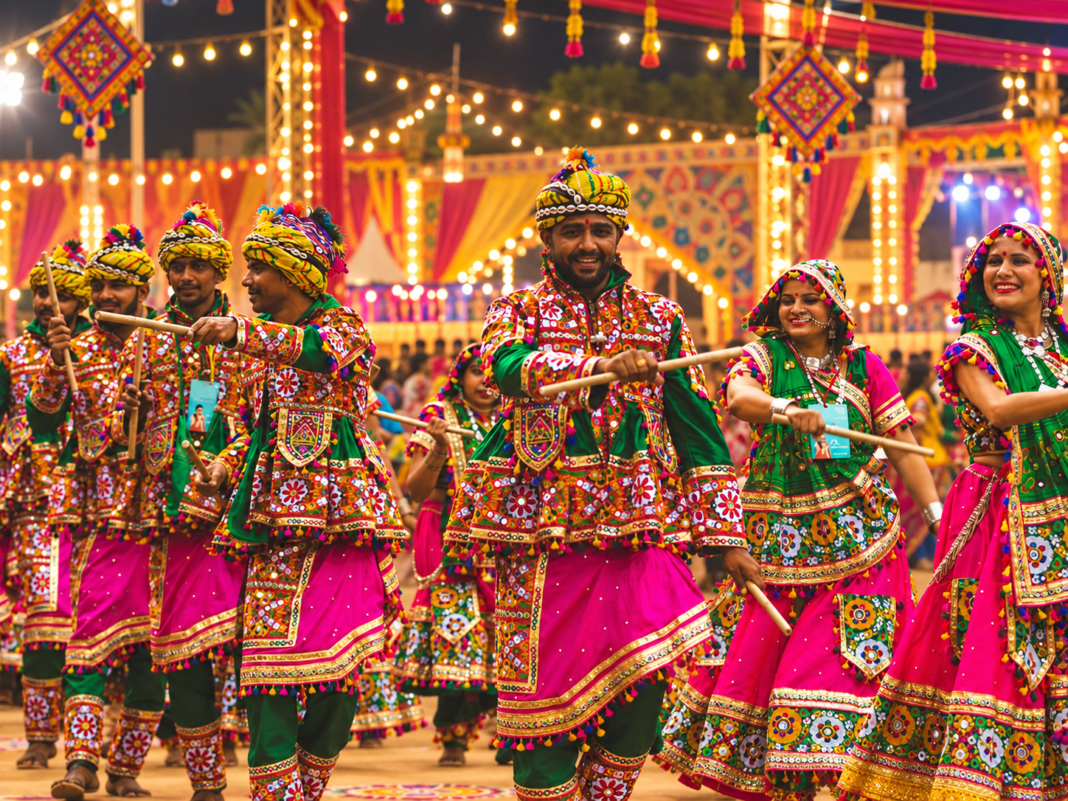
Quick answer: Dandiya Raas is a traditional folk dance from Gujarat, India, performed in pairs with two decorated sticks called dandiyas. Dancers face each other in two lines or circles and strike their sticks to a rhythmic beat, then move on to a new partner. It’s performed mainly during Navratri, the nine-night festival of the Mother Goddess, alongside its sister dance, Garba. The word raas comes from the Sanskrit rasa, linked with emotion and joy, and tradition connects the dance with Lord Krishna’s raas with the gopis of Vrindavan. In 2026, Sharad Navratri runs from about 11 to 20 October.
The Dance That Lights Up Gujarat’s Nights
Imagine a huge open ground under a starry October sky. Thousands of people in mirror-work outfits form circles. The dhol starts to beat. Then, all at once, a sea of sticks rises and falls. Click, click, clack! Partners spin, smile, strike and move on. That’s Dandiya Raas.
For people in Ahmedabad, Vadodara, Surat and across Gujarat, Navratri isn’t just a festival. It’s nine nights of music, colour, devotion and dance. And at the heart of it all are two dances: Garba and Dandiya Raas.
In this complete guide, we cover everything you need to know about Dandiya Raas. First, we explain what it is, where it comes from and what it means. Next, we look at its history, types, music and costumes. Then, we teach you the basic steps, one by one. Finally, we cover Navratri 2026, where to play in Ahmedabad, what to wear, safety tips and much more.
A note on sources: We’ve drawn on reference works, official sources such as UNESCO and Gujarat Tourism, and Gujarat’s living traditions. Many stories about the dance’s origins come from faith and folklore. So, we make that clear as we go.
Dandiya Raas: Quick Facts
| Detail | Information |
|---|---|
| Type | Folk dance performed in pairs with sticks |
| Origin | Gujarat, India; also performed in parts of Rajasthan |
| Main occasion | Navratri, the nine nights of the goddess |
| Sticks used | Two dandiyas per dancer, usually wood or bamboo |
| Formation | Two lines or two circles, partners facing each other |
| Common rhythm | Eight-beat kaherva cycle, among others |
| Main instruments | Dhol, dholak, cymbals, shehnai; today also keyboards and full bands |
| Traditional dress (women) | Chaniya choli with odhni |
| Traditional dress (men) | Kediyu with dhoti or churidar |
| Linked legend | Krishna’s raas lila with the gopis |
| Sister dance | Garba (inscribed by UNESCO in 2023) |
| Navratri 2026 | Around 11 to 20 October 2026 |
| Biggest Ahmedabad event | Vibrant Navratri Festival at GMDC Ground |
What Is Dandiya Raas?
Dandiya Raas is a lively folk dance from Gujarat. Dancers hold a short, colourful stick in each hand. They pair up, face each other and strike their sticks together in a set rhythm. After a few beats, they move along the line or circle and meet a new partner.
The dance is joyful, social and full of energy. It’s easy to learn at a basic level, yet it can become fast and complex as the music speeds up. As a result, both beginners and experts can enjoy it side by side.
Today, Dandiya Raas is performed mostly during Navratri. However, you’ll also see it at weddings, college fests, cultural shows and Gujarati gatherings around the world.
What Do “Dandiya” and “Raas” Mean?
The name has two parts.
- Dandiya: This comes from dando or danda, meaning a stick. So, dandiya are the small sticks used in the dance.
- Raas: This comes from the Sanskrit word rasa. In Indian art, rasa means the emotional flavour or feeling that a work creates. It also refers to the joyful circle dance of Krishna and the gopis, known as the raas lila.
Put together, “Dandiya Raas” means a joyful dance played with sticks. In Gujarati, it’s written as દાંડિયા રાસ.
Garba vs Dandiya Raas: What’s the Difference?
Many people use the two names as if they were the same thing. They’re closely linked, and they’re often danced on the same night. However, they’re different dances.
| Feature | Garba | Dandiya Raas |
|---|---|---|
| Props | No sticks; hands clap | Two sticks per dancer |
| Formation | Circles around a centre | Pairs in lines or double circles |
| Centre | A lit clay pot (garbo) or image of the goddess | No fixed centre needed |
| Partners | Usually danced in a group | Danced in pairs, with partners changing |
| Linked with | Worship of the goddess Amba or Durga | Krishna’s raas, and also Navratri |
| Timing in the night | Traditionally earlier, around the aarti | Often later, as energy builds |
| Name meaning | From garbha, meaning womb or life | Stick dance of joy |
In practice, many modern events mix the two. Also, college competitions have created a blended style called Garba-Raas. So, don’t worry too much about the labels. Just join in!
What Is the Garbo?
The garbo is a clay pot with many small holes, lit from inside with a lamp. Traditionally, it stands at the centre of the Garba circle. According to reference works, the light inside stands for the soul within the womb, or for divine energy shining out into the world. Some traditions say a garbo has 27 holes in three rows of nine, linked with the 27 nakshatras, or lunar mansions.
The Origins of Dandiya Raas
No one can point to a single date when Dandiya Raas began. Instead, it grew over centuries from older dance traditions, stories and community celebrations. Here are the main threads.
Krishna and the Raas Lila
Most Gujaratis link the dance with Lord Krishna. According to the Bhagavata Purana and other texts, Krishna danced with the gopis, the cowherd women of Vrindavan, on moonlit autumn nights. This circle dance of love and devotion is called the raas lila.
Later, Krishna moved to Dwarka, on the coast of Gujarat. So, many believe that the raas tradition travelled with him and took root in Gujarat. Old texts also mention a circle dance called hallisaka, which some scholars link with the raas.
Faith and history: These links come from scripture and tradition. Historians see raas as a very old form that developed over time, rather than something we can trace to one event.
The Goddess and the Sword
Dandiya Raas is also tied to Navratri and the worship of the goddess. A popular explanation says the sticks stand for the sword of Goddess Durga in her battle with the buffalo demon Mahishasura. In this view, the clash of sticks echoes the clash of weapons, and the dance celebrates the victory of good over evil.
Note: This symbolism is widely shared in Gujarat and online. However, it’s a popular interpretation rather than a fact from old texts. We share it because it’s part of how many people experience the dance today.
Folk Roots in Saurashtra and Rajasthan
Long before big Navratri grounds, raas was danced in village squares. Herding and farming communities of Saurashtra and Kutch kept their own styles alive. Men often danced vigorous stick dances, while women had their own songs and steps. Across the border, parts of Rajasthan’s Marwar region share similar traditions.
Over time, these local styles met in towns and cities. They mixed with Garba and Navratri celebrations. Eventually, they became the Dandiya Raas we know today.
A Short Timeline of Dandiya Raas
| Period | What happened |
|---|---|
| Ancient times | Texts describe Krishna’s raas lila and circle dances like hallisaka |
| Medieval period | Raas and garba grow as folk and devotional dances in Gujarat |
| 19th–20th century | Village and community raas styles thrive across Saurashtra and Kutch |
| Mid-20th century | Navratri garba and raas grow in cities like Ahmedabad, Vadodara and Mumbai |
| 1990s | Dandiya pop music and large ticketed events become popular |
| 2000s | College Garba-Raas competitions grow in the USA and abroad |
| 2009 | Raas All-Stars, a US national competition, is set up |
| December 2023 | UNESCO inscribes Garba of Gujarat as Intangible Cultural Heritage |
| Today | Dandiya Raas is danced worldwide during Navratri |
The Spiritual Meaning of Dandiya Raas
For many dancers, Dandiya Raas is more than fun. It carries deep meaning, too. Here are some of the ideas people often connect with it.
- Devotion: The dance is an offering to the goddess during Navratri, or to Krishna in the raas tradition.
- Unity: Everyone dances together, regardless of age or background.
- The circle of life: The moving circles are often seen as a symbol of time, birth and rebirth.
- Good over evil: In the popular view, the striking sticks echo Durga’s victory over Mahishasura.
- Joy: True to the word rasa, the dance is about feeling and sharing happiness.
Of course, not everyone thinks about these meanings while dancing. Many simply enjoy the music and the company. Both ways of playing are part of the tradition.
Navratri: The Festival Behind the Dance
Navratri means “nine nights”. It’s one of the biggest Hindu festivals, dedicated to the Mother Goddess in her many forms. Across India, people celebrate it in different ways. In Gujarat, however, it’s above all a festival of dance.
There are two main Navratris each year. Chaitra Navratri falls in spring, around March or April. Sharad Navratri falls in autumn, around September or October. The autumn one is by far the bigger dance festival, and it’s when most Dandiya Raas takes place.
Each night, people first worship the goddess with an aarti. Then, the music starts, and the dancing goes on late into the night. On the tenth day comes Dussehra, or Vijayadashami, which marks the victory of good over evil.
Navratri 2026 Dates
According to panchang listings, Sharad Navratri 2026 begins on Sunday, 11 October 2026, with Ghatasthapana. Durga Ashtami and Maha Navami both fall on 19 October 2026, and Dussehra is on Tuesday, 20 October 2026.
| Event | Date (2026) |
|---|---|
| Navratri begins (Ghatasthapana) | Sunday, 11 October |
| Durga Ashtami | Monday, 19 October |
| Maha Navami | Monday, 19 October |
| Dussehra (Vijayadashami) | Tuesday, 20 October |
| Vibrant Navratri Festival, GMDC Ground | 11 to 20 October (as listed by Incredible India) |
Note: Hindu festival dates follow the lunar calendar. So, some calendars may differ by a day. Also, local event dates can vary. Always check with the organiser of your event.
The Garbo at Home: How Navratri Begins
For many Gujarati families, Navratri begins at home, not at a ground. On the first day, families set up a small shrine. They place a photo or image of the goddess and light a lamp. In many homes, a clay garbo with a lamp inside is set up, too.
Each evening, the family performs an aarti. Then, in many neighbourhoods, people carry their garbos or join the local circle. In this way, the dance grows from home worship into a shared celebration.
On the last day, the garbo is often taken to a temple or immersed with respect. So, the festival ends just as it began, with devotion.
Note: Customs vary a lot between families and communities. These are common examples, not fixed rules.
The Nine Forms of the Goddess
During Navratri, each night is dedicated to one form of Goddess Durga, known together as the Navadurga. Here they are, in the usual order.
| Night | Form of the goddess | Often linked with |
|---|---|---|
| 1 | Shailaputri | Daughter of the mountains |
| 2 | Brahmacharini | Devotion and discipline |
| 3 | Chandraghanta | Courage and peace |
| 4 | Kushmanda | Creation and light |
| 5 | Skandamata | Mother of Kartikeya |
| 6 | Katyayani | The warrior goddess |
| 7 | Kalaratri | Destroyer of darkness |
| 8 | Mahagauri | Purity and calm |
| 9 | Siddhidatri | Giver of wisdom and powers |
Many people also wear a different colour on each day of Navratri. However, the colour list changes each year and varies between sources. So, check a current list if you’d like to follow it.
Types of Raas in Gujarat
“Dandiya Raas” is the best-known name. However, Gujarat has many raas styles, each with its own flavour. Here are some of the main ones.
1. Dandiya Raas
This is the classic stick dance most people know. Dancers pair up in lines or circles, strike sticks in set patterns and change partners as they move. It’s the style you’ll see at most Navratri events.
2. Mer Dandiya Raas and Maniyaro Raas
The Mer community of the Porbandar region in Saurashtra is famous for its powerful raas. Men, often dressed in white kediyu and turbans, leap, spin and strike sticks with great force. The Maniyaro Raas is a well-known form, sometimes performed by men and women together in rich traditional dress and heavy gold jewellery. It looks almost martial, like a dance of warriors.
3. Gop Raas
Gop raas is linked with herding communities and the story of Krishna as a cowherd. Its songs often describe life in the fields, cattle and Krishna’s playful nature.
4. Raasda
In parts of Saurashtra, women’s raas songs and dances are known as raasda. Here, singing is as important as the steps. Women clap, sing and move in circles, often without sticks.
5. Garba-Raas
This is a modern blend. It grew in college competitions, especially among Indian-American students since the early 2000s. Teams mix Garba and Dandiya steps into tightly planned routines with high energy and big formations.
6. Bollywood and Fusion Dandiya
Today, many events mix traditional steps with film songs, pop remixes and even DJ beats. Purists sometimes frown at this. Still, it brings huge numbers of young people into the dance.
| Style | Where it’s from | Key feature |
|---|---|---|
| Dandiya Raas | Across Gujarat | Paired stick strikes, changing partners |
| Mer Dandiya / Maniyaro Raas | Porbandar, Saurashtra | Powerful, martial style |
| Gop Raas | Herding communities | Krishna and pastoral themes |
| Raasda | Saurashtra | Women’s songs and clapping |
| Garba-Raas | College competitions | Choreographed team routines |
| Fusion Dandiya | Cities and diaspora | Film, pop and DJ music |
Raas in Gujarati Poetry and Song
The raas isn’t only a dance. It has also inspired Gujarati poets for centuries. For example, the 15th-century poet-saint Narsinh Mehta wrote many devotional verses about Krishna, including his raas with the gopis. Later, the poet Dayaram became famous for his garbis, short songs of love and devotion to Krishna.
Many of these old verses are still sung today. In addition, countless folk songs were never written down at all. Instead, mothers, grandmothers and village singers passed them on by heart. So, when you dance to an old tune, you’re joining a chain of voices that stretches back hundreds of years.
Note: Which songs come from which poet is a matter for scholars. We mention these poets as well-known examples of the raas tradition in Gujarati literature.
Stick Dances Across India
Dandiya Raas isn’t India’s only stick dance. In fact, many regions have their own versions. Here’s how it compares with a few of them.
| Dance | Region | How it’s played |
|---|---|---|
| Dandiya Raas | Gujarat | Pairs strike sticks in lines or circles during Navratri |
| Gher | Rajasthan | Men in flowing robes dance in circles, striking sticks |
| Kolattam | Tamil Nadu and Andhra Pradesh | Mainly women strike small sticks in rhythmic circles |
| Kolata | Karnataka | Group dance with sticks, often linked with festivals |
| Kolkali | Kerala | Dancers strike sticks while moving in a circle |
Clearly, the joy of striking sticks to music is shared across India. Each region, however, adds its own songs, costumes and steps. So, if you love Dandiya, it’s worth exploring these cousins too.
The Music of Dandiya Raas
Music drives everything in Dandiya Raas. When the beat speeds up, the dancers speed up. When it slows, they slow down. So, understanding the music helps you dance better.
Traditional Instruments
- Dhol: A large two-sided drum, the heartbeat of the dance.
- Dholak: A smaller hand drum used in many folk songs.
- Manjira and cymbals: Small metal cymbals that keep time.
- Shehnai: A reed wind instrument with a bright, festive sound.
- Harmonium: Often used to accompany singers.
- Nagara and tabla: Used in some groups and styles.
Today, big events also use keyboards, octopads, electric guitars and powerful sound systems. As a result, a single orchestra can fill a ground of thousands.
Rhythm and Beat
Dandiya Raas is often danced to an eight-beat rhythm cycle called kaherva. Some songs use a six-beat cycle called dadra. In simple terms, you count “1, 2, 3, 4, 5, 6, 7, 8” and strike your sticks on set counts.
Songs usually start slow. Then, the singer and drummer push the tempo higher and higher. By the end, dancers are moving very fast. That build-up is part of the thrill.
Types of Songs
- Garba songs: Praise of the goddess Amba and her many forms.
- Raas songs: Stories of Krishna, Radha and the gopis.
- Folk songs: Village life, love, seasons and festivals.
- Modern songs: Remixes, pop albums and film songs.
Songs You’ll Hear at a Dandiya Night
The songs at Navratri cover a huge range of themes. You don’t need to know them to dance. However, knowing what they’re about makes the night richer.
- Praise of the goddess: Songs to Amba, Bahuchar, Kali and other forms of the Mother.
- Krishna and Radha: Playful songs about Krishna’s flute, the gopis and Vrindavan.
- Village life: Songs about wells, fields, cattle, rain and harvest.
- Love and longing: Folk songs about lovers, letters and waiting.
- Birds and nature: Many old songs speak to birds, the moon and the stars.
- Modern hits: Remixes and film songs set to garba and dandiya beats.
Most traditional songs are in Gujarati. Still, the beat speaks a universal language. So, even if you don’t understand the words, you’ll soon be dancing along.
Famous Voices of Navratri
Many singers have become stars of the Navratri season. For example, Falguni Pathak is widely known as the “Queen of Dandiya” for her popular dandiya albums and live shows. In Gujarat, artists such as Atul Purohit in Vadodara, and folk singers like Kirtidan Gadhvi, draw huge crowds.
Each year, dozens of other singers and orchestras perform at events across Ahmedabad and Gujarat. So, check the line-up of your chosen event before buying a pass.
Note: Performers change from year to year. We mention these names only as well-known examples, not as confirmed 2026 line-ups.
Dandiya Sticks: Everything You Need to Know
The sticks are the stars of Dandiya Raas. Here’s what you should know before you buy a pair.
Materials
- Wood: The classic choice. It’s sturdy and makes a lovely sharp sound.
- Bamboo: Light and cheap, but can crack with hard use.
- Metal or steel: Strong and loud, but heavier and can hurt if they hit fingers.
- Acrylic or plastic: Light and colourful, sometimes with LED lights.
Decoration
Traditional dandiyas are wrapped in coloured thread, mirrors, beads, tassels and small bells called ghungroo. Fancy pairs may have lace, stones or tinsel. Meanwhile, plain wooden pairs are popular with serious dancers, since they’re simple and sturdy.
Size
Most dandiyas are about 30 to 45 cm long. Shorter sticks suit kids and beginners. Longer ones give a bigger sound but need more control.
How to Choose a Pair
- Pick a length that feels comfortable in your hand.
- Check that the decoration won’t come loose or scratch.
- Strike them together in the shop to hear the sound.
- Avoid very heavy sticks if you plan to dance for hours.
- Buy an extra pair, since sticks often break or go missing.
Your First Dandiya Night: What It Might Feel Like
This is an imagined scene, based on what many first-timers describe.
It’s 9 pm on the third night of Navratri. You walk into the ground with a friend. Your new chaniya choli feels a little stiff, and your sticks feel strange in your hands. Lights twinkle overhead. Somewhere, a dhol starts to thump.
First, everyone gathers for the aarti. Lamps glow, bells ring and the whole crowd sings to the goddess. Then, the singer starts a slow garba. You join the outer circle and clap along. It’s easy. You start to relax.
Next, the singer calls for dandiya. Two long lines form. You face a smiling aunty who has clearly done this for forty years. “Self, right, self, left,” she says, and shows you the pattern. You miss a beat, laugh and try again. By the fourth partner, you’ve got it.
Then, the music speeds up. The sticks fly faster. Click-clack, click-clack! You spin, strike and move on, again and again. Your arms ache, your feet hurt, and you can’t stop smiling.
Finally, it’s past midnight. You step out of the circle, gulp some water and look back at the sea of dancers. Now you understand. Tomorrow night, you’ll be back.
How a Dandiya Night Usually Unfolds
Every event is different. Still, most Navratri nights follow a similar flow. Here’s what to expect.
- Arrival: People arrive, meet friends and take photos.
- Aarti: The night begins with an aarti to the goddess.
- Slow garba: Gentle circle dances get everyone warmed up.
- Faster garba: The beat picks up, and the circles grow.
- Dandiya Raas: Sticks come out, and pairs form lines or double circles.
- Peak hour: The fastest, loudest rounds, often late in the night.
- Breaks: Short pauses for water, food and rest.
- Closing: A final round, often a slower song, as the night winds down.
So, if you’re new, arrive early. That way, you can warm up with the slower dances before the fast rounds begin.
How to Play Dandiya Raas: A Step-by-Step Guide
Never played Dandiya before? Don’t worry. The basic steps are simple, and most people pick them up in one evening. Here’s a clear guide for beginners.
Note: Step names and patterns vary from place to place. So, the patterns below are common examples. At any event, watch the people around you and follow the local style.
Step 1: Hold the Sticks
Hold one dandiya in each hand, about a third of the way from the bottom. Grip them firmly but not too tightly. Keep your wrists loose, since most of the movement comes from them.
Step 2: Find Your Stance
Stand with your feet about hip-width apart. Bend your knees a little. Face your partner, about an arm’s length away. Then, relax your shoulders and smile. It’s a festival, after all!
Step 3: Learn the Basic Strike
The simplest pattern goes like this.
- First, strike your own two sticks together in front of your chest.
- Then, strike your right stick against your partner’s right stick.
- Next, strike your own two sticks together again.
- Finally, strike your left stick against your partner’s left stick.
Repeat this pattern slowly, saying “self, right, self, left” out loud. Then, once it feels natural, try it to music.
Step 4: Add the Footwork
Now, add simple steps. Step forward with your right foot as you strike your partner’s right stick. Then, step back as you strike your own sticks. Next, step forward with your left foot as you strike left sticks. In short, your feet follow your sticks.
Step 5: Count to Eight
Many dandiya songs follow an eight-beat cycle. So, practise counting “1, 2, 3, 4, 5, 6, 7, 8” with the music. Fit your four-strike pattern into the first four counts, then repeat it in the next four.
Step 6: Learn the Turn
Many patterns include a turn. After a set of strikes, you spin once on the spot, then face your partner again. Start with a slow half-turn before trying a full spin.
Step 7: Move to the Next Partner
Here’s the fun part. In most Dandiya Raas, partners change after each round. Usually, one line or circle stays in place while the other moves one step along. So, after your final strike, step to your side and greet your new partner.
Tip: Watch the people next to you. They’ll show you which way to move.
Step 8: Build Speed Slowly
Songs often start slow and speed up. At first, keep your strikes small and controlled. Then, as you gain confidence, you can add bigger arm movements and faster footwork.
Garba Steps You’ll See Alongside Dandiya
On most Navratri nights, you’ll switch between Garba and Dandiya. So, it helps to know a few popular Garba steps too. Names vary a little between places, but these are widely used in Gujarat.
- Be taali (two-clap): A simple step with two claps in each cycle. It’s the best starting point for beginners.
- Tran taali (three-clap): Similar, but with three claps. It’s one of the most common steps you’ll see.
- Hinch: A graceful step with a gentle dip and turn, often danced to slower songs.
- Dodhiyu: A lively step with quick footwork and a little hop, popular in faster rounds.
- Popatiyu: A playful step, often danced by younger groups as the tempo rises.
Don’t worry about learning them all at once. Instead, pick one, follow the people around you and add more over the nine nights.
Note: Steps and their names differ between regions, families and dance schools. So, treat these descriptions as a general guide.
Common Dandiya Patterns
Once you know the basic strike, you can try a few common patterns. Names vary, so we describe them in plain words.
| Pattern | How it works | Level |
|---|---|---|
| Basic four-strike | Self, right, self, left | Beginner |
| Double strike | Strike your partner’s stick twice on each side | Beginner |
| Strike and turn | Four strikes, then a full spin | Intermediate |
| High-low | Strike above the head, then near the knees | Intermediate |
| Crossover | Swap places with your partner while striking | Intermediate |
| Squat strike | Strike while dipping low on bent knees | Advanced |
| Fast chain | Rapid strikes as the music speeds up, changing partners quickly | Advanced |
Practice Drills for Beginners
Want to feel confident before Navratri? Try these simple drills at home.
- Solo strikes: Strike your own sticks to a slow song for five minutes.
- Counting practice: Clap along to dandiya songs and count the eight beats.
- Partner practice: Practise the four-strike pattern with a friend or family member.
- Turn practice: Spin slowly on the spot without losing balance.
- Speed practice: Gradually play faster songs as you improve.
- Stamina practice: Dance for 20 minutes without stopping, then build up from there.
In addition, many dance studios and community groups in Ahmedabad run Garba and Dandiya classes in the weeks before Navratri. So, if you’d like proper training, look for one near you.
How to Find a Dandiya Class in Ahmedabad
Want to learn properly before Navratri? Many dance schools, gyms and community groups in Ahmedabad run Garba and Dandiya classes in the weeks before the festival. Here’s how to find a good one.
- Start early: Most classes begin about four to eight weeks before Navratri.
- Ask around: Friends, neighbours and society groups often know the best teachers.
- Try a demo: Many classes offer a free first session.
- Check the style: Some teach traditional steps, while others focus on group routines.
- Look at timings: Evening batches are common, so pick one that fits your day.
- Check the fees: Compare prices and what’s included, such as a final performance.
In addition, online videos can help you practise at home. However, nothing beats learning with real partners.
Beginner Mistakes to Avoid
- Gripping too tightly: This tires your hands. Instead, keep a firm but relaxed grip.
- Swinging too hard: Big swings can hurt your partner’s fingers. So, keep strikes controlled.
- Looking at your feet: Look at your partner’s sticks instead.
- Forgetting to move on: Watch the line, and step along when others do.
- Starting too fast: Begin slowly, then build up speed.
- Wearing heavy jewellery on your hands: Rings and bangles can get caught or hurt.
Dandiya Etiquette
Dandiya Raas is a social dance. So, good manners make it fun for everyone.
- Smile and greet each new partner.
- Match your partner’s speed and strength.
- If someone is new, slow down and help them.
- Don’t swing sticks wildly in crowded spaces.
- Respect personal space and boundaries.
- Step out of the circle if you need a break, rather than stopping in the middle.
- Follow the event’s rules and dress code.
Learn From the Elders
Some of the best Dandiya teachers aren’t in dance schools. They’re the grandparents, aunties and uncles in your own family or society. Many of them have danced every Navratri for decades.
So, ask them to show you the old steps. Also, ask them to sing the songs they danced to as children. You’ll learn moves you won’t find in any online video. At the same time, you’ll help keep the tradition alive for the next generation.
In fact, this is exactly how Garba and Raas have always been passed on. UNESCO notes that knowledge of Garba is shared through practice, performance, imitation and observation. In other words, by dancing together.
Dandiya Raas for Offices and Corporate Events
Many Ahmedabad offices now host Navratri nights for their teams. It’s a great way to bond outside work. Here’s how to make it a success.
- Hold it on a weekday evening before the main Navratri rush.
- Book a space with a good floor, lights and sound.
- Hire a short beginner session at the start, since not everyone knows the steps.
- Encourage traditional dress, but keep it optional.
- Offer farali snacks for colleagues who are fasting.
- Add fun prizes, such as best dressed and best pair.
- Finish at a sensible time so people can get home safely.
Is Dandiya Raas Good Exercise?
Yes! A night of Dandiya Raas is a real workout. You’re on your feet for hours, moving your arms, legs and core. As a result, many people treat Navratri as a fun fitness challenge.
Here are some of the benefits dancers often feel.
- Heart health: Long periods of movement raise your heart rate, like cardio exercise.
- Stamina: Dancing for hours builds endurance over the nine nights.
- Coordination: Matching sticks, feet and music sharpens your timing.
- Mood: Music, movement and company can lift your spirits.
- Social connection: Meeting many partners in one night is a great way to bond.
Note: Calorie counts you see online vary widely and aren’t reliable. Also, if you have heart, joint or other health problems, speak to your doctor before dancing for long hours.
Safety Tips for Dandiya Nights
Dandiya grounds can get packed, hot and loud. So, a little care goes a long way.
- Stay hydrated: Drink water often, even if you don’t feel thirsty.
- Warm up: Stretch your legs, arms and back before you start.
- Wear comfortable footwear: Many people dance barefoot or in soft mojdis. Avoid high heels.
- Take breaks: Rest for a few minutes every half hour or so.
- Watch for warning signs: Stop at once if you feel chest pain, dizziness or breathlessness, and get medical help.
- Protect your fingers: Keep strikes controlled to avoid hurting yourself or others.
- Look after your belongings: Keep phones and wallets secure.
- Travel safely at night: Plan your ride home, and travel in groups.
- Emergency number: In India, dial 112 for emergencies.
Questions First-Timers Often Ask
- “Can I join if I don’t know the steps?” Yes! Just join the outer circle, watch and copy. People are usually happy to help.
- “Do I need a partner?” No. In Dandiya Raas, partners change all the time, so you’ll meet many.
- “Can I wear western clothes?” At many society events, yes. However, some big venues require traditional dress.
- “What if I hit someone’s fingers?” Say sorry, smile and slow down. It happens to everyone.
- “How late does it go?” Often past midnight. Still, timings depend on local rules and the event.
- “Can I come alone?” Yes. In fact, it’s a great way to meet people. Just stay aware of your safety.
Common Dandiya Injuries and How to Avoid Them
Dandiya Raas is safe for most people. Still, long nights can lead to small injuries. Here’s how to avoid them.
| Problem | Common cause | How to avoid it |
|---|---|---|
| Bruised fingers | Partner’s stick hits your hand | Hold sticks lower and keep strikes controlled |
| Blisters | New shoes or bare feet on rough ground | Wear soft, broken-in footwear |
| Sprained ankle | Uneven ground or fast spins | Watch your step and turn carefully |
| Sore muscles | Dancing for hours without warming up | Stretch before and after |
| Dehydration | Heat, sweat and long nights | Drink water often |
| Exhaustion | Too many late nights in a row | Rest well during the day |
Of course, if you get hurt, stop dancing and get help. Most big venues have first-aid desks.
What Makes a Great Dandiya Partner?
You’ll meet dozens of partners in one night. Some will make the dance a joy. So, here’s how to be one of them.
- Match the pace: Follow your partner’s speed, especially if they’re new.
- Keep eye contact: It helps you time your strikes.
- Control your strength: Firm strikes are good, but don’t smash.
- Smile: A warm smile makes every round more fun.
- Be patient: Everyone was a beginner once.
- Respect boundaries: Keep a polite distance and stay friendly.
Safety for Women at Navratri Events
Navratri is a time of joy, and most events are safe and well run. Still, it’s wise to take a few simple steps.
- Go with friends or family, and agree on a meeting point.
- Share your live location with someone you trust.
- Keep your phone charged, and carry a power bank.
- Choose well-lit routes and official parking areas.
- Report any harassment to event security or police at once.
- In Gujarat, the 181 Abhayam women’s helpline offers support, and 112 is the national emergency number.
Event organisers also have a role to play. Good lighting, CCTV, trained security and clear help desks make every night safer for everyone.
Dandiya Raas for Kids
Kids love Dandiya Raas. It’s colourful, noisy and full of movement. Here’s how to get them started.
- Buy short, light sticks with no sharp edges.
- Teach the “self, right, self, left” pattern slowly.
- Practise at home with their favourite songs.
- Choose family-friendly events or society garbas with space for kids.
- Bring them home early, since events can run late.
- Keep them close in big crowds, and agree on a meeting point.
Dandiya Raas for Seniors
Age is no barrier to Dandiya Raas. In fact, many older people dance with great skill and joy. Still, it helps to take care.
- Choose smaller, calmer venues such as society garbas.
- Dance in short spells and rest often.
- Pick slower songs, and skip the fastest rounds.
- Wear soft, supportive footwear.
- Check with a doctor if you have any health conditions.
What to Wear for Dandiya Raas
Half the joy of Navratri is dressing up. Grounds fill with colour, mirrors and embroidery. Here’s a guide to traditional outfits.
For Women: The Chaniya Choli
The classic outfit is the chaniya choli. It has three parts.
- Chaniyo: A wide, flared skirt that swirls when you spin.
- Choli: A fitted blouse, often with mirror work or embroidery.
- Odhni: A long scarf draped over the shoulder or head.
Popular styles include the following.
- Kutchi work: Bright thread embroidery and mirrors from the Kutch region.
- Bandhani: Tie-and-dye fabric with tiny dotted patterns.
- Mirror work (abhla): Small mirrors that sparkle under the lights.
- Patola-inspired prints: Geometric designs inspired by Patan’s famous weaves.
- Cotton chaniya choli: Light and cool, ideal for long nights.
- Designer and fusion styles: Modern cuts, jackets and indo-western looks.
For Men: The Kediyu
The traditional men’s outfit is the kediyu, a short, frilled, flared top. It’s usually worn with a dhoti or tight churidar trousers. Many men also add a colourful turban, called a pagdi or safa.
Other popular choices include a kafni (a long kurta) with pyjama, Kutchi-embroidered jackets and bandhani stoles. These are comfortable for dancing and still look festive.
Jewellery and Accessories
- Oxidised silver jewellery: Large earrings, necklaces and bangles.
- Kamarbandh: A decorative waist belt.
- Mang tikka: A forehead ornament.
- Bajubandh: An armlet worn on the upper arm.
- Payal: Anklets with small bells.
- Mojdi or jutti: Soft, flat traditional shoes.
- Kada and pagdi pins: Popular accessories for men.
Comfort Tips for Your Outfit
- Choose breathable fabrics, as grounds get hot.
- Pick a chaniyo that lets you move and spin freely.
- Pin your odhni securely so it doesn’t slip.
- Avoid heavy jewellery on your wrists and fingers.
- Wear soft footwear or dance barefoot if the venue allows.
- Try the full outfit at home before the big night.
Hair and Makeup Tips for Long Nights
Dandiya nights are long, hot and sweaty. So, your look needs to last. Here are some simple tips.
- Prep your skin: Start with a clean face and a light moisturiser.
- Use sweat-proof products: Choose long-wear or waterproof makeup.
- Keep it light: Heavy foundation can melt in the heat.
- Set it: A setting spray or powder helps your look last.
- Tie your hair: A braid or bun stays neat while you spin.
- Add flowers or pins: Gajra and hair accessories add a festive touch.
- Carry blotting paper: It’s handy for quick touch-ups.
Where to Shop for Navratri Outfits in Ahmedabad
Ahmedabad is one of the best cities in India for Navratri shopping. Here are some well-known markets. Please note that stalls and timings change, especially in the weeks before Navratri.
Law Garden Market
Law Garden has long been famous for its street stalls selling chaniya cholis, kediyus, oxidised jewellery and accessories. However, visitors report that many stalls have been cleared by the civic body in recent years. So, check what’s open before you go.
Find it: Open map
Rani no Hajiro and Manek Chowk Area
Rani no Hajiro is a historic tomb complex in the old city, near Manek Chowk. Its lanes are packed with shops selling hand-embroidered outfits, dupattas and dance accessories. It’s crowded, but you can find great value if you’re patient.
Find it: Open map
Dhalgarwad
Dhalgarwad, also in the old city, is a busy clothing market with reasonable prices. It’s popular for fabrics, ready outfits and accessories for the whole family.
Find it: Open map
Other Options
- Bhadra and Teen Darwaza: Street stalls for jewellery, fabrics and small accessories.
- Malls and boutiques: Designer and ready-to-wear Navratri collections.
- Rental shops: Many shops rent outfits for the season, which saves money.
- Online stores: Wide choice, but order early to allow time for fitting.
Shopping tips: Bargain politely at street markets. Also, shop two to three weeks before Navratri, when the choice is good and crowds are smaller.
A Dandiya Night on a Budget
You don’t need to spend a lot to enjoy Navratri. Here’s how to keep costs low.
- Join your society garba: It’s usually free and full of friendly faces.
- Rent your outfit: Rental shops offer lovely outfits for a fraction of the price.
- Mix and match: Pair last year’s chaniyo with a new choli or jacket.
- Shop street markets: Old-city markets are great for jewellery and accessories.
- Buy plain sticks: Simple wooden dandiyas work just as well.
- Eat before you go: Event food can be pricey.
- Share rides: Travel together to save on fuel and parking.
Navratri Budget Guide
Navratri can be as simple or as fancy as you like. Here’s a rough guide to the main costs. Prices vary a lot, so treat these as broad ranges only.
| Item | Budget option | Premium option |
|---|---|---|
| Outfit | Simple cotton chaniya choli or kafni, or a rental | Designer outfit |
| Jewellery | Oxidised street-market pieces | Designer or silver sets |
| Dandiya sticks | Plain wooden pair | Decorated designer pair |
| Venue entry | Free society garba or free zones | Season pass at a big event |
| Food | Home snacks and street food | Event food courts and late-night dinners |
Dandiya Raas at Weddings
Navratri isn’t the only time you’ll see dandiya sticks. In Gujarati weddings, a Dandiya night or Garba night is now a favourite pre-wedding event. Families and friends dance together, often in matching outfits.
Here’s how it usually works.
- It’s held a day or two before the wedding, often in the evening.
- A live singer or DJ plays garba and dandiya songs.
- The couple often makes a grand entry, sometimes with a dance.
- Guests receive sticks, and everyone joins in.
- Many families hire a teacher to lead the first few rounds for beginners.
As a result, Dandiya Raas has become a symbol of Gujarati celebration, not just of Navratri.
Navratri in Ahmedabad: Where to Play Dandiya
Ahmedabad comes alive during Navratri. Every night, the city fills with music, from small society courtyards to giant grounds with thousands of dancers. Here’s an overview of your options.
Vibrant Navratri Festival at GMDC Ground
The state-backed Vibrant Navratri Festival is held at GMDC Ground in Ahmedabad. According to Incredible India, the 2026 edition is listed for 11 to 20 October 2026.
The festival usually features large garba performances, a nightly Maha Aarti, a handicraft bazaar, a food court and children’s zones. In 2025, news reports said general entry was free, with ticketed entry for some special zones. However, entry rules can change each year. So, check the latest details before you go.
Find it: Open map
Party Plots and Big Ticketed Events
Many large ticketed events take place at party plots and grounds across the city, especially along SG Highway, SP Ring Road and in western Ahmedabad. They feature famous singers, big stages and huge crowds. Most sell daily passes and season passes.
Clubs and Hotels
Several clubs and hotels host Navratri nights for members and guests. They’re usually more organised and less crowded, but entry is often limited.
Society Garbas
Almost every housing society in Ahmedabad hosts its own garba. These are the heart of Navratri for many families. They’re free or low-cost, friendly and safe for kids and elders.
Sheri Garba in the Old City
In the pols of old Ahmedabad, street garbas, called sheri garba, keep older traditions alive. Here, you’ll often hear traditional songs and see neighbours dancing around a garbo, just as their grandparents did.
Temple Celebrations
Goddess temples across the city, including the Bhadrakali Temple near Bhadra Fort, linked with Ahmedabad’s patron goddess, hold special aartis and celebrations during Navratri.
Find it: Open map
| Venue type | Best for | Entry | Feel |
|---|---|---|---|
| Vibrant Navratri, GMDC | Big-festival experience | Check yearly rules | Grand and touristy |
| Party plots | Famous singers and young crowds | Paid passes | High energy |
| Clubs and hotels | Organised, calmer nights | Members and guests | Comfortable |
| Society garbas | Families and kids | Free or low-cost | Friendly and local |
| Sheri garba (pols) | Traditional songs | Usually free | Old-world charm |
How the Energy Builds Over Nine Nights
Navratri isn’t the same every night. Instead, the mood changes as the festival goes on. Here’s how it often feels.
- Nights 1 to 3: People settle in, learn new steps and show off their first outfits.
- Nights 4 to 6: Crowds grow, and the dancing gets faster and more confident.
- Weekends: Grounds are at their busiest, so expect long queues and traffic.
- Nights 7 to 9: The energy peaks. Many say the last nights are the best of all.
- Dussehra: The festival ends with prayers, Ravan effigy burnings in some places, and fafda-jalebi in Ahmedabad.
So, if you can only go once, aim for one of the final nights. However, if you want calmer grounds, go early in the festival.
What to Carry on a Navratri Night
- Your dandiya sticks, plus a spare pair
- Your entry pass, printed or on your phone
- Water bottle
- Small towel or handkerchief
- Safety pins and hair ties
- Blotting paper and a small comb
- Power bank and charging cable
- Some cash in small notes
- Light shawl for the ride home on cooler nights
- Any regular medicines you need
Keep everything in a small cross-body bag. That way, your hands stay free for the sticks.
Navratri Timings and Late Nights
Navratri nights in Gujarat usually start after dinner, often around 8 or 9 pm, and go on late. However, the exact closing time depends on local rules and police permissions, which can change from year to year. So, check your event’s timings in advance.
Also, plan for traffic. Roads near big venues get very busy, especially on weekends and the last few nights. Therefore, leave early, share rides and keep extra time for parking.
Five Things to Check Before You Go
- Dates and timings: Confirm when your event starts and ends.
- Entry rules: Check whether you need a pass, and whether there’s a dress code.
- What’s allowed: Some venues restrict bags, food or certain items.
- Parking and transport: Find out where to park, or plan a ride.
- Weather: Late rains can affect open grounds, so check the forecast.
Navratri Food in Ahmedabad
Dancing all night makes you hungry! So, food is a big part of Navratri. Here’s what you’ll find.
- Fasting food: Many people fast, so you’ll see sabudana khichdi, rajgira puri and farali snacks.
- Late-night street food: Food stalls stay open late near big venues.
- Event food courts: Big events offer everything from chaat to pizza.
- Fafda and jalebi: On Dussehra morning, Ahmedabad famously queues up for fafda and jalebi.
Navratri Across Gujarat and Beyond
Ahmedabad isn’t the only place for great Dandiya. Here’s where else Navratri shines.
- Vadodara: Often called the cultural capital of Gujarat, it’s famous for huge, traditional garba events.
- Surat and Rajkot: Both host big grounds and lively society garbas.
- Saurashtra villages: Here, you can see older raas styles, including Mer raas around Porbandar.
- Mumbai: The city has a huge dandiya scene, with major ticketed events.
- Abroad: Gujarati communities in the UK, USA, Canada, Australia and Africa hold large Navratri events.
Photography Tips for Navratri Nights
- Use burst mode: Dancers move fast, so take many shots at once.
- Find the light: Stand near stage lights or decorations for brighter photos.
- Capture details: Close-ups of mirror work, sticks and jewellery look great.
- Try slow shutter: For creative shots, blur the spinning colours.
- Ask first: Always ask before photographing strangers, especially women and children.
- Don’t block the circle: Stay at the edge so dancers can move freely.
Navratri Tips for Visitors to Ahmedabad
Visiting Ahmedabad during Navratri? You’re in for a treat. Here’s how to make the most of it.
- Book early: Hotels fill up fast, so reserve your room well ahead.
- Start with a free event: The Vibrant Navratri Festival is a good first stop, but check the year’s entry rules.
- Ask a local: Hotel staff and friends can point you to welcoming society or club events.
- Dress the part: Many venues expect traditional clothes, and some insist on it.
- Use ride apps: They make late-night travel easier.
- Explore by day: Since you’ll sleep late, plan relaxed sightseeing in the afternoons.
- Respect the faith: Join the aarti quietly and follow local customs.
Navratri Pilgrimages: Ambaji and Pavagadh
For many families, Navratri is also a time for pilgrimage. Two of Gujarat’s most important goddess temples see huge crowds.
- Ambaji: One of the 51 Shakti Peethas, in Banaskantha district. Open map
- Pavagadh: The hilltop Mahakali Temple, near Champaner. Open map
Both temples often change their timings during Navratri. So, check before you travel.
Dandiya Raas Around the World
Wherever Gujaratis have settled, Dandiya Raas has followed. Today, you’ll find Navratri nights in London, Leicester, New Jersey, Chicago, Toronto, Sydney, Nairobi and many other cities.
Abroad, these events do more than entertain. They help families pass their culture on to children born far from Gujarat. They also bring together people from many backgrounds, since anyone is welcome to join the circle.
College Competitions
In the USA, Dandiya Raas has even become a competitive sport. Since the early 2000s, Indian-American college students have formed Garba-Raas teams. In 2009, a national body called Raas All-Stars was set up to run a championship. According to reference works, around 50 college teams were actively competing as of 2023.
These teams train for months. They’re judged on timing, formations, energy, music and traditional dress. As a result, they’ve pushed the dance to new levels of skill and creativity.
How Dandiya Raas Is Changing
Like any living tradition, Dandiya Raas keeps evolving. Here are some trends of recent years.
- Bigger events: Giant ticketed grounds with famous singers and huge stages.
- New music: Remixes, Bollywood songs and DJ sets alongside folk tunes.
- Choreographed groups: Friends and dance schools perform planned routines.
- Fusion fashion: Indo-western outfits, jackets and modern cuts.
- Social media: Reels and videos spread new steps and styles fast.
- Revival of folk forms: At the same time, many groups work to keep older raas styles alive.
Some people worry that the old songs and steps are being lost. Others feel the changes keep the dance alive for new generations. In truth, both views have a point. The best events often find a balance between the two.
Garba’s UNESCO Recognition
In December 2023, UNESCO inscribed “Garba of Gujarat” on its Representative List of the Intangible Cultural Heritage of Humanity. This was a proud moment for Gujarat.
UNESCO describes Garba as a dance performed during Navratri, dedicated to the worship of feminine energy, or Shakti. Dancers move in a counter-clockwise circle around a lit clay pot or an image of the goddess Amba. The movements start slow and gradually build to fast whirling. UNESCO also notes that Garba brings people together across social, economic and gender lines.
Note: UNESCO’s listing names Garba specifically, not Dandiya Raas. However, the two dances are so closely linked during Navratri that the recognition is widely celebrated by all who play.
A Greener Navratri
Big celebrations can create a lot of waste. So, here are some ways to enjoy Dandiya Raas while caring for the planet.
- Reuse or rent outfits instead of buying new ones every year.
- Choose wooden or bamboo sticks over plastic ones.
- Carry a refillable water bottle.
- Use cloth bags for shopping.
- Avoid single-use plastic plates and cups.
- Share rides or use public transport to reach venues.
- Keep the sound at a level that doesn’t disturb neighbours late at night.
How to Host a Dandiya Night
Want to host a Dandiya night for your society, office or community? Here’s a simple checklist.
- Get permissions: Check local rules for events, sound levels and timings.
- Pick a space: Choose an open, level area with room for circles.
- Arrange music: Book a live band, singer or a good sound system.
- Light it up: Use bright, safe lighting, and check all wiring.
- Set up the centre: Place a garbo or an image of the goddess for the aarti.
- Plan safety: Keep water, first aid and clear exits ready.
- Add food: Arrange snacks, including farali options for those fasting.
- Welcome beginners: Start with a short demo of the basic steps.
- Add prizes: Best dressed and best dancer prizes add fun.
- Clean up: Leave the space as clean as you found it.
Explaining Dandiya Raas to Kids in Five Sentences
- Dandiya Raas is a happy dance from Gujarat that people play with two small sticks.
- You stand in front of a partner and tap your sticks together to the music.
- After a few taps, you move along and get a new partner.
- People dance it during Navratri, a festival of nine nights for the goddess.
- Some people say the dance was first played by Lord Krishna with his friends.
Ten Fun Facts About Dandiya Raas
- “Dandiya” simply means sticks, from the Gujarati word for a stick.
- “Raas” comes from rasa, the Sanskrit word for emotion and joy.
- Tradition links the dance with Krishna’s moonlit raas in Vrindavan.
- Many people see the sticks as a symbol of Goddess Durga’s sword.
- Its sister dance, Garba, was inscribed by UNESCO in 2023.
- In the USA, college teams compete in Garba-Raas championships.
- The Mer community of Porbandar is famous for a powerful, martial raas.
- A single big Navratri ground can host thousands of dancers at once.
- Gujaratis around the world dance it, from London to New Jersey.
- On Dussehra morning, Ahmedabad celebrates with fafda and jalebi after the last night of dancing.
Why Dandiya Raas Matters
At first glance, Dandiya Raas may look like simple fun. But it means much more to Gujarat.
First, it keeps an ancient tradition alive, linking today’s dancers with Krishna’s raas and centuries of folk song. Second, it brings people together. Strangers become partners, neighbours become friends, and families dance across three generations. Third, it supports a huge local economy, from tailors and jewellers to singers, sound engineers and food stalls.
Finally, it gives people a sense of joy and belonging that’s hard to find elsewhere. So, whether you dance for devotion, fitness or fun, you’re part of something much bigger than one night.
A Note for Event Organisers and Businesses
Navratri is one of the biggest seasons of the year for Ahmedabad’s businesses. Boutiques, jewellers, tailors, rental shops, caterers, sound and light companies, makeup artists and event organisers all get busy.
If you run one of these businesses, a few things help you stand out. First, start promoting early, about six weeks before Navratri. Second, share clear details such as prices, timings and location. Third, show real photos of your work. Finally, make it easy for people to contact you.
Above all, focus on safety, fair pricing and great service. After all, happy customers come back every Navratri, and they tell their friends.
Myths and Facts About Dandiya Raas
| Myth | Fact |
|---|---|
| Garba and Dandiya Raas are the same dance. | They’re sister dances. Garba is danced without sticks around a centre, while Dandiya Raas uses sticks in pairs. |
| Dandiya Raas is only for women. | Men and women both play it. Some traditional raas styles were mainly danced by men. |
| You need to be a trained dancer. | Basic steps are easy, and most beginners learn in one evening. |
| UNESCO listed Dandiya Raas. | UNESCO inscribed “Garba of Gujarat” in 2023. Dandiya Raas is closely linked but wasn’t named. |
| Dandiya is played only during Navratri. | Navratri is the main season, but it’s also danced at weddings, festivals and events. |
| The sword symbolism comes from ancient texts. | It’s a popular modern interpretation rather than a documented ancient meaning. |
Dandiya Raas in Numbers
- 2: Sticks per dancer.
- 8: Beats in the common kaherva rhythm cycle.
- 9: Nights of Navratri, each linked with a form of the goddess.
- 27: Holes in a traditional garbo, as per some traditions, linked with the 27 nakshatras.
- 2009: Year the US college championship Raas All-Stars was set up.
- 2023: Year UNESCO inscribed Garba of Gujarat.
- 11 October 2026: Start of Sharad Navratri 2026, as per panchang listings.
- 20 October 2026: Dussehra, the day after the last night of dancing.
Numbers only tell part of the story, of course. The rest you have to feel on the dance floor.
A Quick Guide to Key Terms
- Dandiya: The pair of sticks used in the dance.
- Raas: A circle dance; from rasa, meaning emotion or joy.
- Raas lila: Krishna’s divine dance with the gopis.
- Garba: The sister circle dance, without sticks.
- Garbo: The lit clay pot at the centre of the Garba circle.
- Navratri: The nine-night festival of the goddess.
- Chaniya choli: The traditional women’s outfit.
- Kediyu: The traditional men’s frilled top.
- Kaherva: An eight-beat rhythm cycle.
- Sheri garba: Street garba in old neighbourhoods.
- Farali: Food suitable for fasting.
Revision Notes: 15 Key Points
- Dandiya Raas is a folk dance from Gujarat.
- Each dancer uses two decorated sticks called dandiyas.
- Partners face each other in lines or double circles.
- After each round, dancers move on to a new partner.
- The word raas comes from the Sanskrit rasa.
- Tradition links it with Krishna’s raas lila.
- Many also link the sticks with Durga’s sword.
- It’s mainly danced during Navratri.
- Garba is its sister dance, played without sticks.
- In 2023, UNESCO inscribed Garba of Gujarat.
- Common rhythms include the eight-beat kaherva.
- Women traditionally wear chaniya choli.
- Men traditionally wear kediyu.
- Navratri 2026 runs from about 11 to 20 October.
- Ahmedabad hosts the Vibrant Navratri Festival at GMDC Ground.
The Day-Before Checklist
- Try on your full outfit, including jewellery and footwear.
- Check that your sticks are firm and the decorations are secure.
- Charge your phone and power bank.
- Confirm your pass, venue and timings.
- Plan how you’ll get there and back.
- Pack water, safety pins, a small towel and a hair tie.
- Eat a good meal before you leave.
- Get some rest during the day.
Your Navratri Checklist
- Note the Navratri 2026 dates: about 11 to 20 October.
- Buy or rent your outfit two to three weeks early.
- Get a comfortable pair of dandiya sticks, plus a spare.
- Practise the basic steps at home.
- Choose your venue and book passes if needed.
- Plan your travel and parking.
- Carry water, a small towel and safety pins.
- Keep your phone and wallet secure.
- Eat well and rest during the day.
- Most of all, have fun!
More Ahmedabad Guides From Amdavad Gully
- Famous temples in Ahmedabad
- Famous temples in Gujarat
- Tourist places in Ahmedabad
- New cafés in Ahmedabad
Quick Recap
Let’s sum it all up. Dandiya Raas is Gujarat’s joyful stick dance, played in pairs during Navratri. Tradition links it with Krishna’s raas lila, and many also see the sticks as Durga’s sword. Its sister dance, Garba, was inscribed by UNESCO in 2023.
To play, hold a stick in each hand, strike in a simple pattern and move on to the next partner. Wear a chaniya choli or kediyu, carry water and pace yourself. In 2026, Navratri runs from about 11 to 20 October, so get ready to dance!
Frequently Asked Questions
What is Dandiya Raas?
Dandiya Raas is a traditional folk dance from Gujarat, performed in pairs with two decorated sticks called dandiyas. Dancers strike their sticks to a rhythm and change partners as they move. It’s mainly danced during Navratri.
What is the origin of Dandiya Raas?
Dandiya Raas comes from Gujarat. Tradition links it with Lord Krishna’s raas lila with the gopis of Vrindavan, and it grew over centuries from folk and devotional dances.
What is the difference between Garba and Dandiya?
Garba is a circle dance with clapping, traditionally around a lit clay pot or image of the goddess. Dandiya Raas is danced in pairs with two sticks per dancer, with partners changing as the dance goes on.
What does Dandiya Raas symbolise?
Many people say the sticks represent Goddess Durga’s sword in her battle with Mahishasura, symbolising the victory of good over evil. The dance is also linked with Krishna’s joyful raas and with devotion during Navratri.
What does the word raas mean?
Raas comes from the Sanskrit word rasa, which refers to emotion, feeling or aesthetic joy. It also refers to the circle dance of Krishna and the gopis, known as the raas lila.
When is Navratri in 2026?
According to panchang listings, Sharad Navratri 2026 begins on 11 October 2026, and Dussehra falls on 20 October 2026. Some calendars may differ by a day.
How do you play Dandiya Raas for beginners?
Hold one stick in each hand and face your partner. Strike your own sticks together, then your right stick with your partner’s right, then your own sticks again, then your left sticks together. Repeat to the music and move on to the next partner.
What do you wear for Dandiya Raas?
Women traditionally wear a chaniya choli with an odhni, while men wear a kediyu with a dhoti or churidar. Comfortable footwear, oxidised jewellery and a secure dupatta complete the look.
What are dandiya sticks made of?
Dandiya sticks are usually made of wood or bamboo. Some are made of metal, acrylic or plastic, and many are decorated with thread, mirrors, beads and small bells.
Which instruments are used in Dandiya Raas?
Traditional instruments include the dhol, dholak, cymbals, shehnai and harmonium. Today, many events also use keyboards, electronic drums and full sound systems.
Is Garba a UNESCO heritage?
Yes. In December 2023, UNESCO inscribed Garba of Gujarat on its Representative List of the Intangible Cultural Heritage of Humanity.
Where can I play Dandiya in Ahmedabad?
Options include the Vibrant Navratri Festival at GMDC Ground, ticketed events at party plots, clubs and hotels, housing society garbas, and traditional sheri garbas in the old city’s pols.
Where can I buy Navratri outfits in Ahmedabad?
Popular places include Law Garden, the lanes around Rani no Hajiro near Manek Chowk, Dhalgarwad, and Bhadra and Teen Darwaza, as well as malls, boutiques and rental shops.
Is Dandiya Raas good exercise?
Yes. Dancing for hours raises your heart rate, builds stamina and improves coordination. People with health conditions should check with a doctor before dancing for long periods.
Can men play Dandiya Raas?
Yes. Men and women both play Dandiya Raas, and some traditional raas styles, such as the Mer raas of Porbandar, are known for powerful performances by men.
The Bottom Line
Dandiya Raas is more than a dance. It’s a living link to Krishna’s moonlit raas, to the goddess of Navratri and to the village squares of old Gujarat. At the same time, it’s a modern celebration that fills grounds from Ahmedabad to New Jersey.
So, pick up your sticks, slip into your chaniya choli or kediyu and join the circle. Strike, spin, smile and move on to the next partner. By the end of the night, you’ll understand why Gujarat waits all year for Navratri. Jai Ambe!
Organising a Navratri event, running a boutique or selling festive wear in Ahmedabad? Get featured on Amdavad Gully. Write to us at amdavadgully@gmail.com.
References
- UNESCO – Garba of Gujarat
- Wikipedia – Dandiya Raas
- Incredible India – Vibrant Navratri Festival 2026
- Wikipedia – Garba
- Gujarat Tourism – Navratri Festival
- Wikipedia – Navaratri
Festival dates follow the lunar calendar and may vary by a day between sources. Event timings, entry rules and line-ups change every year, so please confirm with organisers. Legends and symbolism are presented as tradition and popular belief.