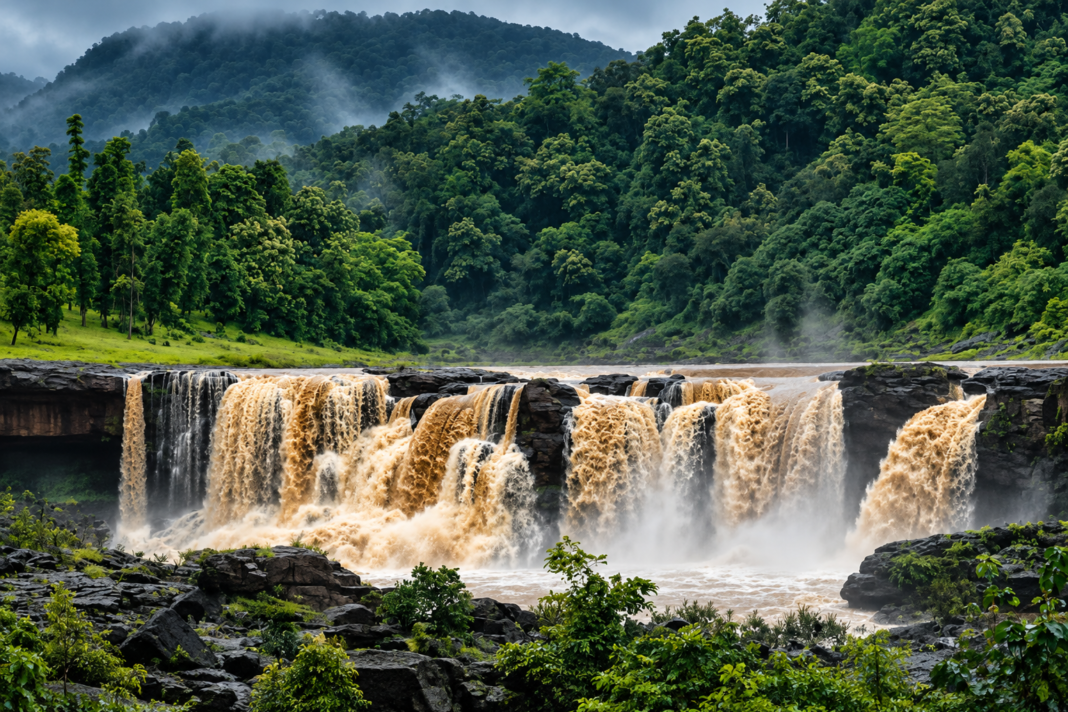
Quick answer: Gira Waterfalls (also called Gira Dhodh or Giradudh) is a wide, roaring monsoon waterfall in the Dang district of South Gujarat. It sits near Waghai, just off the Waghai–Saputara road, and is about 50 km from Saputara hill station. The water drops roughly 30 metres on its way to the Ambika river. The best time to visit is July to October, when the falls are at full force. It is usually open in daylight hours, roughly 8 or 9 am to 5 pm. Entry is free or nominal, and there is a small parking fee. Swimming or entering the water is not allowed, so enjoy the view from behind the rope line.
Why Gira Waterfalls Belongs on Your Monsoon List
Every monsoon, Gujarat’s quiet south turns green. The hills of Dang fill with clouds, and small streams turn into loud rivers. And right in the middle of it all, Gira Waterfalls wakes up.
Gira is not the tallest waterfall in Gujarat. However, it may be the most dramatic to stand in front of. The water spreads across a wide rock face, so it looks more like a white curtain than a thin stream. Also, the roar is loud enough to drown out your voice. That’s why many travellers call it a must-stop on any Saputara trip.
In this guide, we cover everything you need. First, we explain where the falls are, because many people think they’re inside Saputara. Next, we share the best months, timings, fees and safety rules. Then, we plan your route from Ahmedabad, Surat, Vadodara and Mumbai. After that, we list nearby places, food, stays and simple itineraries. Finally, we answer the questions people ask most.
A note on our facts: We’ve used Gujarat Tourism and other trusted reference pages. Still, distances, heights, fees and timings differ a little from source to source. So, we give ranges where sources disagree. Please check local notices before you go, especially in heavy rain.

Gira Waterfalls at a Glance
| Detail | Info |
|---|---|
| Other names | Gira Dhodh, Giradudh, Gira Falls |
| Location | Near Waghai, Dang district, South Gujarat |
| Nearest village | Wanarchond (spelled in several ways) |
| Distance from Waghai | About 3 to 6 km, depending on the source |
| Distance from Saputara | About 50 km |
| River | Khapri stream falling into the Ambika river |
| Height | About 30 m (Gujarat Tourism); some guides say about 75 ft |
| Best months | July to October |
| Usual timings | Daylight hours, roughly 8 or 9 am to 5 pm |
| Entry | Free or nominal; small parking fee |
| Swimming | Not allowed |
| Nearest railhead | Waghai (narrow gauge from Bilimora) |
| Map | Open Gira Waterfalls on Google Maps |
Is Gira Waterfalls in Saputara?
This is the most common mix-up, so let’s clear it up first. Gira Waterfalls is not inside Saputara town. Instead, it lies near Waghai, a small town in the lower part of Dang district. Saputara sits on top of the hills, while Waghai lies in the valley below.
So why do people link the two? Simply because the falls sit on the main road that climbs from Waghai to Saputara. As a result, most people who drive to Saputara from Surat or Valsad pass close by. They stop at Gira on the way up or the way down. In short, it’s part of a Saputara trip, but it’s not in Saputara itself.
The drive between the two takes roughly an hour to an hour and a half. However, the ghat road has many bends. Also, rain, fog and weekend traffic can slow you down. So, plan for a little extra time.
Gira Waterfalls: Open map
What Makes Gira Falls Special?
Most famous waterfalls are tall and thin. Gira is different. It is wide and short, and that gives it a unique look. During peak monsoon, the water pours over a broad, rocky ledge in a thick sheet. Some visitors say it drops in two steps, one after the other.
Because of its shape, some locals and travel writers call it the “Niagara of Gujarat.” Of course, it’s much smaller than the real Niagara. Still, the nickname makes sense when you see the wide white curtain of water in August.
The colour of the water is another surprise. After heavy rain, it often looks milky white or even light brown. That’s because the river carries soil from the hills. Then, as the rain eases in September and October, the flow becomes clearer and calmer.
Finally, there’s the setting. Thick forest, black rocks, wet green slopes and low clouds surround the falls. Plus, the cool spray reaches you even from the viewing area. It feels like a world away from the heat of Ahmedabad.
The River Behind the Falls
Gira is fed by a small river that most people have never heard of. Some sources call it the Khapri (also written Kapri or Khopari). This stream tumbles over the rocks at Gira and then joins the Ambika river. Gujarat Tourism simply describes the falls as part of the Ambika.
The Ambika is one of the main rivers of South Gujarat. It rises in the hills of the Western Ghats, flows through Dang and then runs towards the Arabian Sea near Bilimora. Along the way, it passes forests, farms and tribal villages. So, when you stand at Gira, you’re looking at one small part of a much longer journey.

What Does “Gira Dhodh” Mean?
You’ll hear the falls called by a few names. “Gira” is the name of the spot. Many locals and road signs also use the word “Dhodh” for a waterfall. That’s why you may see “Gira Dhodh” on signboards and Google Maps. Some people also write it as “Giradudh” or “Gira Dhodh Waterfall.”
So, if a local asks whether you’re going to “Gira Dhodh,” just nod. You’re both talking about the same place.
Best Time to Visit Gira Waterfalls
Gira is a seasonal waterfall. In other words, it depends on rain. So, the month you pick decides what you’ll see.
| Months | What to expect |
|---|---|
| June | Early rains; the flow starts to build |
| July–August | Peak flow, loud and wide; roads can be wet and slow |
| September | Strong flow, greener hills, slightly fewer showers |
| October | Calmer flow, clear skies, pleasant weather |
| November | Flow drops; still nice in a wet year |
| December–May | Thin or almost dry; mostly bare rock |
Our pick is late August to early October. During these weeks, the falls still have plenty of water. At the same time, the heaviest rain has usually passed, so the roads are safer. Also, the whole Dang region is at its greenest.
If you want the biggest flow, go in July or August. However, be ready for heavy rain, fog and possible closures. On the other hand, if you visit in summer, you’ll see mostly dry rock. One visitor said it best: you can tell the place turns into heaven in the rains, but in May it’s just a cliff.
Gira Waterfalls in Monsoon: What to Expect
A monsoon visit is the full Gira experience. But it also needs a bit of planning. Here’s what a typical rainy-season trip looks like.
- Rain on and off: Showers come and go in minutes. So, carry a raincoat, not just an umbrella.
- Mist and spray: The spray can soak your clothes and your camera. Therefore, pack a dry bag.
- Muddy paths: The ground near the falls gets wet and slippery. Wear shoes with good grip.
- Weekend crowds: Saturdays, Sundays and holidays get busy. Go on a weekday if you can.
- Temporary closures: In very heavy rain, the authorities may close the spot for safety. Always respect these closures.
In September, the Saputara Monsoon Festival is often held up the hill. Dates change every year, though. So, check Gujarat Tourism’s website for the latest schedule before you plan around it.
Gira Waterfalls Timings, Entry Fee and Parking
Gira is a simple, open-air spot. There’s no big ticket counter or fancy gate. Still, a few basics help.
| Item | What we know |
|---|---|
| Open days | All days, as per Gujarat Tourism |
| Timings | Daylight only, roughly 8 or 9 am to 5 pm (visitor reports) |
| Entry fee | Free or a small nominal fee (reports differ) |
| Parking | Paid parking near the entrance; visitors mention about ₹50 for a car |
| Walk to viewpoint | Short and easy; a few hundred metres from most parking spots |
| Time needed | 45 minutes to 1.5 hours |
Fees and timings can change without notice. So, treat these figures as a guide, not a promise. Also, carry some cash. Mobile signal and online payment can be patchy in parts of Dang.
Don’t plan to stay after dark. The area has little lighting, and the forest road gets quiet in the evening. Plus, it’s simply safer to leave while there’s daylight.
How to Reach Gira Waterfalls
Gira is in a forest district, so there’s no airport or big railway station next door. However, it’s easy to reach by road from all the big cities of Gujarat and from Mumbai. Here’s a quick look at distances.
| From | Approx. distance | Approx. drive time |
|---|---|---|
| Waghai | 3–6 km | 10–15 min |
| Saputara | About 50 km | 1–1.5 hrs |
| Surat | About 110–165 km (by route) | 3–4 hrs |
| Vadodara | About 300 km | 6–7 hrs |
| Ahmedabad | About 400 km | 7.5–9 hrs |
| Mumbai | About 250 km | 5.5–7 hrs |
| Nashik | Via Saputara; check your route | Varies |
Distances are rounded from Gujarat Tourism and other travel guides. Drive times are rough and depend on traffic, rain and stops.
By Road
Road is the easiest way to reach Gira. Most people drive their own car or hire a cab. Generally, the route goes south to Surat or Navsari first. Then it turns east towards Vansda and Waghai. From Waghai, the falls are just a short drive along the Saputara road.
State transport buses run to Waghai and Saputara from Surat, Navsari, Valsad and other towns. From Waghai, you can take a local jeep or auto to the falls. However, buses are slow and less frequent in the hills. So, a car gives you much more freedom.
By Train
Here’s a fun option. A narrow gauge railway runs from Bilimora to Waghai, a distance of roughly 65 km. It’s one of the old, small-track lines still running in India. The slow ride passes villages, farms, forest and a bridge over the Ambika river.
First, reach Bilimora Junction on the main Mumbai–Ahmedabad line. Then, board the narrow gauge train to Waghai. Visitors say the trip takes about three hours, and some services add a glass-roofed vistadome coach. Train times and fares change, so check the latest schedule with Indian Railways before you go. From Waghai station, take a local auto or jeep to the falls.
Bilimora Junction: Open map
Waghai railway station: Open map
By Air
The closest airport is Surat, roughly 115 to 125 km away. Gujarat Tourism also lists Vadodara airport. Mumbai is another option if you’re coming from far away. From any airport, hire a cab for the rest of the trip.

Ahmedabad to Gira Waterfalls: A Simple Road Trip Plan
For readers in Ahmedabad, Gira is a long drive. So, we suggest making it part of a two or three-day Dang trip. Here’s a plan that works for most families.
- Start early: Leave Ahmedabad by 5 or 6 am to beat the heat and traffic.
- Take the expressway and highway south: Head towards Vadodara, Bharuch and Surat.
- Break for breakfast: Stop near Vadodara or Bharuch for tea and a light meal.
- Turn east after Surat or Navsari: Follow the road towards Vansda and Waghai.
- See Gira first: Reach the falls by early afternoon while there’s plenty of light.
- Drive up to Saputara: Check in at your hotel and catch the sunset if the sky is clear.
On the way back, you can stop at Waghai Botanical Garden or Unai Mata temple. That way, you break the long drive and see a bit more of South Gujarat.
Surat to Gira Waterfalls
For Surat, Gira is a perfect day trip. Most people leave early, reach the falls by mid-morning and then head up to Saputara. Some return the same night. Others stay a night in Saputara or at a forest campsite.
The road from Surat goes through Bardoli or Navsari and then on to Vansda and Waghai. Both routes are pretty in the rains. Just drive slowly on the hill section, and keep your headlights on in fog.
Mumbai to Gira Waterfalls
From Mumbai, the usual route runs north along the highway towards Vapi and Valsad. Then it turns east into the hills towards Dharampur, Vansda and Waghai. Another option is to drive via Nashik to Saputara first, then come down to Gira. Both make a lovely long weekend.
The Walk From the Parking to the Falls
Here’s some good news. You don’t need to trek to see Gira. The walk from the parking area to the main viewpoint is short. One visitor says it’s about 200 metres. Others say it’s longer if you park further away on a busy day.
The path passes small stalls selling tea, corn and snacks. Then it opens up to a rocky area facing the falls. In peak season, a rope line marks how close you can go. So, you’ll get a clear view without needing to climb anything risky.
That said, the rocks near the edge are wet and slick. Also, some steps may be uneven. Therefore, walk carefully, hold children’s hands and avoid running.
Safety Rules You Must Follow
Gira looks gentle in photos, but monsoon rivers are powerful. Every year, India sees accidents at waterfalls. Usually, they happen when people ignore the rules. So, please take these points seriously.
- Don’t enter the water. Swimming and bathing are not allowed. Authorities may fine people who break this rule.
- Stay behind the rope line. It’s there because the current near the base is strong.
- Avoid wet rocks. Black rocks covered in moss are very slippery.
- Skip risky selfies. No photo is worth a fall.
- Watch the water level. Heavy rain upstream can raise the flow fast.
- Listen to guards and police. If they ask you to move back, do it at once.
- Don’t drink and drive. The ghat roads need full attention.
- Leave before dark. Forest roads are poorly lit at night.
In very heavy rain, the authorities may close the falls for a few days. If so, don’t try to sneak in. Instead, visit another spot and come back once it reopens.
Food Near Gira Waterfalls
Waterfalls make people hungry. Luckily, Gira has plenty of small stalls. In the monsoon, the stars are hot tea, roasted corn (bhutta), bhajiya and maggi. Also, a few simple eateries near the falls and in Waghai serve Gujarati and Dangi-style thalis.
If you get the chance, try some local Dangi food. The region is known for nagli (finger millet), which locals turn into rotla and other dishes. Also, you may find seasonal forest greens, bamboo shoot dishes and simple dal-rice meals. Menus change by season, though, so ask what’s fresh that day.
For a wider choice, Saputara has many restaurants and hotel dining rooms. On the other hand, the roadside dhabas between Waghai and Saputara are good for a quick, hot meal on a rainy afternoon.
For more on what Gujarat eats, see our guide to the food of Gujarat.
Shopping: Bamboo Crafts, Honey and Local Produce
Dang is a forest district, and much of its craft comes from bamboo. Near Gira, local tribal sellers often set up small stalls. You may find bamboo baskets, lamps, toys, flutes and small decor pieces. Plus, some stalls sell forest honey, jaggery, pickles and seasonal fruit.
These purchases go straight to local families. So, it’s a lovely way to support the community. Just bargain gently, if at all. A few rupees mean much more to a village seller than to a city visitor.
Photography Tips for Gira Waterfalls
Gira is one of the most photographed spots in South Gujarat. Here’s how to get better shots without taking risks.
- Go early: Morning light is soft, and crowds are smaller.
- Protect your gear: The spray is heavy. Use a rain cover or a plastic bag with a hole for the lens.
- Carry a cloth: You’ll need to wipe your lens every few minutes.
- Try a slow shutter: On a phone, use “long exposure” or “live photo” mode for silky water.
- Show the scale: Include a person or a tree to show how wide the falls are.
- Shoot the details: Wet rocks, ferns, the river below and the stalls all tell the story.
- Fly drones only with permission: Drone rules apply, and forest areas may need extra approval.
Visiting Gira With Kids and Seniors
Gira is one of the easier waterfalls in Gujarat to visit with family. The walk is short. Also, you don’t need to climb. Still, a few tips help.
For kids, keep them close at all times near the water. Bring a change of clothes, because they will get wet. Plus, carry snacks, since little ones get hungry fast after a long drive.
For seniors, wear shoes with a good grip and take the walk slowly. A walking stick can help on wet ground. Also, plan rest stops on the drive, because the ghat road can be tiring.
Nearby Places to Visit Around Gira Waterfalls
Gira is just the start. The Dang district is full of green hills, waterfalls, temples and forests. Here are the best places to pair with your visit.
1. Waghai Botanical Garden
Just a few kilometres from Gira, this large garden is run by the forest department. It covers around 24 hectares and holds a huge range of plants, with many native to Dang. Wikipedia mentions about 1,400 plant varieties. It’s quiet, shady and perfect for a slow walk. Visitor reports suggest it’s closed on Tuesdays, so check before you go.
Waghai Botanical Garden: Open map
2. Saputara Lake
Saputara Lake sits right in the middle of Gujarat’s only hill station. You can take a paddle boat, walk around the gardens or just sit by the water. In the evening, the lights of the town reflect on the lake. Also, many hotels and food stalls are within walking distance.
Saputara Lake: Open map
3. Sunset Point, Saputara
Sunset Point is one of Saputara’s best views. On a clear evening, the sky turns orange and pink over rows of hills. In the monsoon, though, clouds can hide the sun. Even so, the view of rolling mist is worth it.
Sunset Point, Saputara: Open map

4. Girmal Waterfall
Girmal is another famous Dang waterfall. Unlike Gira, it’s tall and narrow. Many people call it one of the tallest waterfalls in Gujarat, though exact heights vary between sources. It’s a longer drive from Gira, so plan it as a separate stop. Also, visitors mention a small entry ticket and limited parking on busy days.
Girmal Waterfall: Open map
5. Shabari Dham
Shabari Dham is a hilltop temple near Subir. Many believe it marks the place where Lord Rama met Shabari, the devotee from the Ramayana. The temple is calm, and the forest views are wide. So, it’s a good stop for both prayer and a pause.
Shabari Dham: Open map
6. Pampa Sarovar
Pampa Sarovar is a short drive from Shabari Dham. It’s a peaceful pool with small temples around it, and it’s also linked to the Ramayana. In the monsoon, the stream nearby flows well. Most visitors see Shabari Dham and Pampa Sarovar together.
Pampa Sarovar: Open map
7. Mahal Eco Campsite and Purna Wildlife Sanctuary
Mahal is a forest campsite inside the Purna Wildlife Sanctuary. The forest department runs it. Here, you can stay in simple huts, walk forest trails and listen to the river at night. Don’t expect luxury, though. Instead, expect birds, trees and quiet. Book and confirm your stay with the forest department in advance.
Mahal Eco Tourism Campsite: Open map
8. Unai Mata Temple
Unai is famous for its temple and natural hot water spring. Legend links the spring to Lord Rama. It’s on the plains side, between Gira and the coast, so it’s easy to add on the drive in or out. Visitors note the hot water can drop in summer, but the temple is busy all year.
Unai Mata Mandir: Open map
9. Vansda National Park
Vansda National Park lies close to Dang, in Navsari district. It’s a small but dense forest along the Ambika river. Birdwatchers love it, especially after the rains. Entry rules and timings are set by the forest department, so check before visiting.
Vansda National Park: Open map
10. Don Hill Station
Don is a quiet, little-known hill area in Dang. It’s far less crowded than Saputara, and the views can be lovely after the rains. However, roads and facilities are basic. So, go with a local driver and carry your own water and snacks.
Don, Dang: Open map
11. Other Monsoon Falls in Dang
Dang has several smaller seasonal falls that come alive in the rains. For example, Koshmal Waterfall is one that local trekkers talk about. Some need a short walk, and some are hard to reach in heavy rain. So, ask locals or your hotel about current access before you set out.

Gira Falls vs Girmal Falls: Which Should You Visit?
People often confuse these two, because the names sound alike. In fact, they’re quite different. Here’s a quick comparison.
| Feature | Gira Waterfalls | Girmal Waterfall |
|---|---|---|
| Shape | Wide and short | Tall and narrow |
| Location | Near Waghai | Near Girmal village, Subir side |
| Access | Very easy, short walk | Easy, but further off the main route |
| On the Saputara road? | Yes, almost | No, a detour |
| Best for | Families and quick stops | Viewpoints and photos of a tall drop |
If you have time, see both. But if you have only one day, Gira is easier to fit in. That’s because it sits right on the way to Saputara.
Suggested Itineraries
Half Day From Saputara
Leave Saputara after breakfast and drive down to Waghai. See Gira Waterfalls first, while the light is good. Next, walk through Waghai Botanical Garden. Then, have lunch at a local eatery and drive back up to Saputara in time for the sunset.
Day Trip From Surat
Start by 6 am. Stop at Unai Mata temple on the way. Then, reach Gira by late morning and spend an hour at the falls. After lunch, visit the botanical garden. Finally, head home before dark, or drive up to Saputara if you’re staying the night.
Three Days From Ahmedabad
| Day | Plan |
|---|---|
| Day 1 | Drive from Ahmedabad; stop at Gira Waterfalls; reach Saputara by evening |
| Day 2 | Saputara Lake, Sunset Point, a day trip to Shabari Dham, Pampa Sarovar and Girmal |
| Day 3 | Waghai Botanical Garden or Mahal campsite; drive home |
This plan keeps each day relaxed. Also, it avoids long drives after dark, which matters a lot in the monsoon.
Where to Stay Near Gira Waterfalls
There are three main choices, and each suits a different kind of trip.
- Saputara: The most hotels and resorts, from budget rooms to lake-view stays. Best for families who want comfort and food choices.
- Waghai and nearby: A few simple stays and homestays. Best if you want to stay close to the falls.
- Forest campsites: Places like Mahal offer huts and tents run by the forest department. Best for nature lovers.
Rooms fill up fast on monsoon weekends and during festivals. So, book early. Also, call the property to confirm details such as hot water and food, since some places are basic.
About the Dang District
Dang (also called the Dangs) is one of Gujarat’s most forested districts. It sits at the northern end of the Sahyadri hills, which are part of the Western Ghats. Its headquarters is Ahwa, and Saputara is its best-known town.
Most people in Dang belong to tribal communities. Their way of life is closely tied to the forest, farms and rivers. Their music, dance and festivals are colourful. For example, the Dang Darbar fair is held in Ahwa around Holi each year.
Because of the forest cover and heavy rain, Dang stays green for months after the monsoon. Plus, its many streams create waterfalls like Gira, Girmal and several smaller ones. That’s why it’s often called the green heart of Gujarat.
Read more about the region on Wikipedia’s page on Waghai.

Travel Responsibly in Dang
Gira is beautiful because it’s still wild. So, let’s keep it that way. Here are a few simple habits.
- Carry your trash back: Plastic bottles and wrappers end up in the river.
- Don’t play loud music: Let others enjoy the sound of the falls.
- Respect local people: Ask before you take photos of villagers or their homes.
- Buy local: Pick up honey, bamboo crafts and snacks from village sellers.
- Stay on the paths: This protects the plants and keeps you safe.
- Don’t feed animals: Monkeys and other animals should find their own food.
What to Pack for Gira Waterfalls
- Raincoat or poncho
- Shoes or sandals with good grip
- A spare set of clothes and a small towel
- Dry bag or plastic covers for phones and cameras
- Cash in small notes
- Water bottle and light snacks
- Basic medicines, including motion sickness tablets for the ghat road
- Mosquito repellent
- A power bank
A Monsoon Morning at Gira: What It Might Feel Like
This is an imagined scene, written to help you picture a visit.
You park under a dripping tree and step out into soft rain. The air smells of wet earth and woodsmoke from a tea stall. Then, as you walk down the path, a low rumble grows louder with every step.
Suddenly, the trees open up. In front of you, a wide wall of white water pours over dark rock. Spray drifts across your face. Children squeal and point. Meanwhile, a vendor calls out, offering hot corn with lime and chilli.
You stand behind the rope and just watch for a while. After that, you sip sweet tea from a paper cup, and the rain starts again. It doesn’t matter, though. You came for this, and it was worth every bend in the road.
Gira Waterfalls in Plain Words
Gira is a big waterfall in the forest of South Gujarat. It’s near a town called Waghai. It’s on the road to Saputara. The water is wide and loud in the rains. You can look at it, but you can’t go in the water. The best time to go is from July to October. It’s free or very cheap to visit. There are tea and snack stalls nearby. You can also see a garden, a lake, temples and more falls close by.
Gira Waterfalls Explained to Kids
Imagine a giant tap left on in the middle of a forest. That’s what Gira looks like in the rainy season! A river runs to the edge of a rock and falls down with a big splash. It makes a loud noise, like a train that never stops.
The water comes from rain that falls on the hills. So, when it rains a lot, the waterfall gets bigger. When it’s hot and dry, it gets very small. Remember, the water is strong, so we only look from a safe place. And don’t forget to try the hot corn!
Common Mistakes to Avoid
- Visiting in summer: You’ll likely find a dry cliff.
- Thinking it’s in Saputara: It’s about 50 km away, near Waghai.
- Starting late: Ghat roads and fog make evening drives slow.
- Crossing the rope line: It’s unsafe and may lead to a fine.
- Wearing the wrong shoes: Smooth soles and wet rock don’t mix.
- Relying only on online payment: Signal can be weak, so carry cash.
Myths and Facts About Gira Waterfalls
| Myth | Fact |
|---|---|
| Gira is inside Saputara | It’s near Waghai, about 50 km away |
| It flows all year | It’s seasonal and mostly dry in summer |
| You can swim there | Entering the water is not allowed |
| You need a long trek | The walk from parking is short |
| Gira and Girmal are the same | They’re two different waterfalls |
Quick Revision Notes
- Gira Waterfalls is near Waghai in Dang district, South Gujarat.
- It’s also called Gira Dhodh or Giradudh.
- It’s about 50 km from Saputara, on the Waghai–Saputara road.
- The drop is about 30 metres, and the falls are wide.
- The best time is July to October.
- Entry is free or nominal; there’s a small parking fee.
- Swimming is not allowed.
- Nearby: Waghai Botanical Garden, Saputara, Girmal, Shabari Dham and Unai.
How We Researched This Guide
We started with Gujarat Tourism’s official page on Gira Waterfalls. Then, we cross-checked details with reference pages and travel guides. We also looked at recent visitor notes for current conditions, such as parking and walking distance. Where sources disagreed, we’ve given a range instead of a single number. We haven’t published ratings, and we’ve marked the imagined scene clearly.
More Guides From Amdavad Gully
- Jambughoda Wildlife Sanctuary
- Famous cities in Gujarat
- Food of Gujarat
- Kotna Beach, Vadodara
- Tourist places in Ahmedabad
Frequently Asked Questions
Where is Gira Waterfalls located?
Gira Waterfalls is near Waghai in the Dang district of South Gujarat. It sits just off the Waghai–Saputara road, close to Wanarchond village.
Is Gira Waterfalls in Saputara?
No. Gira Waterfalls is about 50 km from Saputara, near Waghai. However, it’s on the main road to Saputara, so most visitors combine the two.
How far is Gira Waterfalls from Saputara?
Gira Waterfalls is about 50 km from Saputara. The drive usually takes one to one and a half hours on the ghat road.
How far is Gira Waterfalls from Ahmedabad?
Gira Waterfalls is about 400 km from Ahmedabad by road. The drive usually takes seven and a half to nine hours.
How far is Gira Waterfalls from Surat?
Gira Waterfalls is roughly 110 to 165 km from Surat, depending on the route. The drive takes about three to four hours.
What is the best time to visit Gira Waterfalls?
The best time to visit Gira Waterfalls is from July to October. Late August to early October gives a strong flow with safer roads.
What are the Gira Waterfalls timings?
Gira Waterfalls is open in daylight hours, roughly 8 or 9 am to 5 pm. Timings can change, so check local notices.
Is there an entry fee for Gira Waterfalls?
Entry to Gira Waterfalls is free or a small nominal fee. There is a small parking charge for vehicles.
Can you swim at Gira Waterfalls?
No. Swimming and entering the water are not allowed at Gira Waterfalls. Visitors must stay behind the rope line for safety.
How tall is Gira Waterfalls?
Gujarat Tourism says Gira Waterfalls has a drop of about 30 metres. Some guides give a lower figure of about 75 feet.
Which river forms Gira Waterfalls?
Gira Waterfalls is formed by the Khapri stream, which then joins the Ambika river. Gujarat Tourism describes the falls as part of the Ambika.
What is the nearest railway station to Gira Waterfalls?
The nearest station is Waghai, on the narrow gauge line from Bilimora. Bilimora Junction is the nearest main-line station.
What is the nearest airport to Gira Waterfalls?
Surat airport is the closest, roughly 115 to 125 km away. Vadodara and Mumbai are other options.
Is Gira Waterfalls good for kids?
Yes. The walk from the parking is short and easy. However, keep children close, because the rocks are slippery and the water is strong.
What are the best places to visit near Gira Waterfalls?
Nearby places include Waghai Botanical Garden, Saputara Lake, Sunset Point, Girmal Waterfall, Shabari Dham, Pampa Sarovar, Mahal campsite and Unai Mata temple.
Is Gira Waterfalls the same as Girmal Waterfall?
No. They’re two different waterfalls in Dang. Gira is wide and near Waghai, while Girmal is tall and narrow and lies on the Subir side.
The Bottom Line
Gira Waterfalls is South Gujarat’s monsoon showstopper. It’s wide, loud and easy to reach. Plus, it sits right on the road to Saputara, so it fits into almost any Dang trip.
So, pick a weekday between July and October. Start early, wear good shoes and stay behind the rope. Then, pair the falls with the botanical garden, Saputara Lake and a hot Dangi meal. You’ll head home with wet clothes, a full phone gallery and a big smile.
Run a hotel, homestay, restaurant or tour business in Saputara or Dang? Get featured on Amdavad Gully and reach thousands of travellers planning their monsoon trip. Write to us at amdavadgully@gmail.com.