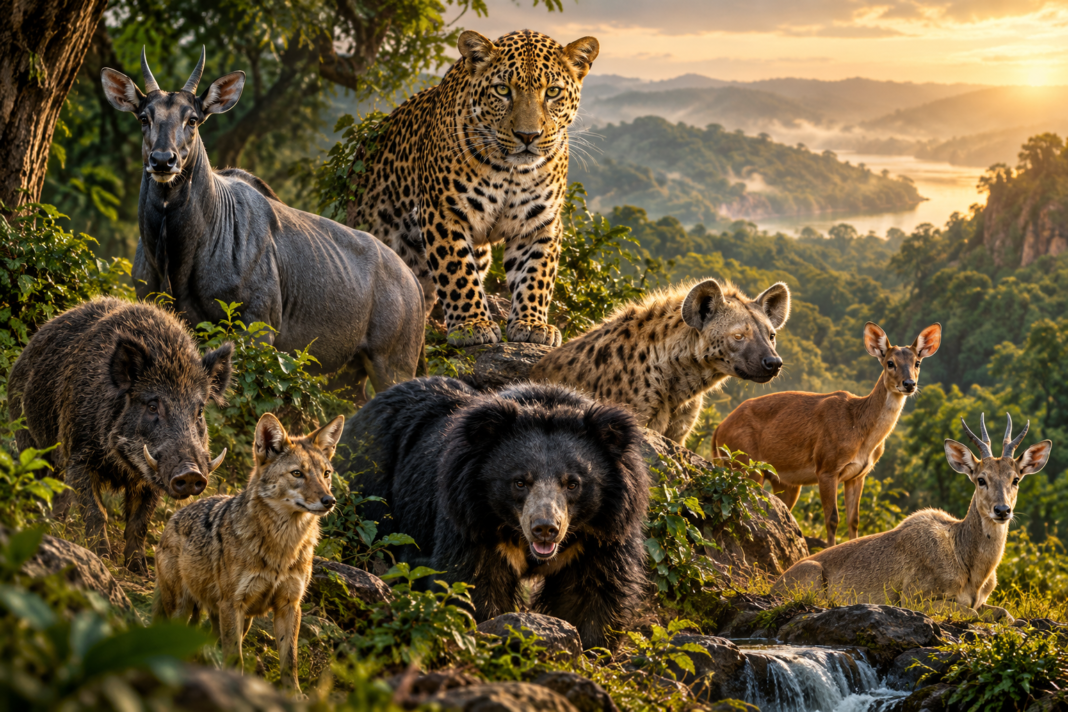
Quick answer: Jambughoda Wildlife Sanctuary is a protected forest in the Panchmahal district of central Gujarat. It covers about 130 sq km of teak, bamboo and mahua forest on low hills. It lies about 70 km from Vadodara and about 20 km from Champaner-Pavagadh, a UNESCO World Heritage Site. The sanctuary was once part of the princely state of Jambughoda and became a sanctuary in 1990. It’s home to leopards, sloth bears, nilgai, four-horned antelope, barking deer, hyenas and large colonies of flying foxes. Key spots include Kada Dam, Targol Dam, the Dhanpari Eco Campsite and the Zand Hanuman Temple. The best time to visit is July to February.
A Quiet Forest Near Vadodara
Imagine waking up to birdsong instead of traffic. Mist hangs over a still lake. Tall teak trees drop broad leaves on a red dirt path. Somewhere in the hills, a peacock calls. That’s a morning at Jambughoda.
For people in Ahmedabad and Vadodara, this forest is one of the easiest escapes into real wilderness. It isn’t a big tiger reserve with jeeps and crowds. Instead, it’s a calm, green place where you walk, sit by the water and let the forest come to you.
In this complete guide, we cover everything you need to know about Jambughoda Wildlife Sanctuary. First, we explain what it is and where it lies. Next, we look at its history, forests, animals and birds. Then, we walk you through its lakes, temple and campsites. Finally, we cover the practical side: timings, fees, how to reach, where to stay, what to pack, nearby places and tips.
A note on sources: We’ve drawn on official sources such as Gujarat Tourism, plus published reference works. However, rules and fees at small sanctuaries can change without much notice. So, we flag anything you should confirm before you go.
Jambughoda Wildlife Sanctuary: Quick Facts
| Detail | Information |
|---|---|
| Type | Wildlife sanctuary (protected forest) |
| Location | Jambughoda taluka, Panchmahal district, Gujarat |
| Area | About 130.38 sq km |
| Declared a sanctuary | May 1990 (process began in 1989) |
| Forest type | Dry deciduous forest with teak, bamboo and mahua |
| Top predator | Leopard |
| Other animals | Sloth bear, nilgai, four-horned antelope, barking deer, hyena, jackal, wild boar, flying fox |
| Main lakes | Kada Dam and Targol Dam |
| Stay inside | Dhanpari Eco Campsite and forest rest house near Kada |
| Sacred site | Zand (Jund) Hanuman Temple |
| Distance from Vadodara | About 70 km |
| Distance from Ahmedabad | About 180 to 190 km |
| Distance from Champaner | About 20 km |
| Visiting hours | Around 6 am to 7 pm (listed by Gujarat Tourism) |
| Best time to visit | July to February |
| Nearest railway station | Vadodara Junction |
| Nearest airport | Vadodara Airport |
What Is Jambughoda Wildlife Sanctuary?
Jambughoda Wildlife Sanctuary is a protected area of forested hills in central Gujarat. The state forest department looks after it. Its main job is to protect the animals and plants that live here, from leopards to tiny wildflowers.
Unlike famous parks such as Gir, it has no lion safaris or big tourist crowds. Instead, it offers quiet trails, two lovely lakes and simple forest camps. So, it suits people who want peace, fresh air and a slow day in nature.
In short, think of Jambughoda as a green lung for central Gujarat. It’s close enough for a day trip from Vadodara, yet wild enough to feel far from city life.
Plan the drive: Open map
Where Is Jambughoda?
Jambughoda is a small town and taluka in the Panchmahal district of eastern Gujarat. The sanctuary spreads across the hills around it. It sits between Vadodara to the south-west and the tribal belt of Chhota Udepur to the east.
- Vadodara: About 70 km, or roughly 1.5 to 2 hours by road.
- Ahmedabad: About 180 to 190 km, or roughly 3.5 to 4 hours by road.
- Champaner and Pavagadh: About 20 km, or under an hour.
- Halol: About 30 km, the nearest big town on the Vadodara side.
- Godhra: Panchmahal’s district headquarters, about 70 km away.
The land here is hilly, with shallow, sandy soil and many small streams. As a result, it looks very different from the flat plains around Ahmedabad. The hills are low, but they give the forest its rolling, layered look.
Jambughoda town: Open map
What Does “Jambughoda” Mean?
The exact origin of the name isn’t clear from official records. In Gujarati, jambu often refers to the jamun or rose-apple tree, and many places in India take their names from trees. So, some locals link the name to the jamun trees of the area. However, this is folk belief rather than proven fact.
You’ll also see the name written in slightly different ways, such as Jambugodha or Jambughoda. They all refer to the same place. In Gujarati, it’s written as જાંબુઘોડા.
A Short History of Jambughoda
Long before it became a sanctuary, Jambughoda was a small princely state. In other words, it was a kingdom with its own ruler, under British control, until India became independent.
The ruling family belonged to the Parmar clan. Records list several rulers in the 19th and 20th centuries. For instance, Dipsinhji Jagatsinhji was born in 1841. Later, Gambhirsinhji ruled until September 1917. After him, Ranjitsinhji Gambhirsinhji ruled from 1917 until 15 August 1947. He was the last ruler of the state.
After independence, Jambughoda merged with the Indian Union on 10 June 1948. Its forests, which the rulers had used as hunting grounds, later became state forest. Then, in May 1990, much of this forest was declared a wildlife sanctuary.
Interestingly, the old royal family still lives in the area. Their home, Jambughoda Palace, now works as a heritage stay for nature lovers. We cover it in the “Where to Stay” section below.
Timeline of Jambughoda
| Period | Event |
|---|---|
| 8th century | Champaner, 20 km away, is founded by Vanraj Chavda, according to tradition |
| 1484 | Sultan Mahmud Begada captures Champaner after a long siege |
| 19th century | Jambughoda exists as a small princely state under Parmar rulers |
| 1858 and 1868 | Naikda tribal uprisings take place in the wider Panchmahal hills |
| 1917 | Ranjitsinhji Gambhirsinhji becomes ruler |
| 1947 | India becomes independent |
| 1948 | Jambughoda merges with the Indian Union |
| 1989–1990 | The forest is notified as a wildlife sanctuary |
| 2004 | Nearby Champaner-Pavagadh becomes a UNESCO World Heritage Site |
| Today | Eco-tourism sites like Dhanpari welcome visitors |
The Naikda Uprisings: A Forgotten Chapter
The hills of Panchmahal have a proud tribal history. In the 19th century, the Naikda community rose up more than once against British rule and local powers. Historians record uprisings in the region in 1858 and again in 1868.
Leaders such as Rupsingh Naik and Joria Bhagat are linked with these revolts. The second uprising mixed religious ideas with resistance, as Joria Bhagat called for a rule of dharma. Both uprisings were put down by British forces.
We share this story because it reminds us that these forests are not empty land. For centuries, they’ve been home to communities who knew every hill and stream. Their story is part of what makes Jambughoda special.
Note: Detailed records of these uprisings are limited. So, we keep to the broad facts that historians agree on.
How Jambughoda Became a Sanctuary
After 1948, the forests of Jambughoda came under the state forest department. For decades, they faced pressure from wood cutting, grazing and farming. At the same time, wildlife across India was shrinking fast.
To protect what was left, the Gujarat government moved to create a sanctuary here. The process began in 1989, and the sanctuary was formally declared in May 1990. Its area was set at about 130.38 sq km.
Since then, the forest department has worked to protect the forest while still allowing local people to live nearby. In addition, eco-tourism camps like Dhanpari were set up. These camps let visitors enjoy the forest while giving local villagers a source of income.
Good to know: Some older sources give different figures for the date and area. However, Gujarat Tourism lists 130.38 sq km and May 1990, and we follow those figures here.
Geography and Landscape
Jambughoda sits on the western edge of a long belt of hills that runs through eastern Gujarat. These hills are old and worn down. So, instead of sharp peaks, you’ll see soft, rounded ridges and wide valleys.
The soil is shallow and sandy in many places. As a result, the land dries out fast after the rains. That’s one reason the forest turns golden-brown in summer and bright green in the monsoon.
Many small seasonal streams flow through the valleys. In the monsoon, they fill up and create small waterfalls. By summer, most of them dry up, leaving only pools and the two main lakes.
The Five Forest Blocks
The sanctuary’s forest is spread across several blocks. According to published reference works, around 25 villages lie in and around these blocks, and a handful sit inside the sanctuary itself. Most people in these villages belong to tribal communities.
For visitors, this means the sanctuary doesn’t feel like a fenced park. Instead, you’ll pass fields, small homes and cattle as you drive between forest patches. That’s normal, and it’s part of the local way of life.
Climate and Seasons
Jambughoda has a typical central Gujarat climate. It’s hot in summer, wet in the monsoon and pleasant in winter. Here’s what each season looks like.
| Season | Months | What to expect |
|---|---|---|
| Monsoon | July to September | Lush green forest, full lakes, streams and small waterfalls |
| Post-monsoon | October to November | Green hills, clear skies, pleasant days |
| Winter | December to February | Cool mornings, good birding, comfortable walks |
| Summer | March to June | Very hot, dry forest, animals gather near water |
Overall, July to February is the best window for most visitors. However, summer has one upside. Since water is scarce, animals are more likely to come to the lakes and waterholes. So, patient wildlife watchers sometimes prefer early summer mornings.
The Forest: Trees and Plants of Jambughoda
Jambughoda is a dry deciduous forest. In simple words, most trees here drop their leaves in the dry season to save water. Then, when the rains arrive, the whole forest bursts back into green.
Gujarat Tourism describes the landscape as covered in “teak, mahua and bamboo thickets”. Other sources list many more trees. Here are the main ones you’ll see.
- Teak (sag): The most common tree. It has huge, rough leaves and tall, straight trunks.
- Mahua (mahuda): A sacred tree for tribal people. Its sweet flowers are eaten, dried and used in many ways.
- Bamboo: Grows in thick clumps on slopes and along streams.
- Khair: A thorny tree whose wood is used to make katha, an ingredient in paan.
- Shisham: Also called Indian rosewood, prized for its strong timber.
- Sadad: A large tree with thick, cracked bark.
- Timru: Its leaves are used to roll local bidis.
- Bor: The wild jujube, with small, tangy fruits loved by birds and people alike.
- Dhav: A hardy tree that grows well on dry, rocky slopes.
- Bili (bael): A sacred tree whose leaves are offered to Lord Shiva.
- Dudhalo: A tree with milky sap, as its name suggests.
Together, these trees create a layered forest. The tall teak forms the top layer. Below it, smaller trees, bamboo and shrubs fill the gaps. Then, grasses and wildflowers cover the ground after the rains.
The Magic of Mahua
If one tree tells the story of Jambughoda’s people, it’s the mahua. In March and April, its pale, fleshy flowers fall to the ground in the early morning. Families from nearby villages gather them in baskets before the sun gets too hot.
The flowers are sweet and rich in sugar. So, people dry them and use them as food through the year. They also sell them in local markets. Meanwhile, the tree’s seeds give an oil used for cooking and lamps.
Animals love mahua too. Sloth bears, deer, monkeys and birds all feast on the fallen flowers. As a result, a flowering mahua tree is a good place to watch for wildlife in spring.
Respect tip: The mahua harvest is important to local families. So, please don’t pick up the flowers yourself inside the forest or village areas.
Animals of Jambughoda
According to published reference works, the sanctuary is home to around 17 species of mammals. The forest department names the leopard as the top predator here. Gujarat Tourism also lists sloth bears, nilgai, jackals, hyenas, barking deer, wild boar and four-horned antelope.
Most of these animals are shy. Also, the forest is thick, and there are no big safari jeeps here. So, don’t expect to see a leopard on a short visit. Instead, enjoy the signs they leave behind: tracks in the mud, scratch marks on trees and alarm calls from birds and deer.
Leopard
The leopard is the king of this forest. It’s a powerful, spotted cat that hunts at night and rests in the day. It usually eats wild boar, deer, monkeys and sometimes village livestock.
Leopards are masters of hiding. In fact, many forest staff spend years here and see them only a few times. So, if you do spot one, count yourself very lucky.
Sloth Bear
The sloth bear is a shaggy black bear with a pale snout and a white V or U mark on its chest. It loves termites, ants, fruits and mahua flowers. Using its long claws, it rips open termite mounds and sucks up the insects with a loud noise.
Sloth bears are shy but can be dangerous if surprised. Therefore, always walk with a guide and make some noise on forest trails. Older sources describe them as occasional visitors here, while Gujarat Tourism lists them as residents.
Nilgai (Blue Bull)
The nilgai is India’s largest antelope. Males are blue-grey, while females are brownish. You’re most likely to see them near the forest edge and in open fields.
Four-Horned Antelope (Chausingha)
This small, shy antelope is special. It’s the only antelope in the world where the male has four horns. The front pair is tiny, and the back pair is a little longer. It lives in hilly, wooded areas and needs water nearby, so Jambughoda suits it well.
Barking Deer
The barking deer, or muntjac, is a small reddish deer. Its name comes from its sharp, dog-like alarm call. If you hear a bark in the forest, it may well be this deer warning others of a leopard.
Striped Hyena
The striped hyena is a shy, night-time scavenger. It has a sloping back, a stiff mane and black stripes on grey fur. Despite its scary image, it rarely troubles people.
Jackal, Wolf and Wild Boar
Golden jackals are fairly common near villages. Their howls at dusk are a classic forest sound. Older reference works also mention the Indian wolf, although sightings are very rare. Meanwhile, wild boars root through the forest floor in family groups.
Smaller Mammals
The forest also hides many smaller animals. These include civets, mongooses, porcupines, hares and several kinds of bats. Most come out at night, so you may only see their tracks.
The Flying Foxes of Jambughoda
One of the most surprising sights here is the Indian flying fox. It’s one of the largest bats in the world, with a wingspan that can reach well over a metre. Published reference works note large colonies of these bats in the sanctuary.
Flying foxes spend the day hanging upside down in tall trees. They chatter, stretch their wings and squabble over the best spots. Then, at dusk, they fly off in long streams to feed on fruit and nectar.
These bats matter a lot to the forest. As they feed, they spread seeds and pollen over long distances. In other words, they help plant new trees. So, if you see a noisy roost, watch from a distance and don’t disturb them.
| Animal | Local or common name | Best chance to see |
|---|---|---|
| Leopard | Dipdo | Very rare; dawn or dusk |
| Sloth bear | Rinchh | Rare; dusk, near mahua trees |
| Nilgai | Rojhdo | Common; forest edges and fields |
| Four-horned antelope | Chausingha | Uncommon; hilly woods near water |
| Barking deer | Bhekar | Uncommon; listen for its bark |
| Striped hyena | Jarakh | Rare; mostly at night |
| Golden jackal | Shiyal | Fairly common; dusk |
| Wild boar | Bhund | Common; early morning |
| Indian flying fox | Chamachidiyu (bat) | At roosts in the day; flying at dusk |
| Langur and macaque | Vandra | Common near temples and roads |
Note: Local names vary from village to village. So, treat these as common examples rather than fixed names.
Birds of Jambughoda
For many visitors, birds are the real stars of Jambughoda. The mix of forest, bamboo, grassland and lakes supports a wide range of species. Early mornings in winter are especially good.
Although we couldn’t find an official bird count for the sanctuary, birdwatchers regularly report many common forest and water birds. Here are some you may see.
- Indian peafowl: India’s national bird, common and noisy at dawn.
- Grey junglefowl and red junglefowl: Wild ancestors of chickens. Published sources say junglefowl are now rare here.
- Grey hornbill: A large bird with a curved beak and a loud, squeaky call.
- Parakeets: Rose-ringed and plum-headed parakeets zip between trees.
- Woodpeckers: Listen for tapping on dead teak trunks.
- Drongos: Glossy black birds with forked tails, often perched on wires.
- Bulbuls and orioles: Colourful singers in the tree tops.
- Raptors: Look up for crested serpent eagles, shikras and kites.
- Water birds: Cormorants, herons, egrets and kingfishers at Kada and Targol.
- Owls and nightjars: You’ll hear them after dark at the campsite.
Birding Tips for Jambughoda
- Start at sunrise, when birds are most active.
- Walk slowly along the lake edge at Kada Dam.
- Carry binoculars, as many birds sit high in the trees.
- Stay quiet and wear dull, earthy colours.
- Use a free app like eBird or Merlin to help identify birds.
- Note what you see, and add it to eBird to help science.
Reptiles and Crocodiles
Jambughoda also has plenty of reptiles. Published sources mention snakes, pythons and crocodiles. In fact, visitors often report seeing mugger crocodiles basking on the banks of Targol Dam.
The mugger, or marsh crocodile, is India’s most common crocodile. It can grow quite large and should always be treated with care. So, never swim in the lakes, and don’t walk right up to the water’s edge.
Snakes are common, especially in the monsoon. Most are harmless, but a few, such as the cobra, Russell’s viper and saw-scaled viper, are venomous. Therefore, wear closed shoes, watch where you step and use a torch at night.
Insects, Butterflies and Small Wonders
The small creatures of Jambughoda are easy to miss, but they’re worth a closer look. After the monsoon, butterflies fill the forest paths. You may spot common Mormons, crimson roses, blue tigers and many small grass blues.
Look closely at tree trunks, too. You’ll find spiders, beetles and colourful bugs. Meanwhile, fireflies sometimes light up the forest on warm, damp nights in early monsoon.
These tiny animals keep the forest healthy. For instance, they pollinate flowers, break down fallen leaves and feed birds, frogs and lizards. So, a good forest walk isn’t just about big animals.
How the Forest Works: A Simple Look at the Ecosystem
Everything in Jambughoda is linked. Here’s a simple way to picture it.
- Rain feeds the forest. The monsoon fills the soil, streams and lakes.
- Plants grow. Trees, bamboo and grasses turn sunlight into food.
- Plant-eaters feed. Nilgai, deer, antelope and boar graze and browse.
- Predators hunt. Leopards keep the plant-eaters in check.
- Scavengers clean up. Hyenas, jackals and vultures eat what’s left.
- Tiny workers recycle. Termites, fungi and insects turn dead matter back into soil.
If one link breaks, the whole chain suffers. For example, if too many trees are cut, deer lose food. Then, leopards turn to village cattle, and conflict grows. That’s why protecting the whole forest matters, not just the famous animals.
People of the Forest
Jambughoda isn’t only a home for animals. It’s also home to thousands of people. According to the 2011 census, Jambughoda taluka had about 42,000 residents, and around 36% belonged to Scheduled Tribes.
Most families farm small plots. Because there’s little irrigation, they depend on the monsoon. Common crops include maize, castor, cotton, rice and pigeon pea (tuvar). In addition, many families collect forest produce such as mahua flowers, timru leaves and firewood.
Tribal communities here have deep links with the forest. They worship local deities in sacred groves, know which plants heal and which ones harm, and celebrate festivals tied to the seasons. So, when you visit, you’re a guest in their home as much as in a wildlife area.
How to Be a Good Guest
- Ask before you photograph people, homes or shrines.
- Buy local produce or snacks when you can.
- Drive slowly through villages, as children and cattle use the roads.
- Dress modestly, especially near temples.
- Never leave litter behind.
Zand Hanuman Temple: The Forest Shrine
Deep in the forest, about 10 km from the Dhanpari campsite, stands the Zand Hanuman Temple. You’ll also see it spelt Jhand Hanuman or Jund Hanuman. It’s the most famous landmark in the Jambughoda area.
The temple’s centrepiece is a huge image of Lord Hanuman carved from a single rock. Sources give its height as roughly 18 to 21 feet. Either way, it’s an impressive sight, rising from the rock under a simple shelter in the middle of the jungle.
Devotees consider the temple especially auspicious on Tuesdays and Saturdays, the days linked with Hanuman. So, expect more visitors on those days and during festivals like Hanuman Jayanti.
Find it: Open map
Legends of Zand Hanuman
Local tradition links this site with the Pandavas, the five brothers of the Mahabharata. According to the story, they spent part of their exile here. Several features of the site are tied to this belief.
- Bhim ni Ghanti: A huge round stone said to be the grinding mill of Bhima, the strongest Pandava.
- Arjuna’s well: A well said to have been made by Arjuna with an arrow. Locals believe it never dries, even in drought.
- Shani under Hanuman’s foot: The idol is said to show Shani beneath Hanuman’s left foot. As a result, devotees come here seeking relief from Shani-related troubles.
- Other carvings: The site also has older, damaged carvings, including images linked with Shiva and Ganesha.
Faith and history: These stories are part of local tradition and belief. We couldn’t find published archaeological research that dates the carvings. So, enjoy the legends as legends, and respect the faith of the people who treasure them.
Visiting Tips for Zand Hanuman
- Mobile network is weak or absent near the temple, so download offline maps first.
- The last stretch of road passes through forest, so drive slowly and watch for animals.
- Remove your shoes before entering the shrine area.
- Monkeys live around the temple. Keep food in closed bags.
- Go in the monsoon or winter, when the forest is green and cool.
Kada Dam: The Heart of the Sanctuary
Kada Dam is a calm reservoir surrounded by forested hills. It’s the most visited spot inside the sanctuary. The lake lies about 1 km from the Dhanpari Eco Campsite, so you can easily walk there.
Visitors often say it feels more like a natural lake than a dam. On clear days, the water reflects the blue sky and green hills. At sunrise and sunset, it glows gold and pink.
Water birds gather along the edges. Meanwhile, animals come down to drink at dawn and dusk, especially in the dry months. So, this is a great place to sit quietly with binoculars.
- Best for: Sunrise, sunset, birding and photography.
- Facilities: Parking and drinking water are reported. However, there’s no café, so carry snacks.
- Stay nearby: A forest rest house near Kada can be booked, as per Gujarat Tourism.
Find it: Open map
Targol Dam: The Wild Side
Targol Dam lies near Targol village, on the western side of the sanctuary. It’s quieter and wilder than Kada. Here, a wide lake sits between steep, green hills, with open grassy banks around it.
Targol is known for its crocodiles. Visitors often report seeing muggers basking on the banks. So, keep a safe distance from the water at all times.
In the monsoon, small streams and waterfalls appear on the slopes around the dam. Some visitors trek up the nearby hills for sweeping views. However, the trails are unmarked and can be slippery. Therefore, only go with a local guide.
From Targol, you can also drive on to Zand Hanuman. This makes a good half-day loop: Kada in the morning, then Targol, then the temple.
Find it: Open map
Kada vs Targol: Which Lake Should You Visit?
| Feature | Kada Dam | Targol Dam |
|---|---|---|
| Location | Near Dhanpari campsite | Near Targol village |
| Feel | Calm, easy to reach | Wilder, more remote |
| Best for | Sunrise, birds, short walks | Views, crocodiles, monsoon streams |
| Stay nearby | Dhanpari camp, forest rest house | Limited |
| Mobile signal | Patchy | Often none |
| Our tip | See it at dawn | Combine with Zand Hanuman |
Ideally, see both. They’re only a short drive apart, and each shows a different side of the forest.
Dhanpari Eco Campsite
The Dhanpari Eco Campsite (also spelt Dhanpuri) is the best way to stay inside the sanctuary. It’s run under the forest department’s eco-tourism programme, with help from a local eco-tourism committee.
According to Gujarat Tourism, the campsite has these facilities.
- An orientation centre with information on the forest
- Three deluxe cottages and ten standard cottages with attached bathrooms
- Tents with separate bathing blocks
- A kitchen and dining area
- Walking nature trail
- A campfire area
- Machans, or raised platforms, for watching wildlife and views
Meals are served by the local eco-tourism committee. Visitors describe the food as simple and home-style. Also, there’s no shop on site. So, bring your own snacks, fruit and any special food you need.
Rules at the camp are strict, and that’s a good thing. Smoking, alcohol and littering aren’t allowed. As a result, evenings are calm, and you can hear the forest come alive after dark.
Find it: Open map
How to Book Dhanpari
Booking methods for forest camps in Gujarat change from time to time. Gujarat Tourism suggests contacting registered tour operators or its own helpline on 1800-203-1111. In addition, you can ask the Jambughoda forest range office for the latest process.
Our advice: Book early for weekends, long weekends and the monsoon. Also, call a day before to confirm your booking, meal timings and road conditions.
Things to Do at Jambughoda
Jambughoda is a slow-travel place. There are no theme parks or adventure zones inside the sanctuary. Instead, the joy lies in simple things. Here’s what you can do.
1. Walk a Nature Trail
The Dhanpari campsite has a walking trail through the forest. Early morning walks are the best. You’ll hear birds, see fresh tracks and feel the cool forest air. Some visitors say camp staff can arrange a guided morning walk on request.
2. Watch Sunrise at Kada Dam
Get to the lake just before sunrise. Then, sit quietly and watch the mist lift. It’s one of the most peaceful moments you’ll have in Gujarat.
3. Sit on a Machan
Climb one of the raised platforms at the camp. From here, you get wide views over the trees. With luck and patience, you may see deer or boar moving below.
4. Go Birdwatching
Carry binoculars and a bird guide. Kada’s edges, bamboo patches and forest clearings are all good spots.
5. Visit Zand Hanuman
Drive through the forest to the famous rock-cut Hanuman. It’s both a spiritual stop and a lovely forest drive.
6. Explore Targol Dam
See the wilder lake, look for crocodiles and enjoy the hill views.
7. Enjoy a Campfire Evening
Where permitted, the camp’s campfire area is a great place to share stories under the stars. Far from city lights, the night sky here is surprisingly clear.
8. Listen to the Night Forest
After dinner, step outside and listen. You may hear owls, nightjars, jackals and the rustle of unseen animals. Stay close to the camp, though, and never wander off alone.
9. Photograph the Seasons
The forest changes dramatically through the year. So, it rewards photographers who come back in different seasons.
10. Learn at the Orientation Centre
Stop by the camp’s orientation centre to learn about local animals, trees and conservation work. It’s especially useful for kids.
Walking Trails and Treks
Jambughoda doesn’t have a network of marked trekking routes like some hill stations. However, there are several ways to walk in the forest.
- Dhanpari nature trail: A short, easy walk near the campsite.
- Kada lakeside walk: A gentle walk along the water, great for birds.
- Targol hill trek: A steeper climb near the dam, for fit walkers with a local guide.
- Village and forest-edge walks: Easy walks between fields and trees, often full of birds.
Trail Safety Rules
- Always walk with a guide or camp staff inside the forest.
- Stay on paths, and avoid thick bushes where animals may rest.
- Walk in daylight only.
- Carry at least one litre of water per person.
- Tell someone at your stay where you’re going.
- Turn back if the path becomes too slippery or unclear.
A Morning at Dhanpari: What It Might Feel Like
This is an imagined scene, based on what visitors often describe.
It’s 5:45 am, and it’s still dark. A rooster calls from a far village. Then, a peacock joins in, loud and sharp. You pull on a jacket and step out of your cottage.
The air is cool and smells of wet earth. Soon, a guide waves you over with a torch. Together, you walk the short path to Kada. By the time you reach the water, the sky has turned pale pink.
Mist floats on the lake. A heron stands still in the shallows. Then, out of nowhere, a kingfisher flashes blue and dives. Meanwhile, somewhere up the hill, a deer barks twice and falls quiet.
Your guide points to fresh prints in the mud. They’re round, with no claw marks. “Dipdo,” he says softly. A leopard walked here last night. You don’t see it, of course. Still, just knowing it was here makes your heart beat a little faster.
By 8 am, the sun is up, and the forest is loud with birds. So, you walk back for hot tea and a simple breakfast. It’s only morning, yet you already feel a long way from the city.
Reading the Signs of the Forest
In a thick forest like Jambughoda, you’ll often see signs of animals before you see the animals. So, learning to read these signs makes every walk more fun.
Tracks
- Leopard: Round prints with four toes and no claw marks.
- Hyena: Four toes, but with claw marks, as its claws don’t pull in.
- Deer and antelope: Small, split, heart-shaped hoof prints.
- Wild boar: Split hooves, plus two small marks behind them.
- Sloth bear: Wide prints with long claw marks, a bit like a human foot.
Sounds
- Alarm calls: Langurs, peafowl and deer make sharp calls when they see a predator.
- Barking: A single loud bark may be a barking deer.
- Howls at dusk: These are usually jackals.
- Chatter in tall trees: This may well be a flying fox roost.
Other Clues
- Broken termite mounds: A sign that a sloth bear has been feeding.
- Dug-up soil: Often left by wild boar looking for roots.
- Scratch marks on trees: Big cats and bears both mark trees.
- Feathers or bones: Leftovers from a hunt.
Of course, never touch droppings or remains. Instead, simply look, take a photo and move on.
Jambughoda Wildlife Sanctuary Timings
Gujarat Tourism lists the sanctuary’s visiting hours as 6 am to 7 pm. Meanwhile, it lists the Dhanpari campsite’s day-visit hours as 10:30 am to 5 pm. Online map listings for Dhanpari show 7 am to 7 pm.
Clearly, these timings don’t fully match. So, we suggest the following plan.
- Arrive after 7 am and leave the forest well before dark.
- If you’re only visiting for the day, reach Dhanpari by late morning.
- If you want sunrise or sunset at Kada, stay overnight at the camp or a nearby resort.
- Call the forest office or your stay to confirm timings before you go.
Entry Fees and Permits
Official sources don’t publish a clear, current fee list for Jambughoda. However, visitors in recent years report that entry works on a vehicle-based permit. In other words, you pay per vehicle rather than per person.
For example, visitors have reported figures of around ₹80 for a two-wheeler and a few hundred rupees for a car. Some also say the same permit covers more than one spot in the sanctuary. However, these are visitor reports, not official rates.
What to do: Carry cash in small notes, as card and UPI payments may not work with weak signal. Also, keep your permit slip safe until you leave, as staff may ask to see it again.
| Item | What we know | Status |
|---|---|---|
| Sanctuary hours | 6 am to 7 pm (Gujarat Tourism) | Official |
| Dhanpari day visits | 10:30 am to 5 pm (Gujarat Tourism) | Official, may vary |
| Vehicle entry | Per-vehicle permit, a few hundred rupees for cars | Visitor reports |
| Camp stay | Cottages and tents; meals via eco-tourism committee | Official |
| Safari jeeps | None reported | Confirm locally |
How to Reach Jambughoda Wildlife Sanctuary
The easiest way to reach Jambughoda is by road. Public transport exists, but it’s limited once you leave the main towns. So, most visitors use their own car or hire a taxi.
From Ahmedabad
From Ahmedabad, take the Ahmedabad–Vadodara Expressway to Vadodara. Then, head towards Halol and Jambughoda. The full trip is about 180 to 190 km and takes around 3.5 to 4 hours, depending on traffic.
Alternatively, you can drive via Halol after visiting Champaner-Pavagadh. This makes a great two-in-one trip. Either way, start early to reach before the midday heat.
From Vadodara
Vadodara is the closest big city, about 70 km away. The drive takes around 1.5 to 2 hours. Roads are good until the last stretch, which passes through villages and forest.
By Train
The nearest major railway station is Vadodara Junction. It’s well connected to Ahmedabad, Mumbai, Delhi and most big cities. From the station, hire a taxi to Jambughoda.
Vadodara Junction: Open map
By Air
The nearest airport is Vadodara Airport, with flights to Delhi, Mumbai and other cities. Ahmedabad’s Sardar Vallabhbhai Patel International Airport is a bigger option with more flights. From either airport, you’ll need a taxi.
Vadodara Airport: Open map
By Bus
Gujarat State Road Transport Corporation (GSRTC) buses link Vadodara and Halol with smaller towns in the area, including Jambughoda. However, buses won’t take you inside the forest. So, you’ll still need a local vehicle to reach Kada, Dhanpari, Targol or Zand Hanuman.
Questions to Ask When You Book
A quick call before your trip can save you a lot of trouble. So, here are some good questions to ask your stay or the forest office.
- Is the forest open on my dates?
- What is the current entry fee for my car or bike?
- Can I pay by UPI, or should I bring cash?
- Are meals included, and what time are they served?
- Is a guided morning walk possible?
- Are the forest roads fine for a normal car right now?
- Is there power backup at night?
- What time should I check in and check out?
Also, note down the name and phone number of the person you speak to. That way, you’ll know who to call if plans change.
Getting Around Inside the Sanctuary
Once you reach Jambughoda, you’ll need your own vehicle to move between spots. Here’s a simple overview.
| From | To | Rough distance |
|---|---|---|
| Dhanpari Eco Campsite | Kada Dam | About 1 km |
| Dhanpari Eco Campsite | Zand Hanuman Temple | About 10 km |
| Zand Hanuman Temple | Targol Dam | A short forest drive |
| Jambughoda town | Champaner | About 20 km |
A normal car can handle most roads in dry weather. However, some forest roads get muddy and rough in heavy rain. So, if you visit in the monsoon, check road conditions with your stay first. Also, fill up on fuel in Halol or Vadodara, as fuel pumps are few near the forest.
Where to Stay Near Jambughoda
You have three broad choices: stay inside the forest at the eco camp, choose a heritage home, or pick a resort nearby. Here are the main options.
Dhanpari Eco Campsite
This is the most authentic forest stay. You’ll wake up inside the sanctuary, with Kada Dam a short walk away. Rooms are basic, but the setting is hard to beat.
- Best for: Nature lovers, birders and families who don’t mind simple rooms.
- Good to know: No alcohol, no smoking and no shop on site.
Find it: Open map
Jambughoda Palace
The former royal family’s home now welcomes guests as a heritage homestay. It promotes itself as “a home for nature lovers”. Visitors describe spacious rooms, a calm garden setting, a swimming pool and a palace hall with old family photos and memories.
- Best for: Couples, families and anyone who loves heritage.
- Good to know: Visitors report that food is vegetarian and that rooms keep things simple, without TVs in some categories.
Find it: Open map
Bhanu The Fern Forest Resort & Spa
This resort sits at Khakhariya, near the edge of the sanctuary. It’s a more polished option, with a restaurant, pool and spa. So, it suits people who want comfort after a day in the forest.
- Best for: Families and couples who want a full-service resort.
- Good to know: Prices are higher than local stays, so compare before booking.
Find it: Open map
Caravan Serai Jambughoda Resort
This resort lies near Shivrajpur, north-west of the sanctuary. It’s known for adventure activities such as rope courses, which makes it popular with school groups and families. However, visitor feedback on upkeep is mixed. So, read recent reviews before you book.
Find it: Open map
Stay in Vadodara
If you prefer a city base, stay in Vadodara and drive out for the day. This works well if you only have one day. However, you’ll miss the magic of dawn and dusk in the forest.
| Stay | Type | Location | Best for |
|---|---|---|---|
| Dhanpari Eco Campsite | Forest camp | Inside the sanctuary | Nature lovers |
| Jambughoda Palace | Heritage homestay | Jambughoda | Heritage and calm |
| Bhanu The Fern | Resort and spa | Khakhariya | Comfort |
| Caravan Serai | Activity resort | Near Shivrajpur | Groups and kids |
| Vadodara hotels | City hotels | About 70 km away | Day trips |
Note: Amdavad Gully hasn’t reviewed these stays in person. Also, room types, prices and facilities change often. So, check the latest details directly with each property.
Food at Jambughoda
Food options are limited inside the sanctuary. So, plan ahead.
- At Dhanpari: Meals come through the eco-tourism committee. Gujarat Tourism says both vegetarian and non-vegetarian meals are available, while some visitors describe the food as sattvik. So, confirm the menu when you book.
- At resorts: Most have their own restaurants. Some serve only vegetarian food.
- On the way: Halol and Vadodara have plenty of restaurants and dhabas.
- Snacks: Carry dry snacks, fruit and water, as there are few shops near the lakes and temple.
If you’re lucky, you may taste local tribal food. For example, maize rotla, simple dals and seasonal greens are common in the area. It’s plain, filling and full of flavour.
Best Time to Visit Jambughoda
The best time to visit Jambughoda Wildlife Sanctuary is from July to February. Here’s how to choose.
- For green forests and waterfalls: July to September. The forest looks its best, but roads can be muddy.
- For comfortable weather: October to February. Days are pleasant, and nights are cool.
- For birds: November to February. Winter brings more birds to the lakes.
- For wildlife at waterholes: March to May. It’s hot, but animals gather near water.
- For quiet: Weekdays in any season. Weekends and holidays get busier.
A One-Day Plan From Vadodara
- 6:30 am: Leave Vadodara with breakfast packed.
- 8:30 am: Reach the sanctuary and get your permit.
- 9:00 am: Walk along Kada Dam and look for birds.
- 10:30 am: Visit the Dhanpari orientation centre and nature trail.
- 12:30 pm: Have lunch at Dhanpari (pre-booked) or a packed lunch.
- 2:00 pm: Drive to Zand Hanuman Temple.
- 3:30 pm: Stop at Targol Dam for views.
- 5:00 pm: Start back towards Vadodara before dark.
A Two-Day Plan From Ahmedabad
Day 1: Champaner-Pavagadh and Jambughoda
- Leave Ahmedabad by 6 am.
- Explore Champaner-Pavagadh Archaeological Park in the morning.
- Have lunch in Halol or near Pavagadh.
- Drive to Jambughoda and check in by late afternoon.
- Watch sunset at Kada Dam, then enjoy dinner and a quiet night.
Day 2: The Forest
- Wake early for a guided morning walk.
- Have breakfast at your stay.
- Visit Zand Hanuman Temple and Targol Dam.
- Have lunch, then drive back to Ahmedabad via Vadodara.
This plan gives you history, faith and nature in one weekend. It’s also relaxed enough for families with kids or elders.
Jambughoda Through the Year
The forest changes a lot from month to month. So, here’s a simple guide to help you pick your time.
| Month | What the forest looks like |
|---|---|
| January | Cool, clear days; great for birds and walks |
| February | Mild weather; trees start to shed leaves |
| March | Warm; mahua flowers begin to fall |
| April | Hot and dry; animals visit the lakes |
| May | Very hot; forest is bare and brown |
| June | First rains may arrive late in the month |
| July | Forest turns green; streams start to flow |
| August | Lush and wet; small waterfalls appear |
| September | Green and full; lakes near their peak |
| October | Clear skies; butterflies everywhere |
| November | Pleasant days; winter birds arrive |
| December | Cool nights; perfect for campfires |
Overall, there’s no bad time to visit. However, each season suits a different kind of trip. So, pick the one that matches what you want to see.
Jambughoda for Solo Travellers
Solo travellers can enjoy Jambughoda too. In fact, the quiet suits people who like time alone with nature. Still, a little care goes a long way.
- Stay at the eco camp, where staff and other guests are close by.
- Book a guide for any walk into the forest.
- Tell your family your plan, since mobile signal is weak.
- Carry a small first-aid kit and a torch.
- Hire a taxi for the day if you don’t have a car.
Also, solo travel here is a great chance to slow down. So, bring a book or a journal, sit by the lake and simply watch the day pass.
Who Will Love Jambughoda Most?
Jambughoda isn’t for everyone, and that’s fine. So, here’s a quick guide to help you decide.
- Nature lovers: You’ll love the trees, lakes and bird calls.
- Birders: Winter mornings at Kada can be very rewarding.
- Families: Kids get space to run and learn, far from screens.
- Couples: A heritage stay and a lakeside sunset make a sweet short break.
- Pilgrims: Pair Zand Hanuman with Mahakali at Pavagadh.
- History fans: Add a day at Champaner-Pavagadh.
- Photographers: Mist, light and wildlife offer plenty to shoot.
However, if you want nightlife, malls or thrill rides, this isn’t the place. In that case, a city break may suit you better. But if you want peace, fresh air and a slow day, Jambughoda is hard to beat.
Common Mistakes to Avoid
Many first-time visitors make the same small mistakes. Luckily, they’re easy to avoid.
- Arriving at noon. Midday is hot, and animals hide. So, arrive early or stay the night.
- Expecting a safari park. Jambughoda is a quiet forest, not a zoo. Therefore, enjoy the calm rather than chasing sightings.
- Relying on UPI. Signal is patchy. As a result, cash is safer.
- Skipping the booking. Rooms fill up fast on weekends. So, book well ahead.
- Driving back after dark. Forest roads are narrow and animals cross at night. Instead, leave before sunset.
- Forgetting snacks. Shops are rare. Hence, pack food for the day.
- Getting too close to the lakes. Crocodiles live here. So, stay back from the edge.
Places to Visit Near Jambughoda
Jambughoda sits in one of the richest corners of central Gujarat. Within an hour or two, you can see a World Heritage Site, a famous hill temple and some lovely waterfalls. Here are the best nearby places.
1. Champaner-Pavagadh Archaeological Park
Just about 20 km away, Champaner-Pavagadh is a UNESCO World Heritage Site since 2004. It’s the remains of a grand city that was once the capital of the Gujarat Sultanate.
According to tradition, Champaner was founded in the 8th century by Vanraj Chavda. Later, Sultan Mahmud Begada captured it on 17 November 1484, after a siege of around 20 months. He then rebuilt it as his capital. Today, the park has 114 listed monuments, including stunning mosques, forts, gates and stepwells.
- Jami Masjid: A beautiful mosque with 172 pillars and two tall minarets, mixing Hindu and Islamic styles.
- Kevda Masjid and Nagina Masjid: Elegant stone mosques with fine carvings.
- Saher ki Masjid: The royal mosque used by the Sultan’s court.
- City walls and gates: Massive walls that still stand around parts of the old city.
Find it: Open map
2. Mahakali Temple, Pavagadh
High on Pavagadh Hill stands the Kalika Mata (Mahakali) Temple. It’s one of Gujarat’s most important Shakti shrines. Pilgrims either climb the steps or take a ropeway most of the way up.
The views from the top are huge. On a clear day, you can see the plains stretching out in every direction. However, the temple gets very crowded during Navratri and on weekends. So, go early on a weekday if you can.
Find it: Open map
3. Hathni Mata Waterfall
North of the sanctuary, Hathni Mata Waterfall is a popular monsoon spot. Its name comes from a rock that looks like an elephant (hathni means female elephant). A small temple sits beside the falls.
The falls are at their best from July to September. However, they get very busy on weekends. Also, rocks near the water are slippery. So, stay careful and keep kids close.
Find it: Open map
4. Vadodara
Vadodara, about 70 km away, makes a great city stop on the way home. Visit the grand Laxmi Vilas Palace, the Maharaja Fateh Singh Museum and Sayaji Baug. Gujarat Tourism also lists Kirti Mandir as a nearby attraction.
5. Statue of Unity
The Statue of Unity at Ekta Nagar (Kevadia) is the world’s tallest statue. It’s a longer drive from Jambughoda, roughly 2.5 hours depending on the route. Still, it fits well into a three-day trip through central Gujarat.
| Place | Approx. distance from Jambughoda | Best for |
|---|---|---|
| Champaner-Pavagadh Archaeological Park | About 20 km | History and architecture |
| Mahakali Temple, Pavagadh | About 25 km | Pilgrimage and views |
| Hathni Mata Waterfall | A short drive north | Monsoon waterfalls |
| Halol | About 30 km | Food, fuel and supplies |
| Vadodara | About 70 km | Palaces, museums, city life |
| Statue of Unity | Roughly 2.5 hours by road | Landmark sightseeing |
Jambughoda vs Other Wildlife Sanctuaries in Gujarat
Gujarat has many protected areas. So, how does Jambughoda compare? Here’s a simple look at a few you may know.
| Sanctuary | Region | Known for | Feel |
|---|---|---|---|
| Jambughoda | Panchmahal | Leopards, sloth bears, lakes, forest camp | Quiet, green, easy weekend trip |
| Gir | Saurashtra | Asiatic lions | Famous, busy, jeep safaris |
| Ratanmahal | Dahod | Sloth bears | Remote and rugged |
| Shoolpaneshwar | Narmada | Large hill forests | Big, wild, near Statue of Unity |
| Nal Sarovar | Near Ahmedabad | Winter water birds | Wetland, boat rides |
| Thol Lake | Near Ahmedabad | Flamingos and cranes | Short birding trips |
In short, choose Gir for lions and Nal Sarovar for water birds. But if you want a calm forest stay with lakes and hills, Jambughoda is one of the best choices near Ahmedabad and Vadodara.
Conservation Challenges
Like many small forests in India, Jambughoda faces real pressure. Knowing about these issues helps visitors act responsibly.
- Forest fires: In the dry season, fires can spread fast through fallen leaves.
- Grazing and wood cutting: Villages near the forest rely on it for fodder and fuel.
- Human–wildlife conflict: Leopards sometimes take livestock, and wild boar and nilgai raid crops.
- Roads and traffic: Fast vehicles can hit animals crossing at night.
- Litter and plastic: Tourist waste harms animals and spoils water sources.
- Invasive plants: Weeds like lantana can crowd out native plants.
The forest department works on fire control, water holes and community programmes. Meanwhile, eco-tourism gives local people a stake in protecting the forest. When you stay at a community-run camp, part of your money helps that effort.
Why Jambughoda Matters
At first glance, Jambughoda may look like just another patch of trees. But it plays a big role for central Gujarat.
First, it protects rare animals like the four-horned antelope and the sloth bear. Second, its forests catch rain and feed the streams and lakes that farms depend on. Third, it cleans the air and cools the land around it. In addition, it gives tribal families food, fuel and income through eco-tourism.
Finally, it gives city people like us a place to breathe. In a fast-growing state, that’s worth a lot. So, when you visit, you’re not just taking a holiday. You’re also supporting a forest that supports so many others.
Be a Responsible Visitor
Your visit can help or harm the forest. So, follow these simple rules.
- Carry all your waste back with you, especially plastic.
- Keep noise low, and skip loud music.
- Never feed monkeys or any wild animal.
- Stay on marked roads and paths.
- Drive slowly, especially at dawn and dusk.
- Don’t pick plants, flowers or mahua.
- Respect local rules on alcohol and smoking.
- Leave the forest as you found it, or better.
Dos and Don’ts at Jambughoda
| Do | Don’t |
|---|---|
| Carry cash for permits and meals | Rely only on UPI or cards |
| Download offline maps | Expect good mobile signal |
| Wear earthy colours | Wear bright red or neon clothes |
| Walk with a guide | Wander alone into the forest |
| Keep a safe distance from lakes | Swim or wade in the water |
| Leave before dark on day trips | Drive forest roads late at night |
| Book stays in advance | Turn up on a holiday weekend unplanned |
Tips for Visiting Jambughoda Wildlife Sanctuary
- Start early: Mornings are cooler, and animals are more active.
- Stay a night: Dawn and dusk are the best times, and you’ll only get them if you stay.
- Visit on a weekday: Weekends and holidays bring more day visitors.
- Carry water and snacks: Shops are few and far apart.
- Fuel up in advance: Fill your tank in Halol or Vadodara.
- Keep expectations real: This isn’t a safari park. Enjoy the forest, not just the animals.
- Confirm details by phone: Timings, fees and bookings can change.
- Bring binoculars: They make birding far more rewarding.
What to Pack
- Comfortable walking shoes with good grip
- Light cotton clothes in green, brown or khaki
- A light jacket for winter mornings and nights
- Raincoat or poncho in the monsoon
- A cap, sunglasses and sunscreen
- Insect repellent
- A torch or headlamp with spare batteries
- A refillable water bottle
- Binoculars and a bird guide or app
- Basic first-aid kit and personal medicines
- A power bank, as power cuts can happen
- A cloth bag to carry your waste back
Photography Tips
- Golden hours: Shoot at sunrise and sunset for warm, soft light at Kada Dam.
- Mist: Winter and monsoon mornings often bring low mist over the water.
- Lenses: A zoom lens helps for birds and shy animals.
- Patience: Sit still near water and let animals come to you.
- Respect: Never chase or bait animals for a photo.
- People: Always ask before you photograph villagers.
- Drones: Don’t fly drones in the sanctuary without written permission.
Visiting With Kids and Elders
Jambughoda is a great place to introduce kids to nature. There’s space to run, animals to spot and stars to count at night. At the same time, it’s calm enough for elders.
For Kids
- Give them a simple checklist of birds and animals to spot.
- Visit the orientation centre to learn about the forest.
- Keep them away from the water’s edge at all times.
- Carry extra snacks and a change of clothes.
For Elders
- Choose a comfortable stay, such as a resort or the heritage palace.
- Avoid long walks in midday heat.
- Visit Zand Hanuman in the cool morning.
- Carry all regular medicines, as pharmacies are far away.
Budget: What a Trip Costs
Jambughoda can be a budget trip or a comfortable one. Here’s a rough guide for two people from Ahmedabad by car. These are broad estimates only, so check current prices before you plan.
| Item | Budget trip | Comfort trip |
|---|---|---|
| Fuel and tolls (return) | Moderate | Moderate |
| Vehicle permit | A few hundred rupees | A few hundred rupees |
| Stay (one night) | Eco camp | Resort or heritage palace |
| Food | Camp meals and packed snacks | Resort restaurant |
| Extras | Champaner entry | Champaner, Pavagadh ropeway, guide |
Money tip: Travelling as a group of four to six and sharing one car cuts costs a lot, since permits are per vehicle.
Safety in the Forest
- Wild animals: Keep your distance from all animals, big or small.
- Crocodiles: Stay back from the water at Targol and Kada.
- Snakes: Wear closed shoes and use a torch at night.
- Heat: Drink plenty of water, especially from March to June.
- Monsoon streams: Don’t cross flooded streams, even if they look shallow.
- Signal: Share your plan with family, as calls may not connect.
- Emergencies: In India, dial 112 for emergencies. The nearest large hospitals are in Halol and Vadodara.
Myths and Facts About Jambughoda
| Myth | Fact |
|---|---|
| You can go on a jeep safari like in Gir. | There are no regular safari jeeps. Most visitors explore by car and on foot with guides. |
| You’ll surely see a leopard. | Leopards live here but are very shy. Sightings are rare. |
| Jambughoda is only a monsoon spot. | The monsoon is lovely, but winter is great for birds and walks. |
| Kada Dam is a big concrete dam. | It feels more like a natural forest lake to most visitors. |
| The forest is empty of people. | Around 25 villages lie in and around the sanctuary, mostly tribal. |
| It’s too far from Ahmedabad for a short trip. | It’s about 3.5 to 4 hours by road, perfect for a weekend. |
Jambughoda in Numbers
- 130.38 sq km: Area of the sanctuary.
- 1990: Year it became a sanctuary.
- 17: Mammal species recorded, as per published sources.
- 2: Main reservoirs, Kada and Targol.
- 13: Cottages at Dhanpari (three deluxe and ten standard).
- 18 to 21 feet: Reported height of the Zand Hanuman idol.
- 70 km: Distance from Vadodara.
- 20 km: Distance from Champaner-Pavagadh.
- 1948: Year the princely state merged with India.
A Quick Guide to Key Terms
- Sanctuary: A protected area where wildlife and habitat are safeguarded by law.
- Dry deciduous forest: A forest where most trees shed leaves in the dry season.
- Machan: A raised platform for watching wildlife.
- Chausingha: The four-horned antelope.
- Mahua: A forest tree with sweet, edible flowers.
- Eco-tourism: Travel that supports nature and local people.
- Princely state: A kingdom ruled by a local king under British control before 1947.
- Mugger: The marsh crocodile, found in Indian lakes and rivers.
Revision Notes: 15 Key Points
- Jambughoda Wildlife Sanctuary is in Panchmahal district, Gujarat.
- The sanctuary covers about 130.38 sq km.
- It became a sanctuary in May 1990.
- Before that, it was part of the princely state of Jambughoda.
- The last ruler, Ranjitsinhji, ruled from 1917 to 1947.
- In 1948, the state merged with India.
- It’s a dry deciduous forest of teak, bamboo and mahua.
- The leopard is the top predator.
- Other animals include sloth bear, nilgai, chausingha, barking deer and hyena.
- Large colonies of Indian flying foxes live here.
- Kada and Targol are the two main reservoirs.
- Dhanpari Eco Campsite is the main forest stay.
- Zand Hanuman Temple has a giant rock-cut Hanuman idol.
- Champaner-Pavagadh, a UNESCO site, is about 20 km away.
- The best time to visit is July to February.
More Weekend Trips From Ahmedabad
If you enjoy Jambughoda, you’ll love these other trips and guides from Amdavad Gully.
- Lothal: The Harappan port city near Ahmedabad
- Tourist places in Ahmedabad
- Places to visit in Gandhinagar
- Famous temples in Gujarat
- Adalaj Stepwell
Explaining Jambughoda to Kids in Five Sentences
- Jambughoda is a big green forest in Gujarat where wild animals live safely.
- A spotted cat called the leopard is the boss of this forest.
- Huge bats called flying foxes sleep upside down in the tall trees all day.
- There are two lakes where birds fish and crocodiles bask in the sun.
- When we visit, we stay quiet, take our trash home and let the animals be.
A Final Planning Checklist
- Pick your dates, ideally between July and February.
- Book your stay early, especially for weekends.
- Confirm timings and permit rules by phone.
- Download offline maps of the area.
- Fill up fuel in Vadodara or Halol.
- Carry cash, water, snacks and binoculars.
- Pack for the season: rain gear or a warm layer.
- Plan a stop at Champaner-Pavagadh.
- Share your plans with family.
Quick Recap
Let’s sum it all up. Jambughoda Wildlife Sanctuary is a calm forest of about 130 sq km in Panchmahal. It lies about 70 km from Vadodara and 20 km from Champaner. It’s home to leopards, sloth bears, nilgai, chausingha and many birds.
Kada and Targol are its two lovely lakes, and Zand Hanuman is its best-known shrine. You can stay inside at the Dhanpari Eco Campsite, or choose a heritage home or resort nearby. Go between July and February, start early and carry cash. Above all, give the forest time, and it will reward you.
Frequently Asked Questions
Where is Jambughoda Wildlife Sanctuary?
Jambughoda Wildlife Sanctuary is in Jambughoda taluka of Panchmahal district, in central Gujarat. It’s about 70 km from Vadodara and about 20 km from Champaner-Pavagadh.
How far is Jambughoda from Ahmedabad?
Jambughoda is about 180 to 190 km from Ahmedabad by road. The drive takes around 3.5 to 4 hours via the Ahmedabad–Vadodara Expressway and Halol.
What is the area of Jambughoda Wildlife Sanctuary?
According to Gujarat Tourism, the sanctuary covers about 130.38 sq km of forested hills.
When was Jambughoda declared a wildlife sanctuary?
Jambughoda was declared a wildlife sanctuary in May 1990, after the process began in 1989.
Which animals are found in Jambughoda Wildlife Sanctuary?
The sanctuary is home to leopards, sloth bears, nilgai, four-horned antelope, barking deer, striped hyenas, jackals, wild boar and large colonies of Indian flying foxes. Crocodiles, pythons and many birds also live here.
Is there a jungle safari at Jambughoda?
There are no regular jeep safaris like those at Gir. Most visitors explore by car, on nature trails and from machans, ideally with a local guide.
What are the timings of Jambughoda Wildlife Sanctuary?
Gujarat Tourism lists the sanctuary’s hours as 6 am to 7 pm, and Dhanpari day visits as 10:30 am to 5 pm. Timings can change, so confirm before you go.
What is the entry fee for Jambughoda Wildlife Sanctuary?
No official fee list is published online. Visitors report a per-vehicle permit, costing around ₹80 for a two-wheeler and a few hundred rupees for a car. Carry cash and confirm at the gate.
What is the best time to visit Jambughoda?
The best time is July to February. The monsoon brings lush forests and full lakes, while winter offers pleasant weather and good birding.
Can I stay inside Jambughoda Wildlife Sanctuary?
Yes. The Dhanpari Eco Campsite offers cottages and tents inside the sanctuary, near Kada Dam. A forest rest house near Kada can also be booked.
What is Zand Hanuman Temple famous for?
Zand Hanuman Temple is famous for a giant Hanuman idol carved from a single rock, reported to be about 18 to 21 feet tall. Local tradition links the site with the Pandavas and Bhim’s grinding stone.
How do I reach Jambughoda by train?
The nearest major railway station is Vadodara Junction, about 70 km away. From there, hire a taxi to Jambughoda.
Which is the nearest airport to Jambughoda?
Vadodara Airport is the nearest airport. Ahmedabad’s international airport is a larger option, about 3.5 to 4 hours away by road.
Is Jambughoda safe for families?
Yes, Jambughoda is generally safe for families who follow the rules. Walk with a guide, stay away from the water’s edge, and leave the forest before dark on day trips.
What are the best places to visit near Jambughoda?
Top nearby places include Champaner-Pavagadh Archaeological Park, the Mahakali Temple on Pavagadh Hill, Hathni Mata Waterfall and the city of Vadodara.
The Bottom Line
Jambughoda Wildlife Sanctuary is proof that you don’t need to travel far to find real wilderness. Here, teak forests roll over quiet hills, lakes mirror the sky and leopards move unseen through the trees. Meanwhile, a giant rock-cut Hanuman watches over it all.
So, pack light, leave early and give the forest time. Watch a sunrise at Kada, listen to the night at Dhanpari and pair it all with the history of Champaner. You’ll come home calmer than you left.
Run a resort, homestay or travel business near Jambughoda or Champaner? Get featured on Amdavad Gully. Write to us at amdavadgully@gmail.com.
References
- Gujarat Tourism – Jambughoda Wildlife Sanctuary
- UNESCO – Champaner-Pavagadh Archaeological Park
- Gujarat Tourism – Dhanpari Eco Campsite
- Wikipedia – Jambughoda
- Gujarat Forest Department – Official website
- Wikipedia – Jambughoda Wildlife Sanctuary
- eBird – Cornell Lab of Ornithology
Timings, fees, bookings and road conditions at forest areas can change without notice, so confirm locally before you travel. Temple legends are presented as tradition and belief. Stays are listed for information only and have not been reviewed in person by Amdavad Gully.