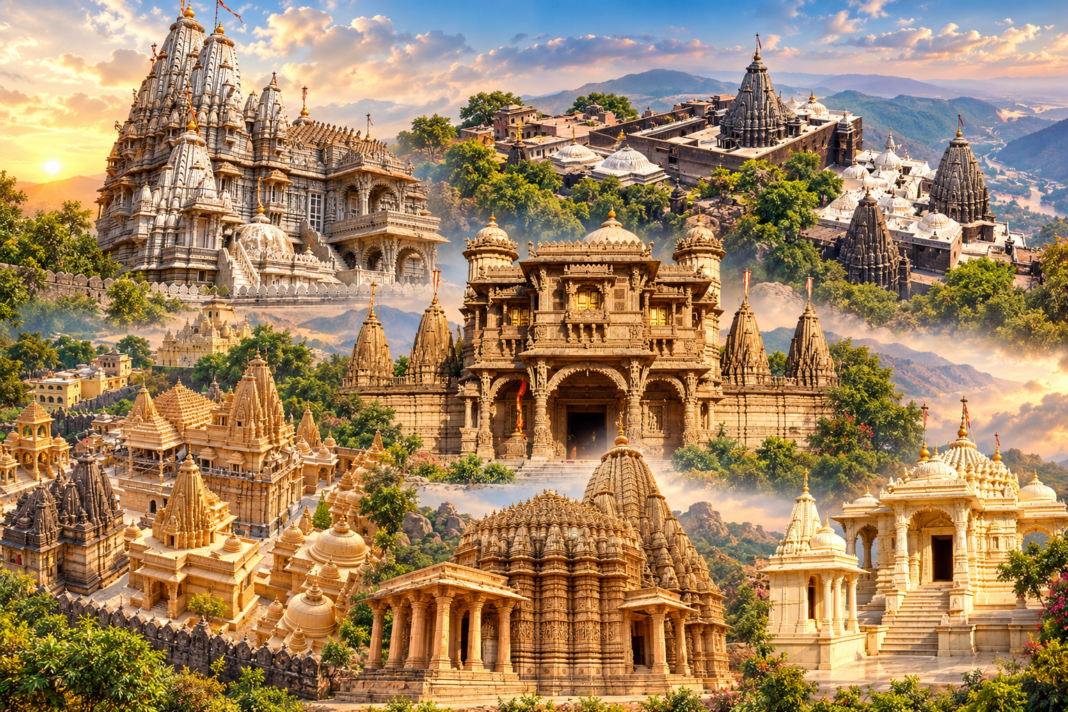
Quick answer: The most famous Jain temples in Gujarat are the hill temples of Palitana (Shatrunjaya), the Neminath temples on Girnar, Taranga, Shankheshwar Parshwanath, the Hutheesing Jain Temple in Ahmedabad and the marble temples of Kumbhariya near Ambaji. Popular Jain tirth near Ahmedabad include Koba, Serisa, Mahudi and Bhoyani, all within about 75 km. Just across the border in Rajasthan, the Dilwara temples of Mount Abu and Ranakpur are the best-known Jain tirth near Gujarat.
Jain Tirth in Gujarat: A Land of Pilgrimage
Picture a hill at dawn. Thousands of white marble spires catch the first light. Pilgrims in white clothes climb stone steps in silence, some barefoot, some chanting softly. That’s Palitana, and it’s just one of many sacred Jain places in Gujarat.
Gujarat has deep ties with Jainism. For centuries, Jain merchants, monks and kings built temples across the state. As a result, you’ll find Jain derasars in almost every town, from tiny shrines in old city lanes to vast hilltop temple cities.
In this complete guide, we cover the best Jain temples in Gujarat. First, we explain the basics of Jainism and Jain tirth. Next, we walk you through each major temple, with what to see, how to reach and tips. Then, we list the best Jain tirth near Ahmedabad and near Gujarat. Finally, we cover rules, routes, stays, food and festivals.
A note on sources: We’ve used official sources, reference books and temple traditions. Many temple histories come from Jain tradition and belief. So, we say so where needed. Also, timings and rules can change, so please check with each temple trust before you go.
Jain Temples in Gujarat: Quick Facts
| Detail | Information |
|---|---|
| Holiest Jain tirth in Gujarat | Shatrunjaya, Palitana |
| Number of temples at Palitana | Around 860 to 900, depending on how they’re counted |
| Steps at Palitana | Over 3,500 |
| Main Jain hills | Shatrunjaya (Palitana), Girnar (Junagadh), Taranga |
| Famous city temple | Hutheesing Jain Temple, Ahmedabad (1848) |
| Nearest tirth to Ahmedabad | Koba, on the Ahmedabad–Gandhinagar road |
| Famous Parshwanath tirth | Shankheshwar, Patan district |
| Best-known tirth near Gujarat | Dilwara (Mount Abu) and Ranakpur, Rajasthan |
| Best time to visit | October to March |
| Typical stay | Dharamshalas run by temple trusts |
| Typical food | Jain food at bhojanshalas, often served before sunset |
What Is a Jain Tirth?
In Jainism, a tirth is a sacred place of pilgrimage. The word means a “ford”, or a place to cross a river. In a spiritual sense, it’s a place that helps the soul cross the ocean of birth and rebirth.
A tirth may be linked with the life of a Tirthankara, one of the 24 great teachers of Jainism. It may also be a place where monks attained liberation, or simply a very old and holy temple. Many tirth have dharamshalas for pilgrims to stay and bhojanshalas for simple Jain meals.
A Jain temple is often called a derasar in Gujarati, or a mandir, basadi or jinalaya elsewhere. Most towns in Gujarat have at least one.
Jainism in Brief
To enjoy Jain temples fully, it helps to know a little about Jainism. Here are the basics.
- An ancient faith: Jainism is one of India’s oldest religions.
- Tirthankaras: Jains revere 24 Tirthankaras. The first is Rishabhanatha, also called Adinath, and the last is Mahavira.
- Mahavira: The 24th Tirthankara lived in the 6th or 5th century BCE, in what is now Bihar.
- Ahimsa: Non-violence towards all living beings is the heart of Jain life.
- Three jewels: Right faith, right knowledge and right conduct lead to liberation.
- Two main traditions: Shwetambar (“white-clad”) and Digambar (“sky-clad”).
- Simple living: Many Jains follow strict diets, avoid harming insects and eat before sunset.
Shwetambar and Digambar
Jainism has two main traditions. Shwetambar monks wear white clothes, and their temple idols are often decorated with eyes and ornaments. Digambar monks do not wear clothes, and their idols are plain and unadorned. Most Jain temples in Gujarat follow the Shwetambar tradition. However, Digambar temples are also found, for example at Girnar and Pavagadh.
The 24 Tirthankaras
Jain temples are dedicated to the 24 Tirthankaras. Each has a symbol, called a lanchhan, carved below the idol. So, the symbol helps you tell who the idol shows. Here’s the list, as given in common Jain tradition.
| No. | Tirthankara | Symbol |
|---|---|---|
| 1 | Rishabhanatha (Adinath) | Bull |
| 2 | Ajitnath | Elephant |
| 3 | Sambhavnath | Horse |
| 4 | Abhinandannath | Monkey |
| 5 | Sumatinath | Curlew (bird) |
| 6 | Padmaprabhu | Lotus |
| 7 | Suparshvanath | Swastika |
| 8 | Chandraprabhu | Crescent moon |
| 9 | Suvidhinath (Pushpadanta) | Crocodile |
| 10 | Shitalnath | Shrivatsa or wish-fulfilling tree (varies by tradition) |
| 11 | Shreyansnath | Rhinoceros |
| 12 | Vasupujya | Buffalo |
| 13 | Vimalnath | Boar |
| 14 | Anantnath | Falcon or bear (varies by tradition) |
| 15 | Dharmanath | Thunderbolt |
| 16 | Shantinath | Deer |
| 17 | Kunthunath | Goat |
| 18 | Aranath | Nandyavarta or fish (varies by tradition) |
| 19 | Mallinath | Water pot (kalash) |
| 20 | Munisuvrata | Tortoise |
| 21 | Naminath | Blue lotus |
| 22 | Neminath | Conch shell |
| 23 | Parshwanath | Snake |
| 24 | Mahavira | Lion |
Tip: Next time you visit a derasar, look for the symbol under the idol. It’s a fun way to learn, especially for kids.
Stories Behind the Tirthankaras
Every Jain temple tells a story. Here are four of the best-loved, shared in simple words. They come from Jain tradition and scripture.
Adinath and the Sugarcane Juice
Adinath, the first Tirthankara, gave up his kingdom to live as a monk. For a long time, he went without food, since people did not yet know how to give alms to a monk. Then, one day, a young prince named Shreyans offered him sugarcane juice. Adinath accepted it and broke his long fast.
Today, Jains remember this on Akshaya Tritiya. Many who keep a year-long fast, called varshitap, end it on this day, often at Palitana, with sugarcane juice.
Neminath’s Wedding Day
Neminath, the 22nd Tirthankara, was a prince and, by tradition, a cousin of Krishna. On his wedding day, he heard the cries of animals that were penned in to be cooked for the feast. He was filled with pity. So, he set the animals free, turned away from the wedding and chose the life of a monk.
Later, he gained supreme knowledge on Girnar. That’s why Girnar is so sacred to Jains today.
Parshwanath and the Snakes
Parshwanath, the 23rd Tirthankara, is often shown with a hood of snakes over his head. According to tradition, he once saved two snakes trapped in a burning log. Later, they were reborn as divine beings. Then, when Parshwanath was meditating and a storm struck, they shielded him with a great hood. So, the snake became his symbol.
Mahavira and the Angry Snake
Mahavira, the 24th Tirthankara, is said to have met a fierce snake named Chandkaushik. The snake bit him, but Mahavira stayed calm and felt only kindness. In the end, the snake’s anger melted away. So, the story shows the power of patience and non-violence.
Note: These are stories from Jain faith and tradition. They’re shared here to help visitors understand the temples and their symbols.
Five Core Jain Values
Jain temples are built around a way of life. So, it helps to know the five main vows that guide it. Monks follow them strictly, while lay people follow them as best they can.
- Ahimsa (non-violence): Don’t harm any living being, in thought, word or deed.
- Satya (truth): Speak the truth, and speak kindly.
- Asteya (not stealing): Don’t take what isn’t given.
- Brahmacharya (self-control): Live with restraint and purity.
- Aparigraha (non-attachment): Don’t cling to things, wealth or people.
In addition, Jains value anekantavada, the idea that truth has many sides. In other words, no one person sees the whole picture. It’s a lovely lesson for anyone, whatever their faith.
Why Gujarat Has So Many Jain Temples
Gujarat has one of India’s largest Jain communities. So, why is the faith so strong here? There are several reasons.
First, Jain merchants have long been leaders of Gujarat’s trade. Their wealth helped build grand temples. Second, many rulers supported Jainism. For example, the Solanki king Kumarpal of the 12th century is remembered as a great patron of Jain temples, guided by the scholar-monk Hemachandra. Third, the ministers Vastupal and Tejpal built and restored many famous temples in the 13th century.
In addition, Gujarat holds two of the holiest Jain hills, Shatrunjaya and Girnar. As a result, Jain pilgrims from across India and the world come here.
Gujarat’s Jain Community Today
Jains are a small share of Gujarat’s people, but their role is big. According to the 2011 Census, a little under 1% of Gujarat’s people are Jain. Still, the community has a large place in trade, learning, charity and public life.
Many of Gujarat’s hospitals, schools, animal shelters, called panjrapoles, and free food halls are run or funded by Jain trusts. So, the values you see in the temples, such as kindness and care for life, also show up in daily life across the state.
In addition, many Gujarati Jains now live in Mumbai and around the world. Yet they often come back to Gujarat for pilgrimage. As a result, the big tirth stay busy all year, except during the monsoon closures.
Parts of a Jain Temple
Jain temples share some common parts. Knowing these terms helps you enjoy every visit.
| Term | Meaning |
|---|---|
| Derasar | A Jain temple, in Gujarati |
| Mulnayak | The main idol of the temple |
| Garbhagriha | The inner shrine that holds the main idol |
| Rangmandap | The main hall, often with a carved dome |
| Shikhar | The tall spire over the shrine |
| Dhwaja | The flag on top of the spire |
| Manastambha | A tall pillar standing before some temples |
| Tonk or tuk | A cluster of temples on a hill |
| Taleti | The foot of a sacred hill, where the climb begins |
| Dharamshala | A rest house for pilgrims |
| Bhojanshala | A dining hall that serves Jain food |
What Makes Jain Temples Special?
Many visitors say Jain temples feel different from other places. But why? Here are a few reasons.
First, they’re very clean and calm. Trusts take great care of them. Second, the carving is often breathtaking. Marble is cut so finely that it looks like lace. Third, the idols show the Tirthankaras in deep calm, either sitting in meditation or standing still. As a result, the mood is peaceful rather than busy.
Also, Jain temples often sit in quiet places, such as hilltops and green valleys. So, the journey itself becomes part of the peace. Finally, the people who care for them follow a life of non-violence, and you can feel that care everywhere.
Famous Jain Temples in Gujarat: Quick List
| No. | Jain tirth | Main deity | District |
|---|---|---|---|
| 1 | Shatrunjaya, Palitana | Adinath | Bhavnagar |
| 2 | Girnar | Neminath | Junagadh |
| 3 | Taranga | Ajitnath | Mehsana |
| 4 | Shankheshwar | Parshwanath | Patan |
| 5 | Hutheesing Jain Temple | Dharmanath | Ahmedabad |
| 6 | Koba | Mahavir | Gandhinagar |
| 7 | Serisa | Parshwanath | Gandhinagar |
| 8 | Mahudi | Padmaprabhu and Ghantakarna Mahavir | Gandhinagar |
| 9 | Bhoyani | Mallinath | Near Kadi |
| 10 | Panchasar Parshwanath, Patan | Parshwanath | Patan |
| 11 | Kumbhariya | Several Tirthankaras | Banaskantha |
| 12 | Bhadreshwar | Mahavir | Kutch |
| 13 | Kutch Panchtirthi (Suthri and others) | Various | Kutch |
| 14 | Talaja | Sumatinath | Bhavnagar |
| 15 | Valabhi (Vallabhipur) | Adinath | Bhavnagar |
| 16 | Pavagadh | Various | Panchmahal |
Note: Some sites have more than one main temple, and local traditions may name the deities differently. So, use this as a quick guide.
1. Shatrunjaya, Palitana: The Holiest Jain Tirth in Gujarat
If you visit only one Jain tirth in Gujarat, make it Palitana. The town sits at the foot of Shatrunjaya hill, about 55 km from Bhavnagar. The hill is crowned by a vast city of marble temples, often called a “city of temples”.
For Shwetambar Jains, Shatrunjaya is one of the holiest places on earth. According to tradition, the first Tirthankara, Adinath, gave sermons here. Also, tradition holds that 23 of the 24 Tirthankaras visited the hill, all except Neminath. As a result, many Jains hope to climb it at least once in their lives.
Find it: Open map
The Temples on the Hill
Reference works describe nearly 900 temples on Shatrunjaya, of which around 108 are large. Other sources count about 863. Either way, the number is amazing. The temples are grouped into nine clusters, called tonks or tuks.
The main and grandest shrine is the Adinath temple, dedicated to the first Tirthankara. Its carved halls and towering spire draw every pilgrim. Other well-known shrines include temples built by rich merchant families over the centuries.
A Long History
The temples were built and rebuilt over many centuries. Much of what you see dates from the 11th century onwards, and many temples were restored after damage in later centuries. Since 1730, the Anandji Kalyanji Trust has managed the Palitana temples, as per reference works.
Palitana is also known for its strict vegetarian rules. In 2014, the town became widely known as the world’s first legally vegetarian city, after the state banned the sale of meat and eggs there following protests by Jain monks.
The Climb
The temples sit on a hill about 600 metres high. To reach them, you climb more than 3,500 stone steps. Most fit people take about two to three hours to reach the top. Then, they spend a few hours on darshan before walking back down.
For those who can’t climb, dolis, or chairs carried by porters, are available at the foot of the hill. Fees vary, so agree on the price in advance.
Rules on Shatrunjaya
- Start early, ideally before sunrise, to avoid the heat.
- Don’t eat or carry food on the climb, as per tradition.
- Carry only water, and avoid plastic, since the hill is a no-plastic zone.
- Dress modestly, and remove leather items.
- Begin your descent well before evening, as no one may stay on the hill at night.
- Photography inside the temples is usually not allowed.
When to Go
The best time to visit Palitana is from October to March, when it’s cooler. However, the hill temples are closed to pilgrims for about four months during the monsoon, during the chaturmas period. So, plan your visit after the hill reopens, which is traditionally marked by a big pilgrimage on Kartik Purnima.
How to Reach Palitana
- From Ahmedabad: About 215 km, or roughly 4 to 5 hours by road.
- From Bhavnagar: About 55 km, or about 1.5 hours.
- By train: Palitana has a small railway station, with links via Bhavnagar.
- By air: Bhavnagar airport is the nearest, though flights are limited.
Where to Stay
Palitana has hundreds of dharamshalas run by Jain trusts and communities. Many offer clean rooms and bhojanshalas. So, you’ll find a place to stay at almost any budget. However, book early during peak days such as Kartik Purnima and Fagun Sud 13.
A Morning on Shatrunjaya: What It Might Feel Like
This is an imagined scene, based on what many pilgrims describe.
It’s 5 am, and the town is still dark. You reach the foot of the hill with a small bottle of water and nothing else. Lamps glow at the first shrine. Then, you bow, touch the first step and begin.
At first, the climb feels easy. Soon, though, your legs start to ache. Around you, people of all ages walk on. A grandmother climbs slowly, one step at a time. A young boy races ahead, then waits for his father. Some chant softly. Others walk in silence.
As the sky turns pink, you look back. The plain below is wide and green, and a river shines in the distance. Then, you turn a corner, and there they are: hundreds of white spires, glowing in the dawn light. It’s hard to believe your eyes.
Finally, you reach the main temple. Inside, it’s cool and calm. You fold your hands before Adinath. For a moment, you forget the climb, the ache and the world below. In the end, that’s what a tirth is for.
2. Girnar: The Hill of Neminath
Girnar, near Junagadh, is another of the holiest Jain hills. It’s sacred to both Jains and Hindus. For Jains, Girnar is linked with Neminath, the 22nd Tirthankara. By Jain faith, he gave up the world, found true knowledge and was set free on this mountain.
The Jain temples sit high on the mountain. The largest is the Neminath temple, a beautiful complex of stone and marble. Nearby, other temples honour various Tirthankaras, and some are linked with the famous ministers Vastupal and Tejpal.
Find it: Open map
Climbing Girnar
Girnar is famous for its thousands of steps. Visitors say the Jain temples come after roughly 4,000 steps on the way up the mountain. The climb is tough, so start very early and carry water.
Since 2020, the Girnar ropeway has made the trip much easier. It carries visitors up much of the mountain. However, the ropeway’s upper station is above the Jain temples. So, visitors say you need to walk down about 1,000 steps from the top station to reach them, and then climb back up.
Girnar ropeway: Open map
Tips for Girnar
- Start the climb before dawn, as it can take several hours.
- Carry water and light snacks for the walk, where allowed.
- Wear shoes with good grip, since the steps can be steep.
- Check ropeway timings and weather before you go, as it may stop in bad weather.
- Visit between October and March for cooler weather.
Distance from Ahmedabad: About 320 km to Junagadh.
3. Taranga: Kumarpal’s Hill Temple
Taranga is a hill tirth in north Gujarat, near Kheralu in Mehsana district. Its main temple is dedicated to Ajitnath, the second Tirthankara. According to history, it was built in the 12th century by the Solanki king Kumarpal, a famous patron of Jainism.
The temple is known for its tall spire and finely carved outer walls. It stands in a calm valley among low hills. Also, visitors say a trail of several hundred steps leads up the hills to smaller shrines, such as Koti Shila.
Find it: Open map
Tips for Taranga
- Stay one night to enjoy the evening aarti and the calm hills.
- Try the simple Jain food at the bhojanshala.
- Watch out for monkeys, and keep food out of sight.
- Photography inside the main temple is not allowed, as per visitor reports.
- Combine your trip with the Ambaji Temple or the Vadnagar heritage town nearby.
Distance from Ahmedabad: About 125 to 135 km.
4. Shankheshwar: The Great Parshwanath Tirth
Shankheshwar in Patan district is one of the most loved Jain tirth in Gujarat. Its main idol is Shankheshwar Parshwanath, a form of the 23rd Tirthankara, Parshwanath. Devotees believe the idol is very ancient and full of spiritual power.
The temple complex is large, with many smaller shrines around the main one. On full moon days, called Poonam, the crowds are especially large. Also, the town has many dharamshalas and bhojanshalas, so it’s easy to stay overnight.
Find it: Open map
Tips for Shankheshwar
- Visit on a weekday if you want a calmer darshan.
- Plan for big crowds on Poonam days.
- Use the paid parking near the main temple.
- Try the local bhojanshalas, which serve simple Jain meals at fair prices.
- Combine your trip with Patan and Rani ki Vav, about an hour away.
Distance from Ahmedabad: About 120 km.
5. Hutheesing Jain Temple, Ahmedabad
The Hutheesing Jain Temple is Ahmedabad’s most famous Jain temple. It stands outside the old city’s Delhi Darwaza, in the Shahibaug area. It was built in 1848 by the merchant Sheth Hutheesing, and his wife, Harkunwar, is credited with completing it after his death. It’s dedicated to Dharmanath, the 15th Tirthankara.
The temple is built of white marble in the Maru-Gurjara style. It has two storeys, fine carvings and a tall manastambha, or pillar, in front. According to many accounts, its building gave work to local craftsmen during a hard time. So, it’s a symbol of both faith and kindness.
Find it: Open map
Visiting Tips
- Timings: Map listings show about 9 am to 12 pm and 5 pm to 7 pm, so check before you go.
- Entry: Free.
- Photos: Photography inside may be restricted.
- Nearby: Combine it with a heritage walk in the old city.
Jain Temples Inside Ahmedabad City
You don’t have to leave Ahmedabad to visit a Jain temple. In fact, the old walled city is full of them. Many pols, the close-knit old neighbourhoods, have their own derasar. Some are hundreds of years old, with carved wooden doors and quiet courtyards.
From the outside, many look like plain houses. Then, you step inside, and you find a bright shrine full of marble and colour. So, a heritage walk in the old city is a great way to discover them.
In addition, new Jain temples stand in many western suburbs, built by local Jain communities. As a result, almost every part of Ahmedabad has a derasar within easy reach.
Tip: Join a guided heritage walk in the old city. Guides can show you derasars that are easy to miss on your own. Also, remember to dress modestly and remove your shoes.
6. Koba: The Jain Tirth Closest to Ahmedabad
Koba, on the Ahmedabad–Gandhinagar road, is home to the Shri Mahavir Jain Aradhana Kendra. It’s one of the most visited Jain tirth near Ahmedabad, and it’s now even easier to reach, since a metro station is close by.
The large campus has a beautiful temple, a dharamshala, a bhojanshala, a meditation centre and a museum. In addition, it’s known for a library of old Jain manuscripts and books.
Find it: Open map
The Surya Tilak at Koba
Koba is famous for a special event called the Surya Tilak. According to the temple and many visitors, every year on 22 May at about 2:07 pm, the sun’s rays fall on the forehead of the marble idol of Mahavir for a few minutes. It’s a moving mix of faith and careful design, and it draws large crowds.
Tips for Koba
- Use the metro if you’re coming from Ahmedabad or Gandhinagar.
- Visit the museum, but note that it may be closed on Mondays.
- Try a meal at the bhojanshala, which works on coupons.
- Book a room in advance if you want to stay for the Surya Tilak.
Distance from Ahmedabad: About 20 to 25 km from the city centre.
7. Serisa: A Peaceful Parshwanath Tirth
Serisa lies on the Kalol–Khatraj road, a short drive from Ahmedabad. Its main idol is Serisa Parshwanath. The temple is old and calm, set in a large campus with tall neem trees and singing birds.
Visitors often praise the peaceful mood, the clean rooms and the good food at the bhojanshala. As a result, many Ahmedabad families visit on weekends for a quiet day of prayer.
Find it: Open map
Distance from Ahmedabad: About 25 to 30 km.
8. Mahudi: Home of Ghantakarna Mahavir
Mahudi in Gandhinagar district is a very popular tirth, visited by Jains and non-Jains alike. Visitors and reference sources say the temple was set up in 1917 by the monk Acharya Buddhisagarsuri. It houses Padmaprabhu, the 6th Tirthankara, and Ghantakarna Mahavir, a protector deity.
Mahudi is famous for its sukhadi prasad, a sweet made of wheat flour, ghee and jaggery. By tradition, the prasad must be eaten inside the temple premises and must not be taken outside. Many visitors also ring the big bell to make a wish.
Find it: Open map
Tips for Mahudi
- Eat the sukhadi prasad on the premises, as per custom.
- Read the rules on the board near the bell.
- Expect more crowds on weekends and special days.
- Parking is available near the complex.
Distance from Ahmedabad: About 70 to 80 km.
9. Bhoyani: The Mallinath Tirth
Bhoyani, near Kadi, is a well-loved tirth dedicated to Mallinath, the 19th Tirthankara. In the Shwetambar tradition, Mallinath is believed to have been a woman, Malli. So, Bhoyani holds a special place for many devotees. However, the Digambar tradition sees Mallinath as a man.
The campus is calm and well kept, with dharamshalas and a bhojanshala. In addition, the Narmada canal passes nearby, which makes for a pleasant evening walk.
Find it: Open map
Distance from Ahmedabad: About 60 to 70 km.
10. Panchasar Parshwanath, Patan
Patan, the old capital of Gujarat, has over 100 Jain temples. The most famous is the Panchasar Parshwanath Derasar. According to tradition, it’s linked with Vanraj Chavda, who founded Patan in the 8th century. The present temple has fine marble carvings and a sacred idol of Parshwanath.
Patan was also home to Acharya Hemachandra, the great Jain scholar of the 12th century. So, the city is a centre of Jain learning, with old libraries of manuscripts. Also, the UNESCO-listed Rani ki Vav stepwell is close by.
Find it: Open map
Distance from Ahmedabad: About 125 km.
11. Kumbhariya Jain Temples, Near Ambaji
Just outside Ambaji, the Kumbhariya Jain Temples are a group of five marble temples dating back to around the 11th century. Their carved ceilings and pillars are among the finest in Gujarat, and some compare them with the Dilwara temples of Mount Abu.
The site is quiet and often uncrowded. So, it’s a lovely stop after the busy Ambaji Temple. Map listings show it open from about 6:30 am to 7:30 pm.
Find it: Open map
Distance from Ahmedabad: About 180 to 185 km.
12. Bhadreshwar: The Ancient Tirth of Kutch
Bhadreshwar, near Mundra in Kutch, is one of the oldest Jain tirth in Gujarat. It’s also known as the Vasai Jain Tirth. Jain tradition holds that the first temple here was built in very ancient times, soon after Mahavir’s nirvana. However, the dates come from tradition rather than firm historical proof.
The temple was badly damaged in the 2001 Kutch earthquake and has since been rebuilt. Today, it has white marble temples, a big campus, rooms and a bhojanshala.
Find it: Open map
Distance from Ahmedabad: About 350 to 370 km.
13. Kutch Panchtirthi: Five Tirth of Abdasa
In western Kutch, the Abdasa area has a famous group of five Jain tirth, known as the Kutch Panchtirthi. The group commonly includes Suthri, Kothara, Jakhau, Naliya and Tera, though some lists vary. Many of these temples were built by wealthy Kutchi Jain merchants in the 19th century.
Suthri is known for Dhrutkallol Parshwanath. Kothara is famous for its grand, richly carved temple. Together, they make a peaceful circuit through rural Kutch.
Suthri tirth: Open map
Tip: Public transport is limited. So, hire a car from Bhuj for the full circuit.
14. Talaja: The Hill Tirth Near Bhavnagar
Talaja, about 50 km from Bhavnagar, has an old Jain temple on a hill called Taldhwaj. Its main idol is Sumatinath, the 5th Tirthankara. Tradition says Talaja was once seen as part of the greater Shatrunjaya tirth. Also, the hill has ancient rock-cut caves.
A climb of a few hundred steps, or about 10 to 15 minutes, leads to the temple. So, it’s an easy stop on the way to or from Palitana.
Find it: Open map
15. Valabhi: Where the Jain Scriptures Were Written
Vallabhipur, the ancient city of Valabhi, has a special place in Jain history. According to Jain tradition, a great council of monks met here in the 5th century CE, led by Devardhigani Kshamashramana. At this council, the Shwetambar Jain scriptures, the Agamas, were written down.
Today, an Adinath temple and a shrine to the old monks stand here, right on the highway to Palitana. So, many pilgrims stop on their way to Shatrunjaya.
Find it: Open map
16. Pavagadh: Jain Temples on a Sacred Hill
Pavagadh, near Champaner, is best known for the Mahakali Temple on its summit. However, it also has Jain temples, including old Digambar temples on the hill and a Shwetambar temple at the base with rooms and a bhojanshala. The whole area forms part of the Champaner-Pavagadh Archaeological Park, a UNESCO World Heritage Site.
Find it: Open map
Distance from Ahmedabad: About 150 km.
Your First Jain Tirth: Which One to Pick?
New to Jain temples? Then, here’s a simple guide to choose your first one.
- Short on time? Start with the Hutheesing Jain Temple or Koba. Both are close to Ahmedabad.
- Want a calm day out? Try Serisa or Bhoyani, with peaceful campuses and simple food.
- Love art? Go to Kumbhariya, or cross into Rajasthan for Dilwara and Ranakpur.
- Want a big spiritual journey? Plan a trip to Palitana and climb Shatrunjaya.
- Travelling with family? Mahudi and Shankheshwar are easy and welcoming.
In short, there’s a Jain tirth for every mood and every pace. So, start small, and let one visit lead to the next.
Five Things to Check Before You Go
- Is the tirth open? Some hill tirth close in the monsoon.
- What are the timings? Temples, museums and food halls all have set hours.
- Are rooms free? Book ahead for festivals and weekends.
- What’s the weather? Heat and rain can make climbs hard.
- What are the rules? Check dress codes, photo rules and what you can carry.
Jain Tirth Near Ahmedabad
Living in Ahmedabad? You’re lucky. Several important Jain tirth are within an easy drive of the city. Some are close enough for a morning visit, while others make a good day trip.
| Jain tirth near Ahmedabad | Approx. distance | Approx. drive | Best for |
|---|---|---|---|
| Hutheesing Jain Temple | In the city | — | Heritage and art |
| Koba | 20 to 25 km | 45 minutes | Quick visit, Surya Tilak, museum |
| Serisa | 25 to 30 km | 45 to 60 minutes | Peaceful half day |
| Bhoyani | 60 to 70 km | 1.5 hours | Mallinath darshan |
| Mahudi | 70 to 80 km | 1.5 to 2 hours | Sukhadi prasad, family day out |
| Shankheshwar | About 120 km | 2.5 hours | Major Parshwanath tirth |
| Patan (Panchasar) | About 125 km | 2.5 hours | Temples plus Rani ki Vav |
| Taranga | 125 to 135 km | 2.5 to 3 hours | Hill temple and overnight stay |
| Pavagadh | About 150 km | 3 hours | Jain temples plus UNESCO site |
| Kumbhariya | 180 to 185 km | 3.5 to 4 hours | Carved marble, with Ambaji |
| Palitana | About 215 km | 4 to 5 hours | The holiest Jain hill |
Note: Distances and times are rough and depend on your starting point and traffic.
One-Day Jain Tirth Plans From Ahmedabad
Plan 1: The Gandhinagar Circuit. First, visit Koba in the morning. Then, drive to Mahudi for darshan and sukhadi prasad. On the way back, stop at Serisa for a calm evening. It’s an easy, relaxed day.
Plan 2: The North Gujarat Circuit. Start early for Shankheshwar. After darshan and lunch, drive to Patan for the Panchasar temple and Rani ki Vav. Then, head back to Ahmedabad by night. Alternatively, stay overnight and visit Taranga the next day.
Plan 3: The Weekend Hill Trip. Drive to Palitana on Friday evening. Climb Shatrunjaya at dawn on Saturday. On Sunday, visit Talaja and Valabhi on the way home.
A Weekend Jain Yatra From Ahmedabad
Have just one weekend? Here’s a simple plan that covers some of the best Jain tirth near Ahmedabad.
Saturday morning: First, leave Ahmedabad early and drive to Shankheshwar. Take darshan while it’s calm, then have a simple lunch at a bhojanshala.
Saturday afternoon: Next, drive to Patan. Visit the Panchasar temple, then walk around Rani ki Vav as the sun sets.
Saturday night: Then, drive on to Taranga and check in at the dharamshala. Enjoy the evening aarti in the quiet hills.
Sunday morning: After an early darshan at Taranga, take the hill trail if you have the energy.
Sunday afternoon: On the way back, stop at Mahudi for sukhadi prasad.
Evening: Finally, end the trip with a calm visit to Koba before you reach home.
Of course, this is a full plan. So, if you prefer a slower pace, skip one stop and enjoy the rest.
Jain Tirth Near Gujarat
Some of India’s most famous Jain temples lie just across Gujarat’s border in Rajasthan. Many Gujarati families visit them often. Here are the best Jain tirth near Gujarat.
Dilwara Temples, Mount Abu
The Dilwara temples in Mount Abu are world-famous for their marble carving, which looks almost like lace. The complex has five temples, built between the 11th and 13th centuries. Of these, the two most famous are the Vimal Vasahi, dedicated to Adinath, and the Luna Vasahi, dedicated to Neminath, which was built by the brothers Vastupal and Tejpal.
Visitors say you can’t take phones or cameras in, and no photos are allowed. Also, map listings show visiting hours for tourists of about 11 am to 5 pm. So, check timings before you go.
Find it: Open map
Distance from Ahmedabad: About 220 to 230 km.
Ranakpur
The Ranakpur Jain Temple, in Rajasthan’s Pali district, is one of the grandest Jain temples ever built. It’s dedicated to Adinath and dates from the 15th century. It’s famous for its hundreds of carved marble pillars, often said to number about 1,444, and no two are said to be alike.
The temple sits in a green valley of the Aravalli hills. It also has a bhojanshala and rooms for pilgrims.
Find it: Open map
Distance from Ahmedabad: Roughly 330 to 350 km.
Kesariyaji (Rishabhdeo)
Kesariyaji is at Rishabhdeo, near Udaipur. Its main idol is Adinath. The name comes from saffron, or kesar, which devotees offer to the idol. It’s revered by Jains of both traditions, and also by Hindu and tribal communities. It lies just off the Ahmedabad–Udaipur highway.
Find it: Open map
Distance from Ahmedabad: About 190 to 200 km.
Jirawala Parshwanath
Jirawala, in Sirohi district, is a calm, well-run tirth dedicated to Parshwanath. It’s close to the Gujarat border, near Abu Road. Pilgrims praise its clean rooms and good food.
Find it: Open map
Distance from Ahmedabad: About 230 to 250 km.
Nakoda Parshwanath
Nakoda, in Barmer district, is a much-loved Parshwanath tirth. It’s also known for its guardian deity, Nakoda Bhairav. It’s further away, but many Gujarati families visit it.
Find it: Open map
Distance from Ahmedabad: Roughly 400 to 450 km.
| Jain tirth near Gujarat | State | Known for |
|---|---|---|
| Dilwara, Mount Abu | Rajasthan | Lace-like marble carving |
| Ranakpur | Rajasthan | Hundreds of carved pillars |
| Kesariyaji | Rajasthan | Saffron offerings to Adinath |
| Jirawala | Rajasthan | Peaceful Parshwanath tirth |
| Nakoda | Rajasthan | Parshwanath and Nakoda Bhairav |
Other Great Jain Tirth in India
Beyond Gujarat and Rajasthan, Jain pilgrims also travel to many other holy places. For example, there’s Sammed Shikharji in Jharkhand. By faith, 20 Tirthankaras found liberation there. Then there’s Pawapuri in Bihar, linked with the end of Mahavir’s life. In the south, Shravanabelagola in Karnataka is famous for its giant statue of Bahubali. So, Gujarat is just the start of a much bigger pilgrimage map.
Sangh Yatras: Walking Pilgrimages
One of the most moving Jain traditions is the sangh yatra, a group pilgrimage. Often, a family sponsors the yatra, and monks lead it. Pilgrims walk together from town to town, sometimes for days or weeks, until they reach a tirth such as Palitana.
Many of these walks follow strict rules of simple living. For example, pilgrims walk barefoot, eat once a day and sleep on the ground. As a result, the journey becomes a deep spiritual practice, not just a trip.
If you see a sangh yatra on the road, slow down and give way. It’s a sign of respect for a tradition that’s centuries old.
Suggested Jain Tirth Routes
The Saurashtra Tirth Yatra (4 to 5 Days)
Ahmedabad → Valabhi → Palitana (two days) → Talaja → Girnar, Junagadh → Ahmedabad. This route covers the two holiest hills in Gujarat.
The North Gujarat Tirth Yatra (2 to 3 Days)
Ahmedabad → Serisa → Bhoyani → Shankheshwar → Patan → Taranga → Mahudi → Koba → Ahmedabad.
The Rajasthan Border Yatra (3 to 4 Days)
Ahmedabad → Kumbhariya → Jirawala → Mount Abu (Dilwara) → Ranakpur → Kesariyaji → Ahmedabad.
The Kutch Tirth Yatra (3 Days)
Start in Ahmedabad, then go to Bhadreshwar → Bhuj → Kutch Panchtirthi (Suthri, Kothara, Jakhau, Naliya, Tera) → Ahmedabad.
Best Time to Visit Jain Temples in Gujarat
The best time to visit is from October to March, when the weather is cool and pleasant. This is especially important for hill tirth like Palitana, Girnar and Taranga, where you climb many steps.
- Winter (November to February): Ideal for climbing and travel.
- Summer (April to June): Very hot, so climb only at dawn.
- Monsoon (July to October): Palitana’s hill is closed to pilgrims during chaturmas, and many monks stay in one place.
Jain Tirth Through the Year
The mood at Jain tirth changes with the seasons. So, here’s a simple guide to help you plan.
| Months | What to expect |
|---|---|
| November | Kartik Purnima; Palitana’s hill reopens to a huge yatra |
| December to February | Cool, clear days; the best time for climbs |
| February or March | The Chha Gau yatra at Palitana on Fagun Sud 13 |
| March or April | Mahavir Jayanti celebrations |
| April or May | Akshaya Tritiya; hot days, so climb at dawn |
| June to October | Monsoon and chaturmas; Palitana’s hill is closed to pilgrims |
| August or September | Paryushan; temples are busy with prayer and fasting |
| October or November | Diwali, marking Mahavir’s nirvana |
Plan B for the Monsoon
What if you want to go on a yatra in the monsoon, when Palitana’s hill is closed? Don’t worry. You still have many good choices.
First, visit tirth on flat ground, such as Shankheshwar, Serisa, Bhoyani, Koba or Mahudi. Most stay open all year. Second, enjoy the green hills around Taranga, which look lovely after the rain. Third, explore the Jain temples of Ahmedabad’s old city on a cool, cloudy day.
Also, the monsoon is the season of chaturmas, when monks stay in one place. So, it’s a good time to hear their talks in local temples. In the end, every season has its own way to connect with the faith.
Jain Festivals and Special Days
Jain tirth fill up on special days. Here are the most important ones. Dates follow the Jain and Hindu lunar calendars, so they change each year.
| Festival or event | Usual month | What happens |
|---|---|---|
| Mahavir Jayanti | March or April | Celebrates Mahavir’s birth with processions and prayers |
| Akshaya Tritiya | April or May | Many end their long varshitap fast, often at Palitana |
| Paryushan | August or September | Eight days of fasting, prayer and forgiveness |
| Samvatsari | End of Paryushan | Day of asking forgiveness: “Micchami Dukkadam” |
| Diwali | October or November | Marks Mahavir’s nirvana |
| Kartik Purnima | November | Palitana’s hill reopens with a big yatra |
| Fagun Sud 13 | February or March | The Chha Gau yatra around Shatrunjaya |
What to Wear to a Jain Temple
Clothes matter at a Jain temple. So, here’s a simple guide.
- Wear clean, simple clothes that cover your shoulders and knees.
- Light colours, such as white or cream, are a good choice.
- Avoid leather belts, shoes, watch straps and bags.
- Choose shoes you can slip off and on with ease.
- For puja, many temples ask for special unstitched clothes, so don’t join the puja in regular clothes.
In short, dress as if you’re visiting a respected elder. That way, you’ll always fit in.
How to Behave on Your First Visit
Visiting a Jain temple for the first time? Don’t worry. Just follow these simple steps.
- First, dress right. Wear clean, modest clothes, and leave leather at home.
- Then, take off your shoes. Use the shoe stand near the gate.
- Next, wash your hands and feet. Many temples have a tap for this.
- After that, enter quietly. Keep your phone off, and speak softly.
- Then, look and pray. Fold your hands before the idol, or simply sit in silence.
- Also, walk around with care. Many temples have a path around the shrine.
- Finally, leave calmly. If you wish, drop a small offering in the box.
That’s it. In short, be quiet, be clean and be kind. Jain temples are places of peace, and that’s all they ask of you.
Words You’ll Hear at a Jain Tirth
Jain pilgrims use a few special words and greetings. Learning them helps you feel at home.
- Jai Jinendra: The common Jain greeting. It honours the Jinas, the great teachers.
- Micchami Dukkadam: “May my wrongs be forgiven.” It’s said on Samvatsari, at the end of Paryushan.
- Navkar Mantra: The most important Jain prayer, which honours the great souls.
- Maharaj Saheb: A respectful way to address a Jain monk.
- Sadhvi: A Jain nun.
- Yatra: A pilgrimage.
- Sangh: The Jain community, or a group travelling together.
So, if someone greets you with “Jai Jinendra”, simply smile and say it back.
Visiting During Paryushan
Paryushan is the most important Jain festival. It usually falls in August or September and lasts eight days for Shwetambar Jains, while Digambar Jains observe ten days, often called Das Lakshan.
During Paryushan, temples are busy with prayer, scripture reading and fasting. Many devotees fast for days. Then, on the last day, Samvatsari, people ask each other for forgiveness by saying “Micchami Dukkadam”.
If you visit at this time, be extra respectful. Also, avoid eating in front of those who are fasting. In return, you’ll see Jain faith at its most devoted.
Rules and Etiquette at Jain Temples
Jain temples follow careful rules of purity and non-violence. As a visitor, following them shows respect. Here are the common ones.
- Dress modestly: Cover your shoulders and knees.
- No leather: Leave belts, wallets and bags made of leather outside.
- Remove footwear: Leave shoes at the stand before you enter.
- No food inside: Don’t carry or eat food in the temple.
- Keep quiet: Speak softly, and switch off your phone.
- Photos: Many temples don’t allow photos of the idols, so ask first.
- Don’t touch idols: Only those doing puja in proper clothes may touch them.
- Follow local rules: Some temples have extra customs, so read the signs and follow staff advice.
In addition, some derasars allow only Jain devotees into the inner shrine area or for puja. So, if you’re not Jain, ask politely and respect the answer.
A Note on Respect
Jain temples are, above all, places of worship. So, even if you come for the art or the views, remember that people around you are praying.
Be patient in queues. Don’t block the path of those doing puja. Also, keep children close, and teach them to stay quiet. If a rule seems strange, ask politely, and follow it anyway. In return, you’ll find that Jain communities are warm and welcoming to guests who show respect.
How Jain Puja Works
Many Jain devotees perform a daily puja called the ashtaprakari puja, or eightfold worship. Each offering has a meaning. Here’s a simple overview.
- Jal: Water, for purity.
- Chandan: Sandalwood paste, for calm.
- Pushpa: Flowers, for good conduct.
- Dhoop: Incense, to burn away bad karma.
- Deepak: A lamp, for the light of knowledge.
- Akshat: Rice, for the goal of liberation.
- Naivedya: Sweets, for freedom from craving.
- Phal: Fruit, for the fruit of liberation.
Note: Practices vary between the Shwetambar and Digambar traditions, and between temples. Visitors can simply watch quietly.
Questions First-Time Visitors Often Ask
- “Do I need to be Jain to visit?” No. Most temples welcome all who come with respect. Still, some rituals are for Jains only.
- “Can I take photos?” It depends. Many temples ban photos of the idols, so always ask first.
- “Is there a fee?” Most Jain temples are free to enter. However, some museums and special areas charge a small fee.
- “Can I eat at the bhojanshala?” Yes, in most places. Just follow the meal timings and the rules.
- “What if I’m not fit enough to climb?” Then, use a doli at Palitana or the ropeway at Girnar. Or, choose a tirth on flat ground.
- “How long should I stay?” A city temple takes an hour or so. A hill tirth may take a full day, and many people stay a night.
How Jain Temples Are Run
Most Jain temples are run by trusts, which are set up and supported by the community. These trusts look after the temples, the rooms, the food halls and the daily rituals. For example, the Anandji Kalyanji Trust has run Palitana’s temples since 1730, as per reference books.
Donations from devotees keep these places running. So, if you’d like to give, use the official donation counter and ask for a receipt. Also, be careful of anyone collecting money in the name of a temple without proof.
A Day at a Jain Tirth
Life at a Jain tirth follows a gentle rhythm. Here’s what a typical day looks like.
- Before dawn: The temple opens, and early devotees begin their puja.
- Morning: Pilgrims climb hills, bathe the idols and offer flowers and sandalwood.
- Midday: The bhojanshala serves lunch, and the campus grows quiet.
- Afternoon: Some rest, while others read, pray or sit with monks.
- Before sunset: Many devotees eat their last meal of the day.
- Evening: Lamps are lit for the aarti, and devotional songs fill the air.
- Night: The campus falls silent early, ready for another dawn.
So, if you stay a night, try to follow this rhythm. Wake early, eat early and sleep early. You’ll feel the calm of the tirth much more.
Jain Food and Bhojanshalas
Most Jain tirth have a bhojanshala, a dining hall that serves simple, pure Jain food. It’s usually tasty, filling and fairly priced. As a result, eating there is part of the pilgrimage for many families.
Jain food follows strict rules, rooted in non-violence. Here’s what makes it special.
- No root vegetables: Onion, garlic, potato and carrot are left out, since pulling them up harms many tiny lives.
- No meat, fish or eggs: Jain food is strictly vegetarian.
- Honey is avoided: Many Jains skip it, since collecting it harms bees.
- Before sunset: Many Jains eat only in daylight. So, dinner at bhojanshalas is often served early.
- Boiled water: Some tirth offer boiled water at set times.
Tip: Check meal timings when you arrive, since many bhojanshalas close before sunset.
What to Expect at a Bhojanshala
Eating at a bhojanshala is a simple, warm experience. Here’s how it usually works.
- First, buy a coupon. Many bhojanshalas sell meal coupons at a counter.
- Then, wash your hands. There’s usually a basin near the door.
- Next, take a seat. Some halls have tables, while others have floor seating.
- After that, eat what’s served. Meals are simple, often dal, rice, roti, a vegetable and a sweet.
- Take only what you’ll eat. Wasting food goes against Jain values.
- Finally, clear your place. Follow the hall’s custom for plates and leftovers.
Also, remember that meals are often served only in daylight. So, plan your day around lunch and an early dinner.
Staying at Jain Dharamshalas
Almost every major Jain tirth has a dharamshala, or pilgrim rest house. Some are simple, while others have air-conditioned rooms with attached baths. Most are clean and fairly priced.
- Book ahead: On festival days and weekends, rooms fill up fast.
- Follow the rules: Many dharamshalas ask guests to follow Jain customs, such as no non-veg food.
- Carry ID: You’ll usually need a photo ID to check in.
- Check timings: Some have fixed check-in times and early gate closing.
Hill Tirth vs City Temples
| Feature | Hill tirth | City or plain tirth |
|---|---|---|
| Examples | Palitana, Girnar, Taranga, Talaja | Hutheesing, Koba, Serisa, Shankheshwar |
| Effort | Steep climbs, often thousands of steps | Easy, flat walking |
| Time needed | Half a day to a full day | One to three hours |
| Best for | Fit pilgrims and deep devotion | Families, elders and quick visits |
| Best time | Early morning in cool months | Any time the temple is open |
Tips for Climbing Jain Hills
Palitana, Girnar, Taranga and Talaja all need a climb. So, here’s how to make it easier.
- Start before dawn: It’s cooler, and the views are beautiful.
- Wear good shoes: Wear them to the top, then leave them outside the temple.
- Carry water: Take a small bottle, but avoid plastic where it’s banned.
- Pace yourself: Rest often, and don’t rush.
- Use a doli if needed: Porters carry pilgrims who can’t climb.
- Plan the descent: Leave enough time to come down before evening.
- Check your health: If you have heart or joint problems, ask a doctor first.
Health and Comfort on Your Yatra
- Drink water often: Keep sipping, mainly on hill climbs.
- Eat light: Simple Jain meals are easy on the stomach.
- Rest well: Sleep early before a big climb.
- Protect your feet: Carry plasters for blisters.
- Mind the sun: Wear a cap, and climb before it gets hot.
- Know your limits: Stop if you feel dizzy, breathless or unwell.
- Carry medicines: Shops near hill tirth may have only basic supplies.
Visiting With Elders and Kids
- Choose tirth without long climbs, such as Koba, Serisa, Shankheshwar or Mahudi.
- Use the Girnar ropeway or a doli at Palitana.
- Visit early in the day, when it’s cool.
- Carry medicines, snacks for the road and water.
- Teach kids the rules before you go, such as keeping quiet and not touching idols.
Jain Art and Architecture in Gujarat
Jain temples in Gujarat are among the finest works of Indian art. Most follow the Maru-Gurjara style, which grew in Gujarat and Rajasthan. It’s known for carved pillars, rich domes and tall spires.
For centuries, the Sompura community of temple builders has passed down the skills to design and carve these temples. Many of Gujarat’s Jain temples, old and new, are their work.
Jains have also long cared for books and learning. So, Gujarat has some of India’s most important Jain libraries, called gyan bhandars. Patan and Koba, for example, hold old palm-leaf and paper manuscripts.
What to Pack for a Jain Tirth Yatra
- Modest cotton clothes, ideally light colours
- Shoes with good grip for hill climbs
- A cloth bag, since leather and plastic are often not allowed
- A small water bottle
- Photo ID for dharamshala check-in
- Cash for donations, rooms and meals
- A cap and sunscreen
- A light shawl for cool mornings
- Any regular medicines
Budget Guide
A Jain tirth yatra can be very affordable. Here’s a rough guide. Prices vary, so treat these as broad ranges only.
| Item | Typical cost |
|---|---|
| Temple entry | Free at most temples |
| Dharamshala room | Low to moderate; AC rooms cost more |
| Bhojanshala meal | Low cost, often around ₹100 per meal as per visitors |
| Doli at Palitana | Varies; agree on the price first |
| Girnar ropeway | Paid ticket; check current fares |
| Travel | Depends on car, bus or train |
Tips for Photographers
- Always ask before taking photos, since many temples ban them inside.
- Shoot the outside of temples in soft morning or evening light.
- Look for details, such as carved ceilings, pillars and doors, where allowed.
- Never photograph people at prayer without their consent.
- Don’t use a flash, as it can disturb worshippers.
- Don’t fly drones near temples without written permission.
Be a Green Pilgrim
Jainism teaches care for all life. So, it makes sense to travel in a way that’s kind to the earth.
- Carry a reusable water bottle and cloth bag.
- Avoid plastic, especially on Shatrunjaya, which is a no-plastic zone.
- Don’t waste food at bhojanshalas. Take only what you’ll eat.
- Stay on paths, and don’t disturb plants or animals.
- Share rides, or use buses and trains where you can.
Why These Tirth Matter
Gujarat’s Jain tirth are more than old buildings. First, they keep an ancient faith alive, passing it from one generation to the next. Second, they’re treasures of Indian art, with some of the finest stone carving in the world. Third, they show how a community can build and care for beauty over many centuries.
In addition, they offer something rare today: quiet. In a busy world, a few hours in a calm derasar can feel like a gift. So, whether you’re Jain or not, these places have something to teach us all.
Common Mistakes to Avoid
- Visiting Palitana in the monsoon. The hill is closed to pilgrims then. So, plan for October to March.
- Starting a climb too late. It gets hot fast. Instead, start before sunrise.
- Carrying leather. Belts and wallets made of leather aren’t allowed in many temples. Therefore, use cloth.
- Missing dinner. Many bhojanshalas close before sunset. Hence, check the timings.
- Taking photos without asking. Many temples ban them inside. So, always ask first.
- Not booking rooms on festival days. Dharamshalas fill up fast. As a result, book early.
Jain Tirth for a Quiet Retreat
Not every trip has to be a big yatra. Sometimes, you just need a calm place to rest your mind. Luckily, many Jain tirth near Ahmedabad are perfect for this.
For example, Serisa has a large, leafy campus with birdsong and shade. Bhoyani is calm, with the Narmada canal close by. Taranga sits in quiet hills, far from city noise. In each, you can stay a night, eat simple food, walk, pray and rest.
So, if city life feels too fast, try a one-night stay at a Jain tirth. Switch off your phone, wake up early and sit in the temple at dawn. You may come home feeling lighter.
Myths and Facts About Jain Temples in Gujarat
| Myth | Fact |
|---|---|
| Only Jains can visit Jain temples. | Most welcome respectful visitors, though some areas or rituals may be for Jains only. |
| Palitana has exactly 863 temples. | Counts vary; sources give around 860 to 900. |
| You can stay on Shatrunjaya overnight. | No one may stay on the hill at night, by tradition. |
| Palitana is open all year. | The hill is closed to pilgrims for about four months in the monsoon. |
| All Jain temples look the same. | Styles vary from simple shrines to vast carved complexes. |
| Mahudi prasad can be taken home. | By tradition, the sukhadi must be eaten on the premises. |
Jain Temples in Gujarat in Numbers
- 24: Tirthankaras honoured in Jain temples.
- 860 to 900: Temples on Shatrunjaya hill, depending on the count.
- 3,500+: Steps to the top of Shatrunjaya.
- 9: Temple clusters, or tonks, at Palitana.
- 1730: Year the Anandji Kalyanji Trust took charge of Palitana, as per reference books.
- 1848: Year the Hutheesing Jain Temple was built.
- 22 May: Date of the Surya Tilak at Koba.
- 5: Marble temples at Kumbhariya.
- 5: Tirth in the Kutch Panchtirthi.
A Quick Guide to Key Terms
- Tirth: A sacred place of pilgrimage.
- Tirthankara: One of the 24 great teachers of Jainism.
- Derasar: A Jain temple.
- Mulnayak: The main idol of a temple.
- Chaturmas: The four months of the monsoon, when monks stay in one place.
- Paryushan: The main Jain festival of fasting and forgiveness.
- Doli: A chair carried by porters on hill climbs.
- Bhojanshala: A Jain dining hall.
- Dharamshala: A pilgrim rest house.
- Ahimsa: Non-violence.
Revision Notes: 15 Key Points
- Gujarat has some of the holiest Jain tirth in India.
- Shatrunjaya at Palitana is the holiest Jain hill for Shwetambar Jains.
- It has around 860 to 900 temples and over 3,500 steps.
- The hill is closed to pilgrims during the monsoon.
- Girnar is linked with Neminath, the 22nd Tirthankara.
- Taranga’s Ajitnath temple was built by King Kumarpal in the 12th century.
- Shankheshwar is a major Parshwanath tirth in Patan district.
- Ahmedabad’s Hutheesing Jain Temple was built in 1848.
- Koba is the closest major tirth to Ahmedabad.
- Koba’s Surya Tilak happens each year on 22 May.
- Mahudi is famous for sukhadi prasad.
- Bhoyani is dedicated to Mallinath.
- Valabhi is where, by tradition, Jain scriptures were written down in the 5th century.
- Dilwara and Ranakpur are the best-known Jain tirth near Gujarat.
- October to March is the best time to visit.
Your Tirth Yatra Checklist
- Choose your tirth and route.
- Check temple timings and seasonal closures.
- Book dharamshala rooms early.
- Pack modest clothes and avoid leather.
- Carry ID, cash and a water bottle.
- Plan climbs for early morning.
- Note bhojanshala meal timings.
- Learn the basic temple rules.
Explaining Jain Temples to Kids in Five Sentences
- Jain temples are calm, beautiful places where people pray to great teachers called Tirthankaras.
- There were 24 Tirthankaras, and each one has a special symbol, like a bull, a lion or a snake.
- Jains believe in being kind to every living thing, even tiny insects.
- Some Jain temples are on top of big hills, and people climb thousands of steps to reach them.
- When we visit, we take off our shoes, stay quiet and keep our hands to ourselves.
One Last Tip Before You Go
Don’t try to see too much in one trip. A Jain tirth rewards those who slow down. So, pick two or three places, stay a night where you can and give yourself time to sit in silence. Also, talk to the people who look after the temples. They often know old stories that you won’t find in any book. In the end, the best yatra is not the longest one. It’s the one you remember with a calm heart.
More Temple Guides From Amdavad Gully
- Famous temples in Gujarat
- Famous temples in Ahmedabad
- Tourist places in Ahmedabad
- Places to visit in Gandhinagar
Quick Recap
Let’s sum it all up. Gujarat is home to some of the holiest Jain tirth in India. Palitana’s Shatrunjaya hill, with its hundreds of temples, is the most sacred. Girnar, Taranga and Shankheshwar follow close behind.
Near Ahmedabad, Koba, Serisa, Bhoyani and Mahudi make easy trips, while the Hutheesing temple sits right in the city. Just across the border, Dilwara and Ranakpur are the best-known Jain tirth near Gujarat. So, pick a cool month, follow the temple rules and start your yatra.
Frequently Asked Questions
Which are the most famous Jain temples in Gujarat?
The most famous Jain temples in Gujarat include Shatrunjaya at Palitana, the Neminath temples on Girnar, Taranga, Shankheshwar, the Hutheesing Jain Temple in Ahmedabad, Kumbhariya near Ambaji, Koba, Mahudi and Bhadreshwar in Kutch.
Which is the holiest Jain tirth in Gujarat?
Shatrunjaya hill at Palitana is the holiest Jain tirth in Gujarat, especially for Shwetambar Jains. It has around 860 to 900 temples.
Which Jain tirth are near Ahmedabad?
Popular Jain tirth near Ahmedabad include Koba (about 20 to 25 km), Serisa (about 25 to 30 km), Bhoyani (about 60 to 70 km), Mahudi (about 70 to 80 km) and Shankheshwar (about 120 km). The Hutheesing Jain Temple is within the city.
Which Jain tirth are near Gujarat?
The best-known Jain tirth near Gujarat are in Rajasthan: the Dilwara temples of Mount Abu, Ranakpur, Kesariyaji near Udaipur, Jirawala and Nakoda.
How many steps are there at Palitana?
Pilgrims climb more than 3,500 stone steps to reach the temples on Shatrunjaya hill at Palitana.
How many temples are there at Palitana?
Sources give around 860 to 900 temples on Shatrunjaya hill, grouped into nine clusters called tonks.
When is Palitana closed?
The Shatrunjaya hill temples are closed to pilgrims for about four months during the monsoon, during chaturmas. The hill traditionally reopens around Kartik Purnima.
Which Tirthankara is linked with Girnar?
Girnar is linked with Neminath, the 22nd Tirthankara, who, according to Jain tradition, attained liberation on the mountain.
Who built the Taranga Jain temple?
The Ajitnath temple at Taranga was built in the 12th century by the Solanki king Kumarpal, a great patron of Jainism.
When was the Hutheesing Jain Temple built?
The Hutheesing Jain Temple in Ahmedabad was built in 1848. It’s dedicated to Dharmanath, the 15th Tirthankara.
What is the Surya Tilak at Koba?
Every year on 22 May at about 2:07 pm, the sun’s rays fall on the forehead of the idol of Mahavir at Koba for a few minutes. This event is called the Surya Tilak.
Why is Mahudi famous?
Mahudi is famous for the shrine of Ghantakarna Mahavir and its sukhadi prasad, which by tradition must be eaten within the temple premises.
Can non-Jains visit Jain temples in Gujarat?
Yes, most Jain temples welcome respectful visitors of all faiths. However, some inner areas or rituals may be limited to Jain devotees, so follow the rules on site.
What is the best time to visit Jain temples in Gujarat?
The best time is from October to March, when it’s cool enough to climb hill tirth like Palitana and Girnar.
Is there accommodation at Jain tirth in Gujarat?
Yes. Most major Jain tirth have dharamshalas for pilgrims and bhojanshalas that serve Jain food, usually at fair prices.
The Bottom Line
Gujarat is one of the great homes of Jainism. Its Jain temples range from the marble city of Shatrunjaya and the high shrines of Girnar to quiet village derasars and the carved halls of Hutheesing in Ahmedabad. Close to the city, Koba, Serisa, Mahudi and Shankheshwar make easy trips. Meanwhile, just across the border, Dilwara and Ranakpur await.
So, plan your yatra for the cool months, follow the temple rules and travel with an open heart. Whether you come for faith, art or peace, Gujarat’s Jain tirth will stay with you. Jai Jinendra!
Run a dharamshala, travel service or Jain food business in Gujarat? Get featured on Amdavad Gully. Write to us at amdavadgully@gmail.com.
References
- Wikipedia – Palitana temples
- Gujarat Tourism – Official website
- Wikipedia – Hutheesing Jain Temple
- UNESCO – Champaner-Pavagadh Archaeological Park
- Wikipedia – Dilwara Temples
- Wikipedia – Jainism in Gujarat
Temple timings, rules, seasonal closures and fees can change, so please confirm with each temple trust before you travel. Temple histories and legends are presented as Jain tradition and belief where noted. Distances are approximate.