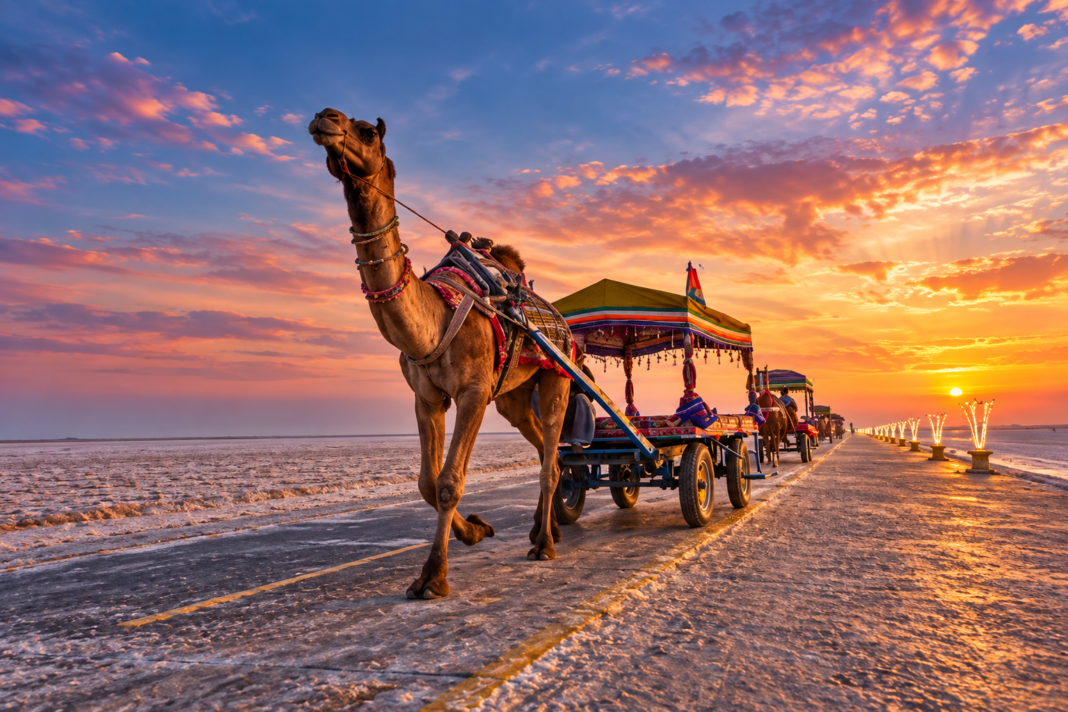
Quick answer: Rann Utsav 2027 refers to the 2026–27 season of Gujarat’s famous winter festival in the White Rann of Kutch. The Tent City at Dhordo is set to run from 1 November 2026 to 7 March 2027, as per its operator, Evoke Experiences, which runs it with Gujarat Tourism. Dhordo is about 85 km from Bhuj. To enter the White Rann, you need a permit, which you can get online or at the Bhirandiyara check post. The best time to see the salt desert is on full-moon nights. For this season, those fall around 24 November, 24 December, 22 January and 20 February. Top sights near by include Kala Dungar, Dholavira, the Road to Heaven and the craft villages of Kutch.
A Desert That Turns White
Picture a flat land that seems to go on forever. The ground is white, like fresh snow. But it isn’t snow. It’s salt. At night, the full moon rises, and the whole desert glows silver. There’s no sound but the wind.
This is the White Rann of Kutch. And every winter, it hosts one of India’s most loved festivals: the Rann Utsav.
For a few months, a small village called Dhordo turns into a city of tents. Folk singers play by the fire. Craftsmen show their work. Camels pull carts across the salt. And people come from across India and the world to see it all.
In this guide, we cover everything you need to plan your trip for the 2026–27 season. First, we explain what the Rann Utsav is and how it began. Next, we share dates, tent types, rough costs and the permit rules. Then, we look at how to reach, what to do and where to go nearby. Finally, we share tips on food, clothes, safety and how to travel in a way that helps local people.
A note on sources: We’ve used official sources, the Tent City operator’s announcements, and news reports. But dates, prices and rules can change. So, always check the latest details before you book. Also, beware of fake booking sites, which we explain below.

Rann Utsav 2027: Quick Facts
| Detail | Info |
|---|---|
| What | A winter festival of culture, crafts and the white salt desert |
| Where | Dhordo, near the White Rann, Kutch district, Gujarat |
| Tent City season | 1 November 2026 to 7 March 2027 (as announced by the operator) |
| Run by | Evoke Experiences, with Gujarat Tourism |
| Nearest city | Bhuj, about 85 km away |
| Nearest airport | Bhuj Airport |
| Nearest railway station | Bhuj |
| Permit | Needed to enter the White Rann |
| Best nights | Full-moon nights |
| Best months | December to February |
| Stay options | Tent City, village resorts, homestays, Bhuj hotels |
| Award | Dhordo named a Best Tourism Village by UNWTO in 2023 |
What Is the Rann Utsav?
The Rann Utsav is a winter festival held in the Kutch district of Gujarat. “Rann” means a salt marsh or desert, and “utsav” means festival. So, it’s simply the festival of the Rann.
At its heart is the White Rann, a huge flat salt desert near the village of Dhordo. In winter, the land dries out and turns white with salt. As a result, it looks like a frozen sea.
The festival brings this land to life with music, dance, crafts, food and fun. The main base is the Tent City, a resort of hundreds of tents put up just for the season. But the Rann Utsav is more than one place. It’s also a chance to see all of Kutch: its villages, forts, beaches, temples and ancient sites.
Is It Rann Utsav 2026 or 2027?
This can be a bit confusing. The festival runs across two years, from late in one year to early in the next. So, the season from November 2026 to March 2027 is called the 2026–27 season.
People search for it as “Rann Utsav 2026”, “Rann Utsav 2027” or “Rann Utsav 2026–27”. All of these mean the same season. In this guide, we use “Rann Utsav 2027” for the season that starts in November 2026.
Rann Utsav 2026–27 Dates
The Tent City operator, Evoke Experiences, has said the 2026–27 season will run from 1 November 2026 to 7 March 2027. Travel news sites, such as Outlook Traveller, have shared the same dates.
In some years, Gujarat Tourism has listed a shorter main festival period inside the Tent City season. For example, for 2025–26, its website listed the festival from 23 November 2025 to 20 February 2026, with the Tent City open till 4 March 2026. So, the main cultural events may be busiest in the middle months. Check Gujarat Tourism’s site for the official festival dates for this season.
| Season | Tent City dates |
|---|---|
| 2025–26 | Festival 23 Nov 2025 to 20 Feb 2026; Tent City till 4 Mar 2026 (Gujarat Tourism) |
| 2026–27 | 1 Nov 2026 to 7 Mar 2027 (as announced by the operator) |
What’s New for Rann Utsav 2026–27
Each season brings a few changes. Based on the operator’s announcements, here’s what stands out this time.
- An early start: The Tent City opens on 1 November 2026, so you can visit before the peak rush.
- A longer season: It runs till 7 March 2027, giving you more dates to choose from.
- Tents near Dholavira: In addition, 35 seasonal tents are planned near the UNESCO site.
- Siddi performances: Also, the operator has highlighted shows by the Siddi community.
- Stargazing: Similarly, night-sky sessions are listed as part of the experience.
- An early-bird sale: Finally, a “Rann Sale” offered discounts on bookings made in late July and early August 2026.
Of course, more details may come out closer to the season. So, check back before you book.
Full-Moon and Dark-Moon Dates for 2026–27
The full moon is the most magical time to see the White Rann. The salt glows under the moonlight, and the desert looks silver. So, many people plan their trip around these nights. Here are the rough dates, as shared by Outlook Traveller.
| Month | Full-moon period | Dark-moon night (best for stars) |
|---|---|---|
| November 2026 | 23 to 25 November | About 9 November |
| December 2026 | 22 to 24 December | About 8 December |
| January 2027 | 21 to 23 January | About 7 January |
| February 2027 | 19 to 21 February | About 6 February |
Tip: Full-moon nights are the most popular, so tents sell out early. On the other hand, dark-moon nights are perfect if you love stars. With no moonlight, the sky is full of them.
Month-by-Month Guide to the Season
Each month of the season feels a little different. So, here’s a simple guide to help you pick.
November
The season starts in early November. At first, parts of the Rann may still be damp after the monsoon. However, the crowds are thinner, and the weather is pleasant. Also, Diwali holidays can make some dates busy.
December
By December, the salt is usually white and dry. As a result, this is one of the most popular months. Christmas and New Year bring big crowds, so book well ahead. Nights also get cold.
January
January is the coldest month and often the most beautiful. The air is clear, and the salt is bright. Moreover, it’s a great time for birds. Still, it’s also busy, so plan early.
February
February brings warmer days and fewer crowds. Meanwhile, the Rann is still white and the nights are cool. For many people, it’s the best balance of weather, price and space.
Early March
The season ends on 7 March. By then, days are hot, but you may find good deals. However, some activities may wind down near the end.
| Month | Crowds | Weather | Our take |
|---|---|---|---|
| November | Low to medium | Pleasant | Good for early birds |
| December | High | Cool to cold | Classic, but book early |
| January | High | Cold nights | Most beautiful |
| February | Medium | Warm days, cool nights | Best balance |
| Early March | Low | Hot days | Good for deals |
What If the Rann Is Wet?
Sometimes, after a heavy monsoon or rare winter rain, parts of the Rann stay wet for longer. As a result, the salt may look patchy early in the season.
Don’t worry too much, though. The area near the main viewpoint is usually dry enough to walk on by the main months. Also, wet patches can make lovely reflections for photos. Still, if you want the classic white look, aim for December to February.
How the Rann Utsav Began
The story of the Rann Utsav is linked to hard times. In January 2001, a huge earthquake hit Kutch. It destroyed towns and villages and killed many people. Bhuj was one of the worst-hit places.
In the years after, Kutch slowly rebuilt. As part of this, the state looked for ways to bring jobs and hope back to the region. Tourism was one answer. So, travel histories say the Rann Utsav began in the mid-2000s as a short festival of just a few days.
Over time, it grew. More days were added. Then, the Tent City came up at Dhordo. Today, the season runs for about four months. It brings work to local artisans, cooks, drivers, guides and performers.
In 2023, the UN World Tourism Organization named Dhordo one of the Best Tourism Villages in the world. It praised the village for its rural growth, its care for culture and its work in green, fair tourism.
How Many People Visit?
The Rann Utsav draws huge crowds. According to figures shared in the Gujarat Assembly, as reported by the news, about 8.55 lakh tourists visited in 2024 and about 9.41 lakh in 2025. That’s nearly 18 lakh visitors in two years.
So, the festival is no longer a hidden gem. It’s one of the biggest tourist events in Gujarat. This means you should book early, especially for holidays and full-moon nights.

What Makes the Rann White?
The White Rann looks unreal. But there’s a simple science behind it.
Long ago, this area was part of the sea. Over time, the land rose, and the sea pulled back. However, the low, flat ground still floods every monsoon. Rain and sea water cover it, often to a shallow depth.
Then, after the rains, the hot sun dries the water. As the water goes, it leaves the salt behind. Layer by layer, a white crust forms on top. By winter, the land is hard, dry and white.
That’s why the White Rann is best seen from about November to February. In the monsoon, it’s under water. And in summer, it’s too hot to visit comfortably.
The Great Rann in Numbers
- Size: The Great Rann covers about 7,500 square km, as per the Utsav portal.
- Type: One of the largest salt deserts in the world.
- Monsoon depth: Floodwater can reach about 50 cm, as per Wikipedia.
- Summer heat: Days can cross 44°C.
- Winter nights: Can feel close to freezing.
- Birds: Over 200 kinds, including flamingos.
The Tent City at Dhordo
The Tent City is the heart of the Rann Utsav. It’s a seasonal resort built near Dhordo village, close to the White Rann. Each year, it’s set up before the season and taken down after it.
Inside, you’ll find rows of tents grouped into clusters. There are dining halls, a stage for shows, a craft market, and spaces for games and activities. Guests often get around on small carts or walk between areas.
The tents are far from basic. Many have beds, heaters or air-conditioning, attached bathrooms and simple decor. So, it feels more like a hotel than a camp. Still, the real charm is the setting: you’re steps away from the desert.
Tent City location: Open map

Who Runs the Tent City?
For the 2026–27 season, the Tent City is run by Evoke Experiences, in partnership with Gujarat Tourism, as per the operator’s announcements. In earlier seasons, travel histories name Lallooji and Sons as the operator.
Tent Types
Tent names and categories can change each year. In recent seasons, booking sites have listed these types, from simplest to most luxurious.
| Tent type | What to expect (rough guide) |
|---|---|
| Non-AC Swiss cottage | The basic option; comfortable, with an attached bathroom |
| AC Swiss cottage | Like the basic tent, with air-conditioning or heating |
| Premium tent | More space and better fittings |
| Super premium tent | Larger, with more comforts |
| Rajwadi suite | A royal-style suite with a sitting area |
| Darbari suite | The top tier, with the most space and extras |
What Packages Usually Include
Most Tent City stays are sold as packages, not just rooms. In past seasons, these have usually included:
- Your tent for the night or nights booked
- All meals: breakfast, lunch, evening tea and dinner
- Pick-up and drop from Bhuj, in many packages
- A visit to the White Rann at sunset or sunrise
- Cultural shows in the evening
- Some sightseeing, such as Kala Dungar
However, inclusions vary by package and season. So, read the details before you pay. Also, some activities, like ATV rides or paramotoring, often cost extra.
How Much Does the Tent City Cost?
Prices change every season and depend on the tent type, dates and number of nights. As a rough guide, booking listings for recent seasons have shown the most basic packages starting at around ₹6,000 to ₹7,000 per person per night, plus GST. Suites can cost many times more.
| Stay | Rough starting price (basic tent, per person) |
|---|---|
| 1 night / 2 days | Around ₹6,000 to ₹7,000, plus GST |
| 2 nights / 3 days | Around ₹12,000 to ₹14,000, plus GST |
| 3 nights / 4 days | Around ₹18,000 to ₹21,000, plus GST |
Note: These are rough figures from booking listings, not official rates. Peak dates, such as Diwali, Christmas, New Year and full moons, often cost more. In addition, the operator ran an early-bird “Rann Sale” in July–August 2026 with discounts. So, keep an eye out for offers.
How the Tent City Comes Together
The Tent City isn’t there all year. Instead, it’s built fresh for each season and taken down after it. According to travel accounts, this takes months of work.
First, teams level the ground and lay paths. Next, they set up tents, water lines, power, dining halls and stages. Then, staff are hired and trained, many of them from Kutch. Finally, the city opens its gates in early winter. After the season, it’s packed away until the next year.
So, when you stay there, you’re staying in a small town built just for a few months. That’s part of what makes it special.
Questions to Ask Before You Book a Package
Not all packages are the same. So, before you pay, ask these questions.
- Which tent or room type is included?
- Are all meals included, or only some?
- Is pick-up and drop from Bhuj part of the deal?
- Is the White Rann permit included?
- Which sightseeing trips are covered?
- Which activities cost extra?
- Is GST included in the price?
- What is the cancellation policy?
In short, the cheapest package isn’t always the best value. Therefore, compare what you actually get.
Beware of Fake Rann Utsav Booking Sites
This is very important. Because the Rann Utsav is so popular, many websites use names that look official. Some are real travel agents. But others may be fake and take money without giving you a booking.
So, how do you stay safe?
- Start at Gujarat Tourism. Go to the official Gujarat Tourism website, gujarattourism.com, and use the Rann Utsav links shared there.
- Check the web address. Look closely for small spelling changes or odd endings.
- Get a written confirmation. A real booking gives you a booking number and clear terms.
- Pay safely. Avoid paying to a personal bank account or a random UPI ID.
- Call to confirm. Use the phone numbers listed on official pages, not ones sent by strangers.
- Be wary of deals that look too good. Very low prices on peak dates are a red flag.
If something feels off, stop and check before you pay.
Other Places to Stay
The Tent City isn’t your only choice. In fact, many visitors stay elsewhere to save money or enjoy a more local feel.
Resorts and Camps Near Dhordo
Several private resorts and tent camps have come up near Dhordo and along the road to the White Rann. Some offer bhunga-style rooms, which are round mud huts typical of the area. Prices and quality vary a lot, so read recent reviews before you book.
Village Homestays
Villages near the Rann, such as Hodka and others in the Banni area, have homestays and village resorts. These let you see daily life up close. You can eat home-cooked food, watch artisans at work and sleep in a bhunga. Also, your money goes straight to local families.
Hodka: Open map
Hotels in Bhuj
Bhuj has many hotels for all budgets. If you stay here, you can make day trips to the White Rann. However, the drive is long, about 85 km each way. So, it works best if you want to see Bhuj too.
| Option | Best for | Keep in mind |
|---|---|---|
| Tent City | Full festival feel, comfort, shows | Costly; book early |
| Resorts near Dhordo | Close to the Rann; more choice | Quality varies |
| Village homestays | Local culture and food | Simpler comforts |
| Hotels in Bhuj | Budget and city sights | Long drive to the Rann |
White Rann Permit: Everything You Need to Know
The White Rann is close to the India–Pakistan border. So, visitors need a permit to enter the area. Here’s how it works.
Where to Get the Permit
- Online: The Gujarat Tourism website points to the official permit portal at rannpermit.gujarat.gov.in.
- Offline: At the check post in Bhirandiyara village, on the road from Bhuj to Dhordo.
Bhirandiyara: Open map
Permit Fees
Fees can change. However, travel guides have reported roughly these rates in recent seasons.
| Category | Reported fee |
|---|---|
| Adult (12 and above) | About ₹100 |
| Child (6 to 12) | About ₹50 |
| Child under 6 | Free |
| Two-wheeler | About ₹25 |
| Car | About ₹50 |
Documents You Need
Carry a valid photo ID, such as an Aadhaar card, driving licence, voter ID or passport. Some guides say a PAN card may not be accepted. Foreign visitors should carry their passport.
Permit Tips
- Apply online before you travel to skip queues.
- Print your permit, since mobile signal can be weak.
- Check the date on your permit matches your visit.
- Tent City guests should ask whether the package covers the permit.
- In peak season, offline queues can take an hour or more, as per travel guides.
Important: Without a valid permit, you may be turned back at the check post. So, sort it out early.
How to Reach Rann Utsav
Bhuj is the main gateway to the Rann Utsav. From Bhuj, Dhordo is about 85 km by road. Here’s how to get to Bhuj first, and then on to the Rann.
By Air
Bhuj Airport is the closest. Visitors report a few daily flights, mainly from Mumbai, with some from Delhi and other cities. Flights fill up in peak season, so book early.
Bhuj Airport: Open map
Another option is to fly to Ahmedabad, which has many more flights. Then, take a train, bus or car to Bhuj. Kandla Airport near Gandhidham is a third choice.
By Train
Bhuj railway station has trains from Ahmedabad, Mumbai, Delhi and other cities. From Ahmedabad, there are several trains a day. In 2024, a fast Namo Bharat Rapid Rail service also began between Bhuj and Ahmedabad.
Bhuj railway station: Open map
By Road
Kutch is well linked by road. From Ahmedabad, the drive to Bhuj is about 330 to 340 km and takes around 6 to 7 hours. Then, it’s another 85 km or so to Dhordo. State buses and private buses also run to Bhuj from many cities.
From Bhuj to Dhordo
From Bhuj, take a cab or drive yourself. The road passes through the Banni grasslands and the Bhirandiyara check post. The drive usually takes about 1.5 to 2 hours. But it can take longer with permit queues. Also, many Tent City packages include transfers from Bhuj.
| From | To Dhordo (approx.) | Time (approx.) |
|---|---|---|
| Bhuj | About 85 km | 1.5 to 2 hours |
| Gandhidham | About 140 km | 2.5 to 3 hours |
| Ahmedabad | About 400 to 420 km | 8 to 9 hours |
| Vadodara | About 500 km | 9 to 10 hours |
| Rajkot | About 320 km | 6 to 7 hours |
| Mumbai | About 900 km | Best by air or train to Bhuj |
Note: These are rough figures. Times depend on your route, stops and traffic.
Rann Utsav From Ahmedabad: A Simple Plan
For readers in Ahmedabad, here’s an easy way to plan a 3-night trip.
| Day | Plan |
|---|---|
| Day 1 | Train or drive to Bhuj; see Prag Mahal, Aina Mahal and the local market |
| Day 2 | Visit Smritivan in the morning; drive to Dhordo; sunset at the White Rann |
| Day 3 | Sunrise on the Rann; Kala Dungar and India Bridge; craft villages; moonlit Rann |
| Day 4 | Optional Road to Heaven or Dholavira; or return to Ahmedabad |
If you have more time, add Mandvi, Lakhpat or Dholavira as extra days.
A Long Weekend From Ahmedabad
Short on leave? You can still see the White Rann over a long weekend. Here’s a simple plan for Amdavadis.
- Friday night: First, take an overnight train or bus from Ahmedabad to Bhuj.
- Saturday: Then, have breakfast in Bhuj and drive to Dhordo. After lunch, rest, and head out for the sunset on the Rann.
- Sunday: Next, catch the sunrise. Later, visit Kala Dungar and a craft village. In the evening, enjoy the Rann again, ideally on a full-moon weekend.
- Monday: Finally, drive back to Bhuj and take a day train to Ahmedabad.
It’s a tight plan. Still, it gives you two sunsets and the full desert feel without too much time off work.
Getting Around Kutch
Kutch is big, and public transport to remote spots is limited. So, plan how you’ll get around.
- Hired cab: The easiest option. Many drivers in Bhuj know all the main sights.
- Self-drive: Good if you like freedom. However, roads can be long and empty, so plan fuel stops.
- Package transfers: Most Tent City packages include pick-up and drop from Bhuj.
- State buses: Cheap and good for main towns, but slow for remote places.
In general, a hired cab for the full trip gives the best mix of comfort and ease.
Things to Do at Rann Utsav
There’s plenty to do, whether you love nature, culture, food or adventure. Here are the highlights.
1. Watch the Sunset on the White Rann
As the sun goes down, the white salt turns pink, orange and gold. It’s one of the most famous sights in Gujarat. So, reach the viewing area early to find a good spot.
White Rann, Dhordo: Open map
2. See the Rann Under the Full Moon
On full-moon nights, the salt reflects the moonlight, and the whole desert glows. Many people say this is the best moment of their trip. Also, it gets cold at night, so carry a warm jacket.
3. Catch the Sunrise
Sunrise is quieter than sunset. The air is crisp, and the light is soft. If you’re staying close by, it’s well worth the early start.
4. Take a Camel Cart Ride
Camel carts are a classic way to explore the Rann. They’re slow, fun and great for kids and older visitors. Agree on the price before you start.

5. Try Adventure Activities
In recent seasons, the Tent City and nearby operators have offered ATV rides, paramotoring, cycling and more. Some seasons have also offered hot-air balloon rides. These usually cost extra, and they depend on the weather.
6. Enjoy Folk Music and Dance
Evenings at the Tent City often feature folk music and dance from Kutch and Gujarat. For 2026–27, the operator has also mentioned shows by the Siddi community, known for their lively dance and drum music.
7. Shop at the Craft Market
The Tent City has a haat, or market, where artisans sell their work. For 2026–27, the operator mentioned Ajrakh prints, Bandhani saris, embroidery, mirror work, jewellery and Lippan art. Buying here supports local craftspeople directly.
8. Go Stargazing
Far from city lights, the desert sky is dark and clear. On nights with little or no moon, you can see countless stars. The operator lists stargazing as part of the experience this season.
9. Try Wellness Activities
Morning yoga and wellness sessions are often offered at the Tent City. Doing yoga as the sun rises over the desert can be a calm start to the day.
10. Explore Kutch on Day Trips
Many packages include trips to places like Kala Dungar. But you can also plan your own visits to forts, temples, beaches and craft villages. We list the best ones below.

Bhunga: The Round Houses of Kutch
As you travel through the Banni area, you’ll see small round huts with cone-shaped roofs. These are bhungas, the traditional homes of the region.
Bhungas are made of mud, with thatched roofs. Inside, they’re often decorated with Lippan art, which uses mud and small mirrors. As a result, they look beautiful in the lamplight.
But they’re also smart. Their round shape is said to help them stand up to strong winds and earthquakes. In fact, many people say lots of bhungas survived the 2001 earthquake. Also, the thick mud walls keep the inside cool in summer and warm in winter.
Today, many resorts and homestays offer bhunga-style rooms. So, staying in one is a great way to experience local life.
Life in the Banni Grasslands
On your way from Bhuj to Dhordo, you’ll pass through Banni. This is a large grassland on the edge of the Rann. For generations, herding communities, known as Maldharis, have lived here with their buffalo, cows and other animals.
Banni is famous for its hardy buffalo breed, which can walk long distances to graze. Also, the herders’ villages are home to many skilled craftspeople, especially women who do fine embroidery.
So, as you drive through, look out for herds on the move, colourful clothes and small clusters of bhungas. Then, if you have time, stop at a village to see crafts being made.
The Music of Kutch
Music is a big part of the Rann Utsav. In the evenings, folk artists play songs that have been passed down for generations. So, it helps to know what you’re hearing.
For example, you may hear the jodiya pava, a pair of wooden flutes played at the same time. Also, look out for the surando, a stringed instrument, and the morchang, a small metal mouth harp with a twangy sound. Meanwhile, drums and handclaps keep the rhythm going.
Many songs tell stories of love, saints, cattle, the desert and daily life. Even if you don’t understand the words, the feeling comes through. Therefore, sit close, listen and enjoy.
The Siddi Community
The Siddis are a community in Gujarat with African roots. Their ancestors came to India centuries ago. Today, they’re Indian, and they speak local languages. However, they’ve kept parts of their African heritage alive, especially in music and dance.
Their Dhamal dance is full of energy, with drums, shells and fast moves. As a result, Siddi performances are often a highlight of festivals in Gujarat. This season, the Tent City operator has said Siddi shows will be part of the cultural programme.
The Crafts of Kutch
Kutch is one of the richest craft regions in India. In many villages, whole families have kept their craft alive for generations. Here are the main crafts you’ll see.
| Craft | What it is | Where to see it |
|---|---|---|
| Ajrakh | Block-printed cloth in deep reds and blues, made with natural dyes | Ajrakhpur, Dhamadka |
| Bandhani | Tie-and-dye cloth with tiny dots | Bhuj, Mandvi, Anjar |
| Rogan art | Painting on cloth with thick, oil-based paint | Nirona |
| Kutchi embroidery | Bright stitch work, often with small mirrors | Banni villages, Hodka |
| Lippan art | Mud and mirror work on walls | Bhunga homes across Banni |
| Weaving | Handloom shawls, stoles and rugs | Bhujodi |
| Copper bells | Hand-made bells in many sizes | Nirona, Zura |
| Leather work | Hand-stitched bags, shoes and goods | Banni villages |
Tip: Buy directly from artisans when you can. Ask how a piece is made. Most artisans love to explain their craft, and you’ll value your buy even more.

Craft Villages to Visit
- Bhujodi: Known for weaving, just outside Bhuj. Open map
- Nirona: Famous for Rogan art and copper bells. Open map
- Ajrakhpur: A hub of Ajrakh block printing. Open map
- Hodka: A Banni village with embroidery and homestays.
A Short History of Kutch
To enjoy Kutch fully, it helps to know a little of its past. So, here’s a quick look.
First, over 4,000 years ago, Harappan people built the city of Dholavira on an island in the Rann. They were skilled planners and managed water with great care. Later, after the Harappan age, the land saw many rulers and traders.
Then, for centuries, Kutch was ruled by the Jadeja Rajput kings. During their rule, Bhuj grew as the capital. Meanwhile, ports like Mandvi and Lakhpat traded with Arabia, Africa and beyond. As a result, Kutch became a place where many cultures met.
After India’s independence, Kutch joined the Indian Union. Later, it became part of Gujarat. Then, in 2001, a major earthquake struck. It caused huge damage. However, the people rebuilt their towns with great courage. Today, Kutch is known for its crafts, its ports, its industry and, of course, the Rann Utsav.
Shopping Guide: What to Buy in Kutch
Kutch is a shopper’s dream, especially for crafts. However, it helps to know what to look for.
| Item | Good gift for | Buying tip |
|---|---|---|
| Ajrakh stole or dupatta | Anyone who loves textiles | Ask if natural dyes were used |
| Bandhani sari or dupatta | Weddings and festivals | Finer dots usually mean more work |
| Rogan art piece | Art lovers | Buy from the artist’s family in Nirona |
| Embroidered cushion covers | Home decor | Check the back for neat stitching |
| Copper bells | Doors and gardens | Ring them to hear the tone |
| Lippan art panel | Wall decor | Pack well, as mirrors can crack |
| Kutchi shawl | Cold nights back home | Feel the weave and weight |
How to Spot Real Handmade Crafts
Machine-made copies are common. So, here are a few simple checks.
- First, look for small flaws. Handmade work is rarely perfect, and that’s part of its charm.
- Next, ask who made it and where. Real sellers usually know.
- Then, check prices. Very cheap “handmade” goods are often machine-made.
- Also, look for craft groups and artisan stalls, which often sell direct.
In the end, buying from artisans directly is the best way to get the real thing and to help them earn fairly.
Places to Visit Near Rann Utsav
Kutch is large, and there’s much more to see than the White Rann. Here are the best places to add to your trip.
1. Kala Dungar (Black Hill)
Kala Dungar is the highest point in Kutch. From the top, you get a wide view over the Great Rann. On a clear day, the white desert stretches to the horizon. There’s also an old Dattatreya temple at the top. Local tradition says the priests feed jackals here after the evening prayer.
On the way, many visitors stop at a “magnetic” spot, where cars seem to roll uphill. It’s an optical illusion, but it’s fun to try. Sunset at Kala Dungar is very popular, so go early.
Kala Dungar: Open map
2. India Bridge
India Bridge is one of the last points civilians can reach near the border in this area. It’s a short stop, often paired with Kala Dungar. You may need your permit, and photos are not allowed in some areas. So, follow the rules of the security staff.
India Bridge: Open map
3. Dholavira
Dholavira is one of the largest cities of the Harappan, or Indus Valley, age. It’s over 4,000 years old. In 2021, UNESCO named it a World Heritage Site. Here, you can see the remains of a planned city, with water tanks, gates and wide streets. There’s also a small museum.
Dholavira is on Khadir Bet, an island in the Rann. It’s a long drive from Dhordo, so plan a full day or stay a night nearby. For 2026–27, the Tent City operator has said it will add 35 seasonal tents near Dholavira.
Dholavira: Open map

4. The Road to Heaven
The road from Khavda to Dholavira cuts straight across the Rann. Visitors call it the “Road to Heaven”, because it seems to float between the white salt and the sky. It’s about 30 km long. Sunrise and sunset are the best times to drive it.
Keep in mind that there are few shops or mechanics along the way. So, fill up on fuel, carry water and drive carefully.
Road to Heaven: Open map

5. Bhuj City
Bhuj is the main town of Kutch and a great base. Here are the top sights:
- Aina Mahal: An 18th-century palace known for its mirror hall. Open map
- Prag Mahal: A 19th-century palace with a tall clock tower and a grand hall. Open map
- Bhuj market: Great for crafts, snacks and local life.
- Hamirsar Lake: A calm lake in the heart of town.
6. Smritivan Earthquake Memorial and Museum
Smritivan, on Bhujiyo hill in Bhuj, honours those who died in the 2001 earthquake. Its museum explains how earthquakes work and how Kutch rebuilt. Visitors say it takes two to three hours, and that it’s closed on Mondays. It’s moving and well worth a visit.
Smritivan: Open map

7. Mandvi Beach and Vijay Vilas Palace
Mandvi is a seaside town about 60 km from Bhuj. Its beach is good for a relaxed evening, with camel rides and snacks. Nearby, Vijay Vilas Palace is a grand summer palace built in the 1920s for the royal family of Kutch. Mandvi is also known for its old wooden shipbuilding.
Mandvi Beach: Open map · Vijay Vilas Palace: Open map
8. Lakhpat Fort
Lakhpat was once a busy port town. Today, its massive fort walls guard a quiet, half-empty town at the edge of India. It’s a haunting place, with wide views over the Kori Creek area. There’s also a gurudwara linked to Guru Nanak. Carry water, since shops are few.
Lakhpat Fort: Open map

9. Narayan Sarovar and Koteshwar
Narayan Sarovar is a sacred lake and one of the holy places of Hinduism. Nearby, the Koteshwar temple sits by the sea. Both are far to the west of Kutch, so combine them with Lakhpat.
Narayan Sarovar: Open map
10. Birding in Kutch
Kutch is great for birds in winter. You may see flamingos, cranes, pelicans and many birds of prey. Wetlands such as Chhari Dhand, near the Banni grasslands, are popular with birders. Hire a local guide for the best sightings.
Distances From Dhordo
| Place | Rough distance from Dhordo | Best for |
|---|---|---|
| White Rann viewpoint | A few km | Sunset, sunrise, full moon |
| Kala Dungar | About 45 to 55 km | Views and sunset |
| India Bridge | About 50 to 60 km | Border area visit |
| Hodka and Banni villages | About 20 to 30 km | Crafts and homestays |
| Bhuj | About 85 km | Palaces, museums, market |
| Dholavira | About 150 to 200 km by road | UNESCO site |
| Mandvi | About 140 km | Beach and palace |
| Lakhpat | About 140 to 150 km | Fort and history |
Note: Distances are rough and depend on your route.
Flamingos of Kutch
Kutch is one of the most important places in India for flamingos. In fact, a part of the Great Rann is known as Flamingo City, because large numbers of flamingos are known to breed there in good years.
However, this area is remote and protected, and access is limited. So, most visitors see flamingos at more reachable wetlands instead. For instance, Chhari Dhand near the Banni grasslands is a well-known spot in winter. Also, you may see flamingos in shallow water along the road to Dholavira.
Remember to keep your distance. Birds get scared easily, and loud noises or drones can disturb them.
Best Sunset Spots in Kutch
Kutch has some of the best sunsets in Gujarat. Here are our top picks, in no special order.
- The White Rann at Dhordo: The classic. Pink and gold light on white salt.
- Kala Dungar: A wide view over the Rann from the highest point in Kutch.
- The Road to Heaven: A straight road with water and salt on both sides.
- Mandvi Beach: The sun sinks into the Arabian Sea.
- Lakhpat Fort: Old walls glowing in the last light.
Of course, you can’t catch them all in one trip. So, pick two or three and enjoy them slowly.
A Note on the Border Area
The White Rann lies close to the India–Pakistan border. As a result, the Border Security Force (BSF) and police keep watch over the area. This is normal, and it keeps visitors safe.
However, it means a few extra rules apply. For example, you need a permit, and some areas are off limits. Also, photos may not be allowed near certain posts. So, always follow signs and staff instructions. If you’re unsure, ask first.
Useful Kutchi and Gujarati Words
Locals speak Kutchi and Gujarati, and many also speak Hindi. Still, a few local words can bring a big smile. Here are some easy ones.
| Word | Meaning |
|---|---|
| Ram Ram | A common greeting |
| Kem cho? | How are you? (Gujarati) |
| Saru | Good (Gujarati) |
| Aabhar | Thank you (Gujarati) |
| Rann | Salt desert or marsh |
| Bhunga | Round mud hut |
| Haat | Market |
| Chhaas | Buttermilk |
Locals will be happy you tried, even if your accent isn’t perfect.
Food at Rann Utsav
Kutchi food is simple, filling and full of flavour. At the Tent City, meals are usually buffets with Kutchi, Gujarati and other Indian dishes. Here are some local foods to try.
| Dish | What it is |
|---|---|
| Kutchi dabeli | A spicy, sweet potato burger in a soft bun; born in Kutch |
| Bajra rotla | Thick millet flatbread, often with ghee and jaggery |
| Kadhi khichdi | Rice and lentils with a light yogurt curry |
| Ringan no olo | Smoky roasted brinjal mash |
| Kutchi pakwan | A crisp, flaky snack |
| Gulab pak | A rich sweet made with milk and rose |
| Chhaas | Spiced buttermilk, served with most meals |
Tip: Try dabeli in Mandvi or Bhuj, where it’s said to have begun. Also, if you visit a village, ask for a home-cooked meal. It’s often the best food of the trip.
Weather and What to Wear
Winter days in Kutch are sunny and warm, but nights can be very cold, especially in the open desert. So, pack for both.
| Month | Days | Nights |
|---|---|---|
| November | Warm | Mild to cool |
| December | Pleasant | Cold |
| January | Pleasant | Coldest; can feel near freezing |
| February | Warm | Cool |
| March | Hot | Mild |
What to Pack
- Warm jacket, cap and gloves for the night
- Light cotton clothes for the day
- Sunglasses, as the white salt is very bright
- Sunscreen and lip balm
- Comfortable walking shoes
- Your photo ID and printed permit
- Power bank and a torch
- Cash, since signal and UPI can be patchy
- Any medicines you need
- A reusable water bottle
Mobile Signal and Connectivity
Mobile signal near the White Rann can be weak or patchy, as many visitors report. So, plan ahead.
- Download offline maps before you leave Bhuj.
- Print your bookings and permit.
- Carry some cash, since UPI may not always work.
- Tell family your plans in case you can’t call.
On the bright side, a little time off the phone can make the desert feel even more peaceful.
Safety Tips for the White Rann
The White Rann is safe for visitors who follow the rules. Still, it’s a remote border area. So, keep these tips in mind.
- Stay on marked paths: Don’t drive or walk far into the salt. Some parts can be soft or wet.
- Follow security staff: The area is near the border. Obey all instructions.
- Protect your eyes: The glare from salt can be strong. Wear sunglasses.
- Stay warm at night: Cold winds can catch you off guard.
- Don’t drive at night if you’re new to the roads: Roads can be dark and empty.
- Keep fuel and water: Fuel stations and shops are far apart.
- Watch kids: The desert is huge, and it’s easy to wander off.
Health Tips for the Desert
The desert climate can be tough on the body. So, take a few simple steps.
- Drink water often: The dry air makes you lose water fast, even in winter.
- Use moisturiser: Your skin and lips can dry out quickly.
- Protect your eyes: Wear sunglasses in the day.
- Layer up at night: Cold winds can bring on a chill.
- Eat light on long drives: It helps avoid motion sickness.
- Carry basic medicines: Such as for colds, stomach upsets and headaches.
Also, note that big hospitals are mainly in Bhuj. So, if you have a health condition, plan with care.
A Night on the White Rann: What It Might Feel Like
This is an imagined scene, based on how many visitors describe it.
It’s a cold December evening. You’ve just reached Dhordo after the drive from Bhuj. The sky is turning orange. You walk out to the edge of the Rann with a cup of hot tea.
Then, the ground changes. The brown earth gives way to white. It crunches under your feet like thin ice. All around you, families laugh and pose for photos. A camel cart rolls past, bells ringing.
The sun sinks. The white salt turns pink, then purple, then grey. People go quiet. A few minutes later, the full moon rises from the other side. Slowly, the desert begins to glow.
Back at the camp, a folk singer starts a song by the fire. The smell of bajra rotla and ghee drifts from the dining hall. You pull your shawl tighter and think: this is why people come here.
Sample Itineraries
2 Nights: The Quick Trip
| Day | Plan |
|---|---|
| Day 1 | Reach Bhuj; drive to Dhordo; sunset on the White Rann; folk show |
| Day 2 | Sunrise on the Rann; Kala Dungar and India Bridge; craft shopping; moonlit Rann |
| Day 3 | Visit a craft village on the way back; leave from Bhuj |
3 Nights: The Classic Trip
| Day | Plan |
|---|---|
| Day 1 | Bhuj sights: Prag Mahal, Aina Mahal, market |
| Day 2 | Smritivan; drive to Dhordo; White Rann sunset |
| Day 3 | Sunrise; Kala Dungar; Hodka or other Banni villages; full-moon Rann |
| Day 4 | Nirona and Bhujodi crafts; return via Bhuj |
5 Nights: The Full Kutch Trip
| Day | Plan |
|---|---|
| Day 1 | Bhuj palaces and market |
| Day 2 | Smritivan; Mandvi beach and Vijay Vilas Palace |
| Day 3 | Drive to Dhordo; White Rann sunset and night |
| Day 4 | Kala Dungar; India Bridge; craft villages |
| Day 5 | Road to Heaven and Dholavira; stay near Dholavira |
| Day 6 | Return via Bhachau to Ahmedabad |
Rann Utsav on a Budget
The Tent City isn’t cheap. But you can still enjoy the Rann Utsav on a tighter budget. Here’s how.
- Travel by train: Trains from Ahmedabad to Bhuj are much cheaper than flights.
- Stay in Bhuj or a homestay: Both cost less than the Tent City.
- Share a cab: Split the Bhuj–Dhordo ride with other travellers.
- Avoid peak dates: Skip Diwali, Christmas, New Year and full moons if cost matters.
- Book early: Early offers can save money.
- Eat local: Small dhabas and village kitchens are cheap and tasty.
Rough Budget for Two People (3 Nights)
| Item | Budget trip | Comfort trip |
|---|---|---|
| Travel from Ahmedabad | Train | Flight or private car |
| Stay | Bhuj hotel or homestay | Tent City or resort |
| Local transport | Shared cab | Private cab |
| Food | Local eateries | Package meals |
| Activities | Sunset, camel cart, villages | Plus ATV, paramotoring, guided tours |
Costs vary widely. So, compare a few options before you book.
A Typical Day at the Tent City
Every package is a little different. Still, based on visitor accounts, a day at the Tent City often looks like this.
| Time | What usually happens |
|---|---|
| Early morning | Sunrise trip to the White Rann, or yoga |
| Breakfast | Buffet at the dining hall |
| Late morning | Free time, activities or a craft village visit |
| Lunch | Kutchi and Gujarati buffet |
| Afternoon | Rest, or a trip to Kala Dungar |
| Evening | Sunset on the White Rann, then tea |
| Night | Folk shows, dinner and, on full-moon nights, a walk on the Rann |
So, there’s a nice mix of planned outings and free time. Also, you can skip anything you don’t feel like doing.
Rann Utsav for Different Travellers
For Families
Kids love the camel carts, the open desert and the evening shows. Also, the Tent City has easy food and comfort. However, nights are cold, so pack warm layers for children. Keep a close eye on young ones on the open Rann.
For Couples
A full-moon night on the White Rann is one of the most romantic sights in India. Add a stay in a suite or a quiet village resort, and you have a perfect getaway. Book early for full-moon dates.
For Photographers
The Rann is a dream for photos. Shoot at sunrise and sunset for colour. Then, try long shots of the moonlit salt or star trails on dark nights. Bring a tripod and spare batteries, as cold drains them fast.
For Solo Travellers
Kutch is generally friendly for solo travellers. Homestays and shared cabs are good ways to meet people. Still, avoid driving alone at night on remote roads, and tell someone your plans.
For Older Visitors
The Tent City has comfortable tents and carts to get around. The White Rann viewpoint involves some walking on flat ground. Pick a basic itinerary with rest breaks, and carry any medicines you need.

How to Photograph the White Rann
The White Rann can be tricky to photograph. The salt is bright, and the land is flat. Still, with a few tips, you can get great shots.
- First, shoot at golden hour. Sunrise and sunset add warm colours to the white salt.
- Next, watch your exposure. Bright salt can fool your camera. So, lower the exposure a little to keep details.
- Then, find patterns. Look down. The salt crust often forms hexagon-like shapes.
- Also, add people. A person, a camel or a cart gives a sense of scale.
- After that, try the moon. On full-moon nights, use a tripod and a slow shutter.
- Finally, try stars. On dark nights, point your camera up for star shots.
Tip: Clean your lens often, as salt dust can settle on it. Also, keep spare batteries warm in your pocket, since cold drains them fast.
Rann Utsav With Kids: Fun Ideas
Kids often love Kutch even more than adults. So, here are a few ideas to make it fun for them.
- Salt hunt: Let them touch the salt crust and look for crystal patterns.
- Camel cart race: Well, not a real race, but kids love the bumpy ride.
- Star spotting: On dark nights, use a free star app to find planets.
- Craft corner: Watch an artisan at work, or try a simple block print.
- Folk show: Let them clap along with the drums at the evening show.
- Dinosaur link: Also, tell them Kutch is known for very old fossils, which makes the land feel even more ancient.
Also, pack snacks, warm clothes and a small torch for each child. Then, keep the days short, so no one gets tired and cranky.
Rann Utsav as a Honeymoon Trip
Many couples now pick Kutch for a honeymoon or anniversary. And it’s easy to see why. The White Rann under a full moon feels like another world. Also, it’s quieter and more unusual than the usual beach trips.
Here are a few ideas to make it special. First, book a suite or a private bhunga for more space and privacy. Next, time your trip with a full moon. Then, add a day at Mandvi for the beach and the palace. Finally, take home a handmade Ajrakh stole or a Rogan art piece as a keepsake.
For more ideas, see our guide to the best honeymoon places in India.
Travelling With Limited Mobility
The White Rann is flat, which helps. However, there are long walks from parking areas and soft patches in places. So, a little planning goes a long way.
- Ask your stay about carts or vehicles to the viewpoint.
- Pick a tent or room close to the dining hall.
- Carry a light folding chair or stool for sunset.
- Visit on weekdays, when crowds are smaller.
- Check access at places like Kala Dungar, where there are steps.
In general, staff at larger stays are used to helping guests. So, don’t hesitate to ask.
Travel Responsibly in Kutch
The White Rann is fragile, and the people of Kutch have a rich culture. So, please travel with care.
- Don’t litter: Carry your waste back. Plastic doesn’t break down in the salt.
- Stay on set routes: Off-road driving can harm the salt crust.
- Buy from artisans: Your money supports families and keeps crafts alive.
- Ask before photos: Always ask people before you photograph them.
- Dress modestly in villages: It shows respect for local customs.
- Respect wildlife: Keep your distance from birds and animals.
- Save water: Water is precious in this dry land.
Local Etiquette in Kutch
The people of Kutch are known for their warm welcome. So, return the kindness with a few simple manners.
- Greet people with a smile and a “Ram Ram” or “Namaste”.
- Ask before you enter a home or take photos.
- Remove your shoes when you enter homes and temples.
- Accept tea if it’s offered. It’s a sign of friendship.
- Bargain gently and with respect, not too hard.
- Dress modestly in villages and holy places.
Common Mistakes to Avoid
- Booking from a fake website
- Forgetting the permit or your photo ID
- Packing only light clothes and freezing at night
- Planning too many places in too few days
- Leaving Tent City bookings too late for full-moon dates
- Driving long distances on dark roads at night
- Skipping Bhuj and the craft villages
Myths and Facts About Rann Utsav
| Myth | Fact |
|---|---|
| The White Rann is snow. | No. It’s a crust of dried salt. |
| You can visit the White Rann all year. | It’s best from November to February. In the monsoon, it floods. |
| You must stay at the Tent City. | No. You can stay in Bhuj, a resort or a homestay. |
| No permit is needed. | A permit is needed to enter the White Rann area. |
| Rann Utsav is only in December. | The Tent City runs from November to early March. |
| Rann Utsav is only about the desert. | It also showcases crafts, music, food and the whole of Kutch. |
Great Rann vs Little Rann
Kutch has two Ranns, and people often mix them up.
| Feature | Great Rann | Little Rann |
|---|---|---|
| Location | North Kutch, near Dhordo | South-east Kutch, near Dasada and Zainabad |
| Known for | White salt desert and Rann Utsav | Indian wild ass and salt farming |
| Best activity | Sunset, full moon, culture | Wildlife safaris and birding |
| From Ahmedabad | About 400 km | About 100 to 130 km |
So, if you’re short on time and live in Ahmedabad, the Little Rann makes a good weekend trip. But for the white desert and the festival, head to the Great Rann.
Combine Rann Utsav With Other Gujarat Trips
If you’re coming from far away, you may want to see more of Gujarat. Here are a few good add-ons.
| Add-on | Why go | Good for |
|---|---|---|
| Ahmedabad | Heritage city, food and the riverfront | 1 to 2 days |
| Little Rann of Kutch | Wild ass safaris and birds | 1 to 2 days |
| Dwarka | Sacred temple town by the sea | 1 to 2 days |
| Somnath | Famous Jyotirlinga temple | 1 day |
| Gir | Home of the Asiatic lion | 1 to 2 days |
| Statue of Unity | World’s tallest statue | 1 day |
Of course, Gujarat is a big state. So, pick two or three places rather than trying to see everything.
Why Rann Utsav Matters for Kutch
The Rann Utsav is more than a holiday. It has changed life for many people in Kutch.
- Jobs: Cooks, drivers, guides, staff and performers find work each season.
- Crafts: Artisans reach buyers from across India and abroad.
- Village life: Homestays bring income straight to families.
- Pride: Global awards, like Dhordo’s UNWTO honour, put Kutch on the world map.
- Revival: It helped Kutch recover after the 2001 earthquake.
Rann Utsav by the Numbers
- 1 Nov 2026 to 7 Mar 2027: Tent City season, as announced by the operator.
- About 85 km: Distance from Bhuj to Dhordo.
- About 9.41 lakh: Tourists in 2025, as per figures reported from the Gujarat Assembly.
- 2023: Year Dhordo was named a Best Tourism Village by UNWTO.
- 2021: Year Dholavira became a UNESCO World Heritage Site.
- 35: New seasonal tents planned near Dholavira for 2026–27.
- 4: Full-moon periods during the season.
Is Rann Utsav Worth It?
For most people, yes. The White Rann is unlike anywhere else in India. Add the culture, crafts and food, and it’s a trip you’ll talk about for years.
However, it isn’t perfect for everyone. The Tent City can be costly, peak dates get crowded, and the drive is long. Also, if you expect a sandy desert like Jaisalmer, the flat salt may surprise you.
So, set the right expectations. Go for the calm, the space, the moonlight and the people. Then, you’ll likely come home happy.
For Businesses: Why Rann Utsav Season Matters
If you run a travel, food, craft or hotel business in Gujarat, the Rann Utsav season is a big chance. Lakhs of people travel through Ahmedabad, Bhuj and Kutch in these months. Many look online for tours, stays, cabs, food and gifts.
So, plan your offers early. Share clear prices. Collect honest reviews. And make sure people can find you before they leave home.
For example, a cab firm in Bhuj can offer fixed-price Rann trips. Similarly, a homestay in Banni can share photos, meals and simple house rules online. Meanwhile, an Ahmedabad travel agent can bundle train tickets, permits and stays into one easy package. In each case, being clear and honest builds trust. And trust brings repeat guests and good word of mouth.
Also, think beyond the season. Many travellers plan months ahead. So, start sharing your offers by early autumn, when people first search for Rann Utsav dates.
Quick Revision Notes
- What: A winter festival of the White Rann and Kutch culture.
- Where: Dhordo, Kutch, about 85 km from Bhuj.
- When: Tent City from 1 November 2026 to 7 March 2027.
- Operator: Evoke Experiences, with Gujarat Tourism.
- Permit: Needed; online or at Bhirandiyara.
- Best nights: Full moons around 24 Nov, 24 Dec, 22 Jan and 20 Feb.
- Stay: Tent City, resorts, homestays or Bhuj hotels.
- Nearby: Kala Dungar, Dholavira, Road to Heaven, Bhuj, Mandvi, Lakhpat.
- Watch out: Fake booking sites and cold nights.
Your Rann Utsav Checklist
- Pick your dates, and check the full-moon calendar
- Book your stay from a trusted source
- Book trains or flights to Bhuj
- Apply for the White Rann permit
- Print your permit and booking
- Pack warm clothes and sunglasses
- Carry photo ID and some cash
- Plan day trips beyond the White Rann
- Keep space in your bag for crafts
- Leave the desert as clean as you found it
How We Researched This Guide
For this guide, we began with official sources. These include Gujarat Tourism, the Government of India’s Utsav portal and the official permit portal. Then, we added details from the Tent City operator’s announcements and travel news reports. Where facts come from news or booking listings, we say so. Prices and dates change often, so we’ll update this page as new details come out.
More Guides From Amdavad Gully
- Famous cities in Gujarat
- Best honeymoon places in India
- Dwarkadhish Temple timings
- Vibrant Gujarat 2027
Frequently Asked Questions
When is Rann Utsav 2027?
The 2026–27 Rann Utsav Tent City season is set to run from 1 November 2026 to 7 March 2027, as announced by the operator. Check Gujarat Tourism for the official festival dates.
Where is Rann Utsav held?
Rann Utsav is held at Dhordo village, next to the White Rann in the Kutch district of Gujarat. Dhordo is about 85 km from Bhuj.
What is the best time to visit Rann Utsav?
The best time is from December to February, when the salt is white and the weather is cool. Full-moon nights are the most magical time to see the White Rann.
What are the full-moon dates for Rann Utsav 2026–27?
The full-moon periods fall around 23 to 25 November 2026, 22 to 24 December 2026, 21 to 23 January 2027 and 19 to 21 February 2027.
How much does the Rann Utsav Tent City cost?
Prices change each season. As a rough guide, booking listings have shown basic packages starting at around ₹6,000 to ₹7,000 per person per night, plus GST, with suites costing much more.
Do I need a permit for the White Rann?
Yes. You need a permit to enter the White Rann area. You can get it online through the official permit portal or at the Bhirandiyara check post on the way from Bhuj.
How much is the White Rann permit fee?
Travel guides have reported about ₹100 per adult, ₹50 per child aged 6 to 12, about ₹25 for a two-wheeler and about ₹50 for a car. Fees can change.
How do I reach Rann Utsav from Ahmedabad?
Take a train, bus, flight or car from Ahmedabad to Bhuj, which is about 330 to 340 km by road. From Bhuj, drive or take a cab about 85 km to Dhordo.
Which is the nearest airport to Rann Utsav?
Bhuj Airport is the nearest, about 85 km from Dhordo. Ahmedabad Airport has more flights but is much farther away.
How many days are enough for Rann Utsav?
Two to three nights are enough for the White Rann and nearby sights. Plan five or more nights to explore Bhuj, Mandvi, Lakhpat and Dholavira too.
Can I visit the White Rann without staying at the Tent City?
Yes. You can stay in Bhuj, at a resort near Dhordo or in a village homestay. You’ll still need a permit to enter the White Rann.
What should I wear at Rann Utsav?
Wear light clothes in the day and warm layers at night, since desert nights can be very cold. Carry sunglasses, as the white salt is bright.
What are the places to visit near Rann Utsav?
Top places include Kala Dungar, India Bridge, Dholavira, the Road to Heaven, Bhuj’s palaces and Smritivan, the craft villages of Nirona, Bhujodi and Ajrakhpur, Mandvi and Lakhpat Fort.
Why is the Rann of Kutch white?
The Rann floods in the monsoon. Then, as the water dries in the sun, it leaves behind a crust of salt, which makes the land look white in winter.
How can I avoid fake Rann Utsav booking sites?
Start from Gujarat Tourism’s official website, check web addresses carefully, get a written booking confirmation and avoid paying to personal accounts or unknown UPI IDs.
The Bottom Line
Rann Utsav 2027 is your chance to see one of the most unusual places on Earth. A white salt desert, a glowing full moon, folk music by the fire and some of India’s finest crafts all come together in Kutch each winter.
So, pick your dates, book from a trusted source and sort out your permit early. Then, pack warm clothes and leave time to explore beyond the desert. Finally, travel with care, buy from local artisans and take home memories that last a lifetime.
Run a travel, tour, stay or craft business connected with Rann Utsav? Get featured on Amdavad Gully and reach thousands of travellers planning their Kutch trip from Ahmedabad. Write to us at amdavadgully@gmail.com.
References
- Gujarat Tourism – Rann Utsav
- Government of Gujarat – White Rann permit portal
- Utsav (Government of India) – Rann Utsav
- Outlook Traveller – Rann Utsav 2026–27 guide
- All India Radio – PM lauds Rann Utsav
- UNESCO – Dholavira: A Harappan City
- Wikipedia – Rann of Kutch
- Wikipedia – Dhordo
- Unsplash License
Dates, tent types, prices, permit fees and rules can change, and some details come from booking listings and news reports, not official sources. Please check with Gujarat Tourism and the official permit portal before you travel. All images are from Unsplash and free to use under the Unsplash License.