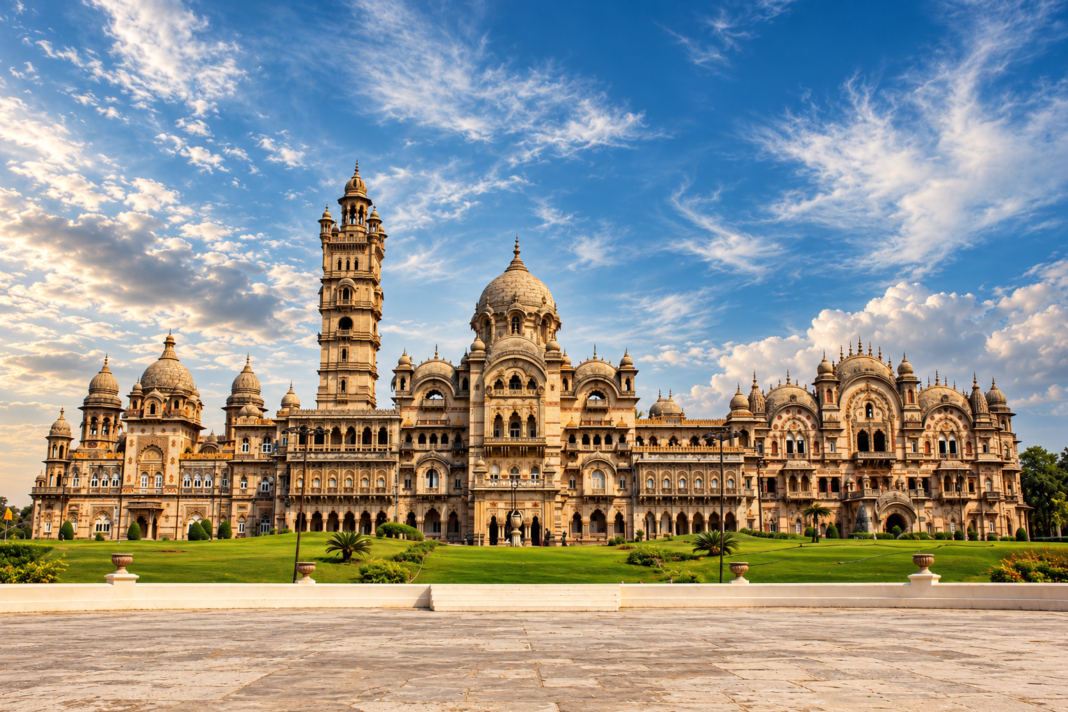
Quick answer: Laxmi Vilas Palace is the royal home of the Gaekwad family in Vadodara (Baroda), Gujarat. Maharaja Sayajirao Gaekwad III built it, and it was done by about 1890. It’s often said to be about four times the size of Buckingham Palace, on an estate of over 500 acres. It’s open from Tuesday to Sunday, about 9:30 am to 5 pm, and closed on Mondays, as per its Google listing. Tickets come with an audio guide. Visitors say they paid about ₹225 to ₹250 for Indian adults, with higher rates for those from abroad. The Maharaja Fatehsinh Museum next door needs its own ticket. It holds many original works by Raja Ravi Varma. Photos are not allowed inside the palace.
A Palace Bigger Than Buckingham
Imagine a home so big that it took twelve years to build. It has 170 rooms, a hall lit by stained glass, marble statues from Italy and a private golf course. Even today, a royal family lives in it.
That’s Laxmi Vilas Palace in Vadodara. When it was finished in 1890, it was one of the largest private homes in the world. And more than 130 years later, it’s still one of the grandest buildings in India.
For people in Gujarat, it’s a symbol of Vadodara’s royal past and its love of art and learning. For travellers, it’s one of the must-see sights of western India.
In this guide, we cover everything you need to know. First, we share the timings, tickets and visitor rules. Next, we tell the story of the Gaekwads and Maharaja Sayajirao III, who built it. Then, we walk you through the palace, the museum and the grounds. Finally, we share how to reach, what to see nearby and how to plan a perfect day in Vadodara.
A note on sources: We’ve used public listings, reference works and trusted news reports. But ticket prices and rules can change, and different sites show different rates. So, please check at the ticket counter or with the palace before you go.

Laxmi Vilas Palace: Quick Facts
| Detail | Info |
|---|---|
| Location | J N Marg, Moti Baug, Vadodara, Gujarat |
| Built by | Maharaja Sayajirao Gaekwad III |
| Work began | Around 1878–1880 |
| Finished | Around 1890 |
| Architects | Major Charles Mant, then Robert Fellowes Chisholm |
| Style | Indo-Saracenic |
| Cost | About £180,000 at the time, as widely reported |
| Size | Often said to be about four times Buckingham Palace |
| Rooms | About 170 |
| Estate | Over 500 acres |
| Owners | The Gaekwad royal family of Baroda |
| Open | Tuesday to Sunday, about 9:30 am to 5 pm |
| Closed | Mondays (and some public holidays) |
| Inside the estate | Maharaja Fatehsinh Museum, golf course, Navlakhi stepwell, gardens |
Laxmi Vilas Palace in Plain Words
Let’s keep it simple. Laxmi Vilas Palace is a very big, very old royal home in Vadodara. A king built it more than 130 years ago. His family still lives there.
You can go inside part of it. Along the way, a small audio player tells you the story as you walk. Inside, you see big halls, old guns, fine glass and paintings. Then, you can walk to a museum next door to see more art.
That’s it. It’s a home, a museum and a piece of history, all in one place. And it’s one of the best days out you can have in Gujarat.
What Is Laxmi Vilas Palace?
Laxmi Vilas Palace is a royal palace in the heart of Vadodara. It’s the home of the Gaekwads, the family that once ruled the princely state of Baroda. The name is also spelt “Lakshmi Vilas” or “Lukshmi Vilas”. All three mean the same palace.
The palace was built in the late 1800s for Maharaja Sayajirao Gaekwad III, one of India’s most forward-looking kings. It mixes Indian and European styles in a way few buildings do. As a result, it’s now one of the best-known examples of Indo-Saracenic design in the country.
Today, the royal family still lives in parts of it. Meanwhile, other parts are open to the public as a museum, with an audio guide. The large estate also has a museum of art, a golf course, gardens, an old stepwell and event spaces.
What Does the Name Mean?
“Laxmi” is the name of the Hindu goddess of wealth and good fortune. “Vilas” means a place of joy or a grand home. So, the name is usually read as “the home of Lakshmi” or “the abode of good fortune”.
That fits well. After all, Baroda was one of the richest states in India, and the palace was its crown jewel.
Laxmi Vilas Palace Timings
According to the palace’s Google listing, it’s open on these days and times.
| Day | Timings |
|---|---|
| Monday | Closed |
| Tuesday | 9:30 am to 5:00 pm |
| Wednesday | 9:30 am to 5:00 pm |
| Thursday | 9:30 am to 5:00 pm |
| Friday | 9:30 am to 5:00 pm |
| Saturday | 9:30 am to 5:00 pm |
| Sunday | 9:30 am to 5:00 pm |
Some travel guides say last entry is around 4:30 pm. Also, the palace may close on some public holidays or for royal family events. So, it’s wise to call ahead, especially if you’re travelling from far.
Maharaja Fatehsinh Museum Timings
The museum is on the same estate, a short walk from the palace. As per its Google listing, it’s open from Tuesday to Sunday, 9:30 am to 5:30 pm, and closed on Mondays.
Laxmi Vilas Palace Ticket Price
This is where it gets tricky. Different websites show different prices, and they change from time to time. So, here’s a fair summary based on recent visitor reports and travel guides.
| Ticket | Rough price (as reported) |
|---|---|
| Palace, Indian adult | About ₹225 to ₹250, with audio guide |
| Palace, foreign visitor | About ₹400 or more |
| Palace, child | Lower rate; check at the counter |
| Fatehsinh Museum, Indian adult | About ₹150, as listed by some guides |
| Combo (palace + museum) | Offered, as per visitor reviews |
Note: These are not official rates. Please confirm at the ticket counter or with the palace before you go.
Can You Book Tickets Online?
Visitors say you can buy tickets at the counter, and some also mention buying online. If you book online, use only the palace’s own channels. As always, be careful of lookalike websites.
A Simple Guide for First-Time Visitors
Going for the first time? Here’s how it usually works, step by step.
- First, reach the main gate. Tell the guard you’re here for the palace tour.
- Next, go to the ticket counter. Buy your palace ticket, and ask about a museum combo.
- Then, collect your audio guide. Keep your photo ID ready for the deposit.
- After that, follow the route. Press the number shown in each room to hear its story.
- Also, keep your camera away inside. Photos aren’t allowed in the palace, as per visitors.
- Finally, return the audio guide. Collect your ID, and head to the museum or the lawns.
It’s an easy, well-run visit. So, just relax and enjoy the story.
Questions to Ask at the Ticket Counter
- What is today’s ticket price for adults and children?
- Is there a combo ticket with the museum?
- Which languages does the audio guide come in?
- Is any part of the palace closed today?
- Where can I take photos?
- Where are the toilets and drinking water?
Staff are usually happy to help. So, don’t be shy to ask.
Short on Time? A One-Hour Plan
If you have just an hour, you can still see the best of the palace. Here’s how.
- First, 5 minutes: Buy your ticket and pick up the audio guide.
- Next, 15 minutes: Walk the first halls and courtyards.
- Then, 15 minutes: Spend time in the Darbar Hall. It’s the highlight.
- After that, 10 minutes: Visit the armoury.
- Finally, 15 minutes: Step out for photos on the lawns.
Of course, you’ll miss some stories. But you’ll still see the heart of the palace.
The Audio Guide
Your palace ticket usually comes with an audio guide. Visitors say it’s available in English, Hindi and Gujarati. It tells the story of the Gaekwads and explains each room as you walk through.
Most people love it. In fact, many reviews say the audio guide is the best part of the visit, since it brings the history to life. You may be asked to leave a photo ID as a deposit while you use the device. So, carry one.
Photography Rules
Photography is not allowed inside the palace, as per visitor reports and travel guides. However, you can usually take photos of the outside and the grounds.
- Inside the palace: No photos, as per visitor reports.
- Outside and gardens: Usually allowed.
- Museum: Rules may differ; ask at the entrance.
- Professional shoots: Need special permission from the palace.
So, take your time on the lawns for photos, and then enjoy the inside with your eyes and ears.
How Long Does a Visit Take?
Plan for about 1.5 to 2 hours for the palace tour with the audio guide. Then, add about 1 hour for the Fatehsinh Museum. So, a full visit to both takes around 2.5 to 3 hours.
If you love art or history, you may want even longer. On the other hand, if you’re short on time, the palace alone is a must.
Best Time to Visit
The best months are October to March, when Vadodara is cool and pleasant. Summers can be very hot, with days above 40°C. So, if you visit in April or May, go early in the morning.
- Best months: October to March.
- Best time of day: Morning, right after opening.
- Quietest days: Tuesday to Friday.
- Busiest days: Weekends and holidays.
- Special time: Navratri, when the palace grounds host a famous heritage garba.
Visiting in the Rainy Season
The monsoon in Vadodara runs from about June to September. During this time, the gardens turn lush and green. As a result, the palace looks lovely against a cloudy sky.
However, heavy rain can make the walk from parking a bit messy. Also, the city sometimes sees flooding in very heavy rain. So, check the weather, carry an umbrella and wear shoes that can handle puddles.
A Short Story of Baroda
Vadodara is an old city. Its name is said to come from “vad”, the banyan tree, which once grew in large numbers along the river. Over time, the British called it Baroda.
For centuries, many rulers held the area. Then, in the 1700s, the Gaekwads made it their capital. Under them, it grew into a rich and busy city.
Later, under Sayajirao III, it changed a lot. He built new roads, parks, schools, museums and offices. As a result, Baroda became one of the most modern cities in India at the time.
In 1974, the city’s name was officially changed to Vadodara. Still, many people, including locals, use both names. So, you’ll hear “Baroda” and “Vadodara” side by side.
The Gaekwads of Baroda
To understand the palace, you first need to know the family behind it. The Gaekwads were a Maratha family. In the 1700s, they rose to power in Gujarat and made Baroda their capital.
Over time, Baroda became one of the richest princely states in India. Under British rule, it kept its own rulers, who were given a high rank among Indian princes. As a result, the Gaekwads had both wealth and status.
After India became independent in 1947, Baroda joined the Indian Union. Later, it became part of Bombay State and then Gujarat. Still, the Gaekwad family stayed on in Vadodara, and they live in Laxmi Vilas Palace to this day.
Maharaja Sayajirao Gaekwad III: The Man Who Built It
The palace was built by Maharaja Sayajirao Gaekwad III. His story is remarkable.
He was born in 1863 as Gopalrao, the son of a farming family in a village in Maharashtra. He wasn’t born to be king. However, after the previous ruler was removed, the royal family looked for a suitable heir. In the end, Maharani Jamnabai adopted the young Gopalrao, and he became Sayajirao III. He took the throne in 1875 and ruled for over 60 years, until his death in 1939.
He was a man of new ideas. For example, as per Wikipedia, he made primary school free and a must for all children in Baroda in 1906, long before most of India. He also worked against child marriage and untouchability. In addition, he set up libraries and founded the Bank of Baroda in 1908.
He also spotted and supported great talent. Most famously, he helped fund the studies of Dr B. R. Ambedkar, who later led the drafting of India’s Constitution. He also gave work to Sri Aurobindo and backed many artists and scholars.
Sayajirao III at a Glance
| Detail | Info (as per Wikipedia) |
|---|---|
| Born | 11 March 1863, as Gopalrao |
| Reign | 1875 to 1939 |
| Died | 6 February 1939 |
| Free primary education | Introduced in 1906 |
| Bank of Baroda | Founded in 1908 |
| Music school (Gayan Shala) | Founded in 1886 |
| Wives | Chimnabai I, then Chimnabai II |
The Boy Who Became a King
Every palace has a story. This one starts with a boy from a small village.
His name was Gopalrao. Born in 1863 in a farm family in Maharashtra, he didn’t grow up in a palace. Instead, he grew up in a village, like millions of other boys.
Then, one day, his life changed. The ruler of Baroda had been removed, and the royal family needed a new heir. So, they looked for boys from their wider clan. In the end, they chose Gopalrao. The boy was adopted, given a new name, Sayajirao, and taught how to rule.
Quick to learn, he read a lot, asked questions and cared about his people. Soon, he became one of the best rulers of his time. He built schools for all children. On top of that, he built roads, banks, parks and libraries. And finally, he built a palace to match his dreams: Laxmi Vilas.
So, when you walk through the palace, remember the village boy who made it all happen.
The History of Laxmi Vilas Palace
When Sayajirao III came of age, he wanted a new palace that matched Baroda’s status. So, in the late 1870s, work began on a grand new royal home.
The project was huge. According to The National, it took about 12 years and cost around £180,000. At the time, that was a vast sum. Then, by about 1890, the palace was ready.
When it was finished, it was one of the largest private homes ever built. As a result, it’s often described as about four times the size of Buckingham Palace in London. It had about 170 rooms, grand halls, courtyards and gardens.
It was also very modern for its time. For instance, historical accounts say it had lifts, an internal telephone system and its own electricity supply. In fact, The National reports that its wooden lifts were the first in Gujarat.
Timeline of Laxmi Vilas Palace
| Year | Event |
|---|---|
| 1863 | Sayajirao III born as Gopalrao |
| 1875 | Sayajirao III becomes Maharaja of Baroda |
| Late 1870s | Work on the palace begins under Major Charles Mant |
| 1880s | Robert Chisholm takes over after Mant’s death |
| Around 1890 | Palace completed |
| 1930s | Golf course laid out on the grounds |
| 1939 | Sayajirao III dies |
| 1947 | India becomes independent; Baroda later joins the Union |
| 1990s | Golf course renovated and opened to the public |
| Today | Royal home, museum and event venue |
Ten Fun Facts About Laxmi Vilas Palace
- It’s often said to be about four times the size of Buckingham Palace.
- It took about 12 years to build.
- It cost around £180,000 at the time.
- Its first architect died before it was done.
- It had lifts long before most homes in India.
- Its estate is over 500 acres.
- It once had its own small zoo.
- A tiny train once ran through its mango groves.
- It has a golf course on its grounds.
- A royal family still lives there today.
How Big Is “Four Times Buckingham”?
“Four times the size of Buckingham Palace” is a big claim. But what does it mean in real life?
Well, think of it this way. The palace has about 170 rooms. If you spent just ten minutes in each, it would take you over a day without sleep to see them all. Also, the estate is over 500 acres. That’s bigger than many small towns’ central areas.
Of course, size claims depend on how you measure. Some count floor space, while others count the whole estate. Still, by any measure, it’s a huge home.
Who Designed the Palace?
Two British architects worked on Laxmi Vilas Palace.
Major Charles Mant
The first designer was Major Charles Mant, a British army engineer. He had worked on other Indian palaces, such as in Kolhapur and Darbhanga. He drew up the early plans and started the work.
However, Mant died before the palace was finished. A popular legend says he feared his design had flaws and that it would fall down. But this is only a story. In fact, the palace still stands strong today.
Robert Fellowes Chisholm
After Mant, Robert Fellowes Chisholm took over. He was a leading architect in India and an early master of the Indo-Saracenic style. As per Wikipedia, he worked on the palace from 1880 to 1890. He also designed other buildings in Baroda, such as the Baroda Museum and Picture Gallery.
| Architect | Role | Known for |
|---|---|---|
| Major Charles Mant | Original designer | Palaces in Kolhapur and Darbhanga |
| Robert Fellowes Chisholm | Finished the palace | Indo-Saracenic buildings in Madras, Bombay and Baroda |

Why Mix Indian and European Styles?
You may wonder why an Indian king built a palace that looks part Mughal, part Rajput and part European. There are a few simple reasons.
First, it was the fashion of the time. In the late 1800s, many Indian rulers and British officials liked this mixed style. Second, it showed that the king was proud of Indian roots. Third, it also showed he was modern and open to the world. Finally, European methods gave the builders new tools, like iron beams, lifts and electric light.
So, the style tells a story. It says: “We are Indian, we are proud, and we are ready for the future.” In many ways, that was Sayajirao III’s whole outlook.
What Is Indo-Saracenic Architecture?
Indo-Saracenic is a style that became popular in British India in the late 1800s. In simple words, it mixes Indian and Islamic designs with European building methods.
So, in one building, you may see Mughal domes, Rajput balconies, Hindu temple shapes and Gothic arches. Meanwhile, the inside may have European furniture, lifts and electric lights.
Laxmi Vilas Palace is one of the finest examples of this style. As a result, architecture students from across India study it.
Spot the Styles
| Feature | Where it comes from |
|---|---|
| Onion domes | Mughal and Islamic design |
| Chhatris (small domed pavilions) | Rajput design |
| Jharokhas (carved balconies) | Rajasthani and Gujarati design |
| Cusped arches | Islamic design |
| Temple-like towers | Hindu design |
| Clock tower and stained glass | European design |
Materials From Around the World
The Maharaja spared no cost. So, materials came from across India and Europe. According to The National and local history sources, these included:
- Golden sandstone, said to come from Songadh and Rajasthan.
- Carrara marble from Italy.
- Venetian and Murano glass work.
- Belgian stained glass for the windows.
- Mosaic floors in the Darbar Hall.
As a result, the stone glows a warm gold at sunrise and sunset. So, if you can, see the outside in the soft light of early morning or late afternoon.

Inside Laxmi Vilas Palace: What You’ll See
Only part of the palace is open to visitors, since the royal family lives in the rest. According to The National, about a quarter of the palace can be seen. Still, there’s plenty to admire. Here are the highlights.
1. The Darbar Hall
The Darbar Hall is the star of the palace. This was the royal court, where the Maharaja met officials and guests and held grand events. Historical accounts describe it as a hall of about 5,000 square feet.
Look up, and you’ll see a richly decorated ceiling. Look down, and you’ll see a fine mosaic floor. Meanwhile, Belgian stained-glass windows fill the hall with coloured light, and chandeliers hang from above.
Today, the hall is still used for concerts and special events. So, you may hear about music shows held here.
2. Courtyards and Fountains
The palace is built around open courtyards. These let in light and breeze, which keeps the inside cool even in summer. In fact, many visitors say it feels much cooler inside than out.
Some courtyards have fountains and marble statues. The sound of water and the soft light make them some of the most peaceful spots in the palace.

3. Felici’s Sculptures
An Italian sculptor named Augusto Felici (often spelt Fellici) lived and worked in Baroda for years. He made many statues for the Gaekwads, in marble and bronze. As a result, you’ll see his work in the palace, the museum and even in Sayaji Baug, the city’s big public garden.
4. Royal Rooms
Several rooms show how the royals lived. According to The National, they include the Veena room, inspired by the Ajanta caves, and the Gulabi or pink room, with soft murals of angels. In addition, you’ll see fine furniture, portraits and decorations.
5. The Armoury
One of the most popular sections is the royal armoury. Here, you’ll see swords, shields, guns and other weapons used by the Gaekwads and their armies. Visitors often call it a highlight, especially kids.
6. Paintings and Murals
The palace walls carry many paintings and murals. Some show royal life, while others show stories from Indian myths. Also, some portraits are by Raja Ravi Varma, though most of his works are in the Fatehsinh Museum next door.

How the Palace Stays Cool
Vadodara gets very hot in summer. Yet many visitors say the palace feels cool inside. How?
First, the walls are thick. They take a long time to heat up. Next, the ceilings are high, so hot air rises away from people. Then, open courtyards let breeze flow through the rooms. Also, fountains and water add a little cool to the air. Finally, wide verandahs shade the walls from the sun.
So, long before air conditioners, the builders knew how to beat the heat. That’s smart design.
The Gardens and Grounds
The palace sits on a huge estate of over 500 acres. So, the grounds are almost as famous as the building.
The Gardens
The gardens were planned by William Goldring, a landscape expert from Kew Gardens in London, according to local history sources. They include wide lawns, tall trees and formal gardens. In addition, peacocks often roam the grounds.
The Golf Course
In the 1930s, Maharaja Pratapsinh laid out a golf course on the estate for European guests, as per Wikipedia. Later, in the 1990s, his grandson Samarjitsinh Gaekwad renovated it and opened it to the public. Today, it’s one of the more unusual golf courses in India, with a palace as its backdrop.
The Navlakhi Stepwell
Inside the estate is the Navlakhi Vav, an old stepwell. Stepwells are deep wells with steps leading down to the water. In dry Gujarat, they were vital sources of water. As per local accounts, this one was an important water source for the palace in the past.
However, visitors say access to the stepwell is often restricted, since it’s on private land. So, don’t count on seeing it unless it’s open on your visit.
Navlakhi Stepwell: Open map
The Little Railway
Long ago, a miniature railway ran through the estate to carry the royal children around the mango groves, according to local history sources. Today, a small locomotive is on display at the Fatehsinh Museum, which visitors love to see.
The Old Zoo
Like many royal estates, the palace once had its own small zoo. Local accounts say it even had crocodiles. Now, only traces of this remain.
Moti Baug
The palace area is known as Moti Baug. It also has the Moti Baug cricket ground, a well-known ground in Vadodara’s cricket history. In addition, there’s the LVP Banquets and Conventions venue, used for weddings and big events.

Maharaja Fatehsinh Museum
The Maharaja Fatehsinh Museum stands on the same estate, a short walk from the palace. As per Wikipedia, the building was first built as a school for the Maharaja’s children. Later, it was turned into a museum to show the royal art collection.
Maharaja Fatehsinh Museum: Open map
What You’ll See
- Raja Ravi Varma paintings: Wikipedia says the museum shows more than 30 original works by this famous Indian painter. They include royal portraits and scenes from Hindu myths.
- European art: Copies of famous European paintings, along with original works by other artists.
- Sculptures: Marble and bronze pieces, including works by Felici.
- Asian art: Chinese and Japanese objects collected on the Maharaja’s travels.
- A small locomotive: A reminder of the old royal railway.
Who Was Raja Ravi Varma?
Raja Ravi Varma was one of India’s greatest painters. He was born in 1848 in Kerala. He became famous for blending Indian subjects with European painting methods. His paintings of goddesses and heroines from Indian epics became hugely popular.
Sayajirao III invited him to Baroda, where he painted portraits of the royal family and many mythological scenes. As a result, Vadodara has one of the finest collections of his work.
Also, his paintings were later turned into cheap prints. These prints spread across India and shaped how millions of people imagined their gods. So, seeing his originals here is a special experience.
Museum Tips
- Buy a combo ticket if available, to save time.
- Give yourself at least an hour.
- Ask about photography rules at the entrance.
- Start with the Ravi Varma gallery if you’re short on time.
Life in the Palace Long Ago
This is an imagined scene, based on what we know of royal life at the time.
It’s an evening in the early 1900s. The lamps are lit, and the palace hums with life. Guards stand at the gates. In the kitchens, cooks prepare a grand dinner for guests.
In the Darbar Hall, musicians tune their instruments. Officials in fine clothes wait to meet the Maharaja. Meanwhile, in the gardens, the royal children ride the little train past the mango trees.
Later, guests gather for dinner. They talk of trade, of art and of the new schools opening across the state. Then, as the night grows late, the palace goes quiet, and the stars come out over Baroda.
The Royal Family Today
Laxmi Vilas Palace is still a family home. Today, the head of the Gaekwad family is Samarjitsinh Gaekwad. He’s a former first-class cricketer who played in the Ranji Trophy, as per Wikipedia. His wife, Radhikaraje Gaekwad, is known for her work to support craft and heritage.
The family lives in private parts of the palace. Meanwhile, they run the public tours, the museum, the golf course and the event venues. In this way, the palace pays for its own upkeep, which is a big job for a building of this size and age.
Of course, Indian royal titles have no legal standing today. Still, the family plays an important role in Vadodara’s cultural life.
Navratri Garba at Laxmi Vilas Palace
Vadodara is famous for its Navratri, and the palace is part of that story. According to The National, the palace grounds host an annual heritage garba during Navratri.
Picture it: a lit-up palace in the background, live folk music and hundreds of people dancing in circles on the lawns. For many, it’s one of the most special garba settings in Gujarat. Entry is usually by pass, and details change each year. So, if you want to attend, look for announcements a few weeks before Navratri.
For more on the dance itself, see our guide to Dandiya Raas.
Tips for the Navratri Garba at the Palace
If you plan to join the garba on the palace grounds, a few tips can help.
- Get passes early: They can sell out fast.
- Dress the part: Wear chaniya choli or kediyu for the full feel.
- Wear comfy footwear: You’ll dance for hours on grass.
- Reach early: Entry queues can be long.
- Carry little: Keep a small bag and your phone safe.
- Plan your ride home: Late-night traffic can be heavy.
Also, rules and timings change each year. So, follow the organiser’s latest updates.
The Golf Course: What to Know
The golf course on the palace estate is one of the most scenic in India. Picture green fairways, old trees, peacocks and a palace in the background.
It was first laid out in the 1930s, as per Wikipedia. Later, in the 1990s, it was renovated and opened to the public. So, if you play golf, it’s a unique place to tee off.
However, rules for guests, fees and timings are set by the club. So, contact them in advance if you’d like to play.
Shopping in Vadodara
After your palace visit, you may want to shop. Vadodara has something for everyone.
- Old city markets: Great for clothes, spices, steel ware and daily goods.
- Khanderao Market area: A busy hub near a fine old building.
- Snack shops: Pick up bhakharwadi and lilo chevdo to take home.
- Navratri wear: Before the festival, shops fill with chaniya cholis and jewellery.
- Malls: Modern malls for brands and food courts.
So, keep a little space in your bag. You’ll likely want to take some Vadodara home with you.
Laxmi Vilas Palace for Photographers
Even though you can’t shoot inside, the palace is a great subject. Here are a few more ideas.
First, try a wide shot from the far end of the lawn to show the full size. Next, use the clock tower as a strong vertical line. Then, wait for clouds, which add drama to the sky. Also, look for peacocks on the lawns, which make lovely foregrounds. Finally, come back at golden hour, when the stone glows warm.
Remember, a professional shoot needs permission. So, keep it to personal photos unless you’ve cleared it with the palace.
Weddings and Events at the Palace
The palace estate is also a popular venue for weddings, parties and corporate events. For instance, the LVP Banquets and Conventions venue in Moti Baug hosts big functions. In addition, the Darbar Hall is used for concerts and special programmes.
So, if you’re dreaming of a royal wedding in Gujarat, this is one of the top names on the list. Of course, prices and rules depend on the event, so contact the venue directly.
Pre-Wedding Shoots and Photography Permission
Many couples dream of a pre-wedding shoot at a palace. Laxmi Vilas Palace is a top choice. However, professional shoots usually need permission and may cost extra.
So, if you plan one, contact the palace well in advance. Ask about dates, areas allowed, fees and rules. Also, never try a professional shoot without permission. It’s a private home, after all.
Laxmi Vilas Palace in Films
With its grand halls and golden stone, it’s no surprise that filmmakers love the palace. As per Wikipedia, it has been used as a shooting location for films such as Grand Masti (2013) and Indian 2 (2024). Many other films, ads and music videos have also been shot in and around Vadodara’s royal buildings.
How to Reach Laxmi Vilas Palace
The palace is in the centre of Vadodara, so it’s easy to reach.
By Train
Vadodara Junction is one of the busiest stations in western India. It’s on the main Mumbai–Delhi line, with trains from across the country. From the station, the palace is only a few kilometres away by auto or cab.
Vadodara Junction: Open map
By Air
Vadodara Airport has flights to Delhi, Mumbai and other cities. From the airport, the palace is about 7 to 10 km by road.
Vadodara Airport: Open map
By Road
Vadodara has good road links. From Ahmedabad, take the expressway. The drive is about 110 km and takes around 1.5 to 2 hours. Buses also run often between the two cities.
Within Vadodara
Autos and app cabs are the easiest way to get around. Simply ask for “Laxmi Vilas Palace, Moti Baug”.
Laxmi Vilas Palace: Open map
| From | Approx. distance | Approx. time |
|---|---|---|
| Vadodara Junction | About 3 to 4 km | 10 to 15 minutes |
| Vadodara Airport | About 7 to 10 km | 20 to 30 minutes |
| Ahmedabad | About 110 km | 1.5 to 2 hours |
| Anand | About 40 km | About 1 hour |
| Surat | About 150 km | 2.5 to 3 hours |
| Statue of Unity (Ekta Nagar) | About 90 km | About 2 hours |
Note: Times are rough and depend on traffic.
What to Wear and Carry
- Comfortable shoes, as you’ll walk a lot
- Light cotton clothes in warm months
- Light layer for winter mornings
- A cap and sunglasses for the grounds
- Water bottle
- A photo ID
- Some cash, in case UPI is slow
- A charged phone for photos outside
Parking and Entry
The palace estate is large, and there’s space for vehicles inside the grounds, as per visitors. However, parking rules may change during big events. Also, expect a short walk from the parking area to the palace entrance. So, wear comfortable shoes.
Accessibility
The palace is an old building, so access can be mixed. The ground floor and grounds are mostly easy to reach. However, some areas may have steps. So, if you or someone in your group uses a wheelchair, call the palace in advance to ask about the best route.
Laxmi Vilas Palace for Different Visitors
For Families
Kids enjoy the armoury and the stories. Also, the lawns give them room to play. Plan a short visit and a snack break.
For Couples
The palace and its gardens are lovely for a slow, romantic walk. Then, end the day at Sursagar Lake in the evening.
For History Buffs
Take your time with the audio guide. Then, add the museum, Kirti Mandir and the Baroda Museum for a full picture.
For Foreign Visitors
The audio guide in English makes it easy to follow. Also, the palace is a good way to see how Indian and European styles came together in the 1800s.
For Older Visitors
Go early, take breaks and ask staff about the easiest route. Also, carry water and any medicines you need.
Visiting With Kids
Kids usually enjoy the palace, especially the armoury and the stories in the audio guide. Also, the wide lawns are great for a run after the tour.
- Go in the morning, when kids are fresh.
- Tell them a royal story before you go, so they know what to look for.
- Let them hold the audio guide and press the numbers.
- Visit the little locomotive at the museum.
- Carry water and a snack for after the tour.
Laxmi Vilas Palace Explained to Kids
- Laxmi Vilas Palace is a huge, very old home where a king’s family lives.
- It was built more than 130 years ago by a king called Sayajirao.
- Inside, there are big halls, old swords and pretty glass windows.
- Next door, there’s a museum full of famous paintings.
- We can visit part of it, but we can’t take photos inside.
Questions Kids Often Ask
Does a real king live here? Well, a royal family lives here. But India has no kings now. So, they’re a family with a royal past, not rulers.
Why is it so big? Because the king was very rich, and he wanted a home fit for a great state. Also, big homes helped show power in those days.
Can we see their bedroom? No. The family’s own rooms are private. But you can see the grand public halls.
Are the swords real? Yes. The armoury has real old weapons. But don’t worry, they’re behind glass.
Is there a train? There used to be a little train for the royal children. Now, you can see a small engine at the museum.
Best Photo Spots Outside the Palace
Since you can’t take photos inside, make the most of the outside. Here are a few ideas.
- The front lawn: First, step back to fit the whole palace in your frame.
- The clock tower: Next, shoot it from a low angle against a blue sky.
- Golden hour: Then, wait for the late-afternoon light that turns the stone gold.
- Arches and domes: Also, zoom in on the details.
- Statues and fountains: Finally, use them as foreground for a layered shot.

Places to Visit Near Laxmi Vilas Palace
Vadodara has many sights close to the palace. So, it’s easy to make a full day of it.
1. Sayaji Baug (Kamati Baug)
This huge public garden was built by Sayajirao III in 1879. It has a zoo, a toy train, a planetarium and lots of green space. It’s a favourite with families.
Sayaji Baug: Open map
2. Baroda Museum and Picture Gallery
Inside Sayaji Baug, this museum is known for its Egyptian mummy, a huge whale skeleton and European paintings. Visitors say it’s closed on Thursdays.
Baroda Museum: Open map
3. Kirti Mandir
Kirti Mandir is the royal memorial of the Gaekwads, built in 1936. It’s known for murals by the famous artist Nandalal Bose. Visitors report that it has been under repair at times, so check before you go.
Kirti Mandir: Open map
4. Sursagar Lake
In the heart of the city, this lake has a tall statue of Lord Shiva in the middle. It looks lovely when lit up at night.
Sursagar Lake: Open map
5. EME Temple
Run by the Indian Army, this Shiva temple is famous for its aluminium dome and its blend of symbols from many faiths. Since it’s inside a military area, carry an original photo ID.
EME Temple: Open map
6. Maharaja Sayajirao University
Founded on Sayajirao III’s vision, this university is famous for its Faculty of Fine Arts. Its domed main building is one of the city’s landmarks.

7. Champaner-Pavagadh
About an hour away, this UNESCO World Heritage Site has old mosques, forts and the hilltop Mahakali temple. It makes a great day trip.
Champaner-Pavagadh: Open map
8. Ajwa Garden
East of the city, Ajwa has gardens, musical fountains and an amusement park. It’s also home to the Ajwa reservoir, part of a water system set up under Sayajirao III.
Ajwa: Open map
9. Kotna Beach
About 17 km away, this sandy bank on the Mahi river is popular for sunsets. However, the river can be dangerous, so don’t swim. See our Kotna Beach guide.
Kotna Beach: Open map
10. Dabhoi
The old fort town of Dabhoi, south-east of Vadodara, is known for its carved gates, such as Hira Bhagol.
Hira Bhagol, Dabhoi: Open map
| Place | Rough distance from the palace | Best for |
|---|---|---|
| Fatehsinh Museum | On the estate | Art |
| Kirti Mandir | About 2 km | Royal history and murals |
| Sursagar Lake | About 2 km | Evening views |
| Sayaji Baug and Baroda Museum | About 2 to 3 km | Families, museum |
| EME Temple | About 5 km | Unique temple |
| Ajwa Garden | About 20 km | Gardens and fun |
| Kotna Beach | About 17 to 20 km | River sunsets |
| Champaner-Pavagadh | About 50 km | UNESCO heritage |
A Morning at the Palace: What It Might Feel Like
This is an imagined scene, based on how many visitors describe their visit.
It’s a cool January morning in Vadodara. You reach the palace gates just after 9:30. A long drive leads through green lawns. Then, suddenly, the palace appears: golden stone, domes, towers and a tall clock tower against the blue sky.
You buy your ticket and pick up the audio guide. A calm voice welcomes you to the home of the Gaekwads. As you step inside, the air feels cooler. Light pours in from a courtyard. Somewhere, water trickles from a fountain.
Room by room, the story unfolds. A farm boy becomes a king. A king builds schools, banks and libraries. Then, you enter the Darbar Hall. Coloured light from the stained glass falls on the mosaic floor. For a moment, you can almost hear the music of a royal court.
After the tour, you walk to the museum and stand in front of a Ravi Varma painting. Finally, you step back out onto the lawns. A peacock calls from the trees. You turn for one last look at the palace, glowing gold in the sun.
Other Royal Buildings in Vadodara
Laxmi Vilas is the most famous, but it’s not the only royal building in the city. Here are a few others you may see or hear about.
| Building | What it is today |
|---|---|
| Nazarbaug Palace | An older Gaekwad palace in the old city |
| Makarpura Palace | A royal palace now used by the Indian Air Force |
| Pratap Vilas Palace | Now a railway training academy |
| Nyay Mandir | A grand court building in the Indo-Saracenic style |
| Khanderao Market | A busy market building from the Gaekwad era |
| Kirti Mandir | The royal family’s memorial |
Some of these can only be seen from outside. Still, they show how much the Gaekwads built in their city.
A Heritage Walk Near the Palace
If you like walking, you can see a lot of old Vadodara in one morning or evening. Here’s a simple route idea.
- First, start at Laxmi Vilas Palace. See the palace and the museum.
- Next, head to Kirti Mandir. Admire the royal memorial from outside.
- Then, walk towards Sursagar Lake. Watch the big Shiva statue.
- After that, see Nyay Mandir. It’s a fine old court building.
- Finally, explore the old city. Look for Mandvi Gate and busy old markets.
Take an auto between stops if it’s hot. Also, go with a local guide if you want the full story.
A One-Day Vadodara Plan
| Time | Plan |
|---|---|
| 9:30 am | Laxmi Vilas Palace tour with audio guide |
| 11:30 am | Maharaja Fatehsinh Museum |
| 1:00 pm | Lunch: a Gujarati thali or local snacks |
| 2:30 pm | Sayaji Baug and the Baroda Museum (not on Thursdays) |
| 4:30 pm | Kirti Mandir from outside, or the EME Temple |
| 6:00 pm | Sursagar Lake at dusk |
| 7:30 pm | Street food dinner |
A Day Trip From Ahmedabad
For readers in Ahmedabad, Vadodara makes an easy day trip. Here’s a simple plan.
- Morning: First, leave Ahmedabad by 7:30 am by car, or take an early train.
- Late morning: Then, reach the palace around opening time and take the tour.
- Midday: Next, visit the Fatehsinh Museum and have lunch in the city.
- Afternoon: After that, see Sayaji Baug or the EME Temple.
- Evening: Finally, enjoy Sursagar Lake and head back to Ahmedabad after dinner.
Remember, the palace is closed on Mondays. So, plan your trip for any other day.
Two Days in Vadodara
Have a weekend? Here’s an easy two-day plan.
| Day | Morning | Afternoon | Evening |
|---|---|---|---|
| Day 1 | Laxmi Vilas Palace and museum | Sayaji Baug and Baroda Museum | Sursagar Lake and street food |
| Day 2 | Champaner-Pavagadh day trip | Explore the old forts and mosques | Back to the city for dinner |
Or, swap Day 2 for a trip to the Statue of Unity, about two hours away.
What to Eat in Vadodara
Vadodara is a food lover’s city. After your palace tour, try some of these local favourites.
| Food | What it is |
|---|---|
| Sev usal | Spicy pea curry topped with crunchy sev; a Vadodara classic |
| Bhakharwadi | Crisp, spiral snack, sweet and spicy |
| Lilo chevdo | A green, savoury snack mix |
| Gujarati thali | A full meal with dal, kadhi, sabzi, rotli, rice and sweets |
| Khaman and dhokla | Soft, steamed gram-flour snacks |
| Jalebi and fafda | A favourite breakfast pair |
Tip: Ask locals for their favourite sev usal spot. Everyone has one, and they all claim theirs is the best.
Sayajirao’s Gifts to Vadodara
The palace is just one part of Sayajirao III’s legacy. In fact, much of today’s Vadodara grew from his ideas. Here are some of the places and things linked to him.
| Legacy | What it is |
|---|---|
| Sayaji Baug | A huge public garden he set up in 1879 |
| Baroda Museum and Picture Gallery | A city museum with art and science collections |
| Bank of Baroda | A bank he founded in 1908, now one of India’s largest |
| Free primary education | Made compulsory in Baroda in 1906 |
| Libraries | A network that grew into the Central Library |
| Ajwa water supply | A gravity-fed water system for the city |
| Music school | The Gayan Shala, founded in 1886 |
| Maharaja Sayajirao University | Named after him and built on his vision |
So, when you explore the city, look out for his name. You’ll see it everywhere.
Vadodara: The Cultural Capital of Gujarat
Vadodara is often called the cultural capital of Gujarat. Much of that comes from Sayajirao III. He built schools, libraries, museums, gardens and a music academy. As a result, the city grew into a centre of art, music and learning.
Today, the Maharaja Sayajirao University’s Faculty of Fine Arts is one of India’s top art schools. Also, the city’s Navratri is famous across the country. So, when you visit the palace, you’re seeing the heart of a city shaped by a ruler who loved culture.
Laxmi Vilas Palace vs Other Famous Indian Palaces
| Palace | City | Known for |
|---|---|---|
| Laxmi Vilas Palace | Vadodara | Huge size, Indo-Saracenic style, still a royal home |
| Mysore Palace | Mysuru | Dussehra lights and grand halls |
| City Palace | Udaipur | Lake views and Rajput design |
| Umaid Bhawan Palace | Jodhpur | Art Deco style; part hotel, part royal home |
| Falaknuma Palace | Hyderabad | European style; now a luxury hotel |
Each palace is special in its own way. Still, Laxmi Vilas stands out for its scale and for still being a family home.
Laxmi Vilas Palace for Students and Architecture Lovers
If you study architecture, history or art, the palace is a living textbook. Here’s what to look for.
- Style blend: See how Indian, Islamic and European ideas mix in one building.
- Climate design: Notice how courtyards, thick walls and high ceilings keep it cool.
- Craft: Look at the mosaic floors, stained glass and stone carving.
- Art history: Study Ravi Varma’s work in the museum.
- Social history: Learn how a princely state ran its affairs.
Also, pair your visit with the Baroda Museum and Kirti Mandir. Together, they tell a fuller story of the Gaekwads and their city.
Respect the Palace
Laxmi Vilas Palace is both a heritage site and a family home. So, please be a good guest.
- Don’t touch paintings, statues or furniture.
- Stay in the open areas, and respect closed doors.
- Keep your voice low inside.
- Don’t litter on the lawns.
- Follow staff instructions at all times.
- Keep children close in the halls.
Myths and Facts About Laxmi Vilas Palace
| Myth | Fact |
|---|---|
| The whole palace is open to the public. | No. Only part of it is open. The royal family lives in the rest. |
| It’s a government museum. | No. It’s owned and run by the Gaekwad family. |
| You can take photos anywhere. | No. Photos inside the palace aren’t allowed, as per visitor reports. |
| It’s open every day. | No. It’s closed on Mondays. |
| The architect left because the palace was unsafe. | This is only a legend. The palace still stands strong after more than 130 years. |
| The museum is part of the palace ticket. | Usually not. It often needs a separate or combo ticket. |
Common Mistakes to Avoid
- Visiting on a Monday, when it’s closed
- Arriving too close to closing time
- Skipping the audio guide
- Forgetting a photo ID for the audio guide deposit
- Trying to take photos inside
- Missing the Fatehsinh Museum
- Visiting at midday in peak summer
Laxmi Vilas Palace Glossary
| Word | Meaning |
|---|---|
| Gaekwad | The royal family of Baroda |
| Maharaja | Great king |
| Darbar | Royal court |
| Indo-Saracenic | A style mixing Indian, Islamic and European design |
| Chhatri | A small domed pavilion |
| Jharokha | A carved, overhanging window or balcony |
| Vav | Stepwell |
| Baug | Garden |
| Vilas | A pleasure palace or abode |
Then and Now
| Then (around 1890) | Now (2026) |
|---|---|
| Home of the ruling Maharaja of Baroda | Home of the Gaekwad family, with no ruling powers |
| Royal court in the Darbar Hall | Concerts and events in the Darbar Hall |
| School for royal children | Maharaja Fatehsinh Museum |
| Private grounds and zoo | Golf course, lawns and event venues |
| Closed to the public | Partly open to visitors with an audio guide |
The Palace by the Numbers
- Around 1890: When the palace was finished.
- 12 years (roughly): Time it took to build.
- About £180,000: Its reported cost at the time.
- 170 or so: Number of rooms.
- Over 500 acres: Size of the estate.
- About 4 times: Its size compared with Buckingham Palace, as often said.
- Over 30: Original Ravi Varma paintings in the museum.
- 1 day: The palace is closed each week, on Monday.
Why Laxmi Vilas Palace Matters
The palace is more than a pretty building. It matters for several reasons.
- History: It tells the story of one of India’s richest and most forward-looking princely states.
- Architecture: It’s one of the best examples of Indo-Saracenic design anywhere.
- Art: It holds a major collection of Raja Ravi Varma’s original paintings.
- Living heritage: It’s still a family home, which keeps it alive.
- City pride: It’s the symbol of Vadodara for people across Gujarat.
The Palace Through the Seasons
| Months | Weather | What to expect |
|---|---|---|
| October to November | Warm days, pleasant evenings | Navratri buzz and festive mood |
| December to February | Cool and dry | Best weather; busy on weekends |
| March to May | Hot, often above 40°C | Go early; fewer crowds |
| June to September | Humid with heavy rain | Green gardens; carry an umbrella |
In short, winter is the most comfortable. But each season has its own charm.
Getting Around Vadodara
Vadodara is easy to explore. Here are your main options.
- Autos: Cheap and everywhere. Agree on the fare first, or ask for the meter.
- App cabs: Easy to book and comfortable in the heat.
- City buses: Cheap, but slower for tourists.
- Your own car: Handy for day trips, such as Champaner.
For a one-day trip, an app cab or a hired car for the day is often the best choice.
Budget for a Palace Day
Here’s a rough idea of costs for one adult on a day in Vadodara. Of course, your costs will vary.
| Item | Rough cost |
|---|---|
| Palace ticket with audio guide | About ₹225 to ₹250, as reported |
| Museum ticket | Extra; check at the counter |
| Autos or cabs within the city | Low to moderate |
| Lunch (thali or snacks) | Low to moderate |
| Other sights | Small entry fees |
So, a full day of royal Vadodara is still quite affordable.
What Visitors Love and What They Wish Were Better
Based on visitor reviews, here’s a fair, balanced picture.
| Visitors often love | Visitors often wish |
|---|---|
| The grand architecture | More of the palace were open |
| The audio guide’s stories | Photos were allowed inside |
| The cool, airy halls | Tickets were cheaper |
| The armoury and paintings | Some areas were better kept |
| The green lawns and peacocks | Signs were clearer |
Overall, the good far outweighs the bad for most people.
Our Top Tips in One Place
- Go on any day except Monday.
- Get there soon after 9:30 am.
- Carry a photo ID for the audio guide.
- Take the audio guide, and listen to every stop.
- Don’t miss the Darbar Hall and the armoury.
- Add the Fatehsinh Museum for Ravi Varma’s art.
- Save your photos for the outside and the gardens.
- Pair your visit with Sursagar Lake at dusk.
- Try sev usal before you leave town.
- Check prices and timings before you travel.
Is Laxmi Vilas Palace Worth Visiting?
Yes, for almost everyone. The scale is amazing, the history is rich and the audio guide makes it easy to follow. Also, it’s in the heart of the city, so it fits easily into any trip.
However, a few things may disappoint some people. For one, you can’t see the whole palace. For another, photos aren’t allowed inside. And ticket prices are higher than at many government sites. Still, most visitors leave impressed.
So, go with the right expectations. Enjoy the story, the craft and the grand spaces. Then, you’ll understand why it’s called the pride of Vadodara.
Vadodara With Kids: Beyond the Palace
After the palace, there’s lots more for kids in the city. Here are a few easy picks.
- Sayaji Baug zoo: Lions, tigers, birds and more.
- The toy train: A fun ride inside Sayaji Baug.
- The planetarium: Shows about stars and planets.
- Baroda Museum: The whale skeleton and the mummy are big hits.
- Ajwa Garden: Fountains and rides in the evening.
So, with kids, plan a palace morning and a garden afternoon. That way, everyone stays happy.
Our Rating
| Aspect | Our view |
|---|---|
| Architecture | Outstanding |
| History and story | Excellent, thanks to the audio guide |
| Art (with museum) | Excellent |
| Value for money | Good, though not cheap |
| Ease of visit | Very easy; central location |
| Family-friendly | Yes |
In short, it’s a must-see in Vadodara and one of the top heritage sights in Gujarat.
A Palace for Every Mood
Different visitors come for different reasons. Some come for history, and others for art. Some just want a calm walk on green lawns. Then there are those who come to dance at Navratri, or to marry in royal style. In each case, the palace has something to offer.
So, before you go, ask yourself what you want from the day. If it’s the story, take the audio guide slowly. For art lovers, give the museum extra time. Want peace? Sit on the lawns. And if it’s photos you’re after, come back at golden hour. That way, you’ll get exactly the visit you want.
Plan Ahead, Travel Light
A little planning goes a long way. First, check the day and the timings. Next, keep your ID, water and some cash in a small bag. Then, leave heavy bags at your hotel, since you’ll walk a lot. Also, charge your phone for maps and photos outside. Finally, save the palace’s phone number in case you need to check anything on the day.
Also, think about the rest of your day. Vadodara has plenty to see, but traffic can slow you down in the evening. So, group nearby sights together, and leave buffer time between them. That way, you won’t feel rushed, and you’ll enjoy each stop more. In the end, a calm, well-paced day is far better than a hurried one.
One Last Tip
Take your time. Many people rush through big palaces to tick them off a list. But Laxmi Vilas rewards those who slow down. So, sit in a courtyard for a few minutes. Listen to the full story on the audio guide. Look closely at the floors, the glass and the carvings. Then, you’ll leave with more than photos. You’ll leave with a feel for a time, a family and a city.
Quick Revision Notes
- What: Royal palace of the Gaekwads of Baroda.
- Where: Moti Baug, Vadodara, Gujarat.
- Built by: Maharaja Sayajirao Gaekwad III.
- Finished: Around 1890.
- Architects: Major Charles Mant and Robert Chisholm.
- Style: Indo-Saracenic.
- Size: Often said to be four times Buckingham Palace.
- Open: Tuesday to Sunday, about 9:30 am to 5 pm; closed Mondays.
- Tickets: Include an audio guide; museum ticket is usually separate.
- Must-see: Darbar Hall, armoury, courtyards and the Ravi Varma paintings.
Your Laxmi Vilas Palace Checklist
- Pick any day except Monday
- Reach soon after opening
- Carry a photo ID for the audio guide
- Check ticket prices at the counter
- Consider a combo ticket for the museum
- Wear comfortable shoes
- Keep your camera for the gardens
- Carry water, especially in summer
- Plan nearby sights for the afternoon
- Try sev usal before you leave Vadodara
How We Researched This Guide
For this guide, we used Wikipedia’s pages on the palace, the museum, Sayajirao III and Robert Chisholm. Then, we added facts from trusted media, such as The National, and local history sites. For timings, we used the palace’s public listing. For prices, we used recent visitor reports and travel guides, and we say they are rough. Finally, we’ll update this page if timings or prices change.
More Guides From Amdavad Gully
Frequently Asked Questions
Where is Laxmi Vilas Palace?
Laxmi Vilas Palace is in the Moti Baug area of Vadodara (Baroda), Gujarat. It’s a few kilometres from Vadodara Junction railway station.
What are the Laxmi Vilas Palace timings?
As per its Google listing, the palace is open from Tuesday to Sunday, about 9:30 am to 5:00 pm. It’s closed on Mondays and may close on some public holidays.
Is Laxmi Vilas Palace closed on Monday?
Yes. Laxmi Vilas Palace is closed on Mondays. The Maharaja Fatehsinh Museum on the same estate is also closed on Mondays.
What is the Laxmi Vilas Palace ticket price?
Visitors report paying roughly ₹225 to ₹250 for Indian adults, with an audio guide included, and about ₹400 or more for foreign visitors. Prices can change, so check at the counter.
Is the audio guide included in the ticket?
Yes. The palace ticket usually includes an audio guide in English, Hindi and Gujarati. You may need to leave a photo ID as a deposit.
Is photography allowed inside Laxmi Vilas Palace?
No. Photography is not allowed inside the palace, as per visitor reports. You can usually take photos of the outside and the gardens.
Who built Laxmi Vilas Palace?
Maharaja Sayajirao Gaekwad III of Baroda built Laxmi Vilas Palace. It was designed by Major Charles Mant and finished by Robert Fellowes Chisholm around 1890.
When was Laxmi Vilas Palace built?
Work began in the late 1870s, and the palace was finished around 1890. It took about 12 years to build.
How big is Laxmi Vilas Palace?
Laxmi Vilas Palace is often said to be about four times the size of Buckingham Palace. It has about 170 rooms and stands on an estate of over 500 acres.
Who lives in Laxmi Vilas Palace now?
Yes, the Gaekwad family of Baroda still lives in parts of the palace. Today, the head of the family is Samarjitsinh Gaekwad.
What is inside the Maharaja Fatehsinh Museum?
The museum holds the royal art collection. It has more than 30 original Raja Ravi Varma paintings, European art, statues by Felici and objects from China and Japan.
How much time do you need at Laxmi Vilas Palace?
Plan about 1.5 to 2 hours for the palace and about 1 hour for the museum, so around 2.5 to 3 hours in total.
What is the architecture style of Laxmi Vilas Palace?
Laxmi Vilas Palace is built in the Indo-Saracenic style, which mixes Indian, Islamic and European design.
How far is Laxmi Vilas Palace from Ahmedabad?
Laxmi Vilas Palace is about 110 km from Ahmedabad, a drive of around 1.5 to 2 hours via the Ahmedabad–Vadodara Expressway.
What are the places to visit near Laxmi Vilas Palace?
Close by, you can see the Fatehsinh Museum, Kirti Mandir, Sursagar Lake, Sayaji Baug, the Baroda Museum, the EME Temple and Champaner-Pavagadh.
The Bottom Line
Laxmi Vilas Palace is one of India’s grandest royal homes. Built by Maharaja Sayajirao Gaekwad III and finished around 1890, it blends Indian and European design on a scale few buildings can match. Even today, it’s a living home, a museum and the pride of Vadodara.
So, pick any day but Monday, go early and take the audio guide. Then, add the Fatehsinh Museum and a few nearby sights. Finally, end your day with a plate of sev usal, and you’ll have seen the best of royal Vadodara.
Run a hotel, tour, food or event business in Vadodara? Get featured on Amdavad Gully and reach thousands of travellers planning their trip. Write to us at amdavadgully@gmail.com.
References
- Lakshmi Vilas Palace, Vadodara – Wikipedia
- Wikipedia – Maharaja Fateh Singh Museum
- Sayajirao Gaekwad III – Wikipedia
- Wikipedia – Robert Chisholm (architect)
- The National – Inside Vadodara’s Lakshmi Vilas Palace
- Gujarat Tourism – Official website
- UNESCO – Champaner-Pavagadh Archaeological Park
- Unsplash License
Timings come from the palace’s public listing. Ticket prices come from visitor reports and travel guides, and they may change. The palace may close for royal family events or public holidays. So, please check with the palace before you go. All photos are from Unsplash and free to use under the Unsplash License.