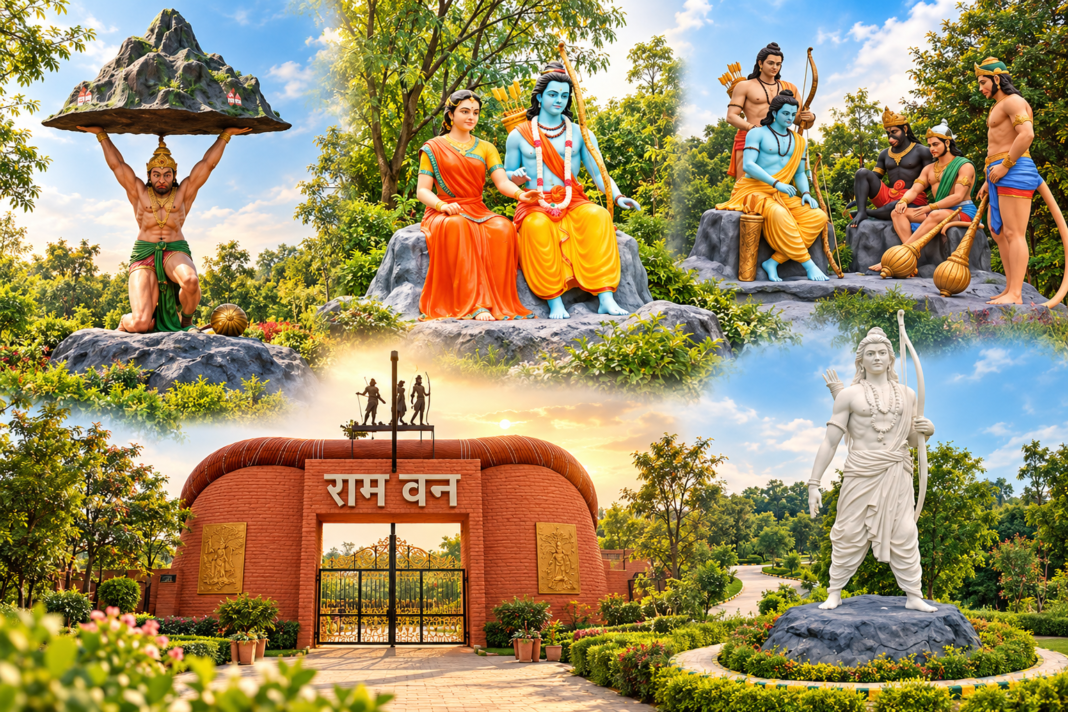
Quick answer: Ramvan Rajkot (also written Ram Van or Shree Ram Van) is a 47-acre urban forest near Aji Dam in Rajkot, Gujarat. It was built by the Rajkot Municipal Corporation on the theme of Lord Ram’s life and forest exile. It has 22 sculptures and scenes from the Ramayana, a bow-shaped entrance gate, a Ram Setu bridge, two ponds, a children’s play area and tens of thousands of trees, including two Miyawaki forest blocks. Gujarat Chief Minister Bhupendra Patel opened it on 17 August 2022. It’s usually open Tuesday to Sunday and closed on Mondays. When paid entry began in 2022, tickets were ₹20 for adults and ₹10 for children.
A Forest Built on the Story of Ram
Picture a giant bow and arrow rising over a gate. Beyond it, a path winds into cool green shade. Around each bend, you meet a scene from the Ramayana. Here, a boatman washes Ram’s feet. There, an old woman offers him berries. Further on, Hanuman flies with a mountain in his hand.
That’s Ramvan in Rajkot. It’s part forest, part open-air gallery and part family park. So, it draws walkers at dawn, families on Sundays, school groups on trips and devotees who want to relive Ram’s story.
In this complete guide, we cover everything you need to know about Ramvan Rajkot. First, we explain what it is, where it lies and how it came to be. Next, we walk you through its sculptures, one Ramayana scene at a time. Then, we look at its trees, ponds and green ideas. Finally, we cover the practical side: timings, tickets, how to reach, food, tips and nearby places.
A note on sources: We’ve used official sources such as the Gujarat Chief Minister’s Office, plus local news reports. However, ticket prices and timings at city parks can change. So, we flag anything you should confirm before you go. Also, Ramayana stories are shared here as scripture and tradition.
Ramvan Rajkot: Quick Facts
| Detail | Information |
|---|---|
| Also known as | Ram Van, Shree Ram Van, Ramvan Urban Forest |
| Type | Themed urban forest and public park |
| Location | Near Aji Dam, eastern Rajkot, Gujarat |
| Area | About 47 acres |
| Built by | Rajkot Municipal Corporation (RMC) |
| Theme | The life and exile (vanvas) of Lord Ram |
| Sculptures | 22 Ramayana scenes and figures |
| Trees | Tens of thousands of saplings; official figure about 80,000 |
| Special forest blocks | 2 Miyawaki blocks, out of 25 planting blocks |
| Cost | About ₹13.77 crore, including ₹1.61 crore for sculptures |
| Opened | 17 August 2022, by CM Bhupendra Patel |
| Closed | Mondays |
| Timings | Roughly 9 or 10 am to 6 pm (confirm locally) |
| Entry fee (2022 rates) | ₹20 adults, ₹10 children aged 3–12, free under 3 |
| Time needed | 2 to 3 hours |
| Nearest railway station | Rajkot Junction |
| Nearest airport | Rajkot International Airport, Hirasar |
What Is Ramvan Rajkot?
Ramvan in Rajkot is an urban forest. In simple words, it’s a planted forest inside a city, made to give people clean air, shade and a place to walk. However, Ramvan adds a twist. Its paths tell the story of Lord Ram, from his exile to the forest to his return to Ayodhya.
The word van means forest in Gujarati and Hindi. So, “Ramvan” simply means “Ram’s forest”. The name fits well, because Ram spent 14 years of exile living in forests, according to the Ramayana.
Today, Ramvan is one of Rajkot’s newest and most popular outings. It’s calm, green and cheap to visit. As a result, it has quickly become a favourite with families across Saurashtra.
Plan your visit: Open map
Where Is Ramvan in Rajkot?
Ramvan lies on the eastern side of Rajkot, close to Aji Dam and the Aji river. Map listings place it in the GIDC area, near the Doordarshan Kendra colony. It’s also close to the Kishan Gaushala.
- Rajkot Junction: Roughly 8 to 10 km by road.
- Race Course and city centre: Roughly 8 to 10 km.
- Aji Dam: Just next door, a short drive away.
- Pradyuman Zoo: A few kilometres north, near Lalpari Lake.
- Rajkot International Airport (Hirasar): Roughly 30 to 35 km.
- Ahmedabad: About 215 to 220 km, or around 4 hours by road.
Tip: Search for “Ram Van Rajkot” on your map app. A nearby pin called “Urban Forest” also points to the same area.
Why Was Ramvan Built?
Rajkot is one of Gujarat’s fastest-growing cities. As it grew, green spaces shrank. Summers got hotter, and the air got dustier. So, the city needed more trees and more places for people to breathe.
At the same time, the Rajkot Municipal Corporation wanted a park with a strong cultural theme. The story of Ram, who lived in the forest and loved nature, was a natural choice. It links faith with care for the earth.
In short, Ramvan in Rajkot was built for three reasons. First, to grow a real forest in the city. Second, to give families a calm, low-cost place to spend time. Third, to share the Ramayana with new generations in a fun, visual way.
The Story of Ramvan: A Timeline
| Date | Event |
|---|---|
| Before 2022 | RMC plans and builds a themed urban forest near Aji Dam |
| July 2022 | News reports say the park will open to the public soon |
| 17 August 2022 | CM Bhupendra Patel opens Ramvan, around Janmashtami |
| 17–28 August 2022 | Free entry for all visitors |
| Late August 2022 | Over 2 lakh people visit during the free period, as per local reports |
| 29–30 August 2022 | Park closes for cleaning |
| 31 August 2022 | Paid entry begins at ₹20 for adults and ₹10 for children |
| Today | Ramvan is a regular weekend spot for Rajkot families |
The Opening Day
Gujarat Chief Minister Bhupendra Patel opened Ramvan on 17 August 2022. On the same day, according to the Chief Minister’s Office, he also launched a set of electric buses for Rajkot’s city bus service. In addition, he announced other development works for the city.
The timing was special, since it fell around Janmashtami, one of the biggest festivals in Saurashtra. Rajkot’s famous Janmashtami fair draws huge crowds every year. So, many families added a first visit to Ramvan to their festival plans.
The response was huge. According to local reports, over 2 lakh people visited during the free-entry period alone. As a result, the city had to close the park for two days just to clean up.
What Did Ramvan Cost?
According to the Gujarat Chief Minister’s Office, Ramvan cost about ₹13.77 crore to build. Of this, about ₹1.61 crore went on the 22 sculptures and replicas.
For a 47-acre green space in a major city, that’s a modest amount. To put it in context, many city flyovers cost far more. Meanwhile, a forest keeps giving back for decades through shade, cleaner air and cooler streets.
What Is an Urban Forest?
An urban forest is a patch of dense trees grown inside or at the edge of a city. It’s different from a normal garden. A garden has lawns, flower beds and neat hedges. An urban forest, however, tries to copy a natural forest, with many layers of trees, shrubs and ground plants.
Urban forests do a lot of good.
- Cooler cities: Trees give shade and cool the air around them.
- Cleaner air: Leaves trap dust and take in carbon dioxide.
- More water in the ground: Tree roots help rainwater soak into the soil.
- Homes for wildlife: Birds, butterflies and small animals move in.
- Better health: Time among trees lowers stress and gets people walking.
Rajkot is a hot, dry city for much of the year. So, a forest like Ramvan matters even more here than in greener places.
India’s Nagar Van Idea
Ramvan in Rajkot is part of a bigger trend. In 2020, India’s environment ministry launched the Nagar Van Yojana, a scheme to create urban forests in cities across the country. The aim is to bring forests closer to where people live.
Gujarat has also pushed tree planting through its own programmes and its yearly Van Mahotsav celebrations. Over the years, the state has created many themed forests, called sanskritik van or cultural forests, each named after a person, idea or story.
Note: We couldn’t confirm from official sources which specific scheme funded Ramvan. So, we describe it simply as an RMC urban forest project.
Ramvan’s Trees: A Forest in the Making
According to the Chief Minister’s Office, around 80,000 saplings were planted at Ramvan. Other sources give figures such as 60,000 trees. Either way, it’s a huge number for a city park.
The planting is split into 25 blocks. Two of these use the Miyawaki method, which we explain below. The rest follow more usual planting styles, with walking paths running between them.
Since the forest is still young, many trees are small. However, they grow fast in the monsoon. So, every year, Ramvan in Rajkot gets a little greener and shadier than before. If you visited in 2022, you’ll notice a big change today.
Some sources say the park has around 80 kinds of plants. These likely include native trees such as neem, peepal, banyan, jamun, amla, khair and bamboo. However, we couldn’t find an official species list. So, treat these as common examples rather than a confirmed list.
The Miyawaki Method Explained
The Miyawaki method is a way to grow a dense forest very fast. It was developed by the Japanese plant expert Akira Miyawaki. Here’s how it works, in simple steps.
- Improve the soil: The ground is dug up and mixed with compost, husk and other natural matter.
- Choose native plants: Only local trees and shrubs are used, since they suit the local climate.
- Plant very close: Saplings go in about three to four per square metre, much closer than usual.
- Mix the layers: Tall trees, small trees, shrubs and ground plants are mixed together.
- Mulch and water: The soil is covered with dry leaves or straw and watered for the first two to three years.
- Let nature take over: After that, the forest mostly looks after itself.
Because the plants grow so close, they compete for light and shoot up quickly. As a result, a Miyawaki patch can look like a real forest within a few years. That’s why many Indian cities, including Rajkot, now use it.
Water and Green Ideas at Ramvan
Keeping thousands of young trees alive in dry Saurashtra isn’t easy. So, Ramvan in Rajkot uses a few smart ideas, according to the Chief Minister’s Office.
- Drip irrigation: Water drips straight to the roots, so less is wasted.
- Reused seepage water: Water that seeps from nearby sources is collected and reused to water plants.
- Revived water source: A natural water source on the site was cleaned and restored.
- Ponds: Two ponds hold water, cool the air and attract birds.
These steps help the forest survive long, hot summers. Also, they show visitors how a city can grow trees without wasting water.
The Ramayana in Brief
To enjoy Ramvan fully, it helps to know the story it tells. The Ramayana is one of India’s two great epics. Tradition credits it to the sage Valmiki. Later, poets retold it in many languages. For example, Tulsidas wrote the much-loved Ramcharitmanas in Awadhi.
Here’s the story in a nutshell.
- Ram is born: Ram is the eldest son of King Dasharatha of Ayodhya. He has three brothers: Lakshman, Bharat and Shatrughna.
- Ram marries Sita: He wins Sita’s hand by lifting and breaking Lord Shiva’s great bow.
- Exile: Queen Kaikeyi asks the king to send Ram to the forest for 14 years. Sita and Lakshman go with him.
- Life in the forest: The three live simply, meeting sages, tribal people and animals along the way.
- Sita is taken: Ravan, the king of Lanka, tricks them with a golden deer and carries Sita away.
- Search for Sita: Ram meets Hanuman and Sugriva, who help him look for Sita.
- The bridge: An army of vanaras builds a bridge of stones across the sea to Lanka.
- War in Lanka: Ram defeats Ravan and rescues Sita.
- Return home: Ram returns to Ayodhya and is crowned king. People light lamps to welcome him, which is linked with Diwali.
Ramvan focuses mostly on steps 3 to 7, the years of vanvas, or forest exile. That’s fitting, since the park itself is a forest.
The Seven Books of the Ramayana
Valmiki’s Ramayana is divided into seven parts, called kandas.
| Kanda | What it covers |
|---|---|
| Bala Kanda | Ram’s birth, childhood and marriage to Sita |
| Ayodhya Kanda | The plan to crown Ram, and his exile |
| Aranya Kanda | Life in the forest and Sita’s abduction |
| Kishkindha Kanda | Meeting Hanuman and Sugriva |
| Sundara Kanda | Hanuman’s journey to Lanka to find Sita |
| Yuddha Kanda | The bridge, the war and Ram’s victory |
| Uttara Kanda | Life after the return to Ayodhya |
As you walk through Ramvan, try to guess which kanda each scene comes from. It’s a fun game, especially with kids.
Ram’s Links With Gujarat
Ramvan brings the Ramayana to Rajkot. But did you know that tradition links parts of Ram’s story with Gujarat itself?
For example, many devotees believe that Shabari’s ashram stood in the Dang district of south Gujarat. Today, a temple called Shabari Dham stands on a hill there, near Subir. Close by, a lake is linked with Pampa Sarovar from the Ramayana. As a result, the area draws many pilgrims, especially from tribal communities.
In addition, Ram Katha, the retelling of Ram’s story, is hugely popular across Gujarat. Famous storytellers hold week-long katha events that draw thousands of listeners. Also, Ram Navami processions fill the streets of many towns every spring.
So, while Ramvan in Rajkot is new, the love for Ram in Gujarat is very old. The park simply gives it a green new home.
Note: Links between Ramayana places and today’s locations come from faith and tradition. Historians and scholars hold a range of views on them.
The Sculptures of Ramvan: A Scene-by-Scene Guide
Ramvan in Rajkot has 22 sculptures and replicas, according to the Chief Minister’s Office. They’re spread along the paths, so you discover them one by one as you walk.
We couldn’t find an official list of all 22 scenes. So, below we cover the scenes that official sources and many visitors describe. Also, the exact look and placement may differ from our descriptions. Still, this guide will help you understand the story behind each one.
1. The Bow and Arrow Entrance Gate
Your visit starts at the main gate, which is shaped like a giant bow and arrow, or dhanush-baan. It’s the most photographed spot at Ramvan.
The bow is Ram’s most famous symbol. In fact, one of his names is Kodandaram, after his bow, Kodanda. Also, it was by breaking Shiva’s bow that he won Sita’s hand. So, the gate is a fitting welcome.
Photo tip: Stand a little back from the gate to fit the whole bow in your frame. Mornings give softer light.
2. Ram, Lakshman and Sita in Exile
One of the key scenes shows Ram, Lakshman and Sita setting out for the forest. They’re dressed simply, as forest dwellers, having left their royal life behind.
The story behind it is moving. Ram was about to be crowned king. But his father had once promised Queen Kaikeyi two wishes. She now asked for her son Bharat to be king and for Ram to go into exile for 14 years. To keep his father’s word, Ram left without a single complaint.
The lesson: Keep your promises, even when it’s hard. Also, notice Lakshman and Sita. They chose to go with Ram out of love and loyalty.
3. Kevat, the Boatman
Another well-known scene shows Kevat, the boatman, who helped Ram cross the Ganga river. It’s one of the sweetest stories in the Ramayana.
According to the Ramcharitmanas, Kevat refused to let Ram step into his boat at first. He had heard that the dust of Ram’s feet once turned a stone into a woman, Ahalya. So, he joked that his wooden boat might turn into a woman too! Therefore, he insisted on washing Ram’s feet first. Then, with great joy, he rowed them across.
When Ram tried to pay him, Kevat said no. He said they were both boatmen: he helped people cross rivers, while Ram helped souls cross the ocean of life.
The lesson: True devotion is simple and joyful. Also, every job, even a boatman’s, has dignity.
4. Shabari’s Berries
The Shabari scene is a favourite for many visitors. It shows Ram with an old tribal woman who offers him berries.
Shabari had waited for years to meet Ram. Every day, she picked berries for him. According to popular retellings, she tasted each berry first to make sure only the sweetest ones reached him. Others might have found this odd. However, Ram ate them happily, because they were given with pure love.
The lesson: Love matters more than rules or status. God, as the story says, sees the heart, not the offering.
5. The Golden Deer
Visitors also describe a scene of Ram and Sita with a deer. This recalls the story of the golden deer, one of the turning points of the Ramayana.
While living in the Panchavati forest, Sita saw a beautiful golden deer and asked Ram to catch it. In truth, it was the demon Maricha in disguise, sent by Ravan. Ram chased it deep into the forest. Meanwhile, Ravan came to the hut disguised as a holy man and carried Sita away.
The lesson: Things aren’t always what they seem. Also, a moment of desire can lead to big trouble.
6. The Jatayu Gateway
Ramvan also features a Jatayu gateway, as per visitor guides. Jatayu was a giant, brave old vulture and a friend of Ram’s father.
When Ravan flew away with Sita, Jatayu tried to stop him. Although he was old, he fought hard. In the end, Ravan cut off his wings. Jatayu lived just long enough to tell Ram which way Ravan had gone. Ram then performed his last rites himself, as he would for his own father.
The lesson: Stand up for what’s right, even when the odds are against you. Also, the story honours birds and animals as real heroes.
7. Ram Meets Hanuman and Sugriva
Another scene shows Ram with Sugriva and his forces. Sugriva was the exiled king of the vanaras, living on Rishyamukha hill. Hanuman was his loyal minister.
Hanuman first met Ram in disguise, to find out who he was. Once he knew, he fell at Ram’s feet and became his greatest devotee. Soon after, Ram and Sugriva became friends and promised to help each other. Ram helped Sugriva win back his kingdom. In turn, Sugriva sent his army to search for Sita.
The lesson: Good friendships are built on trust and helping each other.
8. Hanuman Carrying the Sanjeevani Mountain
One of the most dramatic sculptures shows Hanuman flying with a mountain in his hand. Kids love this one.
During the war in Lanka, Lakshman was badly hurt. The royal doctor, Sushena, said only the Sanjeevani herb from the Himalayas could save him, and it had to arrive before sunrise. Hanuman flew north at once. However, he couldn’t tell which plant was Sanjeevani. So, he lifted the whole mountain and carried it back! Lakshman was saved.
The lesson: When there’s no time to waste, find a way. Hanuman’s strength came from his devotion and his sense of duty.
9. Ram Setu Bridge
Ramvan in Rajkot has a replica of Ram Setu, the bridge to Lanka. It’s one of the park’s key features, according to the Chief Minister’s Office.
In the Ramayana, Ram’s army reached the southern sea but had no way to cross. So, the vanara engineers Nala and Nila led the building of a bridge. According to popular tradition, stones marked with Ram’s name floated on the water. Within days, the bridge was ready, and the army marched across.
Today, a chain of shoals between India and Sri Lanka is known as Ram Setu or Adam’s Bridge. Its origins are a subject of debate between faith and science. At Ramvan, however, the bridge is simply a fun and meaningful spot to walk across.
The lesson: Big goals are reached when many hands work together, stone by stone.
10. The Large Statue of Ram
Some visitor guides mention a large statue of Lord Ram, with one source giving a height of about 30 feet. It’s said to stand as a central landmark of the park.
Note: We couldn’t confirm the exact height from an official source. So, check it out for yourself when you visit.
11. The “Cavern Meet” and Other Scenes
Some guides describe a cave-like scene, called a “cavern meet”. This may show one of the forest meetings in the Ramayana, such as a meeting with a sage. In addition, you’ll find smaller figures and scenes spread across the park. Together, they make up the 22 sculptures.
Since there’s no official printed list, why not make your own? Carry a notebook, and ask your kids to write down every scene they spot. Then, match each one to the story.
Characters You’ll Meet at Ramvan
| Character | Who they are | Known for |
|---|---|---|
| Ram | Prince of Ayodhya, seen as an avatar of Vishnu | Truth, duty and kindness |
| Sita | Ram’s wife, daughter of King Janak | Courage and strength |
| Lakshman | Ram’s younger brother | Loyalty and service |
| Hanuman | Vanara hero and Ram’s devotee | Strength, devotion and wisdom |
| Sugriva | King of the vanaras | Friendship with Ram |
| Jatayu | A giant, brave vulture | Trying to save Sita |
| Shabari | A tribal devotee | Offering berries with love |
| Kevat | A boatman | Washing Ram’s feet |
| Ravan | King of Lanka | Kidnapping Sita |
| Nala and Nila | Vanara builders | Building Ram Setu |
Values Ramvan Teaches
Beyond the stories, Ramvan quietly teaches some timeless values. They’re worth talking about with kids as you walk.
- Duty (dharma): Ram put his duty before his own comfort.
- Loyalty: Lakshman and Sita stood by Ram through every hardship.
- Humility: Ram treated a boatman and a tribal woman with great respect.
- Courage: Jatayu fought a far stronger enemy to do what was right.
- Teamwork: The vanaras built a bridge across the sea together.
- Respect for nature: Ram lived in harmony with forests, rivers and animals.
That last value is especially fitting here. After all, Ramvan in Rajkot is both a story park and a forest.
More Ramayana Stories to Share on Your Walk
Not every Ramayana story has a statue at Ramvan. Still, the forest setting makes it a perfect place to share them. Here are five short stories to tell as you walk.
Bharat and the Sandals
When Bharat learned that Ram had been sent away, he was heartbroken. He rushed to the forest and begged Ram to come back and rule. However, Ram said he had to keep his father’s promise. So, Bharat asked for Ram’s sandals, called paduka. He carried them back to Ayodhya and placed them on the throne. For 14 years, he ruled only as Ram’s helper.
The lesson: Real love isn’t about power. Instead, it’s about loyalty and sacrifice.
The Lakshman Rekha
Popular retellings say that before Lakshman left Sita alone in the hut, he drew a line on the ground. He asked her not to step outside it. Later, Ravan came disguised as a holy man and tricked her into crossing it. Today, “Lakshman rekha” is a common phrase in India for a line you should never cross.
The lesson: Some limits are there to keep us safe.
Hanuman’s Leap to Lanka
To find Sita, someone had to cross the ocean to Lanka. At first, Hanuman doubted himself. Then, the wise bear Jambavan reminded him of his great strength. With new faith, Hanuman leapt across the sea. He found Sita in the Ashok Vatika garden and gave her Ram’s ring as a sign of hope.
The lesson: Sometimes, we need a friend to remind us of what we can do.
The Squirrel’s Help
A much-loved folk story says that while the vanaras built Ram Setu, a small squirrel helped too. It rolled in the sand and shook it off between the stones. Ram was so touched that he stroked its back. According to the tale, that’s how Indian squirrels got their three stripes.
The lesson: No help is too small. Every effort counts.
Note: This story comes from folk tradition and later retellings, rather than Valmiki’s original text.
Vibhishan Chooses What’s Right
Vibhishan was Ravan’s younger brother. He begged Ravan to return Sita and avoid war. But Ravan refused and threw him out. So, Vibhishan crossed over to Ram’s side. Ram welcomed him warmly, even though he came from the enemy’s family.
The lesson: Standing for what’s right can take great courage, even against your own family.
Other Attractions Inside Ramvan
Ramvan in Rajkot isn’t only about sculptures. It also has plenty of spaces to relax, play and explore. According to the Chief Minister’s Office and visitor guides, here’s what you’ll find.
Two Ponds
Ramvan has two ponds, which add a lovely calm to the park. Their banks are good spots to sit and watch birds. In the monsoon, they fill up and reflect the green trees around them.
Adventure Bridge
An adventure bridge gives kids and young visitors a bit of fun. It’s a simple, playful crossing, so it suits families. Still, keep an eye on small children.
Children’s Play Area
The park has a children’s playground, sometimes called a balvatika. It has swings, slides and other play equipment. So, it’s a great place to let kids burn off energy after the long walk.
Traditional Swings
Some guides mention traditional hinchka swings, the wooden swings loved in Gujarati homes. They’re a nice, nostalgic touch for older visitors.
Amphitheatre
Ramvan has an open-air amphitheatre that seats about 150 people. It can host small events, talks, school programmes and cultural shows. However, events aren’t held every day, so check with RMC if you’re hoping to catch one.
Rashivan (Zodiac Forest)
One special feature is the Rashivan, or zodiac forest. Here, trees are linked with the 12 signs of the Indian zodiac, called rashis. Visitors often enjoy finding the tree linked with their own sign.
The table below shows a list commonly used in Indian rashivans. However, the trees planted at Ramvan may differ. So, check the signboards on site.
| Rashi | Western sign | Commonly linked tree |
|---|---|---|
| Mesh | Aries | Red sandalwood (rakta chandan) |
| Vrishabh | Taurus | Saptaparni |
| Mithun | Gemini | Jackfruit (fanas) |
| Kark | Cancer | Palash (khakhro) |
| Simha | Leo | Patal (padal) |
| Kanya | Virgo | Mango (aambo) |
| Tula | Libra | Bakul (borsali) |
| Vrishchik | Scorpio | Khair |
| Dhanu | Sagittarius | Peepal |
| Makar | Capricorn | Shisham (sisam) |
| Kumbh | Aquarius | Shami (khijdo) |
| Meen | Pisces | Banyan (vad) |
Note: These links come from tradition and astrology, not science. Still, they’re a fun way to connect people with trees.
Gazebos, Benches and Senior Zones
Visitor guides mention around eight gazebos, one of them with an artistic design. There are also about 25 creative benches placed along the paths. In addition, there are seating areas for senior citizens. So, you can rest often as you walk.
Devotional Music
Some visitors mention soft devotional music playing through the park. It adds to the calm, prayerful feel of the walk.
Walking Paths
Long walking paths loop through the forest and link all the scenes. Some visitors estimate the full route at 4 to 5 km. So, wear comfortable shoes, and plan for 2 to 3 hours.
Security
According to visitor guides, the park has security buildings, guards at the gates and CCTV cameras. As a result, it feels safe for families, women and senior citizens.
Electric Carts: A Ride Around the Forest
Walking the whole park can be tiring, especially in summer. So, Ramvan offers electric carts or golf-cart-style vehicles on a paid basis, according to visitors.
These are handy for senior citizens, people with limited mobility and families with small kids. However, we couldn’t find an official current fare. Also, carts can be limited at busy times. So, ask at the entrance as soon as you arrive.
Don’t confuse them with the e-buses: On opening day, the CM also launched electric city buses for Rajkot. Those buses run on city routes. They aren’t the carts inside Ramvan.
Birds and Nature at Ramvan
As Ramvan’s trees grow, more wildlife moves in. The ponds and nearby Aji Dam also attract birds. Here are some you may spot.
- Peafowl: Common across Saurashtra, often seen near trees and open ground.
- Parakeets: Bright green and noisy, zipping between trees.
- Bulbuls: Cheerful singers with a small crest.
- Kingfishers: Flashes of blue near the ponds.
- Egrets and herons: Standing still in shallow water.
- Sunbirds: Tiny birds that sip nectar from flowers.
- Butterflies: Plenty after the monsoon, when flowers bloom.
Birding tip: Arrive at opening time. Birds are most active in the morning, and the park is quiet. Also, carry binoculars if you have them.
Aji Dam: Ramvan’s Neighbour
Ramvan sits right next to Aji Dam, one of Rajkot’s oldest and best-loved picnic spots. The dam stands on the Aji river and has long been an important source of water for the city.
The area around the dam has gardens and open spaces. Many Rajkot families have fond childhood memories of Sunday outings here. So, it’s easy to combine Ramvan and Aji Dam in one trip.
Water birds often gather on the reservoir, especially in winter. Also, sunsets over the water can be lovely. However, food options near the dam are limited. So, carry snacks.
Find it: Open map
Things to Do at Ramvan
- Walk the Ramayana trail: Follow the scenes in order and relive the story.
- Take a photo at the bow gate: It’s Ramvan’s signature shot.
- Cross Ram Setu: Walk the replica bridge and think of the vanara army.
- Find your rashi tree: Look for your zodiac tree in the Rashivan.
- Sit by the ponds: Watch birds, dragonflies and ripples on the water.
- Let kids play: Head to the play area and the adventure bridge.
- Take an e-cart ride: Great for elders or tired legs.
- Go birdwatching: Early mornings are best.
- Tell stories: Share the Ramayana with your kids at each scene.
- Add Aji Dam: Visit the dam next door for a longer outing.
A Suggested Walking Route
The exact layout may change as the park grows. However, here’s a simple way to plan your walk.
- Start at the bow gate. Take your photos while the crowd is thin.
- Follow the main path. See the exile, Kevat and Shabari scenes first, since they come early in the story.
- Look for the forest scenes. Find the golden deer and the Jatayu gateway.
- Move on to Kishkindha. Spot Ram with Hanuman and Sugriva.
- See Hanuman and Sanjeevani. Then, walk across Ram Setu.
- Rest by the ponds. Have a snack and some water.
- Explore the Rashivan. Find your zodiac tree.
- End at the play area. Let kids play while adults rest.
If you’re short on time, ask staff which scenes are closest. Alternatively, take an e-cart to cover more ground.
Ramvan vs Other Parks in Rajkot
Rajkot has several popular parks. So, how does Ramvan compare? Here’s a quick look.
| Park | Best known for | Best time | Feel |
|---|---|---|---|
| Ramvan | Ramayana sculptures and a young forest | Morning | Calm, green, story-led |
| Atal Sarovar | Lake, lights, rides and food courts | Evening | Lively and bright |
| Ishwariya Park | Open lawns and picnics | Morning or evening | Relaxed and spacious |
| Aji Dam gardens | Water views and old-style picnics | Late afternoon | Nostalgic and simple |
| Pradyuman Zoo | Lions, tigers and birds | Morning | Fun for kids |
In short, pick Ramvan for a peaceful walk with meaning. Then, if you still have energy, end the day at Atal Sarovar for lights and food.
What Your Visit Might Feel Like
This is an imagined scene, based on what visitors often describe.
It’s a Sunday in November. You reach the bow gate just after it opens. The air is cool, and the sun is soft. Near the entrance, a family is already posing for photos.
You walk in. The path is lined with young trees, taller than they were last year. Soon, you reach Kevat’s boat. A grandmother stops to tell her grandson the story, and he listens with wide eyes.
Further on, you hear parakeets squawk above the ponds. Then, you spot Hanuman in mid-flight, mountain in hand. Your own kids race ahead to see him first.
By noon, you’ve walked for two hours. You rest on a bench, sip water and look around. It’s hard to believe you’re still inside a busy city. Then, as the sun climbs, you head out, tired but happy.
Ramvan Rajkot Timings
Ramvan in Rajkot is open Tuesday to Sunday and closed on Mondays for upkeep. However, sources give slightly different hours.
- When paid entry began in August 2022, local reports gave the hours as 9 am to 6 pm.
- Online map listings now show 10 am to 6 pm, Tuesday to Sunday.
- Some travel guides mention closing times as late as 7 pm.
So, the safest plan is to arrive by 10 am and finish by 5 pm. Some visitors say guards start asking people to leave around 5:30 pm. Also, entry usually stops before closing time.
Holiday note: Hours may change on festivals and public holidays. So, check with the Rajkot Municipal Corporation before a holiday visit.
Ramvan Rajkot Ticket Price
When paid entry started on 31 August 2022, the Rajkot Municipal Corporation set these rates, as per local news reports.
| Visitor | Entry fee (2022 rates) |
|---|---|
| Children under 3 | Free |
| Children aged 3 to 12 | ₹10 |
| Visitors aged 12 and above | ₹20 |
| Electric cart ride | Extra, paid on site (rate not officially listed) |
Travel guides in later years still list ₹20 for adults and ₹10 for children. However, rates may have changed since. So, carry a little extra cash, just in case.
Payment tip: Carry some cash in small notes. UPI usually works in Rajkot, but a backup is always useful.
How to Reach Ramvan Rajkot
Ramvan is on the eastern edge of Rajkot, near Aji Dam. Since it’s a little out of the city centre, the easiest way to get there is by car, taxi or auto-rickshaw.
From Within Rajkot
- By car or bike: Drive towards Aji Dam and follow signs or your map app to Ram Van.
- By auto-rickshaw: Autos are easy to find across the city. Agree on the fare, or use a ride app, before you start.
- By cab: Ride-hailing apps work in Rajkot.
- By city bus: Rajkot has a city bus network. However, routes and stops change, so check the latest route to the Aji Dam area.
From Ahmedabad
Rajkot is about 215 to 220 km from Ahmedabad. By road, the drive takes around 4 hours via the Ahmedabad–Rajkot highway. Alternatively, many trains and buses run between the two cities every day.
For a day trip, leave Ahmedabad early, around 6 am. That way, you can reach Ramvan by its opening time, before the heat builds.
By Train
Rajkot Junction is the main railway station. It’s well connected to Ahmedabad, Mumbai, Delhi and many other cities. From the station, Ramvan is roughly 8 to 10 km away by road.
Rajkot Junction: Open map
By Air
Rajkot International Airport is at Hirasar, outside the city. It replaced the old city airport in 2023. From the airport, Ramvan is roughly 30 to 35 km by road. So, plan for a cab ride of about 45 minutes to an hour.
Rajkot International Airport: Open map
By Bus
Gujarat State Road Transport Corporation (GSRTC) buses link Rajkot with towns and cities across Gujarat. Private buses also run on major routes. From the Rajkot bus station, take an auto or cab to Ramvan.
Rajkot bus port: Open map
| From | Approx. distance to Ramvan | Best way |
|---|---|---|
| Rajkot Junction | 8 to 10 km | Auto or cab |
| Rajkot bus station | Around 8 to 10 km | Auto or cab |
| Rajkot airport (Hirasar) | 30 to 35 km | Cab |
| Ahmedabad | 215 to 220 km | Car, train or bus |
| Jamnagar | About 90 km | Car or bus |
| Junagadh | About 100 km | Car or bus |
Parking at Ramvan
Ramvan in Rajkot has parking space for cars and two-wheelers near the entrance. On weekends and holidays, though, it can fill up. So, arrive early, especially on festival days.
Also, keep valuables out of sight in your car. It’s a good habit anywhere.
Food and Water at Ramvan
Visitor reports on food vary. Some early visitors said there was no canteen or drinking water. Later visitors mention two or three small canteens inside. So, facilities seem to have improved over time.
Still, we suggest you plan ahead.
- Carry at least one litre of water per person.
- Pack light snacks, fruit or theplas.
- Check whether outside food is allowed at the gate.
- Don’t litter. Carry your waste out or use bins.
- For a full meal, head back into the city afterwards.
Where to Eat After Ramvan
Rajkot is famous for its food. So, make time for a meal after your visit. Here’s what to try.
- Kathiyawadi thali: Bajra rotla, sev tameta, ringan no olo, kadhi, khichdi and chaas.
- Ghughra: A Rajkot street snack, often filled with spicy potato and served with chutneys.
- Chevdo and farsan: Rajkot’s namkeen shops are well known across Gujarat.
- Gola and kulfi: Perfect after a hot walk.
- Pendas and sweets: Pick some up to take home.
Many popular restaurants and food streets are around Race Course, Kalawad Road and Yagnik Road. So, you’ll have plenty of choice.
Best Time to Visit Ramvan
The best time to visit Ramvan Rajkot is from October to March. Here’s why, plus what each season offers.
| Season | Months | What to expect |
|---|---|---|
| Winter | November to February | Cool, pleasant weather; ideal for long walks |
| Spring | March | Warm but comfortable in the mornings |
| Summer | April to June | Very hot; visit only early in the day |
| Monsoon | July to September | Green and lush, but paths can be muddy |
| Post-monsoon | October | Green trees, clear skies, lots of butterflies |
Best Time of Day
Go in the morning, soon after opening. It’s cooler, quieter and better for birds and photos. In contrast, afternoons can be hot and bright, especially from March to June.
Weekday or Weekend?
Weekends and holidays are much busier. So, if you want a calm walk, go on a Tuesday to Friday. And remember, the park is closed on Mondays.
Ramvan Through the Year
The park changes with the seasons. So, here’s a month-by-month guide.
| Month | What to expect |
|---|---|
| January | Cool mornings; great for long walks |
| February | Pleasant days; clear skies for photos |
| March | Warming up; go early; Holi crowds possible |
| April | Hot; Ram Navami and Hanuman Jayanti may bring crowds |
| May | Very hot; visit only at opening time |
| June | Hot and humid; first rains may arrive late |
| July | Monsoon; trees turn green fast |
| August | Lush and wet; Janmashtami crowds |
| September | Green and fresh; paths may be muddy |
| October | Butterflies; Dussehra and Navratri season |
| November | Diwali holidays; busy but pleasant |
| December | Cool and calm; ideal for families |
Visiting Ramvan in the Monsoon
The monsoon is when Ramvan in Rajkot looks its greenest. Young trees shoot up, ponds fill and the air smells of wet earth. As a result, many locals say it’s their favourite season to visit.
Still, rain brings a few challenges. Paths can turn muddy and slippery. Also, mosquitoes are more common. So, wear shoes with good grip, carry an umbrella and use insect repellent. Then, simply enjoy the fresh, rain-washed forest.
Festivals and Special Days
Ramvan in Rajkot feels extra special around Ram-related festivals. On these days, expect bigger crowds and possibly special events.
- Ram Navami: Ram’s birthday, usually in March or April.
- Dussehra: Celebrates Ram’s victory over Ravan, in September or October.
- Diwali: Linked with Ram’s return to Ayodhya, in October or November.
- Hanuman Jayanti: Hanuman’s birthday, usually in March or April.
- Janmashtami: Ramvan opened around this festival, and Rajkot’s big Janmashtami fair draws huge crowds.
Tip: If you dislike crowds, avoid festival days. Instead, visit a few days before or after.
A Half-Day Plan for Ramvan
- 9:30 am: Reach Ramvan and buy your tickets.
- 10:00 am: Take photos at the bow gate.
- 10:15 am: Walk the Ramayana trail, scene by scene.
- 11:30 am: Rest by the ponds with water and a snack.
- 12:00 pm: Explore the Rashivan and the play area.
- 12:45 pm: Drive to Aji Dam for a quick look.
- 1:30 pm: Head into the city for a Kathiyawadi lunch.
A One-Day Rajkot Plan With Ramvan
- Morning: Start at Ramvan when it opens, then stop at Aji Dam.
- Late morning: Visit Pradyuman Zoological Park, a short drive north. Note that it’s also closed on Mondays.
- Lunch: Enjoy a Kathiyawadi thali in the city.
- Afternoon: See Kaba Gandhi no Delo, Gandhiji’s childhood home, and the Watson Museum.
- Evening: Relax at Atal Sarovar, which opens in the late afternoon.
- Dinner: Try street food around Race Course or Yagnik Road.
This plan gives you faith, nature, history and food in a single day. However, it’s a full day. So, if you’re travelling with elders or small kids, pick just three or four stops.
A Quick Introduction to Rajkot
If you’re coming from Ahmedabad or elsewhere, here’s a little about the city that’s home to Ramvan.
Rajkot is the biggest city in the Saurashtra region of Gujarat. It was once the capital of a princely state and later of Saurashtra State. Today, it’s a busy hub for trade, engineering and small industry.
Rajkot also has a special place in India’s history. Mahatma Gandhi spent part of his childhood here, and his family home still stands as a museum. In addition, the city is known for its warm people, love of food and lively festivals, especially Janmashtami and Navratri.
So, while Ramvan is a great reason to visit, it’s worth staying a day or two to see the rest of Rajkot too.
Places to Visit Near Ramvan
1. Pradyuman Zoological Park
Rajkot’s zoo sits near Lalpari Lake, a short drive from Ramvan. It’s home to lions, tigers, leopards and many birds. It’s a big favourite with kids. Like Ramvan, it’s closed on Mondays.
Find it: Open map
2. Kaba Gandhi no Delo
This is the family home where Mahatma Gandhi lived for several years as a boy. His father, Karamchand Gandhi, known as Kaba Gandhi, served as a diwan in Rajkot. Today, the house displays photos and items from Gandhiji’s life.
Find it: Open map
3. Watson Museum
Set in Jubilee Garden, the Watson Museum is one of Gujarat’s oldest museums. It holds coins, sculptures, textiles and royal items from Saurashtra’s past. It’s named after Colonel John Watson, a British political agent.
Find it: Open map
4. Rotary International Dolls Museum
This small museum displays dolls from many countries, dressed in their traditional clothes. It’s fun and colourful, so kids usually love it.
Find it: Open map
5. Atal Sarovar
Atal Sarovar is a newer lakefront park in the Race Course area of west Rajkot. It has walking paths, food courts, rides and evening lights. It’s best visited in the evening, since it opens in the late afternoon.
Find it: Open map
6. Ishwariya Park
Ishwariya Park is a large, open park on the northern side of Rajkot. It’s good for picnics and long walks. Families often visit in the monsoon and winter.
Find it: Open map
7. Jalaram Bapa Temple, Virpur
About 55 to 60 km from Rajkot, Virpur is home to the famous temple of Jalaram Bapa, a much-loved saint of Saurashtra. The temple is known for its free meals for all visitors.
Find it: Open map
8. Gondal
About 40 km from Rajkot, Gondal is an old princely town. It’s known for the Naulakha Palace and its royal car collection. It makes a good half-day trip.
Naulakha Palace: Open map
| Place | Rough distance from Ramvan | Best for |
|---|---|---|
| Aji Dam | Next door | Water views and picnics |
| Pradyuman Zoo | A few km | Kids and wildlife |
| Kaba Gandhi no Delo | About 8 to 10 km | Gandhi history |
| Watson Museum | About 8 to 10 km | Saurashtra history |
| Atal Sarovar | About 15 km | Evening outings |
| Ishwariya Park | About 15 km | Picnics |
| Gondal | About 40 km | Palaces and heritage |
| Virpur | About 55 to 60 km | Pilgrimage |
Where to Stay in Rajkot
Rajkot has a wide range of hotels, from budget lodges to upscale business hotels. Since Ramvan is a short drive from the centre, you can stay almost anywhere. Here are some handy areas.
- Near Rajkot Junction: Good for train travellers and budget stays.
- Race Course and Yagnik Road: Central, close to food streets and shops.
- Kalawad Road and 150 Feet Ring Road: Newer hotels, malls and restaurants.
- Eastern Rajkot: Closest to Ramvan and Aji Dam, though with fewer hotel choices.
Tip: Book early around Janmashtami and Navratri, when Rajkot gets very busy.
Who Will Love Ramvan Most?
- Families: Kids get stories, play areas and space to run.
- Devotees: The Ramayana scenes make for a calm, prayerful walk.
- Morning walkers: Long, shady paths are perfect for exercise.
- Students: It’s a living lesson in culture and ecology.
- Nature lovers: Ponds, birds and Miyawaki blocks are worth a look.
- Photographers: The bow gate and sculptures make striking shots.
- Visitors to Rajkot: It’s an easy, low-cost half-day outing.
However, if you’re after rides, shopping or nightlife, Ramvan isn’t the place. In that case, head to Atal Sarovar or the malls on Kalawad Road instead.
Visiting With Kids
Ramvan is one of the best family outings in Rajkot. It mixes stories, nature and play. Here’s how to make it great for kids.
- Tell them the Ramayana story in the car on the way.
- Make a checklist of scenes to find, like a treasure hunt.
- Let them pick their favourite sculpture and explain why.
- Finish at the play area as a reward.
- Carry hats, water and snacks.
- Keep an eye on them near the ponds.
A School Trip to Ramvan
Ramvan in Rajkot makes a great school outing. It links culture, moral values and the environment in one place. Here’s a simple plan for teachers.
Before the Trip
- Tell the class the Ramayana story in short.
- Split students into small groups, each with a teacher or helper.
- Give each group a list of scenes to find.
- Check the latest rules for group visits with RMC.
During the Trip
- At each scene, ask one student to retell the story.
- Stop at a Miyawaki block and explain how it works.
- Visit the Rashivan, and let students find their zodiac trees.
- Count bird species as a group challenge.
After the Trip
- Ask students to draw their favourite scene.
- Discuss one value from the Ramayana in class.
- Plant a sapling at school to carry the lesson forward.
Questions Kids Often Ask
Kids are full of questions at Ramvan. So, here are some simple answers you can share.
- “Why did Ram live in a forest?” Because he kept his father’s promise, even though it meant leaving his palace for 14 years.
- “Could Hanuman really lift a mountain?” In the story, yes! It shows how strong love and duty can make us.
- “Why did Shabari taste the berries?” She wanted Ram to get only the sweetest ones, so it was an act of love.
- “Who built Ram Setu?” The vanara army, led by Nala and Nila, built it together.
- “Why are there so many small trees?” Because Ramvan is a young forest. Just like you, it’s still growing!
Visiting With Elders
- Go early, when it’s cool.
- Use an electric cart if the walk is too long.
- Rest often on the benches and in the gazebos.
- Carry their regular medicines and water.
- Avoid crowded festival days.
Accessibility
Ramvan’s paths are mostly wide and fairly flat. However, it’s a large forest park, and some areas may have uneven ground. So, people using wheelchairs or walking aids may need help in places.
The electric carts can make a big difference. Therefore, ask about them as soon as you arrive. Also, call RMC ahead if you need specific support.
Photography Tips
- Golden hour: Morning light is softer and kinder for photos.
- The bow gate: Shoot from a distance to fit it all in.
- Sculptures: Get low and shoot upwards to make them look grand.
- People: Ask before you photograph other visitors, especially families.
- Ponds: Look for reflections on calm mornings.
- Respect: Don’t climb on the sculptures for photos.
- Drones: Don’t fly drones without permission.
Common Mistakes to Avoid
First-time visitors often make a few small mistakes. Luckily, they’re easy to avoid.
- Going on a Monday. The park is closed. So, plan for Tuesday to Sunday.
- Arriving at noon in summer. It gets very hot. Instead, go at opening time.
- Arriving too late. Staff start closing up before 6 pm. Therefore, reach by 3 pm at the latest.
- Skipping water. The walk is long. As a result, you’ll need it.
- Wearing the wrong shoes. Heels and loose slippers make the walk harder. So, wear trainers or sturdy sandals.
- Rushing. Ramvan rewards a slow walk. Hence, give it at least two hours.
Be a Green Visitor
Ramvan is a young forest, so it needs care. Here’s how you can help.
- Carry a reusable water bottle instead of buying plastic ones.
- Put all waste in bins, or take it home.
- Stay on the paths to protect young roots.
- Don’t pluck leaves, flowers or branches.
- Don’t feed birds or animals.
- Share the green message with your kids.
Also, think about planting a tree at home or in your society after your visit. After all, that’s the real spirit of Ramvan.
A Photo Walk Through Ramvan
If you love photos, here’s a simple shot list to follow.
- The full bow-and-arrow gate, from a distance.
- A close-up of the arrow tip against the sky.
- Kevat’s boat scene, from a low angle.
- Shabari offering berries, with soft morning light.
- Hanuman in flight, shot from below to show his size.
- A wide shot of Ram Setu with the trees behind.
- Reflections of trees in the ponds.
- A dense Miyawaki patch, to show the young forest.
- Your family on a bench, as a keepsake of the day.
Above all, enjoy the moment too. Put the phone away for part of the walk, and simply look around.
Dos and Don’ts at Ramvan
| Do | Don’t |
|---|---|
| Arrive early in the day | Visit on a Monday (it’s closed) |
| Wear comfortable shoes | Wear heels or slippery sandals |
| Carry water and a cap | Skip water in summer |
| Use bins for waste | Litter or leave plastic behind |
| Treat the sculptures with respect | Climb on or damage them |
| Stay on the paths | Trample young saplings |
| Keep noise low | Play loud music |
Tips for Visiting Ramvan Rajkot
- Remember Mondays: The park is closed every Monday.
- Arrive early: Mornings are cooler and calmer.
- Plan 2 to 3 hours: The full walk takes time.
- Ask about e-carts: Book early on busy days.
- Carry cash: Useful for tickets and carts.
- Pack water and snacks: Food options inside are limited.
- Leave by 5 pm: Staff start closing up before 6 pm.
- Check before festivals: Timings and crowds can change.
What to Pack
- Comfortable walking shoes
- Light cotton clothes
- Cap, sunglasses and sunscreen
- Refillable water bottle
- Light snacks or fruit
- Cash in small notes
- Binoculars for birdwatching
- Umbrella or raincoat in the monsoon
- Small first-aid kit
- Cloth bag to carry your waste
Budget: What a Visit Costs
Ramvan is one of the most affordable outings in Rajkot. Here’s a rough guide for a family of four (two adults and two kids aged 3 to 12), based on 2022 rates.
| Item | Rough cost |
|---|---|
| Entry tickets | About ₹60 (2 × ₹20 + 2 × ₹10) |
| Electric cart | Extra, if used; ask on site |
| Auto or cab from the city | Varies by distance and app |
| Snacks and water | Bring from home to save |
| Lunch in Rajkot | From budget thalis to restaurant meals |
In short, you can enjoy a full half-day here for very little. That’s one reason it’s so popular.
Safety Tips
- Heat: Drink water often, especially from March to June.
- Ponds: Keep children away from the water’s edge.
- Insects: Use repellent in the monsoon.
- Slippery paths: Walk carefully after rain.
- Lost children: Agree on a meeting point, such as the main gate.
- Emergencies: Dial 112 in India. Rajkot has many hospitals nearby.
Myths and Facts About Ramvan
| Myth | Fact |
|---|---|
| Ramvan is a temple. | It’s an urban forest and park with a Ramayana theme, not a temple. |
| It’s open every day. | It’s closed on Mondays. |
| Entry is free. | Entry was free only for the first days after opening in 2022. Now there’s a small fee. |
| You can see it all in 30 minutes. | Most visitors need 2 to 3 hours. |
| It’s only for devotees. | It’s for everyone: walkers, families, nature lovers and students. |
| The trees are fully grown. | It’s a young forest that’s still growing each year. |
Ramvan in Numbers
- 47 acres: Total area of the park.
- 22: Ramayana sculptures and replicas.
- About 80,000: Saplings planted, as per the CMO.
- 25: Planting blocks.
- 2: Miyawaki forest blocks.
- 2: Ponds.
- 150: Seats in the amphitheatre.
- ₹13.77 crore: Total cost to build.
- ₹1.61 crore: Cost of the sculptures.
- 17 August 2022: Opening date.
- 2 lakh+: Visitors in the first free-entry period.
A Quick Guide to Key Terms
- Van: Forest.
- Vanvas: Exile in the forest.
- Urban forest: A dense, planted forest inside a city.
- Miyawaki method: A Japanese way of growing dense native forests fast.
- Rashivan: A garden of trees linked with the 12 zodiac signs.
- Ram Setu: The bridge Ram’s army built to Lanka.
- Vanara: The forest beings, like Hanuman, who helped Ram.
- Kanda: A book or section of the Ramayana.
- RMC: Rajkot Municipal Corporation, the city’s civic body.
Revision Notes: 15 Key Points
- Ramvan is a themed urban forest in Rajkot, Gujarat.
- The park lies near Aji Dam, on the city’s eastern side.
- It covers about 47 acres.
- The Rajkot Municipal Corporation built it.
- Its theme is the life and exile of Lord Ram.
- There are 22 Ramayana sculptures and replicas.
- Its main gate is shaped like a bow and arrow.
- About 80,000 saplings were planted in 25 blocks.
- Two blocks use the Miyawaki method.
- CM Bhupendra Patel opened it on 17 August 2022.
- Building it cost about ₹13.77 crore.
- In 2022, tickets were set at ₹20 for adults and ₹10 for children.
- Every Monday, the park stays closed.
- October to March is the best time to visit.
- Most visitors need 2 to 3 hours.
Why Ramvan Matters
At first glance, Ramvan may look like just another city park. But it does much more than that.
First, it adds a real forest to a hot, dry, fast-growing city. Second, it gives families a low-cost place to spend time together, away from screens and malls. Third, it keeps an ancient story alive in a way kids can see and touch. In addition, it shows that faith and care for nature can go hand in hand.
Finally, as the trees grow, Ramvan will only get better. In ten years, the saplings of today will be a shady forest. So, every visit now is a chance to watch that forest grow.
Explaining Ramvan to Kids in Five Sentences
- Ramvan is a big forest park in Rajkot, made to tell the story of Lord Ram.
- As you walk, you see statues of Ram, Sita, Lakshman, Hanuman and many others.
- Each statue shows a part of Ram’s life in the forest.
- Thousands of young trees grow there, making the city cooler and greener.
- When we visit, we walk slowly, learn the stories and keep the park clean.
More Guides From Amdavad Gully
Planning more trips around Gujarat? These guides can help.
- Famous temples in Gujarat
- Lothal: The Harappan port city
- Tourist places in Ahmedabad
- Places to visit in Gandhinagar
- Adalaj Stepwell
Questions to Ask Before You Go
A quick call or check online can save you a wasted trip. So, here are some useful questions to ask the Rajkot Municipal Corporation or a local contact.
- Is Ramvan open on my chosen date, especially around a holiday?
- What are the current opening and closing times?
- Have ticket prices changed since 2022?
- Are electric carts running, and what do they cost?
- Can I bring outside food and water?
- Are there any events at the amphitheatre that day?
- Is there special help for elders or wheelchair users?
Also, look at the most recent visitor photos on your map app. They often show what’s open and how busy it gets.
A Final Planning Checklist
- Pick a day from Tuesday to Sunday.
- Plan to arrive soon after opening.
- Confirm the latest timings and ticket rates.
- Carry cash, water, snacks and a cap.
- Wear comfortable walking shoes.
- Read or share the Ramayana story beforehand.
- Add Aji Dam and the zoo if you have time.
- Book a Kathiyawadi lunch spot for afterwards.
Quick Recap
Let’s sum it all up. Ramvan is a 47-acre urban forest near Aji Dam in Rajkot, built by the Rajkot Municipal Corporation. It tells the story of Lord Ram through 22 sculptures, from Kevat and Shabari to Hanuman and Ram Setu.
It also has two ponds, a Rashivan, a play area, an amphitheatre and thousands of young trees, including Miyawaki blocks. CM Bhupendra Patel opened it on 17 August 2022. It’s closed on Mondays, and tickets are cheap. So, go on a cool morning, allow two to three hours and enjoy the walk.
Frequently Asked Questions
What is Ramvan in Rajkot?
Ramvan is a 47-acre urban forest in Rajkot, built by the Rajkot Municipal Corporation on the theme of Lord Ram’s life and forest exile. It has 22 Ramayana sculptures, ponds, a play area and thousands of trees.
Where is Ramvan located in Rajkot?
Ramvan is on the eastern side of Rajkot, near Aji Dam, in the GIDC area. It’s roughly 8 to 10 km from Rajkot Junction.
What are the timings of Ramvan Rajkot?
Ramvan is open from Tuesday to Sunday, roughly from 9 or 10 am to 6 pm. It’s closed on Mondays. Timings can change, so confirm before you go.
Is Ramvan Rajkot closed on Monday?
Yes. Ramvan is closed every Monday for maintenance.
What is the entry fee for Ramvan Rajkot?
When paid entry began in August 2022, tickets were ₹20 for visitors aged 12 and above and ₹10 for children aged 3 to 12. Children under 3 entered free. Rates may have changed since.
Who inaugurated Ramvan Rajkot?
Gujarat Chief Minister Bhupendra Patel inaugurated Ramvan on 17 August 2022.
How big is Ramvan?
Ramvan covers about 47 acres, according to the Gujarat Chief Minister’s Office.
How many sculptures are there in Ramvan?
There are 22 sculptures and replicas showing scenes and figures from Lord Ram’s life, according to the Gujarat Chief Minister’s Office.
How much time do I need to see Ramvan?
Most visitors need 2 to 3 hours to walk the full park and see all the scenes. An electric cart can save time.
Are electric carts available at Ramvan?
Yes, visitors report paid electric carts inside the park. They’re useful for elders and small children. Ask about fares at the entrance.
Is there food available inside Ramvan?
Some visitors report small canteens inside, while others found few options. So, it’s best to carry water and light snacks.
What is the best time to visit Ramvan?
The best time is October to March, early in the morning. Winters are cool and pleasant, while summer afternoons can be very hot.
How do I reach Ramvan from Rajkot railway station?
Take an auto-rickshaw or a cab from Rajkot Junction towards Aji Dam. The ride is roughly 8 to 10 km.
What is the Miyawaki forest at Ramvan?
Two of Ramvan’s 25 planting blocks use the Miyawaki method, a Japanese way of growing dense native forests quickly by planting saplings very close together.
What are the best places to visit near Ramvan?
Nearby places include Aji Dam, Pradyuman Zoological Park, Kaba Gandhi no Delo, the Watson Museum, the Rotary Dolls Museum, Atal Sarovar and Ishwariya Park.
The Bottom Line
Ramvan is a rare kind of place. It’s a forest, a story and a family park, all in one. Here, you can walk with Ram through his years of exile, meet Kevat, Shabari and Jatayu, and cross Ram Setu. At the same time, you’re helping a young forest grow in the heart of Saurashtra.
So, pick a cool morning, grab your walking shoes and bring the family. Walk slowly, tell the stories and let the trees do the rest. Jai Shri Ram.
Run a business in Rajkot or anywhere in Gujarat? Get featured on Amdavad Gully. Write to us at amdavadgully@gmail.com.
References
- CMO Gujarat – “Ram Van” The Urban Forest, a new sight in Rajkot
- Rajkot Municipal Corporation – Official website
- Wikipedia – Ramayana
- Rajkot District – Places of Interest
- Wikipedia – Rajkot
- Wikipedia – Akira Miyawaki
Timings, ticket prices and facilities at Ramvan can change, so please confirm with the Rajkot Municipal Corporation before you visit. Ramayana stories are presented as scripture and tradition.