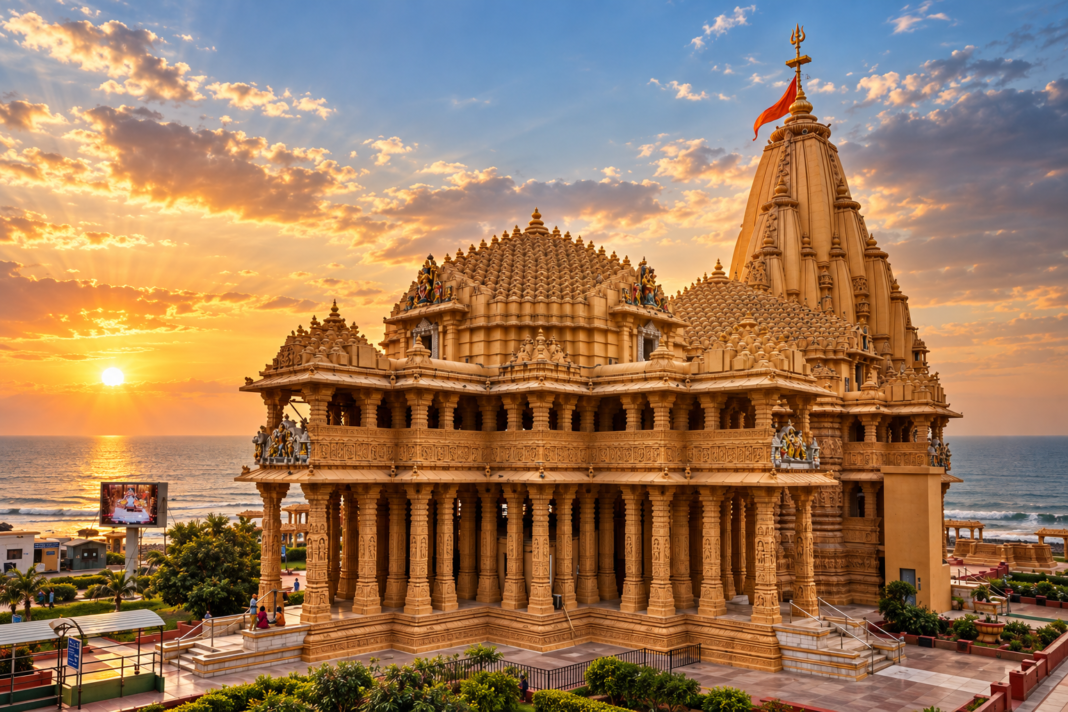
Quick answer: According to the official Shree Dwarkadhish Devasthan Samiti schedule, Dwarkadhish Temple timings are 6:30 am to 1 pm in the morning and 5 pm to 9:30 pm in the evening. The temple stays closed from about 1 pm to 5 pm. The main aarti times are Mangla Aarti at 6:30 am, Shringar Aarti at 10:30 am, Sandhya Aarti at 7:30 pm and Shayan Aarti at 8:30 pm. Darshan also pauses for short bhog breaks through the day. Timings can change on festivals, so always check before you go.
Planning Your Dwarka Darshan
Few moments match your first sight of the Dwarkadhish Temple. The tall stone spire rises over the old town. A huge, colourful flag flutters on top. Bells ring, and the crowd calls out, “Jai Dwarkadhish!”
But here’s the thing. The temple doesn’t stay open all day. Instead, it follows a careful daily routine of aartis, bhog offerings and rest. So, if you arrive at the wrong time, you may wait for hours at a closed door.
In this guide, we explain everything about Dwarkadhish Temple timings. First, we share the full official daily schedule. Next, we cover the Dwarka aarti time for each aarti and the best times for darshan. Then, we look at festival timings, rules, how to reach and nearby temple timings. Finally, we answer the questions pilgrims ask most.
A note on sources: The schedule in this guide comes from the official website of the Shree Dwarkadhish Devasthan Samiti. However, the temple itself notes that timings may change on special days and festivals. So, please confirm before your visit.
Dwarkadhish Temple Timings at a Glance
| Detail | Timing |
|---|---|
| Morning darshan | 6:30 am to 1:00 pm |
| Afternoon closure (Anosar) | 1:00 pm to 5:00 pm |
| Evening darshan | 5:00 pm to 9:30 pm |
| Mangla Aarti | 6:30 am |
| Shringar Aarti | 10:30 am to 10:45 am |
| Uthappan (first evening darshan) | 5:00 pm |
| Sandhya Aarti | 7:30 pm to 7:45 pm |
| Shayan Aarti | 8:30 pm to 8:35 pm |
| Temple closes | 9:30 pm |
| Open days | All days of the week |
| Entry fee | Free |
| Temple contact | +91 2892 234080 (phone and WhatsApp) |
Find the temple: Open map
About the Dwarkadhish Temple
The Dwarkadhish Temple, also called Jagat Mandir, stands in Dwarka town in the Devbhumi Dwarka district of Gujarat. It’s dedicated to Lord Krishna as Dwarkadhish, which means “the King of Dwarka”.
It’s one of the four Char Dham pilgrimage sites of Hinduism, along with Badrinath, Puri and Rameswaram. In addition, it’s one of the seven sacred cities, the Sapta Puri. So, millions of pilgrims visit every year.
According to the temple’s own history, a first shrine here is linked with Vajranabha, Krishna’s great-grandson. Later, Adi Shankaracharya is said to have renewed it around 800 AD. The present temple has been rebuilt and extended over many centuries. Since 1960, the government has managed the temple through the Devasthan Samiti, as per the official site.
The temple has two main gates. The Swarg Dwar (Gate of Heaven) is the main entry for pilgrims. Meanwhile, the Moksha Dwar (Gate of Liberation) leads down 56 steps to the sacred Gomti river.
Official Dwarkadhish Temple Timings: Full Daily Schedule
Here’s the complete daily time table, as published by the Shree Dwarkadhish Devasthan Samiti. It shows when darshan is open and when it’s closed for rituals.
Morning Schedule
| Time | Ritual | Darshan |
|---|---|---|
| 6:30 am | Mangla Aarti | Open |
| 7:00 am to 8:00 am | Mangla Darshan | Open |
| 8:00 am to 9:00 am | Abhishek Pooja (Snan Vidhi) | Closed |
| 9:00 am to 9:30 am | Shringar Darshan | Open |
| 9:30 am to 9:45 am | Snanbhog | Closed |
| 9:45 am to 10:15 am | Shringar Darshan | Open |
| 10:15 am to 10:30 am | Shringarbhog | Closed |
| 10:30 am to 10:45 am | Shringar Aarti | Open |
| 11:05 am to 11:20 am | Gwal Bhog | Closed |
| 11:20 am to 12:00 pm | Darshan | Open |
| 12:00 pm to 12:20 pm | Rajbhog | Closed |
| 12:20 pm to 12:30 pm | Darshan | Open |
| 1:00 pm | Anosar (rest) | Closed |
Evening Schedule
| Time | Ritual | Darshan |
|---|---|---|
| 5:00 pm | Uthappan (first darshan) | Open |
| 5:30 pm to 5:45 pm | Uthappan Bhog | Closed |
| 5:45 pm to 7:15 pm | Darshan | Open |
| 7:15 pm to 7:30 pm | Sandhya Bhog | Closed |
| 7:30 pm to 7:45 pm | Sandhya Aarti | Open |
| 8:00 pm to 8:10 pm | Shayan Bhog | Closed |
| 8:10 pm to 8:30 pm | Darshan | Open |
| 8:30 pm to 8:35 pm | Shayan Aarti | Open |
| 8:35 pm to 9:00 pm | Darshan | Open |
| 9:00 pm to 9:20 pm | Bantabhog and Shayan | Closed |
| 9:20 pm to 9:30 pm | Darshan | Open |
| 9:30 pm | Temple closes | Closed |
Source: Official time table of the Shree Dwarkadhish Devasthan Samiti. The Samiti notes that timings may change on special days and festivals.
Dwarka Mandir Timing in Simple Words
If the full table feels like a lot, here’s the simple version of the Dwarka mandir timing.
- Morning: The temple opens with Mangla Aarti at 6:30 am and stays open until about 1 pm.
- Afternoon: From 1 pm to 5 pm, the doors close while the deity rests. This is called anosar.
- Evening: The doors reopen at 5 pm and close for the night at 9:30 pm.
- Short breaks: Through the day, darshan pauses for 10 to 60 minutes during bhog and other rituals.
In other words, you have about six and a half hours in the morning and four and a half hours in the evening. However, the short breaks mean you shouldn’t expect non-stop darshan.
Dwarka Aarti Time: Every Aarti Explained
The Dwarka aarti time is one of the most searched details by pilgrims. That’s because aarti is the most moving part of the day. Lamps glow, bells ring and the crowd sings together. Here’s each aarti, with its time and meaning.
1. Mangla Aarti: 6:30 am
Mangla Aarti is the first aarti of the day. It “wakes” the Lord in the morning. Devotees believe this darshan is especially auspicious, as it’s the first glimpse of Dwarkadhish each day.
Because of this, crowds gather well before 6:30 am. So, if you want a good spot, reach the temple by around 6 am. After the aarti, Mangla Darshan continues until 8 am.
2. Shringar Aarti: 10:30 am
Before this aarti, the deity is bathed and then dressed in fine clothes and jewellery. This is called shringar. The Shringar Aarti then celebrates the Lord in his full royal attire.
For many pilgrims, this is the most beautiful darshan of the day. Also, it’s usually less crowded than Mangla Aarti. So, it’s a good choice for families and elders.
3. Rajbhog: 12:00 pm
Rajbhog is the royal midday meal offered to the Lord. Darshan closes from 12:00 pm to 12:20 pm for this offering. Then, it reopens briefly before the afternoon rest.
Note: The official schedule lists Rajbhog as a closed-darshan offering, not a public aarti. Some sources call it “Rajbhog Aarti”, so don’t be confused if you see that name.
4. Uthappan: 5:00 pm
Uthappan means “waking up”. After the afternoon rest, the Lord is woken, and the doors open for the first evening darshan at 5 pm. It’s a lovely, calm time to visit.
5. Sandhya Aarti: 7:30 pm
Sandhya Aarti is the evening aarti, held as night falls. Lamps are waved before the deity, and the temple glows with light. It’s one of the most popular aartis, so expect big crowds.
6. Shayan Aarti: 8:30 pm
Shayan Aarti is the last aarti of the day. It puts the Lord to rest for the night. It’s short, lasting only about five minutes. After it, darshan continues with short breaks until the temple closes at 9:30 pm.
| Aarti | Time | Meaning | Crowd level |
|---|---|---|---|
| Mangla Aarti | 6:30 am | Waking the Lord | High |
| Shringar Aarti | 10:30 am | After dressing the Lord | Medium |
| Sandhya Aarti | 7:30 pm | Evening lamp offering | High |
| Shayan Aarti | 8:30 pm | Putting the Lord to rest | Medium |
Dwarka Mandir Timing by Day of the Week
Many pilgrims ask whether the Dwarka mandir timing changes on certain weekdays. The good news is that it doesn’t. The temple follows the same daily schedule on all seven days, from Monday to Sunday.
However, crowds do change through the week. Here’s a general guide.
| Day | Temple open? | Typical crowd |
|---|---|---|
| Monday to Thursday | Yes, normal schedule | Lighter |
| Friday | Yes, normal schedule | Moderate |
| Saturday and Sunday | Yes, normal schedule | Heavier |
| Public holidays | Yes, unless a festival changes timings | Heavy |
| Ekadashi and full moon days | Yes, special rituals possible | Heavier |
Note: Crowd levels are a general guide based on typical pilgrim patterns, not official data.
What Do Bhog, Shringar and Anosar Mean?
The temple schedule uses many traditional words. Knowing them makes the time table much easier to follow.
- Mangla: The first, auspicious darshan of the morning.
- Abhishek or Snan Vidhi: The ritual bath of the deity.
- Shringar: Dressing and decorating the deity with clothes, flowers and jewellery.
- Bhog: Food offered to the Lord. The temple offers several bhogs through the day.
- Gwal Bhog: A late-morning snack, linked with Krishna’s life as a cowherd.
- Rajbhog: The royal midday meal.
- Anosar: The afternoon rest, when darshan is closed.
- Uthappan: Waking the Lord after the afternoon rest.
- Sandhya: Evening.
- Shayan: Sleep, or putting the Lord to bed.
- Bantabhog: A final offering at night.
This routine treats the deity like a living king. So, just as a king wakes, bathes, dresses, eats and rests, so does Dwarkadhish. That’s why darshan opens and closes at set times through the day.
Dwarka Darshan Time: When Is the Best Time to Go?
The best Dwarka darshan time depends on what you want. Here’s a simple guide.
| If you want… | Best time | Why |
|---|---|---|
| The most auspicious darshan | 6:30 am (Mangla Aarti) | The first darshan of the day |
| The Lord in full shringar | 9:45 am to 10:45 am | Shringar darshan and aarti |
| A calmer morning visit | 11:20 am to 12:00 pm | Usually fewer people than early morning |
| A long, unbroken evening darshan | 5:45 pm to 7:15 pm | The longest open window of the day |
| A glowing evening aarti | 7:30 pm (Sandhya Aarti) | Lamps, bells and a lively crowd |
| A quiet end to the day | 8:35 pm to 9:00 pm | After Shayan Aarti, before closing |
Times to Avoid
- 8:00 am to 9:00 am: Darshan is closed for Abhishek. Many first-timers arrive right after Mangla and get stuck here.
- 1:00 pm to 5:00 pm: The temple is closed for the afternoon rest.
- After 9:20 pm: Only a short window remains before closing at 9:30 pm.
- Festival peaks: Janmashtami and long weekends bring very large crowds.
Our tip: If you can only visit once, go for the evening window from 5:45 pm to 7:15 pm. Then, stay on for Sandhya Aarti at 7:30 pm. That way, you get a long darshan and a beautiful aarti in one visit.
Morning or Evening Darshan: Which Is Better?
Both sessions have their own charm. So, which should you choose? Here’s a quick comparison.
| Feature | Morning (6:30 am to 1 pm) | Evening (5 pm to 9:30 pm) |
|---|---|---|
| Main aartis | Mangla and Shringar | Sandhya and Shayan |
| Weather | Cooler early on | Cooler after sunset |
| Longest open window | Shorter, with more breaks | 5:45 pm to 7:15 pm |
| Atmosphere | Fresh and devotional | Lamps, bells and a lively crowd |
| Best for | Early risers and Mangla darshan | Families and first-time visitors |
Ideally, try to do both. Many pilgrims attend Mangla Aarti in the morning, go sightseeing in the afternoon and return for Sandhya Aarti. That way, you see the Lord in two very different moods.
Dwarka Darshan Time for a Short Visit
Not everyone has a full day in Dwarka. So, here’s how to plan your Dwarka darshan time if you’re short on time.
- Only one hour: Visit between 5:45 pm and 7:15 pm, when darshan runs without a break.
- Only a morning: Attend Mangla Aarti at 6:30 am, then leave by 8 am.
- Passing through at midday: Aim for 11:20 am to 12 pm, before the Rajbhog break.
- Arriving late at night: Reach before 9 pm to catch the last darshan windows.
Also, keep 20 to 30 minutes extra for security and depositing your phone and shoes.
How Long Does Darshan Take?
On a normal day, darshan usually takes 30 minutes to an hour, including the queue and security check. However, on weekends, holidays and festivals, it can take much longer.
Here’s a rough guide.
- Weekday, non-festival: About 30 to 60 minutes.
- Weekend or holiday: About 1 to 2 hours.
- Major festival: Several hours, especially around Janmashtami.
Note: These are general estimates based on common visitor experience, not official figures.
What Happens During the Dwarka Aarti?
If you’ve never attended an aarti here, here’s what to expect. First, the crowd gathers and waits as the curtain stays closed. Then, the curtain opens, and the priest waves a lamp with many wicks before the deity. At the same time, bells and drums ring out, and devotees sing and clap.
The whole aarti may last only a few minutes. Still, it’s full of energy and devotion. Afterwards, many devotees hold their hands over the lamp flame and touch their eyes, taking the Lord’s blessing.
Aarti Etiquette
- Arrive early, as the best spots fill up fast.
- Stay calm when the crowd moves forward.
- Keep your hands free and avoid carrying bags.
- Join in the chanting if you like, or simply watch quietly.
- Let elders and children stay safely at the side.
Dwarkadhish Temple Timings on Festivals
On festival days, the daily routine often changes. The official Devasthan Samiti clearly states that timings may change on special days and festivals. So, for these days, always check the temple’s official website or call the temple office.
Janmashtami
Janmashtami, Krishna’s birthday, is the biggest festival at Dwarka. Lakhs of devotees arrive. Celebrations build up through the day and peak at midnight, the moment of Krishna’s birth. As a result, the temple follows a special schedule, often staying open very late.
The official website publishes a special Krishna Janmotsav schedule each year. So, check it closer to the date.
Holi and Fuldol
Around Holi, Dwarka celebrates Fuldol, a colourful festival of flowers and colours. Many pilgrims walk to Dwarka on foot from across Saurashtra for it. So, the town and temple get very busy.
Diwali and Annakut
During Diwali, the temple is decorated with lights. The day after Diwali, a grand Annakut, or mountain of food offerings, is traditionally presented to the Lord in Pushtimarg temples. Darshan timings may shift on these days.
Other Special Days
Other occasions that may bring special darshan or changed timings include Ram Navami, Sharad Purnima, Tulsi Vivah and eclipse days. Temples often close during a solar or lunar eclipse and reopen after cleansing rituals.
| Festival | Usual month | What to expect |
|---|---|---|
| Janmashtami | August or September | Huge crowds; midnight celebration; special schedule |
| Holi and Fuldol | March | Colours, flowers and many foot pilgrims |
| Diwali and Annakut | October or November | Lights, grand food offerings, busy darshan |
| Sharad Purnima | October | Full-moon celebrations |
| Eclipse days | Varies | Temple may close during the eclipse |
Important: Festival dates follow the Hindu calendar, so they shift each year. Always check the current year’s festival calendar on the official website.
Prasad at the Dwarkadhish Temple
After darshan, most pilgrims like to take home prasad. At Dwarka, you’ll find prasad counters and shops near the temple selling sweets and dry offerings. So, you can easily pick some up for family and friends.
The many bhogs in the daily schedule, such as Gwal Bhog and Rajbhog, are offered to the Lord first. Later, parts of these offerings may be shared with devotees as prasad. However, how and when prasad is given can vary. Therefore, ask at the temple counters for the current system.
Tip: Buy prasad only from the temple counters or well-known shops nearby. Also, keep it in a clean, dry bag for the journey home.
Live Darshan and Online Seva
Can’t travel to Dwarka? The official Devasthan Samiti website offers live darshan streaming from the temple. So, you can join the aartis from home.
The website also offers online seva, bhog and donation options. However, always use the official website for bookings and payments. Beware of fake sites or agents promising paid “VIP darshan”.
Official website: dwarkadhish.org
The Dhwaja: The Temple’s Famous Flag
One of Dwarka’s most striking sights is the huge flag, or dhwaja, flying from the top of the temple. According to the official site, it’s 52 yards long. Its colours are said to represent virtues such as bravery, peace and knowledge.
The flag is changed several times a day. Devotees book the honour of offering a flag, often years in advance. According to the official site, flag bookings are arranged through the Guggali Brahmin community, who have served the temple for generations.
If you’re at the temple during a flag change, stop and watch. It’s a moving sight as a new flag climbs the tall spire.
Temple Rules You Should Know
Following the rules makes your darshan smoother. Here are the key ones. However, rules can change, so follow the signs and staff instructions on the day.
Mobile Phones and Cameras
Visitors widely report that mobile phones and cameras aren’t allowed inside the main temple. Counters near the entrance usually let you deposit them. So, carry as little as possible.
Dress Code
In 2023, the temple asked devotees to wear traditional or decent clothes and to avoid short or revealing outfits. Signs near the entrance explain this. So, dress modestly. For example, men can wear trousers or dhotis, and women can wear sarees, salwar suits or long skirts.
Footwear
Remove your shoes before entering. Footwear counters are available near the gates.
Bags and Security
There’s a security check at the entrance. Large bags may not be allowed. Therefore, leave heavy luggage at your hotel.
Behaviour
- Stay calm and patient in the queue.
- Don’t push, even when crowds get tight.
- Keep an eye on children and elders.
- Follow instructions from temple staff and police.
How Darshan Works: Step by Step
- Check the time: Make sure darshan is open when you arrive.
- Deposit items: Leave your phone, camera and footwear at the counters.
- Pass security: Go through the security check at the gate.
- Join the queue: Enter through Swarg Dwar and follow the line.
- Take darshan: Offer your prayers before the deity in the main sanctum.
- Visit the other shrines: The complex has several smaller shrines, including ones for Devaki, Balarama, Radha and others.
- Exit via Moksha Dwar: Walk down the 56 steps towards the Gomti river.
- Collect your items: Pick up your phone and shoes on the way out.
Is There VIP or Paid Darshan?
Darshan at the Dwarkadhish Temple is free for everyone. Some websites and agents offer “VIP darshan” packages. However, we couldn’t find any official paid fast-track darshan on the Devasthan Samiti website.
So, be careful. Don’t pay agents or unknown sites for darshan passes. If you want to offer seva, bhog or a donation, use only the official website or the temple office.
Plan Your Day Around the Temple Timings
Because the temple closes in the afternoon, it’s smart to plan your whole day around the Dwarkadhish Temple timings. Here’s a simple one-day plan that fits the schedule.
| Time | Plan |
|---|---|
| 6:00 am | Reach the temple and deposit your phone and shoes |
| 6:30 am | Mangla Aarti and Mangla Darshan |
| 8:00 am | Breakfast while darshan is closed for Abhishek |
| 9:00 am | Drive to Rukmini Devi Temple |
| 10:00 am | Nageshwar Jyotirlinga |
| 11:00 am | Gopi Talav, then on to Bet Dwarka |
| 12:00 pm | Bet Dwarka darshan before its midday break |
| 1:30 pm | Lunch and rest |
| 5:00 pm | Back in Dwarka; stroll by the Gomti and Sudama Setu |
| 5:45 pm | Evening darshan at Dwarkadhish Temple |
| 7:30 pm | Sandhya Aarti |
| 8:30 pm | Shayan Aarti, then dinner |
This plan uses the afternoon closure for sightseeing and rest. As a result, you don’t waste time waiting at closed doors.
Timings of Other Temples Near Dwarka
Most pilgrims visit several temples around Dwarka on the same trip. Their timings differ from the main temple. The times below are approximate, based on common listings, so confirm locally.
| Temple | Distance from Dwarkadhish Temple | Approximate timings |
|---|---|---|
| Rukmini Devi Temple | About 2 km | Early morning to evening |
| Nageshwar Jyotirlinga | About 16 to 18 km | Early morning to evening, with breaks for rituals |
| Gopi Talav | About 20 km | Daytime |
| Bet Dwarka Temple | About 30 km by road | Roughly 7:30 am to 1 pm and 4:30 pm to 8 pm |
| Hanuman Dandi, Bet Dwarka | On Bet Dwarka island | Roughly 5 am to 10 pm |
Rukmini Devi Temple
This lovely, carved temple honours Rukmini, Krishna’s chief queen. According to legend, she lives apart from Krishna because of a sage’s curse. So, pilgrims visit her temple to complete their Dwarka yatra.
Find it: Open map
Nageshwar Jyotirlinga
Nageshwar is one of the 12 Jyotirlingas of Lord Shiva. A large statue of Shiva stands at the site. Many pilgrims visit it on the way to Bet Dwarka.
Find it: Open map
Gopi Talav
Gopi Talav is a small pond linked with the gopis of Vrindavan. Its yellow clay, called gopi chandan, is used by devotees for tilak.
Find it: Open map
Bet Dwarka
Bet Dwarka is an island believed to be Krishna’s home, where he welcomed his friend Sudama. Since 2024, it’s linked to the mainland by Sudarshan Setu. Its temple has its own timings and a midday closure, so plan to arrive by late morning.
Find it: Open map
Gomti Ghat and the Evening Scene
Just below the temple, the Gomti river meets the Arabian Sea. Pilgrims take a holy dip at Gomti Ghat before darshan. In the evening, the ghat fills with devotees, lamps and sea breeze.
The Sudama Setu, a pedestrian bridge over the Gomti, offers lovely views of the temple, especially at sunset. So, the time between the evening opening and Sandhya Aarti is perfect for a walk here.
Sudama Setu: Open map
How to Reach the Dwarkadhish Temple
By Train
Dwarka railway station is about 2 km from the temple. It’s on the Rajkot–Okha line and has trains from Ahmedabad, Rajkot, Mumbai and other cities. From the station, take an auto-rickshaw to the temple.
Dwarka station: Open map
By Air
The nearest airports are Jamnagar (about 130 to 140 km) and Porbandar (about 100 km). From either, you can hire a taxi to Dwarka. Also, Rajkot’s international airport is a larger option, though it’s further away.
By Road
Dwarka is well connected by road. It’s about 440 to 460 km from Ahmedabad, which takes around 8 to 9 hours by car. It’s about 220 km from Rajkot and about 100 km from Porbandar. GSRTC and private buses run to Dwarka from most big cities in Gujarat.
| From | Approx. distance | Approx. road time |
|---|---|---|
| Ahmedabad | 440 to 460 km | 8 to 9 hours |
| Rajkot | About 220 km | 4 to 5 hours |
| Jamnagar | About 130 to 140 km | 2.5 to 3 hours |
| Porbandar | About 100 km | 2 hours |
| Somnath | About 230 to 240 km | 4.5 to 5 hours |
Timing tip: If you’re driving from Ahmedabad, you’ll likely reach in the afternoon, when the temple is closed. So, plan to check in, rest and head for the 5 pm opening.
Best Time of Year to Visit Dwarka
The best time to visit Dwarka is from October to March, when the weather is pleasant. Summers, from April to June, are hot and humid. The monsoon, from July to September, brings rain and rough seas, though the town looks fresh and green.
- For comfortable weather: November to February.
- Janmashtami visits: August or September, if you don’t mind very large crowds.
- For quieter darshan: Weekdays outside festival and holiday seasons.
Where to Stay Near the Temple
Dwarka has a wide range of hotels, guesthouses and dharamshalas. Many sit within walking distance of the temple. Staying close helps a lot, especially if you plan to attend Mangla Aarti at 6:30 am.
- Near the temple: Best for early aartis and late-evening darshan.
- Along the main roads: More choice of mid-range hotels.
- Dharamshalas: Budget-friendly stays run by trusts and communities.
Tip: Book early for Janmashtami, Diwali and long weekends. Rooms fill up fast.
Tips for a Smooth Darshan
- Check timings first: Especially on festival days.
- Arrive early: Reach 20 to 30 minutes before any aarti.
- Travel light: Leave phones, cameras and bags at your hotel if you can.
- Dress modestly: Follow the temple’s dress guidelines.
- Carry small change: Useful for offerings, prasad and counters.
- Avoid 8 am to 9 am: Darshan is closed for Abhishek.
- Use the afternoon well: Visit other temples or rest from 1 pm to 5 pm.
- Stay hydrated: Queues can be long and warm.
- Watch out for touts: Use official channels only.
Visiting With Elders and Kids
- Choose less crowded slots, such as 11:20 am to 12 pm or 5:45 pm to 7:15 pm.
- Ask temple staff about any help for senior citizens or people with disabilities.
- Keep children close in crowds, and agree on a meeting point.
- Carry water, light snacks and any needed medicines.
- Take breaks, as the 56 steps to the Gomti can be tiring.
Common Mistakes Pilgrims Make
- Arriving at 2 pm. The temple is closed until 5 pm. So, plan for morning or evening.
- Coming at 8 am after Mangla. Darshan is closed for an hour. Instead, come at 9 am.
- Carrying a phone inside. You’ll have to go back and deposit it. Therefore, leave it at the counter first.
- Ignoring festival changes. Timings shift on special days. Hence, check the official website.
- Paying for “VIP darshan”. Darshan is free. So, avoid agents.
Myths and Facts About Dwarka Darshan
| Myth | Fact |
|---|---|
| The temple is open all day. | It closes from 1 pm to 5 pm and for short bhog breaks. |
| You need a paid ticket for darshan. | Darshan is free for everyone. |
| Timings are the same every day of the year. | They can change on festivals and special days. |
| The temple is closed on some weekdays. | It’s open every day, following the daily schedule. |
| Mangla Aarti is at 5 am. | The official schedule lists Mangla Aarti at 6:30 am. |
A Quick Pilgrim’s Checklist
- Check the Dwarkadhish Temple timings for your date.
- Pick your aarti: Mangla, Shringar, Sandhya or Shayan.
- Book a stay near the temple for early aartis.
- Pack modest, traditional clothes.
- Carry small change and a water bottle.
- Plan other temples for the 1 pm to 5 pm break.
- Save the temple’s phone number: +91 2892 234080.
Quick Recap: Dwarkadhish Temple Timings
- Morning darshan: 6:30 am to 1 pm.
- Afternoon: Closed from 1 pm to 5 pm.
- Evening darshan: 5 pm to 9:30 pm.
- Mangla Aarti: 6:30 am.
- Shringar Aarti: 10:30 am.
- Sandhya Aarti: 7:30 pm.
- Shayan Aarti: 8:30 pm.
- Entry: Free.
- Festivals: Timings may change, so check first.
More Temple Guides From Amdavad Gully
- Famous temples in Gujarat
- Famous temples in Ahmedabad
- Lothal: The Harappan port city
- Tourist places in Ahmedabad
Dwarka Aarti Time and Darshan Time: One-Line Answers
- Dwarka darshan time (morning): 6:30 am to 1 pm.
- Evening Dwarka darshan time: 5 pm to 9:30 pm.
- Dwarka aarti time (morning): Mangla at 6:30 am and Shringar at 10:30 am.
- Evening Dwarka aarti time: Sandhya at 7:30 pm and Shayan at 8:30 pm.
- Dwarka mandir timing for the afternoon break: Closed from 1 pm to 5 pm.
Frequently Asked Questions
What are the Dwarkadhish Temple timings?
As per the official Devasthan Samiti schedule, the Dwarkadhish Temple is open from 6:30 am to 1 pm and from 5 pm to 9:30 pm. It’s closed from 1 pm to 5 pm, and darshan pauses briefly for bhog through the day.
What is the Dwarka darshan time today?
On normal days, Dwarka darshan time is 6:30 am to 1 pm and 5 pm to 9:30 pm. On festivals, timings may change, so check the official website dwarkadhish.org or call the temple on +91 2892 234080.
What is the Dwarka aarti time?
The main Dwarka aarti times are Mangla Aarti at 6:30 am, Shringar Aarti at 10:30 am, Sandhya Aarti at 7:30 pm and Shayan Aarti at 8:30 pm.
What is the Dwarka mandir timing in the afternoon?
The Dwarka mandir is closed in the afternoon from 1 pm to 5 pm for anosar, the deity’s rest. Darshan reopens at 5 pm with Uthappan.
What time is Mangla Aarti at Dwarkadhish Temple?
Mangla Aarti is at 6:30 am, followed by Mangla Darshan from 7 am to 8 am.
What time is Sandhya Aarti in Dwarka?
Sandhya Aarti at the Dwarkadhish Temple is from 7:30 pm to 7:45 pm.
What time is Shayan Aarti in Dwarka?
Shayan Aarti is from 8:30 pm to 8:35 pm. It’s the last aarti of the day.
What time does the Dwarkadhish Temple close at night?
The temple closes at 9:30 pm, after a short final darshan from 9:20 pm to 9:30 pm.
When is darshan closed at the Dwarkadhish Temple?
Darshan is closed from 8 am to 9 am for Abhishek, from 1 pm to 5 pm for anosar, and for short bhog breaks such as 12 pm to 12:20 pm and 7:15 pm to 7:30 pm.
What is the best time for darshan in Dwarka?
For an auspicious start, go for Mangla Aarti at 6:30 am. For a longer, calmer darshan, visit between 5:45 pm and 7:15 pm and stay for Sandhya Aarti at 7:30 pm.
Is there an entry fee for the Dwarkadhish Temple?
No. Darshan at the Dwarkadhish Temple is free for all devotees.
Are mobile phones allowed in the Dwarkadhish Temple?
Visitors report that mobile phones and cameras aren’t allowed inside the main temple. Counters near the entrance let you deposit them.
Is there a dress code at the Dwarkadhish Temple?
Yes. The temple asks devotees to wear traditional or decent clothes and avoid short or revealing outfits.
Do Dwarkadhish Temple timings change on Janmashtami?
Yes. On Janmashtami and other festivals, the temple follows a special schedule and may stay open late. Check the official website for that year’s timings.
Can I watch live darshan of Dwarkadhish online?
Yes. The official Shree Dwarkadhish Devasthan Samiti website offers live darshan streaming from the temple.
The Bottom Line
The Dwarkadhish Temple follows a royal daily rhythm. It opens at 6:30 am with Mangla Aarti, closes for the afternoon from 1 pm to 5 pm, and ends the day at 9:30 pm after Shayan Aarti. In between, short bhog breaks pause darshan.
So, plan around the schedule. Catch Mangla Aarti if you can, use the afternoon to see Rukmini, Nageshwar and Bet Dwarka, and return for the glowing Sandhya Aarti. Above all, check the official website before festival visits. Jai Dwarkadhish!
Run a hotel, travel agency or business on the Dwarka route? Get featured on Amdavad Gully. Write to us at amdavadgully@gmail.com.
References
- Shree Dwarkadhish Devasthan Samiti – Official Time Table
- Gujarat Tourism – Official website
- Shree Dwarkadhish Devasthan Samiti – Jagat Mandir
- Wikipedia – Dwarkadhish Temple
- Shree Dwarkadhish Devasthan Samiti – Contact Details
The temple notes that timings may change on special days and festivals, so please verify before your visit. Distances and nearby temple timings are approximate.