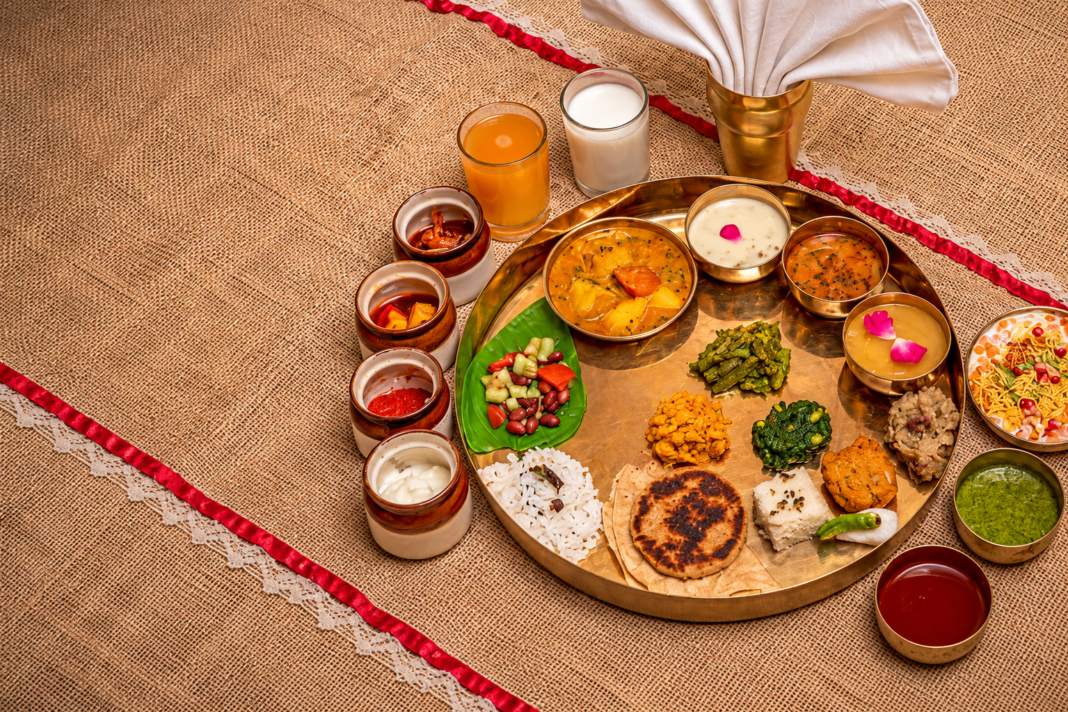
Quick answer: The food of Gujarat is mostly vegetarian. It’s known for a mix of sweet, salty, sour and spicy tastes, and many dishes use a little jaggery or sugar. The classic meal is the Gujarati thali: dal, kadhi, sabzi, rotli, rice, snacks, pickle and a sweet, all on one plate. Famous foods include dhokla, khaman, khandvi, thepla, fafda-jalebi, undhiyu, handvo, dal dhokli, khichdi-kadhi, dabeli and shrikhand. Each region has its own style. Kathiawadi food is hot and rustic, Kutchi food is simple and hearty, and Surti food is rich and bold. Also, Ahmedabad is famous for street food at places like Manek Chowk.
A State That Loves to Eat
Ask anyone from Gujarat what they love most, and food will be near the top of the list. Here, people plan their day around meals. They greet guests with tea and snacks. And they never let anyone leave hungry.
Gujarati food is warm, colourful and full of surprises. A single plate can be sweet, sour, salty and spicy all at once. It’s mostly vegetarian, yet it never feels plain. And from soft dhokla to crispy fafda, there’s a snack for every hour of the day.
In this guide, we explore the food of Gujarat from top to bottom. First, we explain what makes it special. Next, we break down the famous Gujarati thali. Then, we travel through the regions, from Kathiawad to Kutch and Surat. After that, we list the best snacks, main dishes, breads, sweets and drinks. Finally, we share festival foods, street food spots, tips and a few myths.
A note on sources: We’ve used reference works and our own local know-how. Recipes and names vary from home to home and town to town. So, you may know a dish by a slightly different name. Photos marked “representative” show similar Indian dishes, not always the exact Gujarati one.

Food of Gujarat: Quick Facts
| Detail | Info |
|---|---|
| Main style | Mostly vegetarian |
| Signature taste | A balance of sweet, salty, sour and spicy |
| Classic meal | The Gujarati thali |
| Everyday staples | Rotli, dal, rice, sabzi, kadhi, khichdi, chaas |
| Famous snacks | Dhokla, khaman, khandvi, fafda, thepla, handvo |
| Famous sweets | Shrikhand, basundi, mohanthal, ghari, jalebi |
| Main regions | Kathiawad (Saurashtra), Kutch, North, Central and South Gujarat |
| Key grains | Wheat, bajra (pearl millet), jowar, rice |
| Key drink | Chaas (spiced buttermilk) |
| Famous food streets | Manek Chowk and Law Garden (Ahmedabad) |
What Makes Gujarati Food Special?
Gujarati food has a clear personality. Here are the things that set it apart.
1. It’s Mostly Vegetarian
Gujarat is largely a vegetarian state. As a result, cooks have spent centuries making vegetables, lentils, grains and dairy taste amazing. That’s why the cuisine is so rich in ideas.
Still, it’s not all veg. For example, people on the coast eat fish. Also, some groups, such as Parsis and many Muslim families, have their own meat dishes. Wikipedia also notes that the Kharwa people of coastal Gujarat have a fish-based diet.
2. The Sweet Touch
Many Gujarati dishes have a hint of sweetness, even dal and sabzi. Cooks often add a little jaggery or sugar. This balances the sour taste of lemon, tomato or kokum and the heat of chilli. So, the overall flavour feels round and gentle.
However, not all Gujarati food is sweet. In fact, Kathiawadi food is known for being spicy. So, it depends on the region and the family.
3. Sweet, Sour, Salty and Spicy Together
A good Gujarati meal balances all the tastes. For instance, a thali may have sweet shrikhand, sour kadhi, salty farsan and spicy pickle. Together, they make each bite interesting.
4. Clever Cooking for a Hot, Dry Land
Much of Gujarat is hot and dry. So, the food has adapted. Buttermilk cools the body. Salt, lemon and tomato help in the heat, as Wikipedia notes. Also, dried and fried snacks keep well, which suited traders and travellers.
5. The Magic of Vaghar
“Vaghar” is the Gujarati word for tempering. Cooks heat oil or ghee, then add mustard seeds, cumin, curry leaves, asafoetida, chillies and other spices. Then, this hot mix is poured over dal, kadhi or dhokla. It adds a burst of aroma and flavour.
6. Love of Steamed Food
Gujarat is famous for steamed snacks such as dhokla, khaman, muthiya and patra. These are light, soft and less oily than fried snacks. As a result, they’re loved across India.
7. Millets and Pulses
Long before millets became trendy, Gujarat was eating them. Bajra rotla, jowar bhakri and many pulses are part of daily meals, especially in villages.

Common Spices and Ingredients
| Ingredient | How it’s used |
|---|---|
| Mustard seeds | In vaghar for dal, kadhi and dhokla |
| Cumin | In vaghar, chaas and many dishes |
| Asafoetida (hing) | A pinch for flavour and easy digestion |
| Turmeric | For colour in dal, sabzi and khichdi |
| Green chilli and ginger | Fresh heat in most dishes |
| Jaggery (gol) | A gentle sweetness in dal and sabzi |
| Kokum | A sour fruit used in dal and kadhi |
| Gram flour (besan) | Base for kadhi, khandvi, khaman and many snacks |
| Yogurt and buttermilk | For kadhi, chaas and shrikhand |
| Groundnut oil | A common cooking oil |
| Sesame seeds | For garnish and winter sweets like chikki |
| Curry leaves | For aroma in vaghar |
The Gujarati Thali, Explained
The Gujarati thali is the best way to taste the food of Gujarat in one go. “Thali” means plate. And in Gujarat, it’s a big round plate filled with small bowls of many dishes.
As per Wikipedia, a typical thali has rotli, dal or kadhi, rice and shaak (vegetables). It may also have pulses, farsan and sweets. At festivals and special restaurants, a thali can have more than a dozen items. In many restaurants, servers keep refilling your bowls until you say stop.
What’s on a Gujarati Thali?
| Part | What it is | Example |
|---|---|---|
| Rotli | Thin wheat flatbread with ghee | Rotli, bhakri, puri |
| Dal | Sweet-sour lentil soup | Gujarati toor dal |
| Kadhi | Yogurt and gram flour curry | Gujarati kadhi |
| Shaak | Vegetable dishes | Bateta nu shaak, ringan no olo |
| Kathol | Pulse or bean dishes | Mag, chana, val |
| Rice | Plain rice or pulao | Jeera rice |
| Farsan | Snacks | Dhokla, khandvi, patra |
| Mithai | Sweet | Shrikhand, basundi, mohanthal |
| Sides | Pickles, chutney, papad, salad | Mango pickle, green chutney |
| Drink | Buttermilk | Chaas |
How to Eat a Gujarati Thali
- First, start with the farsan and the sweet. Many Gujaratis eat a bit of sweet early in the meal.
- Next, have rotli with shaak and dal. Tear a piece of rotli and scoop up the vegetables.
- Then, move to rice with dal or kadhi. Mix them with your fingers or a spoon.
- Also, sip chaas through the meal. It helps digestion.
- Finally, end with khichdi and kadhi, if served. It’s a comforting close.
Tip: Don’t fill up too fast. The servers will keep coming back with more. So, pace yourself and try a little of everything.
Famous Thali Restaurants in Ahmedabad
Ahmedabad has many great thali spots. Two well-known names are listed below. Prices and menus change, so check before you go.
- Agashiye: A rooftop restaurant on a heritage house in the old city, known for its thali in a historic setting. Open map
- Vishalla: A village-themed restaurant where you sit on the floor and eat in traditional style. Open map
Regional Food of Gujarat
Gujarat isn’t one single food culture. Instead, each region has its own taste, shaped by its land, weather and people. Wikipedia names five main regions: North Gujarat, Kathiawad, Kutch, Central Gujarat and South Gujarat. Here’s how their food differs.
Kathiawadi Food (Saurashtra)
Kathiawad, or Saurashtra, is the peninsula in western Gujarat. Its food is bold, spicy and rustic. In fact, it’s quite different from the “sweet Gujarati food” many people expect.
Here, people eat bajra rotla with ghee, jaggery and garlic chutney. They love sev tameta, ringan no olo, lasaniya bataka (garlic potatoes) and spicy dal. Also, Kathiawadi dhabas on highways are famous for their hearty meals.
- Must-try: Bajra rotla, sev tameta, ringan no olo, lasaniya bataka, khichdi with kadhi, gathiya and chutney.
- Taste: Spicy, garlicky and filling.
- Cities: Rajkot, Bhavnagar, Jamnagar, Junagadh.
Bhavnagar is famous for its gathiya, a crisp gram-flour snack. For example, Manubhai Ganthiya Wala is one long-running name there. Open map
Kutchi Food
Kutch is a dry, desert region. So, its food is simple, hearty and made with what grows well there. Millets, buttermilk, ghee and pulses are common.
The most famous Kutchi food is dabeli, a spicy-sweet potato filling in a soft bun, topped with peanuts and pomegranate. It’s widely said to have started in Mandvi, a coastal town in Kutch. In addition, Kutch is known for its kharek (fresh dates) in summer.
- Must-try: Dabeli, bajra rotla, kadhi khichdi, pakwan, gulab pak.
- Taste: Simple, earthy and comforting.
- Towns: Bhuj, Mandvi, Anjar.
Mandvi: Open map
For more on Kutch, see our Rann Utsav guide.
Surti Food (South Gujarat)
Surat is famous for its love of food. In fact, there’s a well-known Gujarati saying: “Surat nu jaman, Kashi nu maran”. It means a meal in Surat and death in Kashi are both the best. So, you can guess how seriously Surtis take their food.
South Gujarat gets more rain, so it grows more green vegetables. As a result, its food is rich, inventive and often green. For example, Surti undhiyu is famous, and so are locho, a soft, steamed gram-flour snack, and ponk, tender green jowar eaten in winter.
Surat is also known for its sweets. Ghari, a rich sweet filled with nuts and dipped in ghee, is eaten especially on Chandani Padvo, a local festival after Sharad Purnima. Also, try Surti sutarfeni and cold cocoa.
- Must-try: Locho, Surti undhiyu, ponk (in winter), ghari, khaman, rasawala khaman.
- Taste: Rich, bold and creative.
- City: Surat.
For ghari, Shah Jamnadas C. Ghariwala in Surat is one old, well-known name. Open map
North Gujarat Food
North Gujarat, around Mehsana, Patan and Banaskantha, is farming and dairy country. So, its food uses lots of milk, ghee and millets. Meals are simple but rich in dairy.
- Must-try: Bajra rotla, dal, kadhi, ghee-rich sweets, fresh milk products.
- Taste: Simple and wholesome.
- Towns: Mehsana, Patan, Palanpur.
Central Gujarat Food (Ahmedabad and Vadodara)
Central Gujarat, with Ahmedabad and Vadodara, has the “classic” Gujarati thali taste: a mix of sweet, sour and mild spice. It’s also home to busy street food scenes.
Ahmedabad is famous for its street food, from Manek Chowk to Law Garden. Meanwhile, Vadodara is known for sev usal, a spicy pea curry topped with sev, as well as bhakharwadi and lilo chevdo.
- Must-try: Gujarati thali, dhokla, fafda-jalebi, sev usal, bhakharwadi, dal vada in monsoon.
- Taste: Balanced, with a gentle sweetness.
- Cities: Ahmedabad, Vadodara, Anand, Nadiad.
In Vadodara, Mahakali Sev Usal is a long-loved name for sev usal. Open map
For more on Vadodara, see our Laxmi Vilas Palace guide.
Regional Food at a Glance
| Region | Taste | Signature foods |
|---|---|---|
| Kathiawad (Saurashtra) | Spicy and rustic | Bajra rotla, sev tameta, ringan no olo, gathiya |
| Kutch | Simple and hearty | Dabeli, kadhi khichdi, pakwan |
| South Gujarat (Surat) | Rich and inventive | Locho, undhiyu, ponk, ghari |
| North Gujarat | Wholesome, dairy-rich | Bajra rotla, ghee sweets, milk products |
| Central Gujarat | Balanced, mildly sweet | Thali, dhokla, fafda-jalebi, sev usal |
Community Cuisines of Gujarat
Gujarat’s food is also shaped by its many communities. Each has added its own flavours.
Jain Food
Jains follow strict food rules based on non-violence. Many avoid root crops, such as onion, garlic, potato and carrot. Some also avoid eating after sunset. So, many places in Gujarat offer “Jain” versions of dishes. For instance, “Jain pav bhaji” is made with no onion or garlic.
Parsi Food
Parsis came to Gujarat many centuries ago. Over time, they built a food culture that blends Persian and Gujarati tastes. Dishes like dhansak (lentils with meat and vegetables), patra ni machhi (fish in banana leaf) and lagan nu custard are famous. Towns like Navsari and Udvada have strong Parsi roots.
Bohra and Muslim Food
Gujarat’s Bohra and other Muslim groups have rich food ways, often with meat. For example, in Ahmedabad’s old city, lanes near Bhatiyar Gali are known for kebabs and biryani. Also, Bohra homes are known for sharing meals from one large plate called a thaal.
Coastal Food
Along Gujarat’s long coast, fishing communities eat a lot of seafood. Fish curries, fried fish and dried fish are common. So, while the state is mostly vegetarian, its coast tells a different story.
Famous Gujarati Snacks (Farsan)
“Farsan” means snacks, and Gujarat has hundreds of them. Some are steamed, some are fried, and some are roasted. Here are the most famous ones.
1. Dhokla
Dhokla is a soft, spongy cake made from a fermented batter of rice and lentils. It’s steamed, then topped with a tempering of mustard seeds, green chillies and curry leaves. It’s light, tangy and loved across India.

2. Khaman
Khaman looks like dhokla, but it’s made from gram flour (besan). It’s softer, fluffier and a bit sweeter. In fact, outside Gujarat, many people call khaman “dhokla”. So, if your “dhokla” is bright yellow and very fluffy, it’s probably khaman.
3. Khandvi
Khandvi are thin, soft rolls made from gram flour and yogurt. They’re topped with tempering, coconut and coriander. They melt in your mouth. However, they’re tricky to make, so they’re a sign of a skilled cook.
4. Fafda and Jalebi
Fafda is a crisp, long strip made from gram flour. It’s usually eaten with sweet, syrupy jalebi, papaya chutney and fried green chillies. This pair is a classic Sunday breakfast. Also, on Dussehra, Gujaratis eat huge amounts of fafda-jalebi.
5. Thepla
Thepla is a soft, spiced flatbread, often made with fenugreek leaves (methi). It keeps well for days, so Gujaratis carry it on trips. In fact, it’s often joked that a Gujarati never travels without thepla.
6. Handvo
Handvo is a savoury cake made from rice, lentils and vegetables, such as bottle gourd. It’s baked or cooked in a pan until crisp on the outside and soft inside. It’s a filling snack or light meal.

7. Muthiya
Muthiya are small dumplings made from flour and vegetables. They’re steamed, then often tempered or lightly fried. The name comes from “muthi”, meaning fist, since they’re shaped by hand.
8. Patra
Patra are made from colocasia leaves spread with a spicy-sweet gram flour paste. The leaves are rolled, steamed, sliced and tempered. They’re tangy, sweet and spicy all at once.
9. Dabeli
Dabeli is Kutch’s gift to Indian street food. A soft bun is filled with spiced, slightly sweet potato, then topped with roasted peanuts, pomegranate, sev and chutneys. It’s messy, sweet, spicy and delicious.
10. Khakhra
Khakhra is a thin, crisp, roasted flatbread. It comes in many flavours, like methi, jeera and masala. It’s a popular breakfast and travel snack, and it lasts for weeks.
11. Gathiya and Sev
Gathiya are crisp, fried gram-flour snacks, and sev are thin, crunchy noodles of the same flour. Bhavnagar is famous for its gathiya. They’re eaten with tea, chutney or fried chillies.
12. Sev Khamani
Sev khamani is crumbled khaman, mixed with spices and topped with sev, pomegranate and coriander. It’s a tasty way to use up leftover khaman.
13. Locho
Locho is a Surti snack. It’s a soft, loose, steamed gram-flour dish, topped with butter, spices, sev and chutney. Its name means “a mess” in Gujarati, since it looks like a dhokla that didn’t set. But it’s delicious.
14. Lilva Kachori
In winter, Gujaratis make kachori stuffed with fresh green pigeon peas (lilva). They’re crisp outside and sweet-spicy inside.
15. Dal Vada
Dal vada are crunchy fritters made from soaked lentils. They’re a monsoon favourite in Ahmedabad, often eaten with fried green chillies and onions.
Farsan at a Glance
| Snack | Cooking method | Main ingredient |
|---|---|---|
| Dhokla | Steamed | Rice and lentil batter |
| Khaman | Steamed | Gram flour |
| Khandvi | Cooked and rolled | Gram flour and yogurt |
| Fafda | Fried | Gram flour |
| Thepla | Pan-cooked | Wheat flour and methi |
| Handvo | Baked or pan-cooked | Rice, lentils and vegetables |
| Muthiya | Steamed | Flour and vegetables |
| Patra | Steamed | Colocasia leaves and gram flour |
| Dabeli | Assembled | Bun and spiced potato |
| Khakhra | Roasted | Wheat flour |
| Locho | Steamed | Gram flour |
| Dal vada | Fried | Soaked lentils |
Famous Gujarati Main Dishes
Undhiyu
Undhiyu is the king of Gujarati winter food. It’s a slow-cooked mix of winter vegetables, such as purple yam, sweet potato, small brinjals, beans and banana, plus methi muthiya. The name comes from “undhu”, meaning upside down. Traditionally, it was cooked in clay pots placed upside down in a fire pit. Today, it’s a must on Uttarayan, the kite festival.
Gujarati Dal
Gujarati toor dal is thin, sweet, sour and gently spiced. It often has jaggery, kokum or lemon, tomatoes and peanuts. It’s eaten with rice or rotli every day.
Gujarati Kadhi
Gujarati kadhi is a yogurt and gram flour curry. It’s thinner, whiter and sweeter than kadhi from North India. It’s usually eaten with rice or khichdi.
Khichdi
Khichdi is a simple dish of rice and lentils cooked together. It’s the ultimate comfort food in Gujarat. Many families eat it for dinner, with kadhi, papad, pickle and ghee.
Dal Dhokli
Dal dhokli is a one-pot meal of sweet-sour dal with pieces of spiced wheat dough cooked in it. It’s warm, filling and loved on lazy Sundays.
Sev Tameta nu Shaak
This is a tangy tomato curry topped with crunchy sev just before serving. It’s quick, cheap and very popular in Kathiawad.
Ringan no Olo
This is smoky roasted brinjal, mashed and cooked with spices. It’s the Gujarati version of baingan bharta, and it’s best with bajra rotla.
Bateta nu Shaak
A simple, light potato curry with a sweet-sour taste. It’s often served with puri, especially on festivals.
Lasaniya Bataka
Small potatoes in a fiery garlic and red chilli masala. It’s a Kathiawadi favourite for spice lovers.
Main Dishes at a Glance
| Dish | What it is | Best with |
|---|---|---|
| Undhiyu | Mixed winter vegetable casserole | Puri, jalebi |
| Gujarati dal | Sweet-sour toor dal | Rice, rotli |
| Kadhi | Yogurt and gram flour curry | Rice, khichdi |
| Khichdi | Rice and lentils | Kadhi, ghee, papad |
| Dal dhokli | Dal with wheat dumplings | On its own |
| Sev tameta | Tomato curry with sev | Rotli, rotla |
| Ringan no olo | Smoky brinjal mash | Bajra rotla |
| Lasaniya bataka | Garlic potatoes | Rotla, rotli |
Gujarati Breads
Bread is part of almost every Gujarati meal. Here are the main ones.
| Bread | What it is |
|---|---|
| Rotli | Thin, soft wheat flatbread with ghee |
| Bhakri | Thick, crisp wheat flatbread |
| Bajra rotla | Thick pearl millet flatbread |
| Thepla | Spiced flatbread, often with methi |
| Puri | Small fried, puffed bread |
| Puran poli | Sweet flatbread stuffed with lentils and jaggery |
| Khakhra | Thin, crisp, roasted flatbread |

Famous Gujarati Sweets
Gujaratis have a sweet tooth, and their sweets are rich and varied. As Wikipedia notes, many are made from milk, sugar and nuts. Here are the best known.
Shrikhand
Shrikhand is thick, strained yogurt mixed with sugar, saffron and cardamom. It’s cool, creamy and often served with puri. A mango version, called amrakhand, is also popular.
Basundi
Basundi is milk boiled slowly until thick and sweet, then flavoured with cardamom, saffron and nuts. It’s served chilled, especially on festivals.
Mohanthal
Mohanthal is a rich fudge made from gram flour, ghee and sugar, with nuts and cardamom. It’s a classic Diwali sweet.
Ghari
Ghari is Surat’s famous sweet. It’s a round pastry filled with a rich mix of milk solids and dry fruits, then dipped in ghee. It’s eaten especially on Chandani Padvo.
Jalebi
Jalebi is crisp, coiled and soaked in sugar syrup. In Gujarat, it’s paired with fafda for breakfast. Also, it’s a must on Dussehra.

Doodhpak
Doodhpak is a creamy rice pudding made with milk, sugar, saffron and nuts. It’s often served at feasts and religious events.
Sukhdi (Gol Papdi)
Sukhdi is a simple sweet of wheat flour, ghee and jaggery. It’s quick to make and very comforting. Also, it’s a common offering at temples.
Magas and Ghooghra
Magas is a gram-flour sweet with ghee, while ghooghra are sweet, filled pastries. Both are linked to weddings and Diwali, as Wikipedia notes.
Chikki
Chikki is a crunchy sweet of jaggery with peanuts or sesame seeds. It’s especially popular in winter and on Uttarayan.
Sutarfeni
Sutarfeni is a light, thread-like sweet that melts in your mouth. Surat is well known for it.
Sweets at a Glance
| Sweet | Main ingredients | Popular when |
|---|---|---|
| Shrikhand | Strained yogurt, sugar, saffron | Summer, festivals |
| Basundi | Thickened milk | Festivals |
| Mohanthal | Gram flour, ghee, sugar | Diwali |
| Ghari | Pastry, milk solids, ghee | Chandani Padvo (Surat) |
| Jalebi | Fried batter in syrup | Dussehra, Sundays |
| Doodhpak | Milk and rice | Feasts |
| Sukhdi | Wheat, ghee, jaggery | Any time |
| Chikki | Jaggery and nuts or sesame | Winter, Uttarayan |
Gujarati Drinks
Chaas (Buttermilk)
Chaas is the most loved drink in Gujarat. It’s thin, salted buttermilk, often with cumin, ginger and coriander. It cools the body and helps digestion. So, it’s served with almost every meal.
Chai
Gujaratis love their tea: strong, sweet and milky, often with ginger, cardamom or masala. Tea stalls are everywhere, and offering chai is a basic sign of welcome.

Sugarcane Juice
Fresh sugarcane juice, or sherdi no ras, is a summer favourite. It’s often served with ginger and lemon.
Aam Ras
Aam ras, or keri no ras, is thick mango pulp, eaten in summer with puri or rotli. It’s more a dish than a drink, and it’s one of the joys of a Gujarati summer.
Cold Cocoa
In Surat, chilled, thick cocoa drinks are a popular evening treat.
Pickles, Chutneys and Sides
No Gujarati meal is complete without something tangy on the side. Here are a few favourites.
- Chhundo: A sweet, spicy grated mango pickle.
- Methiyu: A mango pickle with fenugreek.
- Gor keri: A sweet mango pickle with jaggery.
- Green chutney: Coriander, mint and chilli.
- Kadhi chutney: A thin, tangy gram-flour chutney served with fafda.
- Papad: Thin, crisp, roasted or fried discs.
- Kachumber: A simple chopped salad.
Seasonal and Festival Foods of Gujarat
In Gujarat, food follows the seasons and festivals closely. Here’s what people eat through the year.
Uttarayan (14–15 January)
On the kite festival, families spend the day on rooftops. So, food is easy to eat with one hand. Undhiyu with puri, jalebi, chikki, til laddoo and sugarcane are the stars of the day.
Winter
Winter brings fresh green vegetables. So, it’s the season of undhiyu, lilva kachori, ponk in Surat and bajra rotla with ghee and jaggery. Families also make “vasanu”, rich winter sweets such as adadiya pak, meant to give strength in the cold.
Summer
Summer is mango season. So, aam ras with puri or rotli is everywhere. Also, Gujarat’s famous Gir Kesar mango, which has a GI tag, is a summer treat. Meanwhile, families make pickles to last the whole year, and chaas and shrikhand help beat the heat.
Monsoon
In the rains, people crave hot, fried snacks. So, bhajiya, dal vada and corn are monsoon favourites, along with hot chai.
Navratri
During Navratri, many people fast. Fasting foods include sabudana khichdi, rajgira and singoda dishes, fruits and dairy. Then, after a night of garba, many head out for late-night snacks.
Dussehra
On Dussehra, Gujarat eats fafda and jalebi in huge quantities. In fact, queues at sweet shops start early in the morning.
Diwali
Diwali is the biggest food festival of the year. Homes fill with sweets and snacks, such as mohanthal, ghooghra, mathiya, chorafali, chakri and sev. Families share them with friends and neighbours.
Festival Foods at a Glance
| Festival or season | Foods |
|---|---|
| Uttarayan | Undhiyu, puri, jalebi, chikki, til laddoo |
| Winter | Lilva kachori, ponk, adadiya pak, bajra rotla |
| Summer | Aam ras, pickles, chaas, shrikhand |
| Monsoon | Bhajiya, dal vada, corn, chai |
| Navratri | Fasting foods; late-night snacks |
| Dussehra | Fafda and jalebi |
| Chandani Padvo (Surat) | Ghari |
| Diwali | Mohanthal, ghooghra, mathiya, chorafali, chakri |
Street Food of Gujarat
Gujarat’s street food is a world of its own. Each city has its favourites. Here are the best places and bites, city by city.
Ahmedabad
Ahmedabad is often called the food capital of Gujarat. Two spots stand out.
Manek Chowk is in the old city. By day, it’s a busy market. But at night, it turns into a huge open-air food street. Visitors love its pav bhaji, ghotala dosa, sandwiches and kulfi. Open map
Happy Street at Law Garden is a newer, cleaner food street with food trucks and stalls. It’s known for pav bhaji, sandwiches, falooda and more, and it opens in the evening. Open map
Also, look out for dal vada in the monsoon, fafda-jalebi on Sunday mornings and roadside chai at any hour. For more ideas, see our guide to tourist places in Ahmedabad.

Surat
Surat is a city that lives to eat. Try locho in the morning, khaman through the day and ghari on special days. In winter, ponk stalls pop up all over the city. Also, try Surti cold cocoa in the evening.
Vadodara
Vadodara’s star is sev usal, a fiery pea curry topped with sev and onions, eaten with bread. In addition, the city is famous for bhakharwadi and lilo chevdo, which make great gifts.
Rajkot
Rajkot loves bold, spicy food. Try ghughra (a fried, stuffed snack), gathiya with chutney, and Kathiawadi thalis. Also, Rajkot is known for its chikki and its love of evening snacks.
Bhavnagar
Bhavnagar is famous across Gujarat for its gathiya. In fact, “Bhavnagari gathiya” is a name you’ll see on snack packets in many cities.
Kutch
In Kutch, dabeli is a must. Try it in Mandvi or Bhuj, where it’s said to have begun. Also, look for pakwan and simple, home-style Kutchi meals.
Popular Gujarati Street Foods
| Street food | What it is |
|---|---|
| Pakodi (pani puri) | Crisp puris filled with spicy water; called “pakodi” in Gujarat |
| Dabeli | Spiced potato in a bun with peanuts and pomegranate |
| Sev puri | Flat puris with potato, chutneys and sev |
| Pav bhaji | Buttery vegetable mash with soft bread |
| Sandwiches | Grilled or plain, often loaded with chutney and cheese |
| Ghughra | Fried pastry stuffed with spiced vegetables |
| Locho | Soft steamed gram-flour snack (Surat) |
| Sev usal | Spicy pea curry with sev (Vadodara) |
| Dal vada | Crunchy lentil fritters (monsoon) |
| Kulfi and falooda | Frozen and chilled milky desserts |

Street Food Tips
- Go where locals go: A busy stall usually means fresh food.
- Watch it being made: Fresh, hot food is safer.
- Be careful with water: Carry your own bottled water.
- Start mild: If you’re not used to spice, ask for less chilli.
- Carry cash: Small stalls may not always take cards, though UPI is common.
- Go in the evening: Many food streets come alive after dark.
An Evening at Manek Chowk: What It Might Feel Like
This is an imagined scene, based on how many visitors describe it.
It’s nearly 10 pm in Ahmedabad’s old city. The shops have shut. But Manek Chowk is just waking up. Stalls light up one by one. Pans sizzle. The smell of butter, spices and toasted bread fills the air.
You squeeze onto a plastic stool. First, a plate of pav bhaji arrives, glistening with butter. Then, a friend orders a sandwich, stacked high with cheese. Meanwhile, a kulfi seller calls out from his cart.
Around you, families laugh, students share plates and old-timers argue over which stall is best. Finally, you finish with a cold kulfi. It’s late, it’s loud and it’s wonderful. That’s Ahmedabad.
Gujarati Food to Take Home
Many Gujarati foods travel well. So, they make great gifts.
| Item | Why it’s a good gift |
|---|---|
| Khakhra | Light, crisp and lasts for weeks |
| Thepla | Keeps for a few days; great for journeys |
| Gathiya and sev | Classic tea-time snacks |
| Bhakharwadi | Vadodara’s famous spiral snack |
| Chikki | Crunchy and long-lasting |
| Pickles (chhundo, methiyu) | A taste of Gujarat for months |
| Ghari | Surat’s rich sweet; best eaten soon |
| Mukhwas | A sweet, fragrant after-meal mix |
Gujarati Food Etiquette
Gujarati hospitality is famous. Here’s how to be a good guest.
- Accept tea: Saying yes to chai is polite.
- Eat with your right hand: If you eat with your hands, use the right one.
- Don’t waste food: Take small amounts and ask for more.
- Say when you’re full: Hosts keep serving until you clearly say no.
- Respect food rules: Some homes are Jain or strictly vegetarian, so don’t bring meat or eggs.
- Remove shoes: In many homes, you’ll eat sitting on the floor.
Is Gujarati Food Healthy?
Gujarati food can be very healthy. But, like any cuisine, it depends on what and how much you eat.
On the plus side, it’s full of vegetables, lentils, millets and buttermilk. Many snacks, like dhokla, khaman and muthiya, are steamed, not fried. Also, home meals are often light and balanced.
On the other hand, some foods are rich in sugar, ghee and oil. For example, sweets, fried farsan and festival dishes can be heavy. So, enjoy them, but in balance.
| Lighter choices | Heavier treats |
|---|---|
| Dhokla, khaman, muthiya | Fafda, gathiya, bhajiya |
| Dal, kadhi, khichdi | Rich gravies with lots of oil |
| Bajra rotla, rotli | Puri, fried breads |
| Chaas | Sugary drinks |
| Fresh fruit | Mohanthal, ghari, jalebi |
Note: This is general information, not medical advice. If you have a health condition, talk to a doctor or dietitian about your diet.
Myths and Facts About Gujarati Food
| Myth | Fact |
|---|---|
| All Gujarati food is sweet. | No. Many dishes have a gentle sweetness, but Kathiawadi food is spicy. |
| Gujaratis only eat dhokla. | No. There are hundreds of dishes beyond dhokla. |
| Dhokla and khaman are the same. | They’re different. Dhokla uses rice and lentils; khaman uses gram flour. |
| Everyone in Gujarat is vegetarian. | Most food is vegetarian, but many communities eat meat and fish. |
| Gujarati food is always oily. | Many dishes are steamed and light. |
| A thali is just a big meal. | It’s a balanced spread of tastes, textures and food groups. |
Gujarati Food Glossary
| Word | Meaning |
|---|---|
| Farsan | Savoury snacks |
| Shaak | Vegetable dish |
| Rotli | Thin wheat flatbread |
| Rotla | Thick millet flatbread |
| Vaghar | Tempering of spices in hot oil |
| Chaas | Buttermilk |
| Mithai | Sweets |
| Kathol | Pulses and beans |
| Gol | Jaggery |
| Mukhwas | After-meal mouth freshener |
| Nasto | Snack or breakfast |
| Jaman | Meal or feast |
A Day of Eating in Gujarat
Here’s what a food-filled day might look like for a typical Gujarati family.
| Time | What’s eaten |
|---|---|
| Early morning | Chai with khakhra, thepla or gathiya |
| Mid-morning | A light snack, like dhokla or fruit |
| Lunch | Dal, rice, rotli, shaak, salad and chaas |
| Afternoon | Chai with a small snack |
| Evening | Street food or farsan |
| Dinner | Khichdi with kadhi, or a lighter meal |
| After dinner | Mukhwas, and sometimes a sweet |

Ten Must-Try Foods for First-Time Visitors
- A full Gujarati thali
- Dhokla and khaman
- Khandvi
- Fafda and jalebi
- Thepla with pickle
- Undhiyu (in winter)
- Dabeli
- Sev usal in Vadodara
- Locho in Surat
- Shrikhand with puri
Easy Gujarati Dishes to Try at Home
Want to cook Gujarati food? Start with these easy dishes. They need simple ingredients and little skill.
- Khichdi: Rice and moong dal cooked together. Add ghee on top.
- Gujarati kadhi: Yogurt, gram flour, ginger, chilli and a little sugar.
- Sev tameta: Tomato curry with sev added just before serving.
- Thepla: Wheat flour, methi, spices and yogurt, rolled thin.
- Chaas: Yogurt, water, salt, cumin and coriander, blended.
Then, once you’re confident, try dhokla, handvo and finally khandvi, the toughest of them all.
Gujarati Food for Different Diets
For Vegetarians
Gujarat is a paradise for vegetarians. Almost every restaurant is fully vegetarian, and you’ll never run out of choices.
For Vegans
Many dishes use milk, ghee, yogurt or butter. However, some are easy to make vegan, like dal, many shaak, khaman (without curd) and rotli without ghee. So, just ask the cook.
For Jains
Jain food is widely available in Gujarat. Many restaurants mark dishes as “Jain”, which means no onion, garlic or root vegetables.
For Gluten-Free Diets
Many Gujarati foods use gram flour, rice and millets instead of wheat. For example, dhokla, khaman, khandvi, bajra rotla and khichdi are naturally free of wheat. However, cross-contact can happen, so check with the cook if you have a strict need.
How Gujarati Food Travelled the World
Gujaratis are famous traders and travellers. Over the centuries, they settled in East Africa, the UK, the US, Canada and beyond. And wherever they went, they took their food.
Today, you can find thepla in London, dhokla in New Jersey and khakhra in Nairobi. In fact, Gujarati snacks are sold in Indian stores around the world. So, Gujarati food has become one of India’s most widely loved cuisines.
Gujarati Food in Plain Words
Let’s keep it simple. Gujarati food is mostly veg. It mixes sweet, sour, salty and spicy. It loves snacks, and many are steamed. The big meal is the thali, with many small bowls on one plate. And each part of the state has its own taste.
So, if you want to start, try a thali. Then, try dhokla, khandvi and fafda. After that, explore each city’s special dish. You’ll soon see why Gujaratis love their food so much.
A Short Story of Gujarati Food
How did Gujarati food become what it is? The answer lies in the land and its people.
First, much of Gujarat is dry. So, people grew hardy crops like millets and pulses, and they kept cattle for milk. As a result, bajra, dal and dairy became the base of daily meals.
Next, the state has long been home to many Jains and Vaishnav Hindus. Both groups value non-violence and pure, simple food. Over time, this made vegetarian food the norm.
Then, Gujarat has always been a land of traders. Its ports linked it with Arabia, Africa and beyond. So, new foods and ideas came in, and Gujaratis took their food out into the world.
Finally, the hot weather shaped the food too. Cooling buttermilk, tangy dishes and snacks that keep well all made sense in a warm land. Put it all together, and you get the food of Gujarat we know today.
Why Do Gujaratis Love Snacks So Much?
It’s a fair question. After all, few places have as many snacks as Gujarat. There are a few simple reasons.
For one, traders and travellers needed food that lasted. So, dry snacks like khakhra, gathiya and thepla were perfect. For another, guests are always welcome in a Gujarati home. So, there’s always something ready to serve with tea. Also, festivals like Diwali call for big batches of snacks to share.
And of course, they simply taste good. So, a bowl of farsan with a cup of chai has become part of daily life.
How to Order at a Farsan Shop
Walking into a busy farsan shop can feel a bit confusing at first. Here’s how to do it like a local.
- First, look at the counter. Snacks are usually sold by weight.
- Next, ask for a taste. Many shops let you try before you buy.
- Then, order in small amounts. For example, ask for 100 or 250 grams of each.
- Also, ask what’s fresh today. Hot items like khaman and fafda are best fresh.
- Finally, grab the chutney. It’s often free with fafda and khaman.
Gujarati Food Explained to Kids
- Most food in Gujarat has no meat.
- Many dishes taste a little sweet and a little sour at the same time.
- Dhokla is a soft, yellow, spongy snack that you can eat with your hands.
- A thali is a big plate with lots of tiny bowls of food.
- Chaas is a cool, salty drink made from yogurt.
A Simple Guide to Your First Gujarati Thali
Never had a thali? Don’t worry. It’s easy and fun. Here’s what to expect.
First, you sit down, and a big steel plate is placed in front of you. Then, servers come by one after another. One adds dal. Another adds kadhi. Next come two or three veg dishes, some snacks, a sweet and a pickle. Soon, your plate is full of small bowls.
After that, hot rotli arrives, often with ghee. Eat it while it’s warm. Meanwhile, sip some chaas. When a bowl runs low, a server fills it up again. So, eat slowly.
Near the end, you may get rice or khichdi with kadhi. Finally, you may be offered a sweet paan or mukhwas. And then, you’ll probably need a nap.
Gujarati Food Through the Day: Breakfast Ideas
Gujarati breakfasts are quick, tasty and often enjoyed with tea. Here are some favourites.
- Thepla with pickle and curd
- Khakhra with tea
- Fafda and jalebi on Sundays
- Poha with sev and lemon
- Handvo or dhokla
- Methi na gota (fritters) on rainy days
So, whatever your mood, there’s a Gujarati breakfast to match it.
Our Top Tips for Food Lovers
- Try a thali first. It’s the best intro.
- Next, eat street food in the evening, when it’s fresh and busy.
- Then, visit each city for its special dish.
- Also, plan your trip by season for undhiyu or aam ras.
- Ask locals where they eat. They know best.
- Finally, carry snacks home for family and friends.
Why Food Brings Gujaratis Together
In Gujarat, food is more than fuel. It’s how people show love. When a guest comes home, out come tea and snacks. When a baby is born, sweets are shared. And when friends meet, they meet over a meal.
So, food is part of every big and small moment. Weddings mean long feasts. Festivals mean boxes of sweets for the whole street. Even a short chat with a neighbour often comes with a cup of chai. In the end, that warmth is the real taste of Gujarat.
Quick Revision Notes
- Style: Mostly vegetarian, with a sweet-sour-salty-spicy balance.
- Classic meal: The Gujarati thali.
- Top snacks: Dhokla, khaman, khandvi, fafda, thepla, handvo, dabeli.
- Best mains: Undhiyu, dal, kadhi, khichdi, dal dhokli, sev tameta.
- Sweets to try: Shrikhand, basundi, mohanthal, ghari, jalebi.
- Regions: Kathiawadi (spicy), Kutchi (simple), Surti (rich), North (dairy), Central (balanced).
- Drink: Chaas, with almost every meal.
- Street food hubs: Manek Chowk and Law Garden in Ahmedabad.
Your Gujarati Food Checklist
- Eat a full thali at least once
- Try dhokla and khaman, and spot the difference
- Have fafda-jalebi on a Sunday morning
- Visit Manek Chowk at night
- Try dabeli in Kutch
- Eat sev usal in Vadodara
- Try locho in Surat
- Eat undhiyu in winter
- Have aam ras in summer
- Take home khakhra and chikki
How We Researched This Guide
For this guide, we used reference works, such as Wikipedia’s page on Gujarati cuisine. We also drew on our own local know-how of Gujarat’s kitchens and food streets. For shops and eateries, we used their public listings. We don’t rate or rank them. Names, recipes and prices vary, so treat this as a friendly guide, not a rulebook.
More Guides From Amdavad Gully
Frequently Asked Questions
What is the famous food of Gujarat?
Top Gujarati foods are dhokla, khaman, khandvi, thepla, fafda-jalebi, undhiyu, handvo, dal dhokli, khichdi with kadhi, dabeli, shrikhand and the thali.
Is Gujarati food always sweet?
No. Many Gujarati dishes have a gentle sweetness from jaggery or sugar, but food from Kathiawad is known for being spicy, and tastes vary by region and family.
Why do Gujaratis add sugar to food?
Gujarati cooks add a little jaggery or sugar to balance sour and spicy flavours in dishes like dal and kadhi. This creates the sweet, sour, salty and spicy balance the cuisine is known for.
What is a Gujarati thali?
A Gujarati thali is a large plate with many small dishes, usually rotli, dal, kadhi, rice, vegetable dishes, farsan, pickles, a sweet and chaas. Servers often keep refilling the bowls.
Is Gujarati food vegetarian?
Gujarati food is mostly veg. But some groups, such as those on the coast, Parsis and many Muslim families, also eat fish, chicken or mutton.
What is the difference between dhokla and khaman?
Dhokla is made from a fermented batter of rice and lentils, while khaman is made from gram flour. Khaman is usually softer, fluffier and more yellow.
What is undhiyu?
Undhiyu is a slow-cooked mix of winter vegetables and methi muthiya. It’s a famous Gujarati winter dish, especially eaten on Uttarayan.
What is Kathiawadi food?
Kathiawadi food comes from the Saurashtra part of Gujarat. It’s hot and rustic. Dishes include bajra rotla, sev tameta, ringan no olo and lasaniya bataka.
What is the famous food of Surat?
Surat is famous for locho, Surti undhiyu, ponk in winter, ghari, sutarfeni and khaman.
What is the famous food of Ahmedabad?
Ahmedabad is known for its Gujarati thalis, fafda-jalebi, dal vada and street food at Manek Chowk and Law Garden.
What is the famous food of Kutch?
Kutch is famous for dabeli, which is widely said to have started in Mandvi, along with bajra rotla, kadhi khichdi and pakwan.
What is the famous food of Vadodara?
Vadodara is famous for sev usal, bhakharwadi and lilo chevdo.
What is chaas?
Chaas is thin, salted buttermilk spiced with cumin, ginger and coriander. It’s served with most Gujarati meals to cool the body and help digestion.
What sweets is Gujarat famous for?
Gujarat is famous for shrikhand, basundi, mohanthal, ghari, jalebi, doodhpak, sukhdi and chikki.
What Gujarati food can I take home as a gift?
Good gifts include khakhra, thepla, gathiya, bhakharwadi, chikki, pickles and mukhwas, since they travel well and last for days or weeks.
The Bottom Line
The food of Gujarat is warm, colourful and full of balance. It’s mostly vegetarian, yet endlessly varied. From a soft dhokla to a spicy Kathiawadi thali, from Surat’s ghari to Kutch’s dabeli, every region has a story to tell on a plate.
So, start with a thali. Then, explore the snacks, the street food and the seasonal dishes. Finally, take home a box of khakhra and a jar of pickle. That way, the taste of Gujarat stays with you long after your trip.
Run a restaurant, farsan shop, sweet shop or food business in Gujarat? Get featured on Amdavad Gully and reach thousands of food lovers. Write to us at amdavadgully@gmail.com.
References
- Wikipedia – Gujarati cuisine
- Gujarat Tourism – Official website
- Undhiyu – Wikipedia
- Wikipedia – Dhokla
- Dabeli – Wikipedia
- Unsplash License
Recipes, names and tastes vary by region, group and family. We name some shops and eateries just to help you. These are not ratings or paid ads. Health notes are general, not medical advice. Photos marked “representative” show similar Indian dishes, and may not show the exact Gujarati one. All photos are from Unsplash and free to use under the Unsplash License.